Monday, February 28, 2011

Africa's Marketplace Revolution

Banner in front of Monrovia City Hall
Weather:  We have had two great rainstorms recently which were a pleasant surprise in hot February.  Temperatures continue to be in the low 90s during the day with humidity around 70%.

LEAD's 4th Conference - formerly a national conference, now an international conference with eight different countries represented, took place at the Monrovia City Hall on February 18-19, 2011.

Commissioning to be Marketplace Ministers
Our goal is to reclaim the already redeemed marketplace for the glory of God and the furthering of His Kingdom on this earth.  Three hundred business people gather to learn, to network, to debate, to dialogue, to question.  The place hums with conversation and greetings.  The business persons are commissioned to become Marketplace Ministers, pledging to view their business as a ministry, as a mission, with God as the owner.  Hands are raised, prayers are said, tears are shed.

Conference Registration
We are informed that the six of the ten fastest growing economies in the world are in Africa.  This is Africa's time!  We spend time talking about how to do agribusiness instead of subsistence farming; how to engage in food processing, the next step in the value chain; we debate business ethics; we ponder new topics like how to creatively deal with the refuse of food processing in a way that is beneficial, or the necessity of micro-insurance for small business owners.  Our speakers are from Liberia, Ghana, Kenya, Zimbabwe, Malawi, the US, and Canada.  In some ways it's a small picture of heaven.

One of the workshop sessions.
People have asked me how I thought the conference went.  It may be that I am pretty worn out and not able to be objective yet, but in hindsight, I wonder if maybe the title of the conference was used too loosely.  In light of the revolutions going on in so many countries these days, are we really ready for a revolution?  What does "Africa's Marketplace Revolution" really mean?

People are dying for a change in Egypt, Tunisia, Yemen, Libya.  Are we ready for that?

Behind the scenes at the conference, contracts that had been made with LEAD over the previous months to make the conference happen are continually broken - from the venue, to the speakers, to the hotels, to the caterer - broken words from government officials and business people alike.   Guests coming to Liberia complain about accommodations, food, and inconveniences.
Exhibit Tables where Ghanaians show their processing busines
In the afternoon on the first day of conference, we hear loud voices outside, as a demonstration takes place against Ghanaians due to some violence that has broken out at the Liberia Refuge camp in Ghana.  We have twenty Ghanaians inside at our conference who are now nervous about being in Liberia.  Arguments between Ghanaians and Liberians take place in the foyer as our conference continues behind closed doors.  We rush to put out one fire after another.  While we preach it, we are being tested in it.  Are we ready for a revolution?  Seriously?

It's exhausting to fight the system, the powers that be, people and their human nature, and bureaucracy.  It's much easier to give in, pay the bribe, forget about the broken word, write it off as "people trying to survive" or human nature.

I know what you may be thinking.  And yes, the conference really did go well.  It was exciting and there were beautiful moments of fresh dialogue and new relationships formed.  And I do have hope.

Mohamed Bouazizi, a 26 year old street vendor in Tunisia.
But a revolution?  Were those just words used in a hope for passion?

On the other hand, the whole revolution in northern Africa started in Tunisia with one man, a street vendor selling fruit, Mohamad Bouazizi.  His goods were confiscated as he endured the harassment and abuse of government officials.  He had just taken $200 US worth of credit to buy these goods and didn't have money to bribe the police.  Out of desperation and as an act of protest, he set himself on fire in front of a government building. 

Mr Bouazizi in the hospital before he died.
The conference is not the end of the story.  We pray that it is only the beginning.  As we see from our brothers and sisters in so many countries, a revolution is serious business.  We need the power of the Holy Spirit to take root.

Please pray with us.

Puppy update:  All dogs are doing well.  Noah is holding his favorite dog, whom he named "Moose".  Don't ask me why.
Their eyes are all open now and they are just beginning to be able to walk.


Monday, February 21, 2011

Model United Nations - by Hannah

The conference room where we met and debated.
While Renita is still in Liberia, we get a word from Hannah.

From Thursday, February 3rd, to Saturday, February 5th, I had the pleasure of partaking in an annual event here in Ghana called the Model United Nations.  Every year, the Lincoln Community School hosts M.U.N., and schools from Ghana, Nigeria, and Burkina Faso all participate.  It is a fairly intense three days, very fun but very formal.   

My placard as the USA.
Okay, so this is how MUN works.  Every year, a couple hundred kids from about 3 countries in West Africa get assigned a country to represent in the Model United Nations Conference as delegates from that specific country in a simulation of a real United Nations conference.  There are several different committees existing within the United Nations, and therefore in MUN.  These committees include the Economic and Social Council (ECOSOC), Human Rights, Environment, and Security Council.  Each year, each of the individual committees have four issues that the delegates in those committees focus on.  Each delegate is asked pick two or three topics to write resolutions on.  These resolutions are brought to the conference, with the intentions of debating and, in the end, passing resolutions on each topic.  

The chairs of our session. They ran everything, called on delegates to ask questions (called Points of Information) and debate, they restored order, called for breaks, and if delegates were late, the Chairs decided their punishment.  For example, six of the delegates were forced to dance to Single Ladies by Beyonce when they were late for sessions.

Other delegates from AIS participating in MUN.
This year, I represented the United States in the Security Council.   The topics for the Security Council were the Question of the Arab-Israeli Conflict; the Question of the Crisis in Yemen; the Question of the Privatization of War; and the Question of the Iranian Nuclear Program.  I wrote two resolutions, one on the Arab-Israeli Conflict and one on the Iranian Nuclear Program.  Both issues are very important and significant to me as the delegate of the US.  Being the delegate of the USA in the Security Council is a big job, since the United States is one of the P5 powers, which also include the Russian Federation, People’s Republic of China, France, and the United Kingdom.  Each of the P5 Powers has veto power in the Security Council; this means we can veto any resolutions that we want for whatever reason we want.  This also means that all of the other nations tend to vie for our votes and support.  It was such a great time!!  The group was small, only about 15 delegates and two chairs, but that was so much nicer because everyone got a chance to speak and debate.   
On the right is the Delegate of China and on the left is the Delegate of Austria.  Both were awesome guys and I became friends with both.
There were some very lively debates between the USA (me) and the delegate of Iran, the delegate of Japan was interesting as she frequently spoke strongly and ‘offended’ some of the other delegates (it was hilarious), and the delegates of the Russian Federation and People’s Republic of China vetoed 5 resolutions combined, out of about 8 total.  On the first day of debates, the second day of MUN, I was so nervous, but after the first few times of standing up to speak I started enjoying myself.  We debated from 8am-4pm, with a lunch break and small breaks in between.  It ended on a great note, with the delegate of China supporting a resolution on the suspension of all Private Military Companies so China could take over the world due to the fact that China has the ‘largest standing army’… meaning the highest number of people.  When asked if he was supporting and planning to initiate World War Three, he responded that “It wouldn’t be World War Three, more like a total demolition,” at which the whole committee burst into laughter.  The last day of MUN proved just as exciting, as we began debating the Iranian Nuclear Program.  Halfway through the debates, the P5 powers came up with a plan.  We all ended up passing the delegate of Iran’s resolution… except for China, who vetoed it as planned.  After a resolution gets vetoed, the P5 Powers go into a caucus where the resolution is altered in the hopes of altering the resolution enough to satisfy all parties and pass the resolution.  We ended up altering his resolution, much to the delegate of Iran’s chagrin as he read the altered portion.  We (the P5 powers) ended up adding a clause that divided Iran into 6 separate portions, 5 of which would be separately owned by each of the P5 powers, and the 6th (approximately .2% of the total land) would be owned by Iran.  It ended with laughter, and a lot of good memories.  I had a great time at MUN this year.  It added some stress to the month of January, but it went really well.  I made a lot of friends, and learned a lot.  Plus, it can be nice to dress up and act formal for a couple days.  It was a very positive experience, and very interesting to learn more about current events.  I will miss it next year, after I go to college… but then I’ll be having a whole new series of adventures!! :-)
In the middle of a debate.  On the far left is the Delegate of Japan, next to her is the Delegate of Israel (who I was strongly allied with), next to him (the one standing) is the delegate of Iran who I had a lot of fun with since we were so against each other in the debates but got to be friends with outside of the debates, next to the Delegate of Iran is the Delegate of India who I also became friends with, and on the far right is the delegate of France.

Monday, February 14, 2011

Reed Family Update - February 2011

Weather:  Harmattan winds have passed and we are able to see the sky again, free from dust.  Temperatures at mid-day are low 90s, humidity at around 80%, and the heat index is low 100s.  

Off to Liberia:  As you read this, I will be on my way to Liberia.  On February 18-19, LEAD will be hosting their fourth conference, "Africa's Marketplace Revolution.  We expect to have over fifty international guests coming for this, from eight different countries.  Lord willing, the President of Liberia, as well as the Auditor General, and the Executive Director of Partners Worldwide will all be plenary speakers.  We hope and pray that this will be a meaningful time of networking, learning, and reclaiming the redeemed Marketplace for God.

Community volunteers gather to clear the land.
LEAD's Research Farm:  In other news in Liberia, this past week LEAD had the ground breaking ceremony for a 25 acre research farm!   Some funds have been raised to begin this project and a partnership has been formed with the community to build this research farm.  We hope to build a training facility and several barns - we plan on showcasing several appropriate technology methodologies which can allow farmers to farm year round instead of only during the rainy season as well as ways to increase crop yields.  We hope to experiment with different crops that can benefit Liberians and farmers. We hope to introduce various animal husbandry projects and then teach them to farmers; we hope to add various value chain methods, such as solar dryers and other food processing techniques that, once proven successful and marketable, can be introduced to entrepreneurs.  As you can see, we have a lot of hopes!
Farmers in Ganta gather at the research farm site.  Also in the picture is Brett Pfister, LEAD's new intern from Indiana and Rick Slager, working with LEAD and Partners Worldwide to develop the agriculture program in West Africa.

Vera in 2009
Passing of a friend:  For those of you who have been with us for some time, you will be sad to hear that Vera Brown, the woman who worked in our home for several years, passed away this past week from cancer of the uterus.  If you remember, Bob wrote a post comparing her house to ours called, "Let's Play Our Home versus Vera's home."  Vera was still living in this house when she died.  (To see that post, click here.)   Vera leaves four children behind.  I look forward to sitting with the family for some time while in Liberia.  I'd like to think that Bob was one of the persons who greeted her in Heaven.

More puppies....again:  Both of our female dogs had puppies yet again.  Just as the last time, all of Faith's six puppies were born premature and died - one made it for 48 hours, thanks to Noah's diligent efforts.  Dusty had five healthy puppies and they all seem to be doing well.  We REALLY want to get Jack fixed but know that there is a real risk of him dying to have that operation here.  Now we need to find homes for these mutts in a few weeks - in the meantime, they are cute.

Monday, February 7, 2011

A Palm Kernel Processing Factory

Dear Friends,

As I mentioned last week, we have had a team of Canadian business women here, learning about the work of Partners Worldwide and Hopeline Institute in Ghana.  On the first day of the visit, we went to visit a Village Savings and Loan group (VSL) [ for more info on the VSL, please click here].  This particular VSL is a group of 16 women who run a palm kernel processing factory.  When we informed the team that we were going to see a palm kernel factory, a different picture came to mind than what they actually saw.  See below.
The group of women, getting ready for their meeting, right at the factory site.

Here are bunches of palm nuts, after they have been cut down from the palm tree.  These bunches are on their way to the market.
As we stopped to look at the palm nuts, there was a woman with a baby.  I learned, when traveling with a group of women, that I needed to beware if any baby was in the area - all focus would be lost on what we were observing and all focus would be on the baby!
This picture is actually from Liberia, but here you see the palm nuts being processed to produce the red palm oil but also what is used in palmbutter soup.
Here we are arriving at the Palm Kernel Factory.  This is Fanny, Director of Hopeline, and the Field Officer, Nesto, who is in charge of this VSL as well as about 30 others VSLs.  You can see the piles of palm nut kernels on the ground - this is what is left after the red palm oil has been taken from the nut.
The first step is to crack the kernels in the machine.
The cracked nuts then get sent here where this woman is preparing to wash the cracked nuts in clay water - the clay helps to hold down the shells and allows the nuts to float.


She is holding a sieve, which will collect the floating nuts.  This work is not easy - we left this woman to visit another group and drove by again four hours later - she was still at it.
The women then sort through the nuts by hand to take out any shells that might have remained after the clay water washing.  The nuts are then washed in clean water.
The nuts then go to be roasted over a fire.  There is no waste here, folks.  The fire is made from the shells of the nuts.  Very hot work - it's already 90 F with an 80% humidity.  After this roasting, they are then sent to another machine where they are ground into a paste.
The paste is added to a large pot of boiling water where eventually the paste will turn into an oil that separates from the water and can be skimmed off the top.
And here is precious oil that will be used for eating as well as for soap and other products - if you've every used Palmolive soap, you may have used palm oil from Ghana. I believe they told me that they make 15 of the yellow 5 gallon containers that you see here, every two weeks.  Each of the containers is sold for about $20 US, so $150/week for 16 women.  And yet they are able to save money in this VSL and help themselves.
The women talked about how hard the work is - you can see the effect of it on their body and skin.  They shared with gratitude how much this business has done for their families in terms of allowing them to put food on the table and pay school fees.  They also shared how the VSL has helped them over the last nine months. 

Some of the members of the Canadian team wondered when the last time was that these women were pampered - given a retreat, had their nails done, hair done, etc.  Who knows? 

Wednesday, February 2, 2011

Partners Worldwide Canada

As many of you know, I was born and raised in Canada.  Most of my family is still in Canada.  And now, Partners Worldwide is also in Canada!  In the past couple of years, there has been a growing interest in Canadians of the work of Partners Worldwide, and last summer John Denbok stepped forward to lead the charge and serve as the Partners Worldwide Canada president.

Since then, our participation from Canadians has grown.  In fact, this week's blog has been delayed as I have been spending time with a group of seven Canadian business women who have come to spend a week with us in Ghana.  The week before that I had a visit from another Canadian businessman;  in a couple of weeks, after the conference in Liberia, John Denbok will be coming to Ghana to visit; and shortly after that, a group from my parent's city of Georgetown will be coming.

Since I have been busy from sun up to sun down with this group that is still here, let me just put some images up of our trip and tell you some of the stories next week.
This is the group at the Elmina Slave Castle. 
On our first day together, at Hopeline Institute's office, we spent time sharing our stories.

We then went out to visit some of the Village Savings and Loan groups.  This group processes palm nut kernels together for oil - more about that next week.
This VSL group recently started their second nine-month savings and loan journey together and shared with us what each of them do in business.
On Saturday, we spent the day visiting our small and medium size entrepreneurs.  This is Georgina, who runs a tailoring and decorations business.  Here she is finishing the dresses for a wedding the next day.

Ravena was next, who runs two businesses - one making beautiful jewelry and one training teachers in Early Childhood Education.  We spent the longest time here - too much shopping for the women to do!
On Sunday, we went to Fanny's church, Lighthouse Chapel in Adenta.  The pastor took time to meet with us after their service.

One of the women, Lynn, is blind - born to a blind mother and an alcoholic, abusive father.  When she was a young girl, she stopped talking and it was determined that she was uneducatably mentally disabled and was placed in a mental institution.  She is a mother, grandmother, wife of 40 years, and a successful business owner.  She gave an inspirational talk to about 70 people, including a number of people from the blind school.  She then gave radio and television interviews - one of the journalists who interviewed her was also blind.  Being blind can be seen as a curse in West Africa and it was truly inspirational for them to see someone who is blind be successful and determined. 

After Lynn's workshop, all the women then went with a business person in their own field and spent the rest of the day with them.  Elma, a nurse and medical adjudicator from Ontario, went with one of our SME clients who is a hospital administrator struggling to keep her business profitable despite the number of people who can't pay.  She had the opportunity to witness a Cesearean section while at the hospital!

Monday, January 24, 2011

Crap Detectors

Pastor Dave and the Crap Detector
The pastor of Madison Square Church, David Beelen, who has been my pastor since 1986 has taught his congregants for years that they need to have "crap detectors".  My children used to giggle when they were younger and heard that phrase - in fact, if it offends you, I apologize and suggest that you stop reading this blog post now.  My father, who was a pastor, probably would never have dared to use the word "crap" from the pulpit.  But Pastor Dave believed in it so much that he used to have a visual image of a crap detector at the front of church for some time to illustrate his point.  He encouraged us to always have our crap detectors on, even when listening to his sermons.  We needed test everything we heard within the context of the Bible - to measure people's words against the Word.

Bob also had a pretty sophisticated crap detector, being a therapist.  He could smell someone being manipulative a mile away and didn't hesitate to call people on it, as I'm sure some of you can attest.  So crap detectors are on pretty constantly at our house and that causes many debates.  I'm so thankful that Hannah and Noah have had this important tool taught to them at both church and home.

Sometimes it does lead to trouble though.  What do you do when it goes off?  Having it go off is good for you personally and allows you to do research into Scripture to test what is being presented.  But does the knowledge then remain there?  What do you do when you believe the person talking, teaching or preaching is "full of crap"?  When the forwarded email sent to masses has the crap detector beeping so loudly it hurts your ears?  Ahhh, there's the dilemma.  Do you keep it to yourself?  Do you dare to assert your own "opinion" about whether it is crap or do you debate that wisdom based on the fact that you might be full of crap yourself?

For example, a while back, our church in Ghana had a guest pastor who showed a YouTube video called "Muslim Demographics".  Hannah, Noah and I kept looking at each other throughout the video as our crap detector was going off pretty loudly - we thought it might be disturbing others but it didn't seem to be.  We debated it on the way home, and then found a rebuttal on YouTube from the BBC, called "Muslim Demographics:  the Truth", refuting much of the "evidence".  So, what do we do with that?  Can we believe the BBC?  Is it fair for the church, in a position of authority, to show something that presents a "truth" that doesn't appear to be based on facts without being challenged? Do we have a responsibility to those who have no crap detectors, or underdeveloped ones, to point out the smell?

This past week, I received two email messages sent to large groups; both from well-meaning Christians - good people.  But both presenting information that had my crap detector going off...so much so that I lost sleep over it as I debated whether to keep my mouth (or fingers in this case) shut or to speak up. Oh crap - what to do?!

If you know me, and you know the impact that being married to Bob for 19 years would have on anyone, you probably know my decision.  What I actually did is irrelevant though.  The important thing, in my opinion, is the presence in all Christians of a crap detector...and the courage to use it. Ephesians 4:114-15 says,
Then we will no longer be infants, tossed back and forth by the waves, and blown here and there by every wind of teaching and by the cunning and craftiness of men in their deceitful scheming.  Instead, speaking the truth in love, we will in all things grow up into him who is the Head, that is, Christ. (emphasis mine)
So...do you have a crap detector?

Is it on?

Did it go off while you read this blog?

If so, let me know!

This flower has been inspiring me for the past two weeks.  It is growing on the road by our house - with no care, no water, just dust and dirt.  It reminds me of the saying, "bloom where you are planted."  The only One who planted this flower was God.

Monday, January 17, 2011

Reed Family Update - January 2011

Weather:  Very hazy.  Temps continue to be in the low 90s F (low 30s C) during the day and low 80s at night.  Humidity is around 50%.

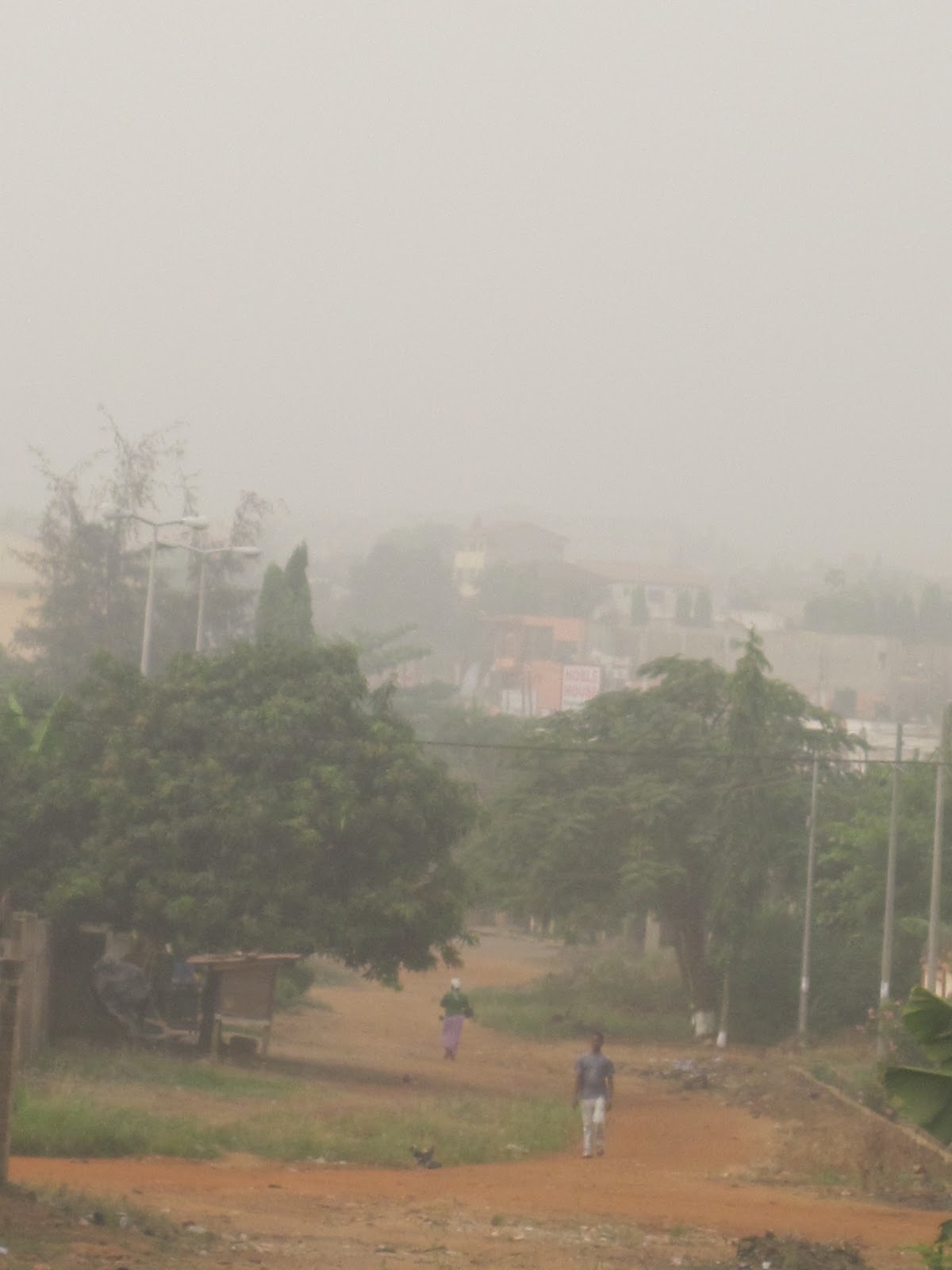
The White Stuff Keeps Falling!  Visibility is limited, flights are delayed or canceled, it is darker in the morning and generally all day long...is Ghana experiencing the same weather as the US?  No, but there are definitely similarities.  This is the worst Harmattan winds that I have seen and many Ghanaians report that this is worse than normal.  As you can see by the picture, the dust is so heavy in the air  - you can dust things in the morning and two hours later it is covered again with a fine white dust.  Imagine dust raining in your house - you leave footprints when you walk.  It's a dusting nightmare!  People are coughing as we breathe it in all day, eyes are burning with it.  The picture taken at the sun was at mid-day - you can easily look directly at the sun without it hurting your eyes because there is so much dust in the way.  The weather is still warm enough that you don't want to shut the windows but it makes me rethink the air conditioning debate of February 2010 that Bob wrote about...

Hannah has been oh-so-busy applying to colleges and also scholarships.  She found out that she was accepted to the two colleges of her top choice - Calvin College and Eastern University.  When she learned that she was accepted to Calvin, I think people within a five mile radius could hear her scream of excitement.  Clearly she is favoring being in her home town, with friends, her aunt and uncle, her beloved church and pastor, and of course, lots of familiarity.  She continues to do well in school but does seem to be fighting a little bit of "senioritis".  She is currently in the Model United Nations, along with many highschool students from the West Africa region, and this year was assigned to represent the United States Security Council.  Should be a good learning experience again. 

Noah turned 16 years old on Sunday, January 16!  It's so strange to think of him that age!  He spent the weekend with five other young men, playing Xbox, basketball, guitar, watching movies, and played a great board game called "Quelf" - this board game is lots of laughs and is great for a group.  They stayed up all night on Friday night will probably be paying for it for a few days but they had fun.  He is starting the second semester of his junior year - the year that is important for grades as that is what colleges look at.  They just received their first semester report cards last week and he continues to do well.

Managing Relationships with LOVE (Limits, Obligations, Values, and Education) - For the past ten days, we have had a visitor from Judson University in Illinois, Dr. Marsha Vaughn.  We met Marsha at the Partners Worldwide conference in October and she expressed interest in the boundaries class that we teach as part of our business curriculum.  She is also doing research on the impact of business on women and their families in developing countries, so a trip here would allow her to continue that research as well as offer a workshop that would go deeper into the boundaries issue.  The first few days were spent visiting women-owned businesses, with the focus of learning about the impact on the woman herself.  I learned a lot about Ghanaian marriages and the role of the extended family.  It was enlightening to visit businesses from this context.  We then had a three day workshop, on the above named topic, with leaders who both need boundaries for themselves as well as find themselves in positions where they need to counsel people.  This was then followed by two days of counseling appointments for these leaders, for them to experience being a counselee as well as to learn more directly from Marsha.  The time was powerful, productive, and eye-opening.  We thank God for Marsha and her willingness to spend some time here.  The pastors are now planning on how to follow this up and create more supports within their churches. 
Marsha and Georgina, owner of Lexgina Tailoring shop, Lexgina Vocational School, and Lexgina Medicine Shop.  The amount that women juggle in terms of family, home, and business is amazing.


This is Grace and the young men who work for her.  Grace owns a business processing the refuse of tuna fish from the Starkist plant in Tema, outside of Accra.  She drys and grinds the tuna refuse and sells it to those who make poultry feed.  Grace was a Muslim and became a Christian a few years ago, which resulted in many trials for her - she renamed herself "Grace" and has an incredible story.  She hopes to join our next SME training with Hopeline and also hopes to write a book about her story at some point.
About 40 people attended this three day workshop - SME business owners, many pastors, church leaders, community leaders.  This slide has info about limits - the highlight of the workshop - learning that it is right, good, stewardly, and even Godly, to set limits.
The obligatory group picture
A shot of the Aburi Botanic Gardens, northeast of Accra - the majesty of some of the trees was beautiful.This is a 160 acre reserve, with about three acres developed into a formal garden.
A huge tree at the Aburi Gardens - I believe it is commonly known as a Rubber Shade tree, or a Ficus Elasticoides.