Monday, May 27, 2013

2nd Commissioning and an Animal Orphanage

ATS Dean of Theology, Alfred Rutto, giving certificates.
House of Hope Marketplace Ministers
Yesterday we were able to have our second commissioning service, at the House of Hope Church in Kitale.  The pastor is Dorcas Kibathi, the only female pastor that I have had in my classes yet.  I have attached a brief video of their worship time - Pastor Kibathi is in the front, dancing, in the blue.  She has a pretty amazing life story and it is a blessing to watch her love her church.  This is a small church, located in a very poor section of Kitale, with mostly micro-business persons and hawkers (people who walk the streets selling their wares).  We commissioned eighteen persons and gave sixteen certificates from the business training.  This was the more challenging group of the three for me, as the literacy rate was very low, as was the ability to speak English.  I was unsure that there had been much impact until I heard the testimonies as well as heard the pastor tell of the difference it was making and the questions that she has been fielding, showing that there was a thought process going on behind the scenes.  One woman said that she had just been playing with the business up until now - not recognizing God as the owner and having a purpose for the business.  She has now recognized Him as owner, and is taking her role as manager much more seriously, setting up boundaries to protect the business.  Last week, a couple of young men who hawk brought a couple of their friends to Church, and they gave their lives to Christ that day.  Marketplace Ministers walking the streets of Kitale.  Praise God!


A little of the joyful celebration at the House of Hope service.

L to R:  Joy, Ray, Pastor Ashivaga, Abigail
On Saturday, I had an opportunity to go to a nearby Animal Orphanage with Pastor Ashivaga from the Friends Church, along with three of his children (Abigail, Joy, and Ray).  It was a very nice environment with lots of scenes set up from the Bible and statues everywhere.  The goal of the orphanage is to take in animals with genetic defects and give them a safe refuge.  Typically, animals born with some sort of genetic defect were seen as curses and this Kenyan man wanted to change that mindset and set up this orphanage.  There were two schools visiting when we were there (on a Saturday) so it seems to get good traffic.  But it was not an easy place to visit.  Seeing these animals with these significant defects struggling to live and survive was difficult.  It made me wonder about the humanity of it, while all the while appreciating the intention of the place. I will share a few pictures from that place.  It's not a place I will probably visit again too quickly.  But the kids had a great time and enjoyed the playground.


Monday, May 20, 2013

A Week of Blessings

This has been a very busy week...but a week of blessings indeed.

Let me start however by picking up on a picture from last week - the mystery picture.  Thanks to all of you who made guesses!  The most popular guess by far was some sort of animal dung to be used for burning.  One person did come up with the right answer but confessed that she had consulted a Kenyan to find out, so that didn't count.

The picture is of sugar molasses, which people can eat in small amounts or it can be used for animal feed.  Some people put it in their tea.  To be honest, I have not sampled the one I bought.  What was surprising to me was that these were not covered in flies or ants...there were some bees that had made holes and were inside...but sugar molasses out in the open air, no plastic to protect...hmmm. 

On Wednesday and Thursday, from 8 pm - 12:30 am, we were privileged to join a training by the Marketplace Chaplains USA.  This is an organization that I came in contact through fellow Madison Square Church member, JoAnn Swart.  They have over 2500 Chaplains in four countries that are sent into various businesses to work with the employees.  I was able to attend their training in January and have remained in contact with them since then.  This is an option of Marketplace Ministry that I have presented to the pastors in my classes - to reach out to businesses in their areas that may not be engaged with their church - for encouragement and prayer.  The pastors that were invited to attend this training were those who indicated interest in this ministry for their own church.  From right to left, Pastor Leonard Ashivaga, Pastor Alfred Kibiaru, Pastor Manasseh Lumwagi, and Pastor John Matui.  It was a late couple of nights for us, but a very good discussion about the potential for this ministry in Kenya.

On Saturday, I traveled to Mosoriot, about 2.5 hours from Kitale, on the other side of Eldoret.  I went with a pastor from my second class, Pastor Stephen Barchok, to the Community Baptist Church.  We had a training for 54 business people, addressing Business as Mission and then spending some time on Basic Business Principles.  It was a good day, made better by an energetic and engaging group.  They would like me to come back in September and begin a full training with them, making Mosoriot one of the twelve cities we hope to impact.  Additionally, a pastor traveled to this training from Kericho, Kenya, about five hours away.  Interestingly, I have never heard of this city before, but in three days, I heard about it three times from different people.  So, I may go there in September as well for some exploration.  September seems to be getting pretty busy already!
Pastor Stephen Barchok on the left of me - everyone drinking Chai.
They gathered outside in a big circle and I had to around and greet everyone.  They then "dressed" me in some Kenyan dress and gifts, which was fun. 
On Sunday, May 19, 2013, the Marketplace Minister Commissioning was held in Butere Miracle Center Marketplace.  This is the first of three commissioning services in a row in different churches.  While I have taken part of many such services over the years, this is the first time that we did it from within the Church.  It was a holy and beautiful service.  I will tell the story in the pictures below.
The Pastor led the responsive reading, with portions for the congregants and other portions for the Marketplace Ministers.
The sixty Marketplace Ministers Commisioned, making their commitment with the support of the Church.
Each person was anointed with oil, being told, as Jesus said, "Go...in the name of the Father, the Son, and the Holy Spirit."  Many wept as they were anointed.  Being affirmed in their calling is a powerful thing.
We then offered communion to the Marketplace Ministers.  I am serving with "Mama Bishop."  The person we are serving is Moses, an amazing worship leader who has ministered to me, and is the owner of a small provision shop.
Those who met the requirements were given a certificate - forty businesses in total.


Testimonies of the impact of the Business Training on their businesses, by five members, selected by the class.
I had the privilege of bringing the Word at both of the morning services. 
I like this picture - I was giving the certificate to the Pastor of the church, Rev. Samson Ibrahim Makokha.  We have enjoyed working with each other and have become friends.  This picture captures the warmth of welcome that I receive when I arrive in Butere.  I call Butere my second home in Kenya...and the Butere Miracle Center my first church in Kenya. 
The group picture - a fun and happy group.


Monday, May 13, 2013

Marketplace Ministers Commissioning

Some of the ICM/ATS team
This past week has been a busy week, with catching up after a two week absence from Kenya, as well as with the graduations at the Africa Theological Seminary.  Unfortunately, I missed the graduations, due to travel as well as trainings in other cities, but it has been nice to have the ICM USA team around Kitale.  We have shared meals, conversations, processed challenges, and gotten to know each other better.  One of the great things that ICM has been able to do is to give out motorcycles each year at the graduation.  Someone donated 30 motorcycles again this year, and current students and alumni are able to apply for one of these motorcycles.  They received hundreds of applications, and I'm so happy that three of the pastors with whom I am working were given a motorcycle!  I know that their work in the Marketplace Ministry was one of the factors that allowed for them to be a recipient, so I am grateful as well.  This will greatly aid them in moving about to visit with the business owners in their church, and encourage this ministry to move forward.
Motorcycles given away at graduation.  They were all dedicated to the two ATS students who lost their lives in ministry this past year.
Mary, and her prayer partner, Sheryl
Sheryl Giesbrecht, the Executive Director of ICM USA, is also visiting and sharing my room.  Sheryl is a widow as well - she lost her husband in a motorcycle accident just six months before Bob died.  So we have a lot to talk about when we are together as we share and process our loss, as well as our recovery.  Sheryl is also one of the prayer partners for two of the businesses in my Kitale class.  She went to visit them with me and pray for them in person, which was a great blessing. 

Next week Sunday begins the first of three Sundays in a row where we will be commissioning Marketplace Ministers in three different churches.  For the first time in my experience, this will take place in the church, during the worship services.  This is the main reason for my transfer to ICM - to be able to send out Marketplace Ministers with the support and accountability structure from the church.  The Church now will have the opportunity for partnership between pulpit pastors and marketplace ministers to impact the Marketplace for Christ.  Those who accept this calling will be held accountable by the church, as any minister would be, and will be encouraged, discipled, mentored, and prayed for by the church.  This is an exciting time!  Marketplace Ministers have been taught the principles of Business as Mission, and are encouraged to have a quadruple bottom line:  economic, spiritual, social, and environmental. They have also gone through the Basic Business Training, covering Ethics, Book-keeping, Marketing, Pricing, Cost Analysis, and a host of other topics.
Agnes and her "ground nut" (peanut) business.

Next Sunday will be the first Commissioning in Butere, with 70 Marketplace Ministers.  At this service, following the commissioning and prayer, we will be anointing each Marketplace Minister with oil, followed by celebrating communion with them.  Those who qualify will then receive their certificates (based on attendance and performance) and have a chance to share some of their thoughts with the church.  I will be sharing the Word at both of the services.  The following Sunday, May 26, will be the second Commissioning service with a church called House of Hope, in Kitale, with 22 Marketplace Ministers.  And the last service will be with the pilot project - the focal point of my work for the past two months - in the Friends (Quakers) Church, on June 2, with 50  Marketplace Ministers.  I am looking forward to these services and to see how God continues to use these business person to bless their communities, their churches, and the Kingdom of God.  Please pray with us for blessings on these new Marketplace Ministers as they seek to change the Marketplace in their cities and throughout the nation of Kenya.
Picture of the week:  What is this?  I saw this item in the Butere market this morning - it is something I have never seen before.  Each piece is about five inches tall, two inch diameter at the bottom, one inch at the top, and weighs close to two pounds.  Whoever guess correctly will be given a Kenyan gift when I return to the US!  Email me at renitar@icmusa.org if you want to guess.

Sunday, May 5, 2013

Has Africa Outgrown Dependence on Aid?

I arrived safely back in Kitale on Sunday morning at 6 am, after a 36 hour travel time, and spent much of Sunday sleeping.  Due to this time shortage, I'm going to take this opportunity to pass on an article recently posted on the BBC, which is a very good read.  It shifts the way we think about Africa, and continues to lend credibility to the argument that in twenty years, Africa may become an economic world power.   This type of news about Africa still does not seem to get out much but it is a message that needs to be heard and considered moving forward.  We need to keep developing business leaders who view their business as a mission in this exciting time! 
 -----------------------
This article is taken from http://allafrica.com/stories/201301311471.html?viewall=1
Written by Wolfgang Fengler, the lead economist for the World Bank in Nairobi.
Source: World Bank Blog

Africa's emergence is the new consensus. For the second time in a just few months, a major international journal has run a cover illustrating newfound optimism about the continent.

After The Economist's mea culpa (correcting its previous assessment of a "hopeless continent"), TIME magazine just re-ran an earlier title: "Africa rising".  This is no fluke: Africa's economies are growing and the continent is much wealthier today than it ever was - even though, collectively, it remains the poorest on the planet.  Many African nations (22 to be precise) have already reached Middle Income Country (so called "MIC") status and more will do so by 2025.

Today, Africa includes a diverse "mix" of countries, ranging from the poorest in the world to the fastest growing; from war-torn countries to vibrant democracies; from oil-rich economies to ICT champions, and the list goes on.  This has important implications for the "aid architecture". Until now, Africa was at the center of global aid attention. But what if Africa continues to grow strongly and steadily?  What will be the role of international partners (often called "donors") in this new configuration? Is aid becoming obsolete?

I don't think so, rather the opposite! Many Africans still experience deep poverty. The challenge is so huge that ten years of moderately strong growth are just a down-payment in the fight against poverty.  Today, some 400 million Africans (roughly 40% of the total population) still live on US$ 1.25 a day or less. Newfound wealth means little to them if it is not equitably spread out.

Some countries are becoming richer, often as a result of oil discoveries, with very little changes in the lives of average citizens.

Fundamentally, if the poor remain neglected, a country's development outlook has not changed. What is new, however, is that some of these MICs no longer need aid money to fill development gaps.  In principle, they have enough internal resources. Yet they still need assistance in designing programs that help them spend their new resources efficiently, especially if they wish to target the poor. Aid programs, if designed well, can help do precisely this.

Kenya is a perfect illustration of this new aid reality. Today, Kenya's budget is roughly US$ 12 billion, about 30 percent of the country's economy.  This share is one of the highest in Africa, making the state the biggest player in the economy. Donors are small players in comparison even though the amount of aid recovered over the last ten years after a sharp decline in the 1990s.  Today, aid to Kenya is around US$ 1.5 billion (amounting to a little over 10 percent of total expenditures) of which only half is reflected in the budget.  Bilateral partners like the USA and China still prefer to implement their programs outside of government systems; likewise new players, especially NGOs, typically choose to execute their programs directly (rather than through the administration).

So what needs to change in the way aid is being delivered? How can it be made not only relevant still but even more effective than in the past?

First, we need to acknowledge (and celebrate!) the demise of the old North-South paradigm. With Asia's emergence - and China's spectacular turnaround - former recipients of aid are now new donors.
The previous regime, with rich countries in the North supporting poor countries in the South through government-to-government and multilateral relationships, is changing rapidly. Today, relationships are much more complex and varied, and there is a host of new players on the pitch.

Second, aid will be increasingly about transferring knowledge rather than money. No matter how significantly some donors may scale-up their financial commitments, aid money will remain small compared to domestic resources in recipient countries. If current trends continue, most of today's stable low-income countries will reach MIC status by 2025.  Going forward "traditional aid" (of the brick-and-mortar type) will focus increasingly on emergencies and fragile states. In others, transferring know-how and skills will be the name of the game.

Third, innovation and support to country systems will drive the impact of future aid. By 2025, Africa will have a majority of MICs. But as countries climb up the income ladder, they will face new and more complex policy challenges.

In order not to stay stuck in the "Middle Income Trap", African countries will need to innovate, including in traditional sectors, such as education, health or transport.

The resources will be there but the challenge will be to make sure services are actually delivered and at good quality. In these countries, aid should move from building monuments (schools, clinics and roads) to improving the machine room (the systems through which education, health and transport are being provided).

Simply put: If we continue to equate aid with money only, then it will become obsolete in most countries over the next decade or two - except perhaps in fragile states.

However, if it is focused on transferring the knowledge countries need to catch up and compete with each other, it will remain indispensable.

Sunday, April 28, 2013

BAM Congress, Chiang Mai, Thailand

The view of Chiang Mai from my hotel room.
The Business as Mission (BAM) Congress just ended on Sunday afternoon.  Three days with 525 BAM people from 41 nations.  It was a great experience. The Congress was more theoretical as it relates to BAM - best practices, lessons learned, impacts and assessments, research, advocacy, and like topics.  While there were many BAM business persons in attendance, there were also many people like myself, facilitating the growth of the BAM movement.  Immediately following the close of the BAM Congress began phase two, the Call2Business Trade Fair which will go until Tuesday. The Trade Fair will be more practical with more BAM business persons involved, sharing the challenges of operating a BAM business, networking, industry specific gatherings, and the like.

I was very disappointed by the small number of Africans present at the conference.  Part of reason was a logistical problem - registration for the conference was done online with credit cards, and many African nations do not yet use credit cards as it is a cash society.  But there also needs to be much more exposure in Africa to the BAM movement.  Since Africa is projected to become an economic world power in the next twenty years (with an annual growth rate projected at 6%, compared to 1.8% in the US), then we need to be equipping these leaders with Business as Mission principles and values.

These little vehicles are everywhere, along with the bicycles and carts.
I was not able to discover any other persons who are doing the work that I am doing in terms of engaging Church leadership in order to build up and affirm the calling of business members.  People continue to complain about how churches marginalize business persons, treating their work as less holy or viewing successful business persons as corrupt or greedy, yet no-one else seems to be addressing this, other than the International Christian Ministries.  The co-chair of the BAM Congress told me that I was pioneering this movement and they are eager to hear how it will go.  I still have to believe that there are others out there doing and maybe we don't know of them yet.  It would be great to have some company on this to talk through strategies and best practices.

Because the the large number of people from closed countries, we were not allowed to take pictures at the event, in order to protect those persons.  So I don't have pictures of the conference, but did take some pictures in Chiang Mai.
 Roxanne DeGraaf (Partners Worldwide staff, friend and former colleague) and I toured the old city of Chiang Mai.  It is home to over 300 temples - seemingly every 100 feet or so.  
Pretty amazing buildings.
 The inside of one of the temples.

One of the fun things we did one evening was to have a fish massage.  Yes.  A fish massage.  You sit for 15 or 30 minutes with your feet in these pools and the fish nibble at your feet.  It is supposed to make your feet very smooth!  I am here with Kent, from Colorado, and Vey, from California, both conference attendees as well.
 This is not something for the extremely ticklish person.  It feels like hundreds of little shocks going through your feet...or like your feet are falling asleep.  A couple of little shrieks got out of me...but it really was pretty cool.  I think this would catch on in the US!
Two of my favorite men, Lou Haveman (from Grand Rapids) and Daniel Jean-Louis (from Haiti).  Love these guys!

Because of flight issues, I will be in Chiang Mai until Friday, at which time I will then return to Kenya, arriving back in Kitale on Sunday.  Please join with me in prayer for the message of Business as Mission to spread throughout Africa!

Monday, April 22, 2013

Uganda...Nairobi...then Chiang Mai, Thailand

Proof that I was in Uganda...if you look closely at the small sign.
Last week was pretty busy with teachings, but also included a quick trip to Uganda as my ninety days in Kenya was running out and I needed to leave the country and re-enter again to renew my visa.  Not much of a visit and the Ugandans were clearly disappointed that I was going to see more of their beautiful country than just the border town of Busia.  But it makes the number of African countries I have visited fifteen...even though I'm not sure that a two hour visit should count as a full visit.

On Saturday I boarded a bus from Kitale to Nairobi.  The six hour trip took nine hours, passing a pretty significant accident involving three large trucks...causing diversions down and up steep banks...but in the end, a safe arrival in Nairobi.

Pastor Achola in front of his church.
I am here to spend a couple of days with one of the pastors from my first class at the Seminary. Pastor James Achola and his church, Grace World Harvest Center, is located in the second largest slums of Nairobi, called Mathare, home to approximately 500,000 people.  On Sunday morning, I attended his church, looking forward to hearing him bring the word...only to have that sinking feeling in your stomach as the worship leader invites the pastor forward...to welcome the speaker.  At that moment, I realized I was the speaker.  I had two minutes to prepare a message. 

I thought I had made it clear to the pastors in my class, since they heard me teach for such a length of time, that when I visit them I want to hear them speak.  Apparently, I wasn't clear enough.  All I could do was pray for the Holy Spirit to have His way...take a deep breath...and go up front.  The Lord did provide and the message actually went pretty well.  I was SO thankful for the necessity of a translator, as it gave me a few seconds each time to find my next words. 

I then spent the afternoon meeting with business owners from the church.  Pastor Achola had just completed a four week Bible Study with them on Business as Mission (part of his field assignment
Business Owners Bible Study group
for the class) and so they were primed and eager to begin Marketplace Ministry.  The only woman in the group came up to me afterwards and told me she was despairing and ready to quit her business, but that my words had encouraged her to keep trying and recognize God as the owner of her business.  Praise God for that.  Today I will visit her business, as well as a handful of others - as many as Nairobi traffic will allow in a day.

On Wednesday, I will fly to Chiang Mai, Thailand for the Business as Mission Congress and Trade Fair.  I am looking forward to being surrounded with like-minded passionate people and to hear best practices as well as other models of BAM around the world.  I will have a chance to share what I am doing in Kenya, as well as serve as a coach for those looking to implement BAM in their context.  I will return to Kenya on May 4 and then will take a bus back to Kitale, arriving there on May 5.  Unfortunately, it is one day after the ATS graduation and I will have missed the occasion.  A number of my pastors from the first class are graduating and I hate to miss the celebration with them, but I was unable to get an earlier flight.

On Thursday, April 25, my dear daughter, Hannah, turns 20.  A significant milestone in her life.  While she is missing her father's voice and the distance of her mother, we are celebrating the gift of her life and thanking God for recent healing from her exhaustion. 

Praise God from whom all blessings flow!

Tuesday, April 16, 2013

Praising God: First Quarter Stories and Report

April 21 marks my three month anniversary in Kenya.  I have met so many people that I have grown to love in a short period of time.  There have been many open doors and positive receptions to the idea of incorporating Business as Mission into churches, and working to reclaim the redeemed marketplace for Christ.  I am so thankful to God!

"Muzungu!  How are you?!"
Since arriving in Kenya, I have learned to respond to many different names.  The name that I hear the most as I travel around Western Kenya is "Muzungu!,"  followed by a very enunciated, "How are you?"  This is apparently how children are taught to address white people.  The second most common name I am called is, "Mwalimu," meaning "Teacher."  I think that one is easier for the adults than REnita.   I've been called "Pastor" a number of times, and have learned that the simple act of preaching a sermon in church will warrant the title of pastor.   And lastly, I have been called bishop twice...but I put a pretty quick stop to that. 

Mary
Mary's cabbage garden, which seems to be struggling.
I would like to introduce you to a couple of people that I have had the privilege of getting to know in Kitale.  The first is Mary.  Mary is a widow - her husband died about three years ago in a traffic accident.  Mary farms approximately three acres of maize, keeps some poultry, and grows some vegetables and fruit in a garden (kale, cabbage, bananas).  When I met her, the farmers were getting ready to plant, but Mary had not yet raised the funds necessary to do the second plowing of the land and the purchase of necessary fertilizer to provide the best yield from her land.  When I asked Mary what her average yield has been in the past, she told me that she averages approximately 15 ninety kilogram bags per acre (most farmers get between 20-30 bags; bigger farms are able to get 40 bags; and I've even heard of some getting 50 bags).  Mary's yield is very low...resulting in lower profit, if any at all.  When I explored a bit further with her, it was clear that Mary knew what she needed to do increase her yield; she just did not have the funds.  Harvesting only one time a year requires that farmers put aside the capital from their sales and not touch it until planting again, six months later.  This is very difficult to do, especially when the average income in this area is approximately $1.25/day.  The land could be farmed twice per year, but irrigation equipment would be needed.

Noel and her cows on her farm.
I then met Noel, also a widow and a farmer.  She was the second wife to a man who dies about ten years ago.  He had a large farm, but after his death, there was a lot of disputes between the first wife and her children.  Rather than go to court, Noel just kept giving the land away to appease the family members.  She is now left with ten acres.  She inter-crops maize and beans on five of the acres, and uses the other five acres for grazing for her ten cows.  She employs three full-time persons, and three casual laborers.  When I asked Noel what her average yield was per acre, she said she had no idea.  She further explained that she really didn't want to know.  She is afraid that if she finds out that she is operating at a loss, she will quit farming, and there is nothing else for her to do.  So she would rather not know.  Surprised, I pushed her a bit and asked her what she would think if she found out her yield was 15 bags per acre but her neighbor was getting 50 bags per acre.  She thought for a moment and said that she would want to figure out how to increase her yield as well. 

Noel's maize field, waiting for the second plowing.
These challenges are not unique to Mary or Noel.  Knowledge of basic business principles such as book-keeping and cost analysis is a real problem, but a solvable one.  Another of the key challenges facing business owners in warm cultures, including Kenya and West Africa, has to with boundaries.  Yesterday I worked with fifty business owners on this issue.  There tends to be no separation between the business owner and the business.  The warm culture emphasis community versus individualism; this means if you have and I need, you help - because tomorrow I may have and you will need, and I will help you.  While appreciating the rich aspects of this in a culture, it can be quite destructive to a business, especially when an owner begins to give away the capital of the business, rather than just the profit.  So we had a lively and rich discussion about whether businesses have relatives or friends.  Do businesses belong to a church (FYI, churches - members and pastors - tend to demand a lot from business members in the church)?  There was lots of disagreement and discussion regarding this issue.  One man insisted that businesses do belong to a church.  When I pointed out that at the service that morning, I didn't see a single business present, putting its tithe in the bucket...but I saw lots of business owners putting their tithe in; there was lots of laughter and finally agreement.  Business owners tend to be the biggest violators of boundaries within their business, as they tend to not separate their personal finances from the business finances.  We talked through how to manage their relationships with LOVE (limits, obligations, values and excellence), taking many references from Galatians 6.  The light-bulbs going off were almost visible, but at the same time, the sobering thought of actually applying these principles in their context was also palpable.  Implementing boundaries will cause strain in relationships, so we had to talk through strategies of how to achieve this.

Second class of pastors at ATS
The churches and pastors have been great supporters in the three classes that I am running with almost 160 students; they are affirming their business people in their calling, referring to them as ministers, joining in the classes, encouraging dialogues about praying for the city, and providing a safe place for business owners to talk through the regular challenges to business ethics that are faced

I believe that the call to Kenya and the Africa Theological Seminary (ATS) has been affirmed, and for that I am truly grateful.  What a joy to be able to join God in the work that He is already doing here.  But I know that when God called me, He did not call me alone.  He called me in the light of the body of Christ, as representatives of many of you who continue to pray and financially support this work.

Kerosene seller in Butere...a family business.
This ministry is facing a challenge, however, in terms of funding.  The start-up process of a new ministry is always expensive, especially as we work to bring a new concept or idea to people who will need some convincing, so the front end of a ministry always has a higher cost.  There is a potential to grow deep and wide - I am beginning to see a vision of twelve cities impacted throughout Kenya in the next two years.  But your continued partnership is needed.  This cannot be done without the body of Christ around the world joining together to reach the relatively hidden people group within the Marketplace.  If you are already giving, on behalf of the churches and business persons in Kenya, I thank you.  If you would like to join in this work in this way, you will find more information at www.icmusa.org, if you are in the US, or www.icmcanada.org if you are in Canada; simply put "Marketplace Ministry" in the comment section of the donations box. 

I continued to feel honored and privileged that you join with me in the reading of this blog and I continue to seek your prayers for this work to go forward in the will of God.  To Him be the glory!

[Some of you have been following this work closely and with great curiosity as to its impact.  If you are interested in seeing my full quarterly report, with tables of activities, you are welcome to see it by clicking here.]

Sunday, April 7, 2013

A bicycle built for...

Bicycle loaded down with bananas
...so many things!
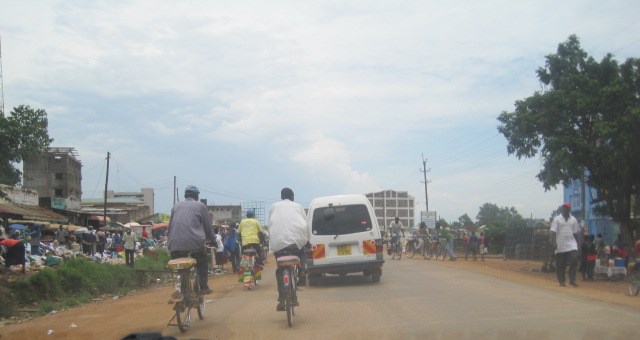
Driving in Kenya takes a little getting used to.  Not only does one have to adjust to driving on the left side of the road, but there numerous other things to watch out for:  deep potholes, numerous speed bumps,  crazy bodaboda drivers (motorbike taxis), numerous pedestrians, aggressive matatus (minibuses), carts hauling many things, bicycles, cows (which are everywhere!), donkeys, goats, sheep, dogs, chickens, and the occasional monkey. Driving here is not for the faint of heart.
Female passengers tend to ride side-saddle.

Everyone needs to fit on the road...
Thankfully, I'm familiar with most of these from driving in West Africa, with the exception of three things:  driving on the left, many many more animals, and bicycles. 

While I drove to Butere last weekend, I decided to take a few shots while I drove to share with you - please note that these are not the best shots, because as I mentioned above, driving is a full time concentration job here...so the shots were taken quickly through the windshield.  By the way, I have yet to see a female riding a bike or a motorcycle.  They ride as passengers...but not as drivers.  Gender equity on two wheels is needed!
Farm produce going to the market...
Napier grass for the cows...
...and more grass for the cows...
Bicycle taxis looking for passengers
Carrying lumber, bamboo, roof sheeting, even furniture is a common sight.
 A few weeks ago, while driving to Mt. Elgon, we passed through a large group of youth on their way to some event.  About a kilometer later, we heard banging on the roof, checked the rear view mirror and saw that a young man jumped off the vehicle.  The youth were so loud that we didn't hear this guy jump on our vehicle!  This picture is three young boys who decided to hitch a ride on the truck ahead of me. 
Another common sight is young boys watching their cows.  As most of the cows here graze all day long, the boys are assigned the task of following (or leading) them.  They seem to meet up together and have fun hanging out together on the side of the road as the cows graze. 
On my way to church Sunday morning...
To a very rural church on a dirt road...
...which reminds me of another challenge..about two inches of rain fell in one hour during church...we were literally a captive audience as no-one was leaving in that...then drove through the mud...or maybe slid through the mud is a better term...not unlike driving in snow!
 All in all, no danger of falling asleep at the wheel...and very thankful for traveling mercies every day!