Sunday, January 5, 2014

Feedback: Comments to the Blogger

No pictures specifically relating to this blog, so random shots of us!  :)
I love getting feedback on my blogs.  As much as each weekend I scratch my head over what to put out on Monday morning, I look forward with anticipation to see the response once it is out.  And all of you are so kind.  The feedback is almost always kind and encouraging.  And I'm getting a feel for who will respond to which kinds of posts...in other words, I'm learning about you as well!  For example, my blogs tend to center around three themes:  faith, work, and personal.  There are groups of you that I can almost predict now will respond to something about one of those themes, but not the others!  I love that I'm getting to know you even as you accompany me on this journey.  This blog has been a powerful tool to me (and to us as a family) over the years, and I so appreciate those of you who take the time to read it.

Most of the time, the comments I receive are short and sweet.  But sometimes I get thoughtful, reflective comments, and sometimes even some push back.  I have asked permission from three people to publish their comments here, as I learned something from them and thought you might too.

The first is in relation to my blog two weeks ago about access to capital (click here to reread).  Karl Westerhof is a staff person with World Renew, the development arm of the Christian Reformed Church.  Karl is one who responds with encouragement almost every week, regardless of the theme.  :)  Here is an exert from his response last week:

Now the second thought.  It's vague and general and I can't really put it into words.   I hear you wrestling with the vexing issue of loans, and the cultural realities that make loans especially vexing in your situation.  There's something that just doesn't quite sit right about all this.  The issues you raise are familiar ones, and they do need to be addressed.  But....   here's where I am vague and tentative....  it "feels" to me as though you are way too skittish about the subject of capital.  You name all the complexities; you say the right things about the importance of capital; you acknowledge its vital importance...   and at the same time you see it as the weak point or the "necessary evil" in a Kingdom approach to business.  Or at best as the point most vulnerable to sabotage by the dimensions of culture in a "warm" climate.  
         Of course you know the basic development stuff better than I do.... start small and slow and build the group's strength and trust and habits.  And use the strength of the Kingdom community group accountability.  And you know there are poverty loan programs that achieve excellent repayment rates.  So can you.  So I want to say, Don't be skittish or ambivalent about this!   This is the very key to whether Africa will rise or not!  It's not at all certain that Africa can get to a place of economic health, but programs like yours are a vital part of the bigger movement toward development of healthy economies on the continent.  You have something vitally important to contribute, and you need to grab hold of that and embrace it without ambivalence.  And your donors need this education desperately too!  We over here need to be shown ways to conquer our stereotypes about Africa.  
     Your program of training is so biblical, and so community based, and so eagerly used, that consequently you have a great base to build on to develop a strong loan program.  Go for it.  Tough and loving discipline, careful attention to how the culture of relationships can strengthen loan paybacks rather than weaken them, start small and lean and slow....   Here is an area where you need to discern so carefully which strengths of the existing culture you want to keep and value, and how those strengths can be USED to support a really excellent loan program.  
         OK, I'm embarrassed because you know all this, and all I'm doing is trying to explain my dis-ease with some of the tone of your blog.  Hardly a message for Christmas week.    But I hope you know I only dare to write this way because I am so appreciative of the work you do.
     So consider this a "for what it's worth" email, and if it's not helpful.......   just discard it.  I promise I won't be offended!
I thanked Karl for his words, acknowledged that he was right, received his permission to quote him, and will try to move forward without ambivalence!!

I also received these questions about the same blog from my Pastor at Madison Square Church, Rev. David Beelen:
I have a question for you: You said 127 people received loans and 90 of that number were women.
My question.....does it seem to you that in Africa the women are more likely these days to get access to education and capital than men?
I have noticed a trend here in the US: boys are dropping out of high school at a much higher rate then girls and most colleges nowadays have more women than men in them...the cultural trend is that men are in decline....and the cultural narrative is that men have been advantaged and it is time for the women to become dominant....and in my view that is happening and with very negative results.
We are fast becoming a culture of women achievers and men slackers.
What do you think?
Hannah, winning the love of Laventer, Pastor Ashivaga's daughter.
These are great questions and I love how my pastor pays attention to the big picture in the world.  My response to him stated that it is true that most microfinance institutions pursue women - in fact, they recommend that the portfolio be 95% women and only 5% men.  The reasons for that are that women are typically better at repayment but also women in developing countries are still under-served (both in education and in capital yet).  In fact, Kenya rates as one of the top countries in terms of being patriarchal - it was just last year that the law changed to allow women to own land (which is often needed to secure collateral for access to capital).  I agree, however, that we must be balanced with opportunities to men so that we don't participate in reverse discrimination.  We did not target women in this program; we only took who came.  And when you look at the amount of money given to men versus women, men did get more because their businesses were stronger, they had more savings, and their need for capital was higher. This is a very brief answer to a complex question - one that may beg to be addressed on its own in a future blog.

The third quote is a response to a blog that I posted in October, called "Inspiration from the field" (can be seen here).  The respondent is Joe Rodriguez, a fellow member of Madison Square Church.  He has been an elder to me, a counselor to me, a friend to me, and someone whom I consider to be very wise.  So his comments in response to my blog resonated with me and I appreciated his honesty.  Here is what he said (again, used with permission):
Renita -
This posting is having an effect on my perspective about others in the world. I would ordinarily presume that people who are poor are in need of a financial handout. I am struck by the innate creativity of my fellow human beings. Although I would acknowledge this to be so, I believe my thoughts were conceptual out of some sense of an obligatory respect for others. I feel a bit ashamed to admit this. However, your posting here seems to make it feel real for me. It feels true that people in developing areas of the world are in deed very creative. They just need safety, predictability, and access to viable markets. I would think that the local government and the local church have legitimate roles in nurturing this God-given wealth of creativity and advocating for what the business person needs in order to thrive. Renita, thank you for helping me appreciate more what God has planted in people and is doing to bring it forth.
- Joe Rodriguez
Noah, wowing everyone with his sharp suits...

I love the phrase, "I believe my thoughts were conceptual out of some sense of an obligatory respect for others."   
If only all of us were so self-aware of our assumptions and presumptions.  I will probably do a blog on that in the next couple of weeks as it is something I have been struggling with as well, but for now, I appreciate again Joe's honesty and believe that he speaks not only for himself, but also for me, as well as many others in the world as we look at other people, other cultures, other countries with assumptions that can be benign at best and cancerous at worst.

So again, thank you for accompanying me on this journey, for reading, for praying, for encouraging, but also for sharing your thoughts, your heart, and your mind!

Monday, December 30, 2013

Christmas in Kenya and Happy New Year!

On Sunday morning, as we prepared to leave Mt. Elgon National Park, Hannah thanked God for the splendor of His creation and how blessed we are to catch just a glimpse of it.  My kids know that despite the hardships of being missionary kids and losing their father, they are incredibly blessed to see so much of the world, a privilege that many people never have the chance to see.

Since arriving in Kenya, we have traveled from Nairobi to the far western part of Kenya, catching a glimpse of Uganda.  We have visited Lake Naivasha, Lake Nukuru, and Mt. Elgon; we have seen countless animals and incredible views.  Kenya is a beautiful country.  I will let the pictures tell the story:
The view outside of Nairobi, on the way to Western Kenya
Zebras along the road in Naivasha
Boat ride to see some of the 1500 hippos that call Lake Naivasha home.  Note Hannah's excited expression.  :)
Our friend and colleague, Greg Snell, put us up at his amazing house.  This is their deck.  Quite the view!
Some of the aforementioned hippos.
A fish-eagle grabbing a fish...pretty cool.
Lake Naivasha is home to 450 different types of birds - some of them pretty amazing.
Hannah's picture, capturing the beauty of the sun through the clouds.
The beautiful and stately giraffe.
Next to Lake Nakuru National Park, which has experienced a lot of flooding of late.
The buffalo seemed happy to see us.
A sighting of a black rhino.
Lake Nakuru National Park is home to about 200 rhino.  There are several white rhinos resting in this picture.
Lake Nakuru is known for being home to many, many flamingos.  However, the flamingos have been leaving with the rising water and the changing habitat.
Two male implalas fighting over who would get the available group of 30-50 female impalas.  We witnessed the fight and saw the winner.
The lovable but forgetful warthog. 
Further view of flood damage at the lake.
A waterfall found within the park.  And a good looking and lovable son next to it.
Lots of baboons seen at Lake Nakuru and at Mt. Elgon.
Hannah and Noah are amazed by the amount of cows, sheep, and goats in Kenya.  Quite a difference from West Africa. 

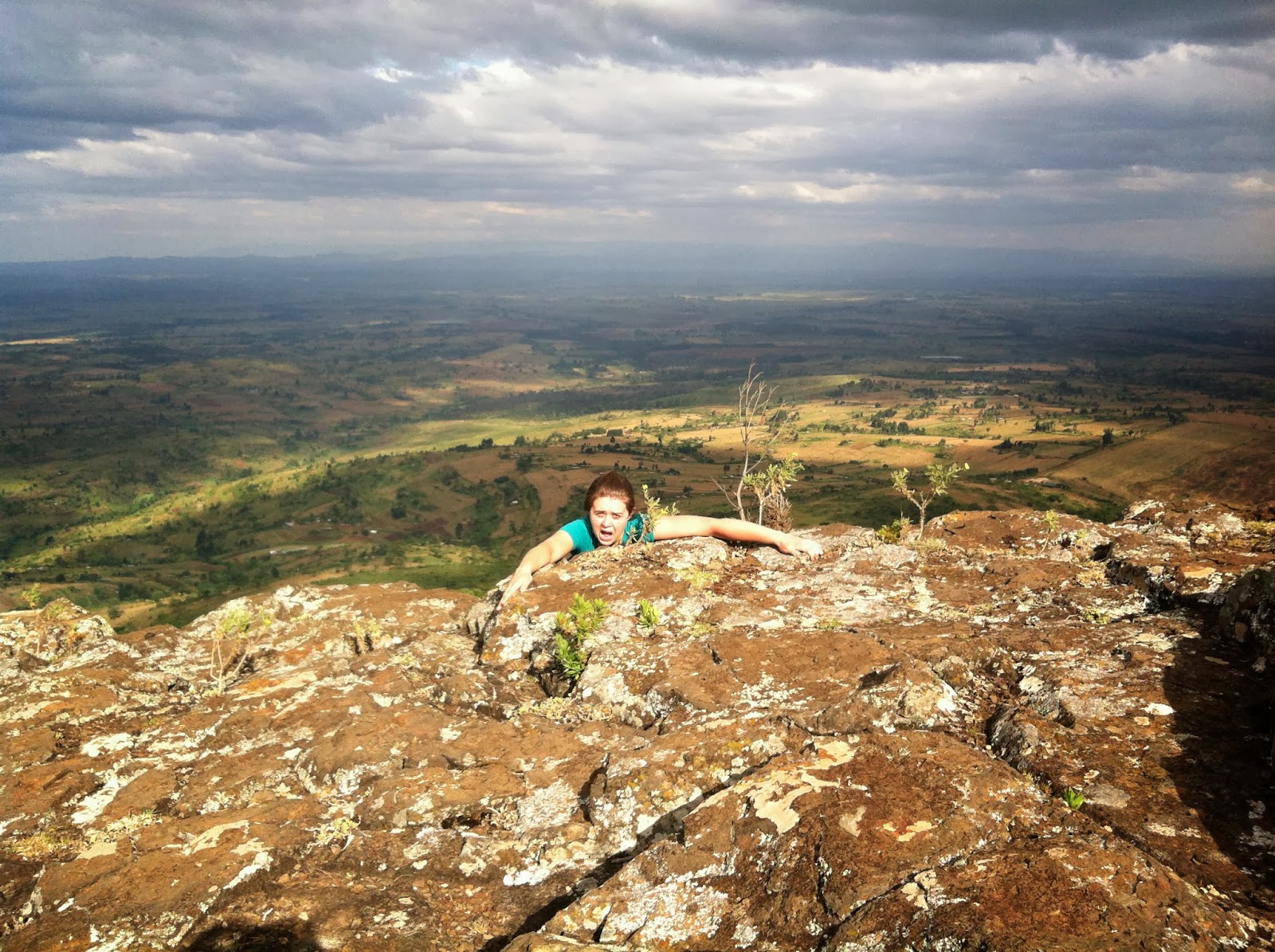
After hiking six kms uphill when our car broke down at Mt. Elgon, we finally reached the top of the Endibiss bluff.  Unfortunately, Hannah got too close to the edge and we almost lost her!!!
Just kidding.  :)
Christmas morning - they both clean up pretty well, don't they?  Noah loves to wear suits - yes, you heard me right...the same Noah whom you have seen day after day in black t-shirts and jeans - and I love that he loves it!
Happy New Year to all and may God bless and keep you in 2014!

Monday, December 23, 2013

(sigh)...Access to Capital

In my work with Partners Worldwide, I implemented the four strategic activities believed to cause long-term change for small and medium size businesses:  training, mentoring, advocacy, and access to capital.  Three of these activities are internally focused on the business, and one is external (advocacy).  I continue to use that strategy in the ICM Marketplace Ministry, and have talked a fair bit of three of the activities in recent months but haven't said much on the blog about access to capital.

Of the four activities, it is the one that I like the least.  But, of course, it is the one that businesses want the most.  It is a necessary evil in my work.  I say "evil" loosely, of course, because it is considered necessary for most business in the world to receive between three-five loans in order to help them increase their business and be able to compete in the market. We often say, "If you give a man to fish, he eats for the day; if you teach him to fish, he eats for a lifetime."  But that is not true.  There are many, many
training programs around here that teach people to sew or bake, but without access to capital...without having "access to the pond, or the ability to buy the fishing boat or net" (to continue the analogy further) the teaching to fish does not do much good.  We are watching "Africa rising" and multi-national companies moving into Africa with their large capital and resources, and at the same time, we see Africans lose contract bid after contract bid to these international corporations.  The profits made by these international corporations often do not remain in Africa but are sent home to the native country.  Africans need to be able to own their own resources and win their own contracts to do the work in their country.  So access to capital is a good and necessary thing.

But it is so complex.  In a warm culture, the lure of a loan brings many temptations from family, friends, church, and community.  In a developing country, the need for school fees, paying for funerals, and paying out of pocket for medical, can hamper the success of a business loan.  People often take a business loan that ends up having no positive impact on the business, as basic business principles or boundaries have not been applied.  So the loan becomes something that can destroy the business.  As Christians involved in loan programs, the most painful thing is to give a loan, have something negative happen (often legitimate) to that person or their business, and yet the loan still needs to be repaid.  Not enforcing repayment can destroy a loan program.  So that is why I say it is a necessary evil.  I would much rather NOT be involved in access to capital.

But since I know it is necessary, I have been addressing it.  This past summer I spoke with Lou Haveman (former colleague at Partners Worldwide) who has developed a program called the Solomon Funds, for people who want to invest their savings or retirement money in access to capital, allowing them to make about 5% annual interest on their investment.  He organized a few donors and was able to secure about $25,000 US for the ICM Marketplace Ministry to use as loans.  But we didn't want to manage the loans ourselves and I didn't want to put ICM in the position of giving loans (again, the giving is not the problem - it's the repayments).  So I approached two Christian micro-finance institutions - one started by the National Council of Churches in Kenya (NCCK) and one started by Food for the Hungry.  I asked them if they would take this money, distribute it to our approved groups, and handle the repayments.  However, the money that I wanted them to coordinate for us was apparently not enough to get their attention.  So after repeated attempts, proposals written, meetings had, two months passed and no positive response was received.  So I approached ICM to see if they would be willing for this small amount of loans in the pilot project to go out under their name.  We eventually worked it out to have it go that way.

I'm happy to report that on December 21, 2013, $25,000 has been disbursed to seven groups, which total 127 people (90 women, 37 men).  These are all groups who have at least one of the members that I have trained in the Training of Trainers for the basic business class, and have multiple members who have sat through the training.  These groups have a peer mentoring aspect to them, so that is helpful.  All of these groups have been in existence for at least six months and only received three times the amount of their savings.  They operate much like the Village Savings and Loans groups that I wrote about in Ghana (click here for more information on VSLs).  These loans should have gone out in October and so I feel bad that they got out so late, but we ran into roadblock after roadblock.  The people waiting were pretty gracious, but unfortunately they lost a lot of opportunity to capitalize on the Christmas busy season for their business.

They will turn this money over and over in their groups for the next six months, and then they will pay it back.  In six months, we will distribute the same money again.  We hope to have more money to distribute at that time, because our businesses in Kakamega and Eldoret will also be ready for access to capital by then, having finished the training, and started mentoring and advocacy.  After six months, the interest and principle will be paid back to the investors, through the Solomon Funds.  If we are blessed, the investors will keep their principle in for another year, and we can start again.  Hopefully by then we will have more funds and can get the attention of a qualified fiduciary to manage the loans for us.  [If you have savings or retirement funds that you would like to invest for one year, and receive about 5% earnings on it, while blessings businesses in Kenya, please email me at renitar@icmusa.org or email Lou Haveman at louhaveman45@gmail.com.  The money will be put to good use!  I have been working with Lou to bless Ghana and Liberia for several years and we have had great success!]

So I do this part of my work with a sigh...and many, many, many prayers.  I usually lose more than a few nights of sleep over it when decisions are made as to loan disbursement.  It is my neck on the line if defaults happen as well as the reputation of ICM, so I take this very seriously.  We make commitments to the investors and we are putting our activities to the test to be sure that business will actually grow.  In many ways, it is putting other people's money where my mouth is.

At the end of 2013 though, I look back with great delight.  We were able to address all four activities.  We have seen God's hand through the provision of investors and the provision of solid businesses.  We have seen God's hand in the provision of mentors and prayer partners.  We have seen good activity in our advocacy work. And we will now wait to see what 2014 brings.  We pray that it is a year of blessings and growth for our businesses who strive to alleviate poverty and provide jobs.  We pray that it is a year where Kenya sees positive movement forward as a country.  And we continue to watch with anticipation as Africa continues to rise, economically, socially, and spiritually.  ICM calls this the "decade of the African leader."

Thank you for joining me on this journey in 2013!  I have sent out a year-end letter to those of you that I have physical addresses for.  If you did not receive it, you can see it here.  I am so thankful for all of you who continue to pray for, encourage, and support this ministry in so many ways!  I praise God for how He has made the body of Christ!

I also know this is a time of year when many people consider their blessings and chose to pass some of those blessings on to others.  If you feel led to join in this work financially, it is very easy to give by going to www.icmusa.org, click on donate, and follow the instructions there.  Or you can go to www.crwm.org, clicking on Missionaries, then find my name and follow the instructions there.  This ministry continues to need support and we are thankful for every person who joins us in this manner. 

May God bless and keep you in 2014. May He turn His face and smile upon you, and give you His peace.  Mungu awabariki!  Amen.

PS.  My children did arrive safe and sound in Kenya to spend Christmas with me.  So thankful for that too!
This is how they appeared when arriving at the airport after the cold winter in Michigan, exams at Calvin, and long flight to Kenya.
After a couple days of love and pampering from Mom and enjoying the beauty of Kenya, they began to look normal again.

Monday, December 16, 2013

Ripples

It is a great joy to sit by still water, on a quiet summer day, and drop something in the water to watch the ripples; and it is fascinating to watch rain hit a puddle and see the multiple ripples going out and touching each other.

In the past couple of weeks, I feel like I have been watching ripples going out in the Marketplace Ministry.  And it has been a great joy, as well as fascinating.

Friends Women Conference, sitting out in the hot sun.
While the pilot project that I am working on is to work specifically with three churches from three denominations, one of the outlying factors we are monitoring is how this will impact denominations.  The Friends/Quakers Church has written Marketplace Ministries into their strategic plan and are beginning to push it out to their churches.  Two weeks ago, I was asked to speak at the Friends Women's conference, with over 500 women in attendance, regarding Business as Mission.  Then, this past week, I was contacted by the Friends Youth Conference to speak to 1100 youth (youth being defined as up to 35 years of age) regarding Business as Mission.  Apparently the youth heard good things about the talk with the women and wanted to have me present at their conference.  I traveled there with the General-Secretary of the Friends Yearly Meeting for Western Kenya and heard him speak of how this is gaining excitement throughout the region.  They want to send another group of trainers to the next Training of Trainers in February, including from their newest region of Lodwar.  Lodwar is the region where both oil and water were just discovered.  It was so exciting to hear the talk after the presentation amongst business men from the church as they debated how best to roll this out and get the church engaged.  They really own this work and continue to push forward to make it happen!  I sat back and watched the ripples with joy.
Friends Youth Conference

Additionally, last Sunday I had the opportunity to invite the newly hired Marketplace Ministry Coordinator, Alfred Kibairu, to teach the class in Kakamega on Cost Analysis (which has been historically one of the more difficult classes for people to feel comfortable teaching).  He rocked it!  He did a better job than I would have done!  More ripples.

Then on Friday, we had a mentoring meeting with the Kitale group, but we also had a farewell lunch for the principal of the Africa Theological Seminary (ATS).  So, I sent Alfred and Jeff ahead to the meeting and I remained behind to say a few words at the lunch.  When the lunch was over, I texted Alfred and Jeff to see how it was going and decide if I should still go, even though the time was almost up.  They both said that everything was going great and there was no need for me to come.  That felt great! More ripples.

There are multiple drops in the pool.  And as the ripples are spreading out, there are equipped people to carry it forward.  Considering that when I started this work in January I was by myself, I am encouraged that just 11 months later, there is a team and a denomination pushing this forward.  And not just pushing it forward through me, but pushing it forward on their own.

Watching the ripples go out, quietly, on their own, growing wider as they go.  A great joy.  Fascinating to watch.
This is a singing group from the newest Friends Church in Northern Kenya, made up of refugees from Sudan, DRC, and Somalia, as well as Kenyans.  It was beautiful! (If you don't have time to watch the whole 1.5 minutes, skip to about one minute in.  Great voices praising God!)

Another great joy is that my children are coming to Kenya tomorrow and will be here for a month!  We will celebrate Christmas and New Years together.  They will then take a class at ATS which will count for their interim class at Calvin.  I get them all to myself - with no jobs to distract them, or friends, or even TV!  I can't wait to see them and pamper them for a bit. Plus I think they are ready for some warm weather!