Monday, November 7, 2016

An Ugly Blog

Greetings from Kaduna, Nigeria, where it is hot and the food is spicy! 

I don't like to write ugly blogs.  I like to tell positive stories of Africans, of positive changes, and of hope.  But every now and then you have to talk about the ugly stuff.

It's true that the USA has its own ugly stuff going on as well.  It's also true that ugly stuff can be found all over - where-ever there are human beings who bear the mark of sin.

But in order for change to come, darkness needs to be called out so that people can pray for light to enter in.  So I will share a bit of the ugly stuff in the hopes that people who care about Africa and fellow brothers and sisters in Christ will pray with knowledge about specific issues.

Let me start with Ethiopia and then Kenya.

Ethiopia has been going through some turbulent times in the last six months as people have been protesting against the government.  It is rumored that hundreds have been killed and many more hundreds have been detained for protesting.  It is a rumor because the government controls all communications in Ethiopia so getting information has been difficult.  Several weeks ago, the government declared a state of emergency which bans the following seven things in the country:  social media, protests, broadcast media from TV channels outside of the country, political gestures (such as the crossing of the arms which has been widely used in the protests against the government), visiting a factory, farm, or government institution between 6 pm and 6 am (as they have been the target of some destruction), diplomats cannot travel more than 40 km outside the capital without permission, and guns cannot be taken within 25 km of the main roads or 50 km from the country’s borders.  All of this is done to control the citizens and block them from communicating with the outside world.  Please continue to pray for our brothers and sisters in Christ in Ethiopia.

In Kenya, I was sent this news clip from a DML Marketplace Minister whose heart is breaking over the current rise in corruption.


Since arriving here, I have heard so many stories of these challenges, that affect all levels but hurt the disenfranchised the most.

But even beyond corruption, there are two other issues that continue to sadden me.  One is related to polygamy - I was at a church conference and was introduced to the third wife of a government official in the Kitale area.  She is in her 30s.  This is not an "older generation issue" of a person married multiple times before things changed, but a current issue that shows a sign of strength by the husband.  How can this be in this day and age, in a country that is so very Christian?

The other issue is that which is referred to as “extra-judicial justice” – that is, “justice” that takes place outside of the formal justice system.  I’ve written about this before as I have personally witnessed this in several different situations across Africa (one such incident was a man being beaten to death for stealing rice).  But two reports that I heard in the last few days have shaken me again in a way that causes me to fall  to my knees to pray. 

 The first is the number of poisonings that happen to people who are perceived to be wicked or a threat in some way.  People that I know and love have been threatened with being poisoned or have had it attempted, only to be protected by God in some way.  How many times this happens is unknown to me and I’m not sure that anyone has the answer.  It would need toxicology reports and autopsies for every death, but the fact that I have heard it as often as I have makes me wonder, and would make me very nervous to eat food offered to me if I were a Kenyan.

The second report I heard had to do with the “justice” served on a person who committed a crime.  A by the new lottery machines that have appeared at every staging area for passengers of public transport decided to do something about it at one area.  The pastor saw how addicting it was for the matatu (taxi-buses) and boda-boda (taxi motorcycles) drivers, putting their very little hard earned money into something with the hope of a payoff.  He found the place that was providing electricity to that lottery box and switched it off.  The young men who were using it went to find the source of the problem, and as they were distracted, this pastor stole the box and ran away with it.  He ran into a nearby sugar cane field, and the young men quickly surrounded that field.  They smoked him out and then beat him to death.  I’m told his last words to them were, “I’m trying to save you from yourselves.”  This pastor did not do the right thing, but he certainly did not deserve death.
pastor who has been very disturbed

These situations make it very difficult to tell people to go against the culture to do the right thing in terms of   To make a poor decision is to be met with a justice that allows for no grace, mercy or forgiveness.  Last week, as I rode on a boda-boda, a street boy tried to rip the earring out of my ear.  Other people were already yelling at him to stop chasing the bike I was on, and I was so thankful that he wasn’t successful as he probably would have received quite a beating.
standing up against corruption – it’s not just about having courage, it may be about risking your life.

And I know that for every story I tell, we can think of similar corruption or destruction from our own context.  This world is broken – so very broken.  But we do have hope that God can bring good from brokenness and that He has given us this day to try to make a difference in whatever way we can. 

Today, please pray for the victims and the perpetrators of injustice, and for the Church to grow in strength to be counter-cultural and not a sub-culture.  And this week especially we pray the same for the USA.

Sunday, October 30, 2016

Economics of Hope

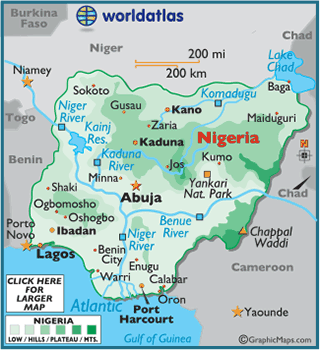
This week I leave Kenya for Nigeria, where we will give a conference in Lagos on "Positioning the Nigerian Church for Global Millennium Realities," and then teach at the ECWA Seminary in Kaduna on Integrity and Finance.
But today I want to write about the economics of hope.  This is something my former colleague, Jeff Bloem, introduced to me, and it became more evident on our trip to Guatemala.  So I've been thinking and wondering about it of late.  When I wrote a few of weeks ago about our trip to Guatemala, I referred to the fact that there are many similarities between the poverty there and what I've seen in Africa, but also many differences.  One of the more startling differences seemed to be a lack of entrepreneurship.  In almost any African village you visit, you will see multiple small scale, hand-to-mouth businesses.  Almost every African you meet will have one, if not two or three, small scale businesses running, often in addition to a full-time job. Yet the villages that we walked into in Guatemala seemed to have almost none.  [Again, I only went to a few villages, the tours were quick, and so I may be generalizing too much.]  Assuming these differences are accurate - and we did consult with a number of Guatemalans who substantiated the observation - what is the reason for the difference?

We know that God made all people in His image, with His creativity, so it's not that people in Guatemala are simply less entrepreneurial.  All people find happiness when contributing to something greater than themselves, so it can't be that Guatemalans are not-hard working.  Guatemala is a rich country in terms of natural resources, so it's not that people don't have resources with which to work.  A very wide gap between the rich and poor exists in many nations, so that can't be the reason.  Hardships (civil war, hurricanes, earthquakes) have been plenty across Africa as well as Guatemala, so that can't be it.

Or can it?

Guatemala had a thirty-six year civil war.  That's a very long time of insecurity.  Unlike Africa, most rural people do not own land on which they can grow food.  They are more likely to be day laborers of large scale farms. Throw into that mix a very long history of conquerors, and natural disasters, and it seems to be a recipe for what we used to call a "lack of hope in the heart," which psychologists today call self-efficacy.

Jeff quotes a psychologist who said this:
A psychologist walked around a room while teaching stress management to an audience. As she raised a glass of water, everyone expected they’d be asked the “half empty or half full” question. Instead, with a smile on her face, she inquired: “How heavy is this glass of water?”
Answers called out ranged from 8 oz. to 20 oz.
She replied, “The absolute weight doesn’t matter. It depends on how long I hold it. If I hold it for a minute, it’s not a problem. If I hold it for an hour, I’ll have an ache in my arm. If I hold it for a day, my arm will feel numb and paralyzed. In each case, the weight of the glass doesn’t change, but the longer I hold it, the heavier it becomes.”
She continued, “The stresses and worries in life are like that glass of water. Think about them for a while and nothing happens. Think about them a bit longer and they begin to hurt. And if you think about them all day long, you will feel paralyzed – incapable of doing anything.”
Remember to put the glass down.
Imagine holding that glass for 36 years and apply that to a person living in poverty in Guatemala.  [Then think of North America and those locked out of the social system whether they are Native Americans, African-Americans, Latinos, or Anglo-Americans through poverty that is not easily escaped.]  What hope do they see of being able to effect change?  What aspirations might they hold to believe that things can change with hard work and perseverance?

Often times we approach the challenge of poverty with external solutions - such as micro-credit, education, and other well-intended programs but we don't address the internal constraints that a lack of hope imbues. We forget that when we don't understand who we are in Christ - made ON PURPOSE and FOR A PURPOSE, we lack the hope to make positive changes.  A "hope intervention" was done in Mexico by economists who focused on micro-finance loans AND a Biblically-based curriculum that looked at bolstering aspirations, helping people recognize their own abilities, and their ability to see a path out of poverty.  The results of that study showed good results.

It's a BOTH/AND not an EITHER/OR.  Too many churches focus only on who we are in Christ without the practical tools of how to apply it.  Too many NGOs/non-profits focus on external solutions to poverty without addressing a lack of hope in the heart.

Most of us reading this have no idea what it is like to be without hope.  Not real, deep, on-going, all-encompassing despair for yourself and your children.  Most of us have networks and relationships that we can navigate - with a worse case scenario of having to swallow our pride to use those networks.

But imagine holding a glass half full of water for thirty-six years.

Let's be the Church that says, with Christ and some practical tools, you can try it one more time.
Please pray for the work of Discipling Marketplace Leaders as we try to reinforce the message that we all have been created ON PURPOSE, FOR A PURPOSE, and supply some practical tools for how to multiple those talents.

Monday, October 24, 2016

Two Simple Words: "Receive Jesus"

Last Monday, I left for Kenya.  I arrived in Kitale on Wednesday morning, had ten minutes to "settle in" and then we took off for a long day of meetings in Kakamega, returning to Kitale twelve hours later.  Needless to say, I was exhausted.

Thankfully, Thursday was a national holiday in Kenya and so I had the day to rest, unpack, iron my clothes, do my grocery shopping, and some cooking to carry me through the next week of teaching and meetings.  I was to start teaching Business as Mission for the BA Theology class at Africa Theological Seminary on Friday.

Mid-morning, I left the seminary campus to get my groceries.  I flagged down a "boda-boda" (motorcycle taxi) and jumped on the back.  Despite having been on the road and in meetings yesterday seeing a great deal of Kenya, I took a deep breath of fresh air and sighed happily.  This is what I love when being back in Africa - having all my senses wake up with the sights and sounds of a society who lives so much outside:  people walking, talking, and laughing, cooking and cleaning, hustling here and there, cows, goats, sheep on the road, little shops everywhere.  The boda-boda zipped through town, dodging people, cars, animals, and other boda-bodas.  As we came close to the junction of the grocery store, there was heavy traffic and we were stopped for a few minutes.  Cars, motorcycles, and pedestrians were pressing in on all sides.  Instinctively, I tightened my arm against my chest to protect my purse from being grabbed.  Then a man, maybe in his 50s, thin and looking a little disheveled, crossed between the bike I was on and the car behind me.  He caught my eye as he came closer.  And as he passed, he put his hand on my shoulder and said, "Receive Jesus" and kept walking.


I smiled and relaxed.  My first thought was, "Thanks, but I have."  Traffic began to move again and as I felt the wind in my face, those words continued to wash over me again and again.  Such simple words.  No agenda behind them as we were in traffic.  He wasn't trying to present the four spiritual laws to me.  Simply a hand on my shoulder, "Receive Jesus" and moved on.

And it made me think all day.  Thoughts like... 
  • ...Why don't I ever say things like that?  I'd be afraid they are already Christian and I'd be insulting them.  I'd be afraid it would be seen as a platitude of a "muzungu" (white person) who wants to be the "missionary savior..."
  • ...Wishing that ministry could be that easy.  Two simple words.  Not the long challenge of empowerment and personal ownership, of transformation that takes a great amount of time... 
  • ...Where did he learn to come up with those two words and how long has he been saying them?  Rather provocative words, they immediately make one think.  They are an invitation, not a command. If all you have it two seconds with someone, those are two great words... 
  • ...Reflecting back to my flight from Amsterdam to Nairobi, where I was sitting next to two men (one from Toronto and one from Sweden) who wanted to talk the whole way.  In the past I would have assumed that these men were coming for humanitarian reasons and probably were associated with a missions group (they both were with groups seated elsewhere on the plane).  It didn't take long to understand they were both going to Kenya for safaris and, given my recent blog on unreached people groups, it was pretty safe to think that they might not have "received Jesus."  When they asked me what I was doing in Kenya, I spoke with boldness but didn't say "Receive Jesus..."
  • ...Wondering if that man said that to all people, or when he caught my eye, whether he saw something in me specifically.  I wondered about his own life, his story, his own journey with Jesus...
You can see how my mind was going.  But what a delightful thing - two words and I'm left in a world of thoughts for the day.

Please continue to pray for the work of Discipling Marketplace Leaders in Kenya as we seek to reach more people for Jesus, equip them to achieve the purpose for which God made them, and send them out to be a blessing to others, causing more people to "receive Jesus."

I leave you with a picture of me and DML Kenya Co-Director, Rev. Elly Kisala.  My dear husband, Michael, complained that it has been many, many months since I have put a picture of me on this blog, so here it is!

Sunday, October 16, 2016

This is NOT Normal "Locker Room Talk"

I didn't think I'd ever write about this.  Ever.  Ever ever.  My fingers tremble as I begin.

However the recent video released from Donald Trump in which he says "when you are a star, they let you do it...you can do anything," and the on-going follow-up afterwards, is compelling me to speak up.  As I listened to Michelle Obama’s passionate speech about this subject, I heard her say the following, "...it would be dishonest and disingenuous of me to just move on to the next thing like this is all a bad dream...this is not something that we can just sweep under the rug as another disturbing footnote in a sad election season...It’s that feeling of terror and violation that too many women have felt when someone has grabbed them, or forced himself on them and they’ve said no but he didn’t listen – something that we know happens on college campuses and countless other places every single day...if all of this is painful to us as grown women, what do you think this is doing to our children?"  I realized that the violation that I felt during one period of my life also needs to come out as part of the landscape of what women deal with from generation to generation that is glossed over and passed over by countless others.  I realized that my story is one of thousands upon thousands, but it may be one that is helpful to share to remind us that this is very real, very disturbing, and very much part of our present. 

When I was nineteen years old, a sophomore at college, I was acquaintance-raped.  The guy was a senior, a captain of a sports team, and a guy I thought was really cool.  It was April and he was graduating from Calvin College in a few weeks.  He hadn't really paid any attention to me prior to this event but that night, out of the blue, he called me and asked if he could come over.  His girlfriend had just broken up with him, he was bummed out, and he wanted to talk.  He showed up at my door with a twelve pack of beer and proceeded to lament his situation.  And then he started to make some moves on me.  At first, I was flattered.  But then, not so much.

And then he went further and I told him "no" a number of times.  But he didn't stop.  I didn't scream.  I didn't hit.  I didn't punch.  I struggled.  I was overwhelmed.  I felt helpless.  He was popular.  He was a star (in my eyes). I didn't know how to stop it.  And then it was over.  The next day, he sent me an "I'm sorry" card, which I still have.  He knew what he did was wrong.  I never heard from him again.  He graduated a few weeks later and disappeared.

Life for me changed dramatically after that.  Up until that time, I had had a very active social life but it all stopped after that event.  I told no-one.  For two years, I dated no-one.  I stopped seeing friends.  My parents, who had called me their "sunshine girl" while I was growing up, didn't know what happened as their little girl was no longer smiling.    I focused on school and began working forty hours a week while going to school full-time, just to stay busy.  I made three appointments with my pastor over those two years, but cancelled each one as I could not bring myself to talk about it.  I was struggling with tremendous guilt and shame.  How could I complain about something when I didn't do everything to stop it?  I thought it would have been easier if I had been stranger-raped and attacked.  This was a very quiet, hidden crime.

I didn't tell anyone for two years.  Two very long, lonely years.  The first person I finally told was Bob, not as a counselor, but as my boyfriend at that time.  He, of course, helped me to process it and put the locus of responsibility off myself and onto this man.  Bob helped me heal and come back to be myself again.  My parents were so happy when Bob came into my life because they said they finally had their little girl back.  I started to smile again.

Why am I telling this now in this public forum?  Because of the words that Trump used as related to justifying sexual assault and then calling it locker room talk.  That was NOT locker room talk.  Locker room talk is crude; it is not about assault and breaking the law.  He was a 59 years old man (!!) who had been married for one month to his third wife when that incident was caught on tape.  He was not a pimply 19 year old trying to impress his buddies.  These comments show a scary side of a need in a grown man for power and control.  Saying that he can "do anything" to women, because of his position, was reminiscent to me of the man who raped me.  This guy knew that because of his sports position and being a senior that he had some power over me, a young enamored starry-eyed girl.  I imagine the women that Trump groped felt the same way as I did.

But I think it was even worse for them.  Their jobs were/are at stake.  This is a man who is has no hesitation to publicly lie and call names at any accusation. I completely understand why the women now accusing Trump of sexual assault didn't come forward for years and years.  It was 28 years ago for me and while I have no interest in knowing what the man who did this to me is doing now, I would feel compelled to speak up if he entered a public arena.  Without a doubt. 

I'm glad that the person interviewing him, Billy Bush, was suspended.  We apparently have lower standards for people running for president then for journalists.  It's appalling to me that Donald Trump might be the president of this country and that we, as a people, have let him get as far as he has.

As a victim of sexual assault, I'm outraged.

As a woman, I'm outraged.

And as a human being, I'm outraged.

This is not a political statement.  I have no interest in engaging politics in this blog.  But I do care about not having someone who flouts sexual assault as the commander-in chief of this country.

Enough is enough.

Monday, October 10, 2016

Surprising News About Unreached People Groups

I just returned from a mission conference in Seattle, with hundreds of people who are passionate for world-wide missions.  It is great to see the creativity of God's people in meeting needs, challenges and opportunities around the world in such creative ways!

As I was manning a table for most of my time for Discipling Marketplace Leaders, I didn't have a chance to hear a lot of the workshops or speakers, but there was one workshop that I was able to attend.  The speaker was J.D. Payne, an author and pastor from Birmingham Alabama, who talked about "Pressure Points" for the Global Church.  What was most intriguing for me was the research that he shared about unreached people groups.

A simple definition of an unreached people is a group that has a common affinity linguistically, culturally and socially, and where there are less than 2% evangelical Christians, or less than 5% adherents to Christianity.

What was most surprising is the list of the four countries with the most unreached people groups.  They are:  1.  India; 2.  China; 3. United States; and 4. Canada.

Surprising, isn't it?  The US and Canada are number 3 and 4.  All four countries are also rather large, but if we were to look at much of Europe, we would probably see a similar phenomenon as only 2.5% of Europeans are Evangelical Christians.  The face of missions is changing.  No longer does "missions" mean going overseas.  No longer does missions mean going to a foreign land or learning another language.  Doing missions now includes going into our cities, our communities, and learning who our neighbors are, right where we live.

The US, Canada, and Europe are considered Post-Christian Mission Fields.  It's an interesting concept to process.  Ironically, Seattle and Portland are the least religious cities in the US.  A city in Utah has only one church for every 18,500 citizens.  This takes an entirely new thought process to missions.

The Great Commission, in Matthew 28:19-20 says, "Go and make disciples of all nations, baptizing them in the name of the Father, Son, and Holy Spirit, and teaching them to obey everything I have commanded you."  There is one main command in the Great Commission, which is to "make disciples."  Once you have made the disciples, you are to baptize and teach them.  And the word "go" is to be understood NOT as going to a foreign land, but more "as you are going about your business."  Too often we emphasize the word "Go" and not the words "make disciples."  All of us can be involved in making disciples every day of the week as we go about our work.

For me, this makes the work of Discipling Marketplace Leaders all the more necessary in the United States.  We need to know "as we are going about our business" how to be the Church from Monday to Saturday.  It has continued to be somewhat baffling that we have yet to find traction with a US Church who understands the need for this for their members and embraces this ministry.  Business people understand the need for it and frequently tell us that it is necessary here - not just in developing countries.  A man overheard me describe this ministry at the conference to a pastor - he interrupted me with an apology and told me he worked at Boeing and has been searching for something like this for thirty years! 

The challenge is in front of us.  For the US and Canada, the nations and people groups of the world are coming in great numbers.  There are many opportunities to fulfill the Great Commission.  Are we ready?

Monday, October 3, 2016

What is your objective for your children?

Noah and his Hannah
A friend told me that it was time to give an update on my children, so here goes.  Noah seems to be settling well into his work in Washington DC as a background investigator for a federal contractor.  He is learning to negotiate Washington traffic and seems to enjoy the challenges in his work.  I'm happy because I think this position is a good fit for Noah and at the same time, he is contributing to keeping our country safe.  I'm also thankful for Facebook Messenger which allows me to keep in contact with him.  Hopefully we will get to see him at Christmas.

Hannah is living at home, working full-time, and recently started grad school at Western Michigan University in a specialty program for Alcohol and Drug Abuse.  Her passion is social work and many of our conversations center around that passion. Last week I had the opportunity to drive with Hannah to Lake City, MI to visit Bob's mom.  On the way back we had an interesting conversation that went something like this:
Hannah:  What I don't understand is what people's objectives
are for their children.  Is it only for them to be happy?  Or for them to also be well-adjusted, contributing members of society?

Renita:  Well-adjusted, contributing members of society would be great.  But, wait a minute, are you saying that your childhood wasn't happy?  (Pause)

Renita (cont'd):  It's not like we moved from the countryside into a high crime urban neighborhood with drug houses and prostitution on our street when you were four years old.....oh yeah...we did...(pause)
...It's not like we sent you to a failing closing public school for which your dad lost his job, and you and your brother were the only white children when you were eight years old....oh yeah...we did...(pause)

...It's not like we moved you to a war torn country where there was no running water or electricity when you were twelve years old...oh yeah...we did...(pause)

...It's not like you lost an important family member when you were sixteen years old....oh yeah...you did...(pause)
...Well, ummmmm... at least I didn't sell you into the sex trade!
My Hannah, in Washington DC
My goodness, Hannah.  We gave you a tough challenging childhood! 
Hannah:  But that's the thing, Mom.  It was challenging to be sure, but you and Dad were always there for me (well, until Dad was not).  All decisions were made together through discussion.  And you processed everything with us.  Too many parents seek only their children's happiness and comfort, and fail to produce well-adjusted contributing members of society.  Part of the reason that my childhood was happy was because I learned very early on that you respected me and I learned to respect you.  Respect was a mutual expectation.  I was happy to hang out at home because I loved being with you guys.  I feel that the problem with many parents is that they come down too hard on the happiness or too hard on the discipline, but if you have mutual respect you don't have to come down hard on either side.   Don't get me wrong, I thought some of your rules were unfair growing up, but it was not because you didn't explain them to me but because I thought I was smarter than your rules.  Also, I know that even though we discussed the rules, the rules weren't up for discussion.  There was consistency and an intentional consciousness of everything we did. 
Siblings!
This was only a snapshot of a discussion that we had for quite some time.  I am still waiting to see if one day my kids will say that we "sacrificed them for the ministry" as many missionary kids say of their parents.  Bob and I worked very hard to not allow that to happen.  That is why we didn't send them to boarding school, but home schooled when there wasn't a better option.  When they went to the public school, I dropped them off and picked them up every day, and was home when they were home so that they would never be "latch-key" kids.  We had regular family meetings.  We told stories around the dinner table.  And every dinner also had high points and low points from the day, shared by adults and kids alike.  When we moved from Liberia to Ghana, we had a family meeting to discuss, before God, what were our "must-haves," our "like-to-have," and our "would be very nice to have" options.  Running water and electricity were not on anyone's "must-have" list but both kids had "a school with friends" on their "must-have" list, which is why Ghana was a good choice for them.  We certainly didn't do everything right, and they can testify to lots of mistakes, but our objective was happy AND well adjusted, contributing members of society. Clearly, taking them outside of their comfort zone was part of that process.

It is fun to have adult conversations with my children and to hear their perspective on their childhood.  Bob and I sometimes wondered whether our call to the mission field was going to be more about them then about us and any work we might accomplish.  Lots of these things are only seen in hindsight, so at age 23 and 21 it still is probably to early to tell.  But I continue to thank God for the privilege of knowing Hannah and Noah and trust their Heavenly Father to meet their needs according to His riches in glory!

Monday, September 26, 2016

¡Guatemala feliz

This bridge was built by slaves in the late 1400s.
Guatemala, whose name means "place of many trees" is a beautiful country, very mountainous with many rivers, lakes and forests, as well as volcanoes.  Not only is it rich geographically, it is rich in history, going back thousands of years with many historical buildings and landmarks.  Unfortunately, it is also has had many challenges - a civil war from 1960-1996, earthquakes (the one in 1976 killed 200,000) and hurricanes, just to name a few.  Guatemala is a land of extremes in many ways: highlands and lowlands, wetlands and deserts, historical and modern, and a wide gap between the rich and the poor.

A very shaky bridge leading to one of the villages.
We spent time this past week with Partners Worldwide and a church called Lluvias de Gracia (Rains of Grace).  Lluvias de Gracia has planted many churches throughout Guatemala, approximately 250.  On Wednesday, we took time to travel to some remote villages and visit a few of the small churches in those villages, learning about the types of business and work in which the members are involved.  The pastors all serve as volunteers (with no salary) and therefore most are involved in some sort of work.  Many work as day laborers in some of the large farms in the area - coffee, corn, bananas or sugar.  It was great to walk into these villages of 200 people or less, and see these churches - often the only one in the village - persevering under challenging circumstances.  While Guatemala is certainly different culturally than many places in Africa where I have worked, there are many similarities as it relates to the struggle of business and the challenges of poverty.

A coffee plant nursery in one of the villages.
We then spent some time with the leadership who are looking to help empower not just the business members of these churches but also the pastors in terms of poverty alleviation.  We took them through the two day workshop of understanding the God of Business in the Old and New Testament, as well as understanding the various needs of reconciliation that need to be done in the Marketplace.  The message was very well received and there was real excitement about the potential of working through their many churches with Discipling Marketplace Leaders.  One of the pastoral supervisors who was in attendance was going to speak with thirty pastors the very next day and he decided to immediately start presenting this material.
One of the churches of Lluvias de Gracia, with Pastor George.

The particular group around the table was unique in some ways as there was more "haves" at the table than "have nots."  The challenge in this case is to help the "haves" understand the necessity of the operating from a "pull" not a "push" - meaning that those struggling with poverty and the volunteer pastors must have a say in the solution if there is to be any progress.  There can't be a decision that "all pastors will run a business" when many pastors may not be gifted or have the desire to run a business.  My experience with Asset Based Community Development and Restorers came in very handy for those discussions.
Very traditional dress in one of the villages, worn by all the women.

Overall, it was a very good week in which we learned a lot about Guatemala and they learned about Discipling Marketplace Leaders.  They will now consider as a church how to begin implementation of this ministry.

We are thankful to God for this opportunity and we covet your prayers for Lluvias de Gracia as they seek to move their people out of poverty to discover the full potential that God has for them!
Part of the group with whom we spent time.  A dynamic bunch of leaders, passionate about Christ, His Church, as well as a strong desire to end poverty.

A prayer meeting held in front of the presidential mansion at 6 am on Saturday morning.  What a blessing to participate with these Christians praying for their country, their leaders, their economy, and their people!


Monday, September 5, 2016

Reflections

It's been a while since I've posted on some personal reflections.  A day like 9/11 brings out the reflective side of many of us.  We can all remember where we were the day that happened.  I was at Restorers, the Christian Community Development Organization in Grand Rapids where I was serving as Executive Director. 

It seems that several lifetimes have passed for me in those fifteen years.  At the time of 9/11, Bob knew he was to leave Calvin because of our decision to send our children to a closing public school, but he still had a couple of months left and had no idea of what he would do nor where our income would come from (I was making very little at Restorers).  At that time, Africa was not even remotely in the picture.  We of course had no idea that Bob had less than nine years to live.  And while Michael Thomson was someone I knew from church, I would never have guessed that one day I would be married to him.

It was a year ago, on 9/11, that I was sitting at the airport in Chicago, on my way to Ghana, and I suddenly felt hit with the realization that I was on the edge of burnout.  I fought (read "denied") it for three months before it completely overwhelmed and consumed me by early December, after which I spent two months in what felt like "the dark night of the soul." 

And this past week, a dear sister in Christ buried her second son under the age of 21, and I found myself caught up in the throes of grief for her, and the realization of the on-going devastation of the grief of loss by many around us who suffer silently with memories, longings, and desires that things "could have been different."  This suffering takes place through daily reminders, as insignificant as hearing a line that the loved one frequently used,  to a significant event that the loved one is missing. 

Suffering.  Both loud and obvious, and silent and invisible. 

In John 16:33, Jesus says, "I have told you these things so that in me you may have peace.  In this world, you will have trouble.  But take heart!  I have overcome the world."

Take heart. 
A day at a time.
A moment at a time.
One step forward at a time.
Soon, fifteen years will pass and you will be amazed at what has changed.
You will see where it was that Christ entered in to give peace.

My prayer list continues to grow longer and longer.  I suspect it will be that way until the day I am called home. 

This prayer, from one of my favorite prayer books called Guerillas of Grace (by Ted Loder), reminds us that while we think there is too much suffering, we need to be reminded that it may because there is too little of something else:
Sometimes, Lord, it just seems to be too much:  too much violence, too much fear; too much of demands and problems; too much of broken dreams and broken lives; too much of war and slums and dying; too much of greed and squishy fatness and the sounds of people devouring each other and the earth...
Sometimes the very air seems scorched by threats and rejection and decay until there is nothing but to inhale pain and exhale confusion. 
Too much of darkness, Lord, too much of cruelty and selfishness and indifference...Too much, Lord, too much, too bloody, bruising, brain-washing much.
Or is it too little, too little of compassion, too little of courage, of daring, or persistence, of sacrifice; too little of music and laughter and celebration?
O God, make of me some nourishment for these starved times, some food for my brothers and sisters who are hungry for gladness and hope, that, being bread for them, I may also be fed and be full.
And that is my prayer - "make of me some nourishment for these starved times."  Come, Lord Jesus.

Second Annual Prayer Walk

The prayer team in Kitale
Last week Saturday, Discipling Marketplace Leaders had its second annual prayer walk in Kenya, taking place across four cities:  Kitale, Kisumu, Kakamega, and Eldoret with more than 100 Marketplace Ministers participating.

A prayer walk for DML is where we gather at a church for some corporate prayer and to share our prayer concerns for the city.  We then break up into pairs and walk the streets, two by two, praying over the businesses, government buildings, hospitals and schools as we walk, and taking time for the Holy Spirit to reveal to us what we need to be seeing in our city.  Every pair is assigned streets to pray over and a prearranged time is set to gather on the other side of the city for some chai and mendazi (tea and donuts) and debriefing.
Taking time to pray for a small vendor. 

During the debriefing, these are some of the comments that were heard:
  • This needs to be a habit, not just an annual event.
  • This should be longer than three hours - it should be a whole day.  
  • People were wanting us to stop and pray for their business but we didn't have enough time to stop at each place.  We want to have lots of time to pray for each business!
  • The prayer walk should be tied to fasting.
  • God opened my eyes to see so many things differently than how I had been looking at them before this prayer walk.
So many churches coming together to reclaim the redeemed marketplace!
Don't you love these comments?  These were not business people who complained about giving up their Saturday to do a prayer walk.  These were not complaints about walking in the hot sun.  These were Marketplace Ministers who seized the opportunity to be part of a transformational movement, after having been discipled to the purpose of being a minister to the Marketplace.

Please join us in prayer for the Global Marketplace and your specific city or town by reading the prayer below.

A Prayer for Our Work

Lord God,
We pray for all
who work in business and industry,
who work in homemaking,
who work in medicine,
who work in education,
who work in agriculture,
who work in government,
The prayer team in Eldoret.
who work in service to others,
who are beginning a new career,
who struggle in their work,
who are seeking new or different jobs,
who are retired or anticipating retirement,
who are unemployed or underemployed.
[Add other categories as appropriate]
Give us joy in our work, and in using gifts and talents we receive from you.
Give us joy in doing all our work to your honor and glory.
Equip us to labor in ways that promote justice and peace.
Equip us to be ministers of your peace in a world that cries for peace.
Through Jesus Christ, our Lord. Amen.
(Taken from the Calvin Institute of Christian Worship)
Debriefing after the prayer walk with chai and mendazi, sponsored by the DML Cooperative.

Monday, August 29, 2016

Working at Being Unapologetic

A couple of months ago, I met with Nate VanderStelt, a friend, brother in Christ, fellow church member at Madison Square Church, and consultant for the Timothy Group (http://www.timothygroup.com).  The Timothy Group is a company that helps ministries with fundraising and capacity building.  While Discipling Marketplace Leaders (DML) can't afford to hire them, Nate offered to meet with me gratis in light of DML's fundraising challenges.

I walked into the coffee shop with a sense of dread.  I knew he would ask me how much time I spend with donors, how I am doing with the "ask," how many "touch-points" I have with key givers, etc.  And I knew I didn't have good answers.  I just want to do the ministry.  I don't like the whole donation side of things.  I don't like to "ask."

So I brace myself and slide into my seat to face Nate.

But if you know Nate, you know this to be true:  He is probably the only person that I have ever met that truly enjoys fundraising NOT because he is such a schmoozer or so charismatic (although he is that) but because he TRULY is excited about the opportunity to connect the dots between people who want to be involved in meaningful ministry and the participants in the ministry, both of whom want to help those ministries grow.  This is a God-thing for Nate.  He loves what he does because he sees a calling in it.  And God blesses that - Nate is good at what he does.

I like this.  I need discipline when it comes to fundraising!
I began to relax in my chair and change my perspective from the "dreaded obligation" of fundraising to potential "dot-connector."  Seeing Nate's energy and passion for this is helpful for me.  Being reminded that I am the bridge between the small business person in East, West or Northern Africa and a donor who wants to significantly partner in making a difference is important.  If I don't provide that bridge, there will not be a connection.  Nate reminds me that all three (donor, me as bridge, and Kenyan business owner) are all under God the Father, under His sight, His provision, His delight.  I have the joy of sharing the story of what God is doing through Discipling Marketplace Ministries. 

But Nate doesn't stop at just sharing his enthusiasm.  He gave me some tips (that I didn't think I needed since I've been doing this for so long!) and he encouraged me to share with you.  I will share two tips with you now:
  • One blog reader once told me several years ago that the reason they read my blog is because I don't ask for money in it.  I have since used the blog for fundraising a few times but have felt great angst about it.  However, as Nate pointed out, NPR (National Public Radio) and other Christian radio stations all have their pledge weeks.  People can tune out during that week and return when it is over.  So I will do the same.  The blog is a good resource for me as a point of contact for many of you.  Paper mail gets almost no return.  So here is my pledge:  I put out probably 50 blogs in a year, once a week.  Once every quarter (no more than that!) I will invite you into the story of what God is doing through financial partnership.  You don't have to read that one if you don't want, but you can know that the next eleven weeks will say nothing about that.
  •  Decide with your donor one time per year where you will discuss their donation.  Then for the rest of the times that you meet during a year, you can both relax and know that this does not need to be discussed.  One thing that I have found so difficult is to not take on the "donor/recipient" mentality every time I see a donor!  My guess is that donors might feel the same, so this is great advice!
There is a significant opportunity right now, so let me use this blog as a bridge.  I need to raise $1250/month for the next twelve months ($15,000) for the ministry in Ghana.  We have 130 pastors and church leaders trained both in Accra and in Tamale (northern region).  Eleven churches have started or will be starting soon a four week series in their church called "Thirty Days in the Marketplace."  When that is completed, they will call for their business people to come forward and begin a twelve week basic business skills class, followed by being commissioned by their church as Marketplace Ministers.  This is very exciting!

I learned this past week that the word about Discipling Marketplace Leaders has gone from pastors in the Northern Region of Ghana to Niger and Chad, and I was informed to expect about fifty pastors to come from those two countries when we return to do another two-day workshop in Ghana in November.  This is exciting, especially these are all very heavily dominated Muslim regions!  However, we do not have the funds to go into two more countries at this time, so we are left with the challenge of possibly needing to tell them not to come.

If you would like to join with what God is doing through DML in building His church, please go to www.icmusa.org, click on Donate, and then select Discipling Marketplace Leaders - 609045.  We are especially looking for monthly donors, as this work continues to grow and spread.  If thirteen people decided to give $100/month, we would meet this goal! Thank you for prayerfully considering this, and for reading this blog to the end!
I want this to be my new attitude about fundraising!

Monday, August 22, 2016

Discipling Marketplacer Leaders Update

It's time for a bit of an update as it relates to the actual work of Discipling Marketplace Leaders (DML).  The past six weeks have involved a lot of meetings and networking Stateside for me and now the time is approaching for me to get back out on the field again.

There are a couple new surprise additions to the countries where DML will be implemented.  The first is Guatemala, ICM's first non-African country, as well as my first time going to Central
America.  This came out of a relationship with a member of one of my supporting churches, working with a Partners Worldwide affiliate.  We will travel there during the third week of September, and materials are being rapidly translated into Spanish as I write.  Additionally, we hope to have two prospective team members from the US who hope to help us with our training join us for this trip.  God is building His team!

Additionally, this week we interviewed candidates for a DML staff position in Ghana, and during the course of the conversation with Fanny, the director of our implementing partner Hopeline Institute, I learned that the two day training we are planning to do in Ghana in November will have at least fifty pastors and church leaders from neighboring countries Niger and Chad, who have heard about DML and wish to join!  This is because of our good friend and partner Rev. Johnson, who I wrote about earlier, and the work he is doing in Northern Ghana as it relates to business as mission.  These are all heavily Muslim areas that have had some significant struggles, so if we can equip business people to be Marketplace Ministers, we believe that the Marketplace can be reclaimed for Christ!

As for Ghana, there are eleven churches who are implementing "30 Days in the Marketplace" in which there are four weeks of preaching and teaching by the senior pastor as it relates to faith and work, which will then be followed by training of the business members.  This is very exciting!

Kenya continues to be moving forward, with the annual prayer walk approaching on August 27.  This will take place across four different cities, with Marketplace Ministers traveling two by two, praying for businesses, government buildings, and the city in general.  Please pray with us for a good turn-out, for God to hear the prayers of His people, and that the Marketplace Ministers may also continue to have their hearts turned toward the city as their active parish.

I spent time this past week training a missionary to Ethiopia to be a trainer for DML.  We met him in Addis Ababa several months ago and found that he was doing business development already but needed a stronger curriculum.  When we introduced the idea of doing this through the church, he immediately saw the potential for where he is in north-west Ethiopia.  Ethiopia has been having some challenges however and continues to need our prayers.
Egypt continues to move slowly, but at least it is moving.  We have struggled to find the right churches with whom to partner.  Unfortunately, churches there apparently expect to be paid for doing ministry, rather than owning the ministry for themselves.  This has been brought about through unhealthy development practices where people are paid to come to workshops, etc.  But we continue to hear loudly the need and desire for it, especially by business people, and so we are trusting that with patience, the right church will be found.

This fall we will also make our first presentation in Nigeria.  So that means that from September to November, I will be in Guatemala, Kenya, Nigeria, and Ghana.  I will be back in Egypt in January, then Kenya and Ethiopia in March, and so on.

Please continue to pray with us.  We want to join God in where He is working, and we want to see His church built, with His will done on earth "as it is in Heaven."  Thanks to all of you who join us in prayer, in encouragement, through volunteering your time, or through financial support!  God is building His church by using His church!

Monday, August 8, 2016

Bob's Birthday - sharing his words...

The photo entitled, "Yers Trooly," his pen name for the blog.
August 9 is Bob's birthday.  He would have been 62 and probably would have been grumpy about it.  He did not like birthdays and did not like growing older.  The worst memory of a birthday with him was when he turned 50 years old, we were camping, and I had the nerve to invite some people that we knew to have birthday cake with us. He was not happy about that!  As I approach 50, I can see a bit of what he meant!

I have to admit that I've been missing him more lately.  [And please know that I can say that without it having any reflection of my marriage to Michael or my love for Michael.  I love Michael dearly, but just as many of you miss parents or siblings or friends who have passed, I miss Bob for the many different roles he had in my life.]  If you are new to this blog, I was married to Bob for 19 years, raised two children with him (to the ages of 15 and almost 17), and served in ministry together for nine years.  He died very suddenly in 2010, while we were living and working in Ghana, West Africa.  He started writing the blog when we moved to Liberia in 2005 (he started with www.reedsinliberia.blogspot.com) and was a great writer.  Many of you can attest to that.  But even beyond writing, he was a great thinker and a wise man.  So to celebrate his birthday (and in some defiance to his wishes which may have now changed since he has crossed over to heaven and hopefully realizes that birthdays are a celebration of life, NOT an acknowledgement of age and demise!), I want to share some words that he wrote ten months before he died:

With his favorite pet in Liberia, a pangolin.
After living for 54 years, and paying attention for 40, I find myself tired and occasionally angry, a victim of sorts to an ironic paradox.  40 years ago—or more precisely 39 years ago—I set out on a quest.  Terrified by my own morality, of the thought that this incredible thing called life would end, I sought  the truth—wherever I found it.  I was particularly interested in the unseen truths. I wondered: was there a god, an afterlife, consciousness after death?  But really, any truth would help, I assumed, as I journeyed.   I hungered and thirsted for it.
After 40 years here are a few observations that have proven themselves worthy of being called true. 
·         Non attachment is the wise course through life. Attachment leads to loss of awareness and disconnect from self.

·         Quietness with patience is wise.  Quietness with patience clarifies and allows truth to emerge.
·         Distraction from being centered within ourselves is the great evil.  Being centered fosters patience, distraction leads to loss of self.
·         Truth is found in many places, but it is always found in beauty. 
·         Non attachment, patience, quietness and centeredness are great principles, spanning thousands of years across civilizations and religious traditions.
·         There is a Truth that especially honors patience, quietness and non attachment.
·         This Truth seems to be conscious and interactive.  I call it God.
·         The Christ event (Jesus of Nazareth’s life and resurrection from death) actually happened and is the central event in human history.

Bob and Noah
The irony or paradox is this: for years I’ve aligned myself with a religion that—in its American expression— often distracts me from my pursuit of truth.  American culture is not patient, centered, unattached or quiet, and these characteristics have permeated and saturated American Christianity.  My observation is that American Christians are quick to speak, reactive not reflective, noisy, slow to listen and seem thoroughly distracted by social and cultural activities.   And I find myself frustrated because I feel like I’ve joined a club of distracted, busy people, fully attached to the trappings of the surrounding culture, casually convinced that all is well.   And then I become distracted by my own observations, and then I become judgmental, and at that point my own pursuit of quietness and non-attachment gets derailed. 

What did Jesus’ death and resurrection accomplish?  Was it not to simply restore us to fellowship with the Father? And once restored, how are we to live our lives?  Is it not at least to allow us to remain connected to spiritual principles that have remained constant across cultures and millennia?

For 10,000 years-- 99.9% of our time here-- we lived close to the earth, close to the beautiful, painful reality of the natural world around us. For 10,000 years, we lived as part of the creation and in small communities.  Our tasks were basic, in front of us, and simple.  Within just the last few hundred years, that “close to the earth” way of life changed profoundly, first for thousands, then millions, eventually for billions of us.  And for billions of others, still living close to the earth, many seek to live in the distracting, options-laden world spawned by the great Industrial and technological revolutions.   

Could it be that humans are not spiritually equipped for this high tech, options-laden life – separated from the earth, from the creation?  Could it be that we do not function as well with the distractions and choices of wealth and access?  Could it be that we are in over our heads?  How will we be able to find truth in the cacophony, without access to simplicity and natural beauty? 

And by the way, how do we fight for justice while remaining quiet and centered?
He closed this writing by asking people for their thoughts on the subject.  How I'd love to hear his thoughts, having had a view from heaven for six years now.  What would he say today about the racial tensions in the US, the upcoming election, the world situation with IS, and the growing refugee movement?  I'm thankful that some day we will catch up again.

Happy birthday, Robert Allen Reed.  Your life was and is a blessing.