Monday, November 28, 2016

Am I picking up a theme (or two) here?

Most of my work these days involves teaching and facilitating dialogue with adult learners, whether they are pastors, church leaders, or business men and women.  The stories I hear continue to both inspire and challenge me.  And after eleven years of listening to these stories, from people in more than ten different countries, there are definitely themes that emerge.

One theme is that business people around the world believe that they are viewed by the Church as an "ATM."  Of course, for most of us, an ATM refers to an "Automatic Teller Machine" and that is often how business people feel that the church sees them - only able to offer financial support for ministry.  But Rev. Dennis Tongoi of Kenya describes ATM as it relates to business people in the Church in a different way: "Appendix To Mission."  Where do you find an appendix to a book?  At the end.  It is supplemental, not integral to the story.  Most people don't read it, don't see it as necessary or pertinent.  And that is the sadder part of this theme:  that business people do not see that what they do IS part of the main story of God and of His people.  We are made to be fruitful and to multiply, and this creation calling was made prior to the calling of the Great Commission and the Great Commandment.  Business people are NOT an appendix to mission - they are the core mission.

A second theme is that business people are seen as a corrupt people group, especially if they are successful.  (That doesn't mean that the church won't accept their money though, even if they are seen as corrupt!)  Yet we know that Zephaniah 3:3-4 tells us that corruption is a HUMAN condition, not a business condition:  Her officials within her are roaring lions; her rulers are evening wolves; who leave nothing for the morning. Her prophets are unprincipled; they are treacherous people.  Her priests profane the sanctuary and do violence to the law.  Corruption appears in the church and non-profits as well.  In fact, we are told that an estimated $16 billion was embezzled by the world's Christian churches in the year 2000 alone (David B. Barrett, Global Missions Researcher).

This intersection of corruption was told to me by a church leader in Tamale, Ghana, just last week.  He shared a story that just recently his church leaders were sent to purchase a new vehicle for the church.  They were able to find a negotiate for a vehicle from one of their church members, in the amount of 80,000 Ghana cedis (about $20,000 USD).  But the church leaders asked this member to write the receipt for 120,000 Ghana cedis ($30,000 USD) and they would pocket the additional $10,000.  The member knew that this was unethical, but didn't want to lose the sale.  So he gave them a blank receipt and left it up to the church leaders to fill in the amount.  Unfortunately, the church leaders filled in 120,000 Ghana cedis.  Here is a case where both parties (business and church) were complicit in corruption.  It is a sad story but unfortunately much more common than we care to know, and is throughout all countries (some countries are better at being more subtle than others).
 
A third theme is business people are seriously hard working people, who have a strong desire to have their calling and their work affirmed by God, by their church, and by their pastor.  People who have a passion for clothing, hair, cars, technology, sales, etc,  want and need to know that their work fits into who God made them to be.  I wish all of you could feel what changes in a room when we go through the following chart to see how different jobs and careers fit into God's work and God's plan (from Amy Sherman, Kingdom Callings):


Redemptive Work
God’s saving and reconciling actions
Pastor, counselors, peacemakers, writers, artists, poets, actors
Creative Work
God’s fashioning of the physical and human world
Interior designers, metalworkers, carpenters, builders, fashion designers, architect, novelists, urban planners
Providential Work
God’s provision for and sustaining humans and creation
Utility workers, shopkeepers, farmers, firemen, repairmen, printers, transport workers, IT workers, entrepreneurs, bankers, civil servants, mechanics, engineers, janitors, plumbers, and all who keep economic and political order working smoothly
Justice Work
God’s maintenance of justice
Judges, paralegals, lawyers, legal secretaries, government regulators, city managers, prison wardens and guards, police officers, administrators of law enforcement
Compassionate Work
God’s involvement in comforting, healing, guiding, and shepherding
Doctors, nurses, paramedics, therapists, social workers, pharmacists, community workers, nonprofit workers
Revelatory Work
God’s work to enlighten with truth
Teachers, preachers, scientists, journalists, writers.

These lists are not exhaustive but you get the idea.  It is amazing to see people identify their own work in this list and own that they are involved in God's providential work, or God's creative work, and so on.  People begin to sit up straighter in their chair, and the idea that they are ambassador's for Christ in their workplace begins to sink a bit deeper.

There are actually several more themes, but I'll stop with these three. We are part of an exciting work.  It is exciting to see people move from "going to church" to "being the church!"

Monday, November 21, 2016

188 Marketplace Ministers Join the Mission Field In Tamale, Ghana

Koinonia Baptist Church Marketplace Ministers
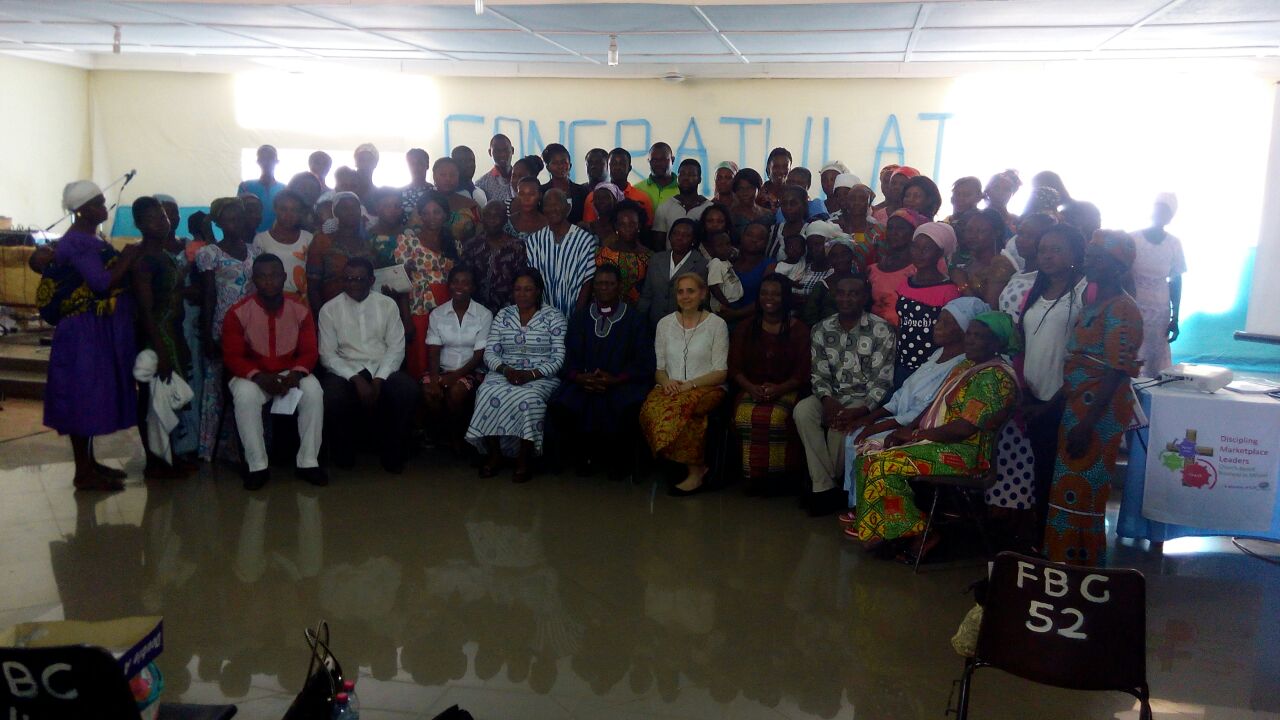
On Saturday, November 19, Discipling Marketplace Leaders (DML) in partnership with Hopeline Institute, commissioned 188 Marketplace Ministers in Tamale, Ghana.  Tamale, located in the Northern Region of Ghana, is a city of about 350,000 people, made up of 95% Muslims.  When we went to Tamale this past June, we trained about one hundred pastors and church leaders in the theological basis of Business as Mission and challenged them to do "Thirty Days in the Marketplace" where they spend one month with their church preaching and teaching on the call of God for all of us to do our work "as unto the Lord" and not compartmentalizing our faith.  A number of churches responded to this challenge and by mid-October five churches had completed their "Thirty Days."  It was the business members of those five churches who were trained and commissioned, equipped and sent out to do their work with a quadruple bottom line:  spiritual, social, environmental, and economic.  The classes varied from micro businesses to
Faith Baptist Church Marketplace Ministers
SMEs (small and medium entrepreneurs), from those with an MBA to those who couldn't read or write, from those with a doctorate degree to those who hadn't even attended a year of school in their life, from those with multiple degrees to those who received a certificate from DML as the first certificate in their life.  Some openly wept when given their certificate, as it gave them such a sense of affirmation in who they are and what they do.  Pastors attended the training along with their parishioners.  Baptist churches dominated this particular training for some reason, and other churches are getting close to completing their "Thirty Days in the Marketplace."

Half of the group in training.
As usual, our two most lively classes were Biblical Worldview versus Cultural Worldview and Boundaries.  It is striking to hear how the beliefs in the ongoing role of ancestors is still so prevalent.  For this it was good for the pastors to remind people that "greater is He that is in me than he that is in the world" and that God is in control, not ancestors.  Additionally, as a warm culture, community comes before individuals and so saying "no" is usually not culturally allowed.  However, as we taught that God is the owner and we are the managers, you could see people begin to process the need to establish boundaries. 

The women bow so low...
One woman in particular, named Lily, gave a testimony about action that she took the day of that class.  Lily was spending so much on food and provisions every month and it was beginning to break down her business.  She knew that the main cause was her sister who would always come to her house and help herself.  Lily couldn't figure out how to tell her sister "no," but after this class, she decided to pick up a padlock on her way home to lock her fridge.  She decided that she needed to better manage her resources, to love her sister but not enable her.  The next day as Lily was on her way to our training, her sister called and declared she was on her way to Lily's house. Lily didn't say anything to her about the padlock and we all wondered what the reaction would be when Lily came home.  But in an environment that is somewhat conflict avoidant, there ended up being no conversation about it and Lily gave a testimony at the end of the week that she feels so much better about being able to protect her business and even have a healthier relationship with her sister because of this boundary! 

At the commissioning service, which was such a joyful event with so many people, the Marketplace Ministers made the following personal commitment verbally in the presence of many witnesses.  I think this is something that many of us could also take, whether we own a business or work in a business:

The Marketplace Ministers

Personal Commitment: 
  • I will do business with joy and thankfulness because it is a means of providing for my family.
  • I will seek wise counsel and work to implement what I learn.
  • I will do research before starting a new business to make sure I am able to meet a real need in the community.
  • I will treat others in the same way I want to be treated.
  • I will look not only to my interest but also to the interest of others.
  • I will learn everything I can about my potential market.
  • I will be faithful in the little things.
  • I will be actively involved in my community and look for ways to bless it.
  • I will have competitive and fair prices. Repeat business is my goal.
  • I will be truthful.
  • I will keep good records and nurture the business.
  • I will seek to do everything with integrity and excellence.
  • I will remember that people are more important than money.
  • I will plan realizing there are factors beyond my control that will benefit and hinder the business.
  • I will witness and reach out in love and respect to my Muslim neighbors, friends and customers.
  • I will use the business as a bridge to reach Muslims so that they can see the love of Jesus Christ in my all-daily life.

Saturday, November 12, 2016

"I pledge that I will use this privilege in the hopes of losing it."

[Writing to you from hot and dusty Tamale, Ghana, the third country and last of six cities for this trip.  I leave for home in about six days.  God has been good to me on this trip despite being sick several times, but I am ready for a good long shower and my clothes are ready for a washing machine!  Thanks to all of you who support the work of Discipling Marketplace Leaders, where we are working to unleash church members from the church building, to BE the Church every day!]

This week was an emotional roller-coaster in the lives of most Americans.  For my children, it was no different.  It was great to see them both engage this election as adults, with passion for God and their country.  While this election brought painful conversations to the forefront, it no doubt has caused people to think deeply with both heart and mind; unfortunately this has caused pain for those who think and care differently from them.

I received an email from my daughter as she processed her own struggle with this election and wish to share a portion with you, with her permission.  It gave me hope and buoyed my spirits - which I hope it will do for some of you as well.  It also made me think that I want to be like my daughter when I grow up. I love the deep thinking in her pledge and her commitment to make a difference in whatever way God gives her opportunity as a social worker.  I especially love what she says about white privilege - she acknowledges she has it and pledges to work in order to lose it.  Too often we told too tightly to privilege out of fear of losing it, but then more people suffer.  Hannah has witnessed this first hand in a variety of contexts.  She grew up in a low-income African-American community, then in war-torn Liberia, then in Ghana.  This had helped her to shape her perception of privilege and also inspired a commitment to equality, rather than holding tight to safety and comfort.  May we all take a similar pledge - I know that I am.

And now, in her words, first from her email to me, followed by her pledge:

As we go into a new period of American history, I believe that social workers and those caring for the oppressed and underrepresented may be more needed than ever.  I realized that, as a citizen and social worker, my career could work to defeat some of the horrible values that exist in the USA.  I could make a difference - maybe not in this election, but try to make a difference in the way we function as an American people.  I decided that, if the results of this election were a defining moment for me, I was going to make it a moment that made me more passionate for my field, more ready to fight against injustice, and more willing to put myself out there.  But I refuse to embody the ignorance, hatred, and prejudice that have disgusted me from both sides of this election.  Both parties have, now and in the past, shown a stubborn unwillingness to hear the other side, to work together, to agree to disagree and still have progress happen. 

 I am exhausted with politics.  I am exhausted with hypocrisy and lies and disappointment and fear.  My goal, and part of my pledge, is to keep on engaging.  Cynicism, pessimism, and feeling despondent are all things that will keep me from being an active participant in this nation and I won't let that happen.  I trust God that it will all be okay, either in this world or the next.

My Pledge 
I pledge to work for justice, truth, and love

Understanding that in fighting for these, I will face opposition
From politicians
From peers
From people in power
From family and friends
I pledge that I will not allow myself to become close-minded to views that oppose mine
To hate or speak in hatred when in disagreement
To make sweeping assumptions based on the actions of one or a few
I pledge that, in the face of injustice or hatred, I will speak
Not to return that hatred or injustice
But to provide a voice for whomever was receiving the injustice or hatred.
I acknowledge that I am privileged.
I am white.
I am well-educated.
I am wealthy by the world’s standards.
I was born in America
Into a two-parent household
Into the religious majority.
I have never been persecuted for my beliefs, 
my race, or my background.
I am privileged.
I pledge that I will use this privilege in the hopes of losing it.
To use my privilege, unfairly bestowed, to fight for justice and peace
To use it in the hopes that eventually, I will not be privileged
In the hopes that, one day, I will lose the favor accorded to me purely based on appearance
And instead will see equal opportunity, love, and respect accorded to all.
I pledge that I will listen to God and follow Him.
I will be a representative of my Creator in a world that needs His love.
I pledge that I will be advised by trusted leaders and role models in my pursuits.
I pledge that, when I make errors, I will acknowledge them and do what I can to correct them.
I pledge to fight for truth, for love, for equality
To fight for those who have been marginalized
To do what I feel is right and not what is easy or safe.
I will show respect and love to those with whom I have profound disagreements.
I will not let my own prejudices get in my way.
Instead, I will acknowledge them
Work through them  
Conquer them.
I will engage with people who I disagree with.
I will love those who will hate me in return. 
 I will not let cynicism, fear, and pessimism drag me down  
As these are tools of the Enemy that distract from pursuing Good.  
I will continue to fight, knowing that loss is possible and likely  
Knowing that I am young and naïve  
Knowing that there is a long way to go.  
My life will be dedicated to God, to His calling, and His creation.  
It will be dedicated to fellow citizens of the Earth.  
My life will be one of uphill battles, frustrations, disappointments, and pain. 
 It will also be filled with victories, with love, with knowledge, and with conviction. 
 I will not shirk my responsibilities. 
 This is my pledge.

Monday, November 7, 2016

An Ugly Blog

Greetings from Kaduna, Nigeria, where it is hot and the food is spicy! 

I don't like to write ugly blogs.  I like to tell positive stories of Africans, of positive changes, and of hope.  But every now and then you have to talk about the ugly stuff.

It's true that the USA has its own ugly stuff going on as well.  It's also true that ugly stuff can be found all over - where-ever there are human beings who bear the mark of sin.

But in order for change to come, darkness needs to be called out so that people can pray for light to enter in.  So I will share a bit of the ugly stuff in the hopes that people who care about Africa and fellow brothers and sisters in Christ will pray with knowledge about specific issues.

Let me start with Ethiopia and then Kenya.

Ethiopia has been going through some turbulent times in the last six months as people have been protesting against the government.  It is rumored that hundreds have been killed and many more hundreds have been detained for protesting.  It is a rumor because the government controls all communications in Ethiopia so getting information has been difficult.  Several weeks ago, the government declared a state of emergency which bans the following seven things in the country:  social media, protests, broadcast media from TV channels outside of the country, political gestures (such as the crossing of the arms which has been widely used in the protests against the government), visiting a factory, farm, or government institution between 6 pm and 6 am (as they have been the target of some destruction), diplomats cannot travel more than 40 km outside the capital without permission, and guns cannot be taken within 25 km of the main roads or 50 km from the country’s borders.  All of this is done to control the citizens and block them from communicating with the outside world.  Please continue to pray for our brothers and sisters in Christ in Ethiopia.

In Kenya, I was sent this news clip from a DML Marketplace Minister whose heart is breaking over the current rise in corruption.


Since arriving here, I have heard so many stories of these challenges, that affect all levels but hurt the disenfranchised the most.

But even beyond corruption, there are two other issues that continue to sadden me.  One is related to polygamy - I was at a church conference and was introduced to the third wife of a government official in the Kitale area.  She is in her 30s.  This is not an "older generation issue" of a person married multiple times before things changed, but a current issue that shows a sign of strength by the husband.  How can this be in this day and age, in a country that is so very Christian?

The other issue is that which is referred to as “extra-judicial justice” – that is, “justice” that takes place outside of the formal justice system.  I’ve written about this before as I have personally witnessed this in several different situations across Africa (one such incident was a man being beaten to death for stealing rice).  But two reports that I heard in the last few days have shaken me again in a way that causes me to fall  to my knees to pray. 

 The first is the number of poisonings that happen to people who are perceived to be wicked or a threat in some way.  People that I know and love have been threatened with being poisoned or have had it attempted, only to be protected by God in some way.  How many times this happens is unknown to me and I’m not sure that anyone has the answer.  It would need toxicology reports and autopsies for every death, but the fact that I have heard it as often as I have makes me wonder, and would make me very nervous to eat food offered to me if I were a Kenyan.

The second report I heard had to do with the “justice” served on a person who committed a crime.  A by the new lottery machines that have appeared at every staging area for passengers of public transport decided to do something about it at one area.  The pastor saw how addicting it was for the matatu (taxi-buses) and boda-boda (taxi motorcycles) drivers, putting their very little hard earned money into something with the hope of a payoff.  He found the place that was providing electricity to that lottery box and switched it off.  The young men who were using it went to find the source of the problem, and as they were distracted, this pastor stole the box and ran away with it.  He ran into a nearby sugar cane field, and the young men quickly surrounded that field.  They smoked him out and then beat him to death.  I’m told his last words to them were, “I’m trying to save you from yourselves.”  This pastor did not do the right thing, but he certainly did not deserve death.
pastor who has been very disturbed

These situations make it very difficult to tell people to go against the culture to do the right thing in terms of   To make a poor decision is to be met with a justice that allows for no grace, mercy or forgiveness.  Last week, as I rode on a boda-boda, a street boy tried to rip the earring out of my ear.  Other people were already yelling at him to stop chasing the bike I was on, and I was so thankful that he wasn’t successful as he probably would have received quite a beating.
standing up against corruption – it’s not just about having courage, it may be about risking your life.

And I know that for every story I tell, we can think of similar corruption or destruction from our own context.  This world is broken – so very broken.  But we do have hope that God can bring good from brokenness and that He has given us this day to try to make a difference in whatever way we can. 

Today, please pray for the victims and the perpetrators of injustice, and for the Church to grow in strength to be counter-cultural and not a sub-culture.  And this week especially we pray the same for the USA.

Sunday, October 30, 2016

Economics of Hope

This week I leave Kenya for Nigeria, where we will give a conference in Lagos on "Positioning the Nigerian Church for Global Millennium Realities," and then teach at the ECWA Seminary in Kaduna on Integrity and Finance.

But today I want to write about the economics of hope.  This is something my former colleague, Jeff Bloem, introduced to me, and it became more evident on our trip to Guatemala.  So I've been thinking and wondering about it of late.  When I wrote a few of weeks ago about our trip to Guatemala, I referred to the fact that there are many similarities between the poverty there and what I've seen in Africa, but also many differences.  One of the more startling differences seemed to be a lack of entrepreneurship.  In almost any African village you visit, you will see multiple small scale, hand-to-mouth businesses.  Almost every African you meet will have one, if not two or three, small scale businesses running, often in addition to a full-time job. Yet the villages that we walked into in Guatemala seemed to have almost none.  [Again, I only went to a few villages, the tours were quick, and so I may be generalizing too much.]  Assuming these differences are accurate - and we did consult with a number of Guatemalans who substantiated the observation - what is the reason for the difference?

We know that God made all people in His image, with His creativity, so it's not that people in Guatemala are simply less entrepreneurial.  All people find happiness when contributing to something greater than themselves, so it can't be that Guatemalans are not-hard working.  Guatemala is a rich country in terms of natural resources, so it's not that people don't have resources with which to work.  A very wide gap between the rich and poor exists in many nations, so that can't be the reason.  Hardships (civil war, hurricanes, earthquakes) have been plenty across Africa as well as Guatemala, so that can't be it.

Or can it?

Guatemala had a thirty-six year civil war.  That's a very long time of insecurity.  Unlike Africa, most rural people do not own land on which they can grow food.  They are more likely to be day laborers of large scale farms. Throw into that mix a very long history of conquerors, and natural disasters, and it seems to be a recipe for what we used to call a "lack of hope in the heart," which psychologists today call self-efficacy.

Jeff quotes a psychologist who said this:
A psychologist walked around a room while teaching stress management to an audience. As she raised a glass of water, everyone expected they’d be asked the “half empty or half full” question. Instead, with a smile on her face, she inquired: “How heavy is this glass of water?”
Answers called out ranged from 8 oz. to 20 oz.
She replied, “The absolute weight doesn’t matter. It depends on how long I hold it. If I hold it for a minute, it’s not a problem. If I hold it for an hour, I’ll have an ache in my arm. If I hold it for a day, my arm will feel numb and paralyzed. In each case, the weight of the glass doesn’t change, but the longer I hold it, the heavier it becomes.”
She continued, “The stresses and worries in life are like that glass of water. Think about them for a while and nothing happens. Think about them a bit longer and they begin to hurt. And if you think about them all day long, you will feel paralyzed – incapable of doing anything.”
Remember to put the glass down.
Imagine holding that glass for 36 years and apply that to a person living in poverty in Guatemala.  [Then think of North America and those locked out of the social system whether they are Native Americans, African-Americans, Latinos, or Anglo-Americans through poverty that is not easily escaped.]  What hope do they see of being able to effect change?  What aspirations might they hold to believe that things can change with hard work and perseverance?

Often times we approach the challenge of poverty with external solutions - such as micro-credit, education, and other well-intended programs but we don't address the internal constraints that a lack of hope imbues. We forget that when we don't understand who we are in Christ - made ON PURPOSE and FOR A PURPOSE, we lack the hope to make positive changes.  A "hope intervention" was done in Mexico by economists who focused on micro-finance loans AND a Biblically-based curriculum that looked at bolstering aspirations, helping people recognize their own abilities, and their ability to see a path out of poverty.  The results of that study showed good results.

It's a BOTH/AND not an EITHER/OR.  Too many churches focus only on who we are in Christ without the practical tools of how to apply it.  Too many NGOs/non-profits focus on external solutions to poverty without addressing a lack of hope in the heart.

Most of us reading this have no idea what it is like to be without hope.  Not real, deep, on-going, all-encompassing despair for yourself and your children.  Most of us have networks and relationships that we can navigate - with a worse case scenario of having to swallow our pride to use those networks.

But imagine holding a glass half full of water for thirty-six years.

Let's be the Church that says, with Christ and some practical tools, you can try it one more time.
Please pray for the work of Discipling Marketplace Leaders as we try to reinforce the message that we all have been created ON PURPOSE, FOR A PURPOSE, and supply some practical tools for how to multiple those talents.

Monday, October 24, 2016

Two Simple Words: "Receive Jesus"

Last Monday, I left for Kenya.  I arrived in Kitale on Wednesday morning, had ten minutes to "settle in" and then we took off for a long day of meetings in Kakamega, returning to Kitale twelve hours later.  Needless to say, I was exhausted.

Thankfully, Thursday was a national holiday in Kenya and so I had the day to rest, unpack, iron my clothes, do my grocery shopping, and some cooking to carry me through the next week of teaching and meetings.  I was to start teaching Business as Mission for the BA Theology class at Africa Theological Seminary on Friday.

Mid-morning, I left the seminary campus to get my groceries.  I flagged down a "boda-boda" (motorcycle taxi) and jumped on the back.  Despite having been on the road and in meetings yesterday seeing a great deal of Kenya, I took a deep breath of fresh air and sighed happily.  This is what I love when being back in Africa - having all my senses wake up with the sights and sounds of a society who lives so much outside:  people walking, talking, and laughing, cooking and cleaning, hustling here and there, cows, goats, sheep on the road, little shops everywhere.  The boda-boda zipped through town, dodging people, cars, animals, and other boda-bodas.  As we came close to the junction of the grocery store, there was heavy traffic and we were stopped for a few minutes.  Cars, motorcycles, and pedestrians were pressing in on all sides.  Instinctively, I tightened my arm against my chest to protect my purse from being grabbed.  Then a man, maybe in his 50s, thin and looking a little disheveled, crossed between the bike I was on and the car behind me.  He caught my eye as he came closer.  And as he passed, he put his hand on my shoulder and said, "Receive Jesus" and kept walking.


I smiled and relaxed.  My first thought was, "Thanks, but I have."  Traffic began to move again and as I felt the wind in my face, those words continued to wash over me again and again.  Such simple words.  No agenda behind them as we were in traffic.  He wasn't trying to present the four spiritual laws to me.  Simply a hand on my shoulder, "Receive Jesus" and moved on.

And it made me think all day.  Thoughts like... 
  • ...Why don't I ever say things like that?  I'd be afraid they are already Christian and I'd be insulting them.  I'd be afraid it would be seen as a platitude of a "muzungu" (white person) who wants to be the "missionary savior..."
  • ...Wishing that ministry could be that easy.  Two simple words.  Not the long challenge of empowerment and personal ownership, of transformation that takes a great amount of time... 
  • ...Where did he learn to come up with those two words and how long has he been saying them?  Rather provocative words, they immediately make one think.  They are an invitation, not a command. If all you have it two seconds with someone, those are two great words... 
  • ...Reflecting back to my flight from Amsterdam to Nairobi, where I was sitting next to two men (one from Toronto and one from Sweden) who wanted to talk the whole way.  In the past I would have assumed that these men were coming for humanitarian reasons and probably were associated with a missions group (they both were with groups seated elsewhere on the plane).  It didn't take long to understand they were both going to Kenya for safaris and, given my recent blog on unreached people groups, it was pretty safe to think that they might not have "received Jesus."  When they asked me what I was doing in Kenya, I spoke with boldness but didn't say "Receive Jesus..."
  • ...Wondering if that man said that to all people, or when he caught my eye, whether he saw something in me specifically.  I wondered about his own life, his story, his own journey with Jesus...
You can see how my mind was going.  But what a delightful thing - two words and I'm left in a world of thoughts for the day.

Please continue to pray for the work of Discipling Marketplace Leaders in Kenya as we seek to reach more people for Jesus, equip them to achieve the purpose for which God made them, and send them out to be a blessing to others, causing more people to "receive Jesus."

I leave you with a picture of me and DML Kenya Co-Director, Rev. Elly Kisala.  My dear husband, Michael, complained that it has been many, many months since I have put a picture of me on this blog, so here it is!