Sunday, March 1, 2020

"I don't like going to church," said the Pastor

This week's blog is written by my colleague, Dr. Phillip Walker.

Yaounde, Cameroon:

He stood up in the meeting and shared how he has stopped looking forward to going to church on Sunday.  He shared that he felt something was missing.  Church seemed locked into a way of operating that felt dry and not relevant to real life.  He also shared that he was frustrated with the local Bible School.  It seemed that the curriculum the school used was simply the same one everyone else was using and did not have much new to add.  After the first day of training with Discipling Marketplace Leaders (DML), he said he had learned more in six hours than he had learned in the past six years.

His remarks were encouraging to us as facilitators of the message of DML.  I remarked to one of the other participants that I hoped his pastor was not in the group.  The man next to me smiled, and said,  "He is the pastor.  He is also a professor at the Bible School."

Later I learned from him that he currently teaches at four different Bible schools in Cameroon, but is hoping to launch a school built around discipling the students to be disciple-makers.  Later, when we met with participants from several Bible Schools, they all affirmed that they were looking for something that would help them address the issues faced by the churches in Cameroon. 

They all felt that the DML training was part of the piece that was missing which can move churches and Bible schools from the theoretical to the applicable, from purveyors of knowledge to catalysts of application.

As we travel around Africa teaching DML, we hear many stories of a holy dissatisfaction with the way the church is operating.  Far too many churches are more like theaters where church programs are more about entertaining than equipping.  The emphasis is on getting people into the church, rather than sending equipped disciples into the marketplace.  In most places where we go, the Holy Spirit has already been turning the ground over, preparing people for the message of engagement with doing "work as worship."  
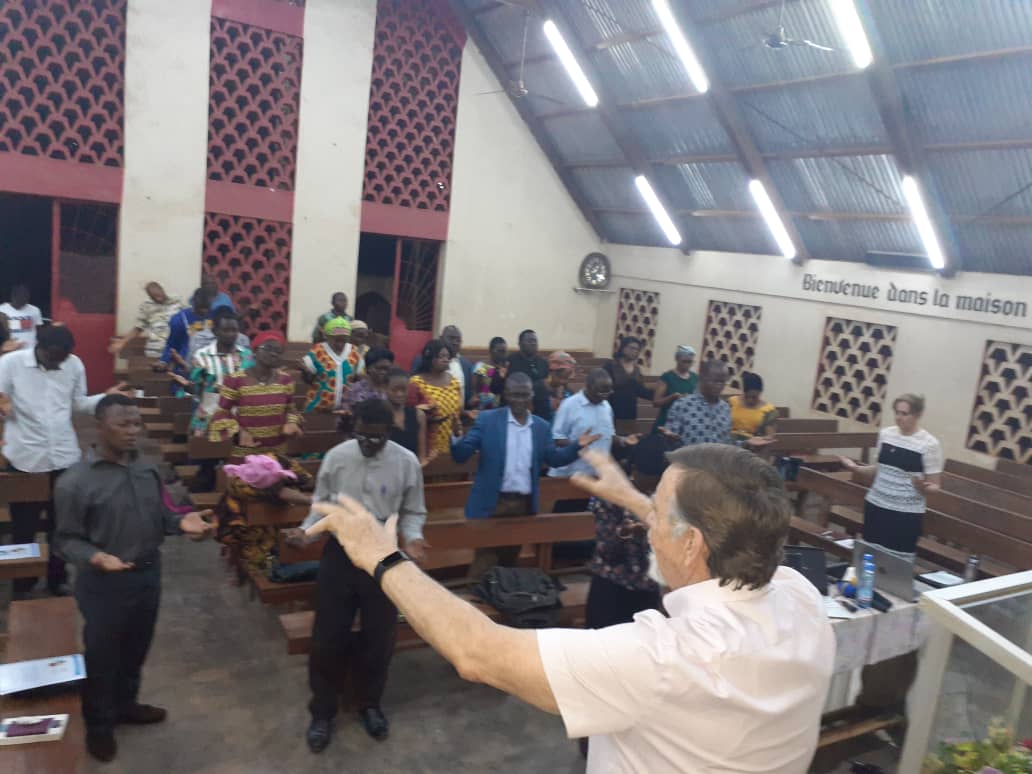
Churches and leaders are looking for a way to become relevant to a new generation, staying true to the Word and equipping them for fulfilling the Great Commission.  (Note:  the median age in Africa is 17 years old.  A young generation!)  When we talk about the greatest untapped resource for the Great Commission being the people in the pew and how their workplaces are their parishes, it resonates and excites.

We have more open doors than we have time to teach.  Please pray for us as we move from Cameroon to Burundi, and then from Burundi to Zambia.

Monday, February 24, 2020

Knowing what I know, what will I do?

On the plane to Cameroon this weekend, I read a book called Visions of Vocation by Steven Garber. It is one of about twenty books that I have stacked on my desk, mostly gifts from my thoughtful husband who picks up any and every book he can find for me on the subject matter. As I read so many books like this, I honestly didn't expect many more new things to be revealed.  But I was pleasantly surprised.

He asks this key question throughout the book:  Knowing what I know, what will I do?

He takes a close at Adolph Eichmann, a Nazi official, who maintained that all he was doing was his job, following the rules, obeying commands.  He didn't kill a single Jew, nor did he give orders for Jews to be killed.  He asked, "How can that be wrong?  I simply did my duty."  Yet it was concluded that he saw enough to be fully informed and therefore he was morally responsible.

He contrasts that story with the founder of International Justice Missions, Gary Haugen, who was working for the US government with the Department of Justice when he was sent to Rwanda following the genocide in 1994.  What he saw upset him to the point that he had to take action and IJM was born.  It now advocates for justice and addresses many legal issues in many countries in the world.  He could have helped Rwanda and left that country, feeling satisfied, and continuing to work for the Department of Justice.  But instead, he left a good-paying job to start IJM where he would have to raise a lot of money, and where his life and the lives of the lawyers that work for IJM are threatened and (some have been) taken.

Two men witnessing a genocide.  Two very different responses.  It begs the question:

Knowing what I know, what will I do?

Or, once you see what is going on in the world, can you still love the world?  Can we know and love the world at the same time?

It is the most difficult dilemma facing every human being to figure out what you will do with what you know.  In large part, it is what makes us human.

The Good Samaritan is an example of this need to love our neighbor by paying attention to the details that matter the most.  But Garber suggests paraphrasing from Walker Percy, "The Man who got all A's and still flunked life" for a new title of the Good Samaritan parable.  The lawyer who was asking the question was obeying the law but not morally serious about the question.  Justice is about following the letter of the law whereas righteousness is about doing what is right regardless of the law.  You can get all A's and completely miss the point.

Garber says,
Good societies anywhere require people with a similar sense of calling, folk who see into the messes and horrors and complexities of human history and decide to enter in for justice's sake, for mercy's sake.
I see things that you don't see.  I see messes and horrors and complexities.  There are people beaten down on the path I take and I have to decide when to enter in for justice's sake, for mercy's sake.

You see things that I don't see.  You see messes and horrors and complexities.  There are people beaten down on the path you take and you have to decide when to enter in for justice's sake, for mercy's sake.

I don't know how you respond to what you see.  I don't know how you struggle to "do with what you know."  I know how I struggle.  Yet I believe that there is much more going on than what we hear about in the news.  I get glimpses of it daily from fellow brothers and sisters in Christ, glimpses that are beautiful and encouraging.  Heroes who are loving their neighbors by paying attention to the details that matter most.

But I believe there could be even more going on if each person was encouraged and equipped to be a change agent in their specific circumstances.  How many of us say "I can't" or "I don't know how to start" or "Someone else can do it better" or "I'm just...".  How many of us are indifferent, living in a climate of "whatever" and "to each his own" or "I don't have time."

Each of us has a piece of knowledge of this world that is different from another.  Our unique personalities and upbringings and cultures all play into that.  And as Christians, we all have been made in the image of God, given gifts and talents, and have the same Holy Spirit.

The call is to do something.  Eichmann did nothing.  We can't all be like Gary Haugen, but we can figure out how to do something with what we know.

This question is good enough by itself and I want to stop here.  But there is more that we need to consider with this question and that will be a future blog.

May you have good and deep considerations this day on this question:  Knowing what I know, what will I do?

Monday, February 17, 2020

Environmental Racism and Environmental Missions

Despite the growth and busyness of Discipling Marketplace Leaders, I continue to try to find time to plug away at my dissertation.  Thankfully the subject matter is very much tied to my work, passion, and ministry, so as I read...and read...and read...and read...I continue to find ways to insert what I'm learning into the ministry.

The terms "environmental racism" and "environmental missions" are two terms that I have recently run across and have resonated deeply with me.

But before I get into those, let me back up a bit.

In the year 2000, sociologist Kurt Alan ver Beek declared that religion was "a development taboo."  In his research, he found that development organizations, including Christian ones, consciously and deliberately avoided the topic of religion, faith, spirituality in their work, saying it wasn't a "development focus."  Ten years later, that narrative changed significantly mostly because earlier research that declared that religion would decrease in importance in the world was found to be wrong.  Religion was found to be "persistent" and had actually increased in importance worldwide.
The second reason that development has turned to include faith-based organizations (FBOs) is that major donors and NGOs began seeing that their way of doing development wasn't working.  The inclusion of faith in development has significantly increased since that time.  Today as much as 50% of all health and education services given in Sub-Saharan Africa are from faith-based organizations!

And this shouldn't be too much of a surprise to us as Christians.  Medical missions and missions for Christian education is something we hear a lot about.

Which is what brings me then to the title of this blog - Environmental Missions.  We don't hear much about this.  And it is often because we don't hear about the first part of the title - environmental racism.

What is environmental racism?  Research is showing an increase of toxic dumping by governments and corporations in communities that disproportionately negatively impact minorities.  The amount of shipping of hazardous waste from developed countries to developing countries has significantly increased, in large part because regulations tend to be expensive and more intense in developed countries, making it cheaper to pack up and send to developing countries.  Rev. Dr. Chavis defined environmental racism as this:
"Racial discrimination in environmental policy-making.  It is racial discrimination in the enforcement of regulations and laws.  It is racial discrimination in the deliberate targeting of communities of color for toxic waste disposal and the siting of polluting industries.  It is racial discrimination in the official sanctioning of the life-threatening presence of poisons and pollutants in communities of color.  And, it is racial discrimination in the history of excluding people of color from the mainstream environmental groups, decision-making boards, commission, and regulatory bodies."
Environmental missions is a response to this that is growing in some churches and faiths. Bringing the gospel addresses both physical and spiritual needs, and environmental issues negatively impact many of the poor around the world.

The Lausanne Commission addressed this in 2012 and formulated the Jamaica Call to Action.  I encourage you to read the whole call to action if this subject matter is of interest to you (http://lwccn.com/about/jamaica-call-to-action/).

In their study, they came to two main conclusions:
1.  Creation care is indeed a 'gospel issue within the lordship of Christ."  Informed and inspirted by our sutdy of the Scripture - the original intent, plan, and command to care for creation, the resuurection narratives, and the profound truth that in Christ all things have been reconciled to God - we reaffirm that creation care is an issue that must be included in our response to the gospel, proclaiming and acting upon the good news of what God has done and will complete for the salvation of the world.  This is not only biblically justified, but an integral part of our mission and an expression of our worship to God for his wonderful plan of redemption through Jesus Christ.  Therefore, our ministry of reconciliation is a matter of great joy and hope and we would care for creation even if it were not in crisis.
2.  We are faced with a crisis that is pressing, urgent, and that must be resolved in our generation.  Many of the world's poorest people, ecosystems, and species of flora and fauna are being devastated by violence against the environment in multiple ways, of which global climate change, deforestation, biodiversity loss, water stress, and pollution are but a part.  We can no longer afford complacency and endless debate.  Love for God, our neighbors, and the wider creation, as well as our passion for justice, compel us to "urgent and prophetic ecological responsibility."
Environmental missions.  It used to be that missions was for pastors and evangelists.  Then it grew to include doctors, nurses, and teachers.  Recently the Church has begun to recognize the need for business people to be on mission and the need for their expertise in poor communities.  And now those who are passionate about creation care are also being recognized.

And it should be no surprise.  We are all on mission, whatever our gifts, passion, or talents, God can use us to help the world flourish.  Christopher Wright says this:
"It is not so much the case that God has a mission for his church in the world, as that God has a church for his mission in the world.  Mission was not made for the church; the church was made for mission - God's mission." 

Monday, February 10, 2020

A Plague of Locusts in East Africa

Over history, there are times when solitary locusts undergo what the BBC calls a "Jekyll and Hyde" transformation and become very sociable, forming huge flying swarms.  Of course, we remember the plague that God sent to Egypt when Moses was seeking to convince Pharaoh to let the Israelites go.  But the chart below from the FAO shows that this type of plague is not uncommon.

These plagues can have up to 10 million (10,000,000) locusts and can cover 120 miles (200 km) in a day, eating enough crops which would comparatively feed 2500 people for a year.  The last swarm in West Africa cost 2.5 billion in harvest losses in the years 2003-2005.
The worst swarms in decades are now crossing the Horn of Africa, causing significant damage in Kenya, Ethiopia, and Somalia.  They eat 1.8 million tons of vegetation over 135 miles (350 km) every day, affecting more than 20 million people.

The FAO said that this swarm is breeding so fast, it could grow 500 times by June.  There are efforts being made to spray chemicals but the area is so large that the cost is prohibitive (and also has other side effects).

Please pray for East Africa and for swift responses by the UN and others involved in emergency aid to combat this issue.  Please pray for the smallholder farmer, the families that will be impacted both in terms of food and income.

Monday, February 3, 2020

"Teaching a man to fish" does NOT go far enough.

For years, many people have used the Chinese proverb, "Give a man a fish and he will eat for a day.  Teach a man to fish and he will eat for a lifetime."

The first sentence is clear and true.  If you give a man a fish, his hunger will be alleviated for that day.  The next day he will be hungry again.

For years, I've been hedging on the second sentence.  To help me hedge, I've added a third sentence:  For a man to eat for a lifetime, he needs more than knowhow, he needs access to the pond, a fishing net, and other resources.

But I think I'm to the point of saying flat-out that the second sentence is not complete and we should probably stop saying it because it is misleading.

Groups run training courses all over in developing countries on soap-making, tie and dye, baking, etc. But that does not mean that they will eat for a lifetime.

I would say this:  Give a man a fish and he will eat for a day.  Teach him to fish, help him develop his capacity, connect him to networks, and he MAY eat for a lifetime.

I returned from Kenya last week where I had spent time with business people who have been trained and given loans through DML.  While I heard good success and growth stories, I also heard plenty of stories of frustration, sin, and corruption.

Most of the time, we want to tell and hear the good stories - the stories that make us feel like we are making a difference and that the world is becoming a better place.  But anyone who has been involved in development knows the stories are not always good.  And we need to hear the good with the bad.  We need to know the struggles that people go through and understand reality from their perspective.  We need to have our hearts broken because of the sin in this world that is not only outside the church but inside the church.  And we need to let those messages shape how we work and move tomorrow.  Those experiences become part of the wisdom of moving people towards being able to eat independently for a lifetime.

Some stories that I heard went like this:
  • A widow received a loan but her son was in the hospital at the time.  She asked her pastor to take the loan money and buy her goods for her.  He instead spent it on himself.  He admitted this and said he would pay it back but never paid a dime back, leaving this woman responsible to pay the loan (and ultimately leave his church).  Today she is selling bananas, making $1.50 every two days, struggling to survive.  Heartbreaking.  
  • A businessman (carpenter) took a loan but rather than use it in business (as he had been trained), he used it to pay the back rent owed on his shop, the back rent owed on his house, his children's school fees which were in arrears, as well as other debts.  He is living from loan to loan, juggling quite a number of loans at one time, robbing Peter to pay Paul, and living hand to mouth.  He doesn't see a way out and can't get out from the pressure of people coming to him, constantly looking for their money.  He is in bondage - a slave to those whom he owes.  The Bible warns about this and that is why we spend time teaching about not using loans for consumption.  We prayed for wisdom and freedom for this man.
  • Death threats, lawsuit threats, lack of transparency and accountability among the leaders of the groups that we lent to, and other ugly stories.  We expect things to be different among Christians but we are also very well aware that people do not become perfect when they give their lives to Christ and the church is made up of 100% sinful people.  How we need constant discipleship on how to be ambassadors of reconciliation in the Marketplace!
Our teams are working hard to help the churches build in the necessary best practices to help their members be successful.  But it is not a simple fix or a direct line to success.  The path is often circular (with two steps forward, one step back) and is almost never simple.

While there are occasional needs to give a man a fish, it can ultimately strip a person of dignity and self-worth.  While there are needs to teach a man to fish, the number of training programs in developing countries is high, as are the sky-rocketing numbers of people graduating from universities across Africa.  What we don't have are groups who are helping people to do business as Marketplace Ministers, with ongoing discipleship, creating jobs for those who need work.  We need job makers not job seekers, but jobs who are designed to allow the image of God to be revealed in each person.

It's not fast.  It's not always pretty.  But it is necessary.

Sunday, January 19, 2020

Feedmills and Water and Cows, Oh My!

It was a week of intensive learning about livestock - from feed to health, to genetics, to farm management.  It was great!

Narok County is unlike any other part of Kenya, according to people we met with this week.  It is made up of the Masai Tribe, who have a rich tradition and culture with deep roots in raising beef cattle.  Many own 50+ acres of land and could have up to 400 cows.  We had some very good meetings and are being to see how the work of DML, through the church in Narok County, could work towards a holistic plan toward a quadruple bottom line.

It was also a week of lots and lots of water.  The rains should have stopped a while ago but it rained almost every day we were there.  The last night it rained a lot and we were driving on a dirt road that stretched about 30 kilometers.  On the way in, it took us about 2.5 hours to drive that distance.  On the way out, after all the rain, it took us 3.5 hours.  We only got stuck three times and had the fun of driving over a bridge that was underwater (see picture).
The Masai Mara is an incredibly beautiful land as well and is very well known for its amazing animals.  We were blessed to be able to see some of them this past week as well.

This week I will be making visits with our Kenya DML team to a number of churches that we have been working with over the years and look forward to catching up with some people I haven't seen in a long time.
Beautiful people, beautiful land, beautiful culture, and beautiful traditions.

A creative God, infinite yet detailed, global yet personal, merciful yet just.
So blessed to be known by Him and loved by Him!

Sunday, January 12, 2020

Business Missions: Livestock Feed and Value Addition

I'm in Kenya this week with Paul Soper, CFO of DML, and an old friend, Malcolm DeKryger from DeMotte IN.  Malcolm is the President and CEO of Belstra Milling and Fair Oaks Pig Adventure, as well as a number of other agribusinesses.  We will be taking a look at the challenges relating to livestock feed around several parts of Kenya.  The conversation around a trip like this started during a phone call in September of 2019 and was then confirmed by a visit that Malcolm had in October with one of the Kenyan governors asking for assistance in this specific field.  We quickly felt
like God was confirming this track.  This week will be looking at the demand for livestock feed, the current feed producers, and the potential gaps in the market relating to the value chain in producing healthy meat.  We will be meeting with this Governor and the livestock farmers in his county who do not have good access to feed.  We will also be meeting with one of our key partners in Kenya through the Anglican Church and discuss challenges for their livestock farmers for their members as well.

I'm excited about this because for the last five years, I have been focused on helping the church understand the importance of business in the Kingdom of God and developing tools to help them be able to disciple their members to do their work as an act of worship.  But my real passion is seeing business owners equipped and released to do the work that helps people flourish, use their gifting in a way that is reflective of the Image of God, and to find real joy in doing meaningful work.

As we begin to round a corner of churches and denominations understanding it, there are a number of businesspeople who have said to me, "Now it's time to continue developing tools to help business owners thrive!"  Malcolm is one of those people who has said this to me.

This year we are launching a new part of our ministry called "Business Ambassadors."  For years, typical missions has involved those of a theological background or those willing to paint/build.  But what many parts of Africa need for sustainable poverty alleviation is technology transfer - learning from other entrepreneurs and business people - access to information about new technologies that can help their business grow, and possibly leapfrog some technologies to get to those that can really develop capacity in this growing world.

These business ambassadors will be representing Christ by mentoring and teaching business owners in their specific area of expertise.  They will come for a week and be able to go deep in mentoring with two businesses and then provide a workshop for a much larger group in the area.

We believe it's time that business people take on business missions and we believe that through our network of churches and denominations, this can be done in a way that will be mutually beneficial and respectful, with the goal of fulfilling Genesis 1:28.

If you might be interested in being a business ambassador, please email us at info@disciplingmarketplaceleaders.org.  We appreciate your prayers for God's leading as we explore this important topic this week!

Monday, January 6, 2020

Guest Blog: The Power of Church and BAM Partnerships

Happy New Year to all! We are so grateful for the gift of life that allows us to see this new day, this new week, this new month, this new year, and this new decade!  Our prayer is that in this year and in this decade, Christ may be high and lifted up, with His Church reclaiming all aspects of this earth for Him!

And thanks to many of you, we not only met our financial goal for December, and therefore for 2019, but surpassed it, which allows us to move forward with our plans for 2020!  We are grateful for your partnership and humbled by the opportunity to continue to join God in this work in 2020!

In November Dr. Walker and I had the opportunity to write an article for the Global Business as Mission movement.  We have received feedback from several new parts of the world based on this writing and I thought I would share it here as well.  We continue to see the hand of God as this ministry moves forward and takes root in churches and denominations, with the goal of it becoming part of the DNA of the church!


Discipling Marketplace Leaders: The Power of Church and BAM Partnerships


by Renita Reed-Thomson and Dr. Phil Walker

A Kenyan pastor approached us following our workshop and said, “Church begins on Monday. Sunday is ‘garage/maintenance time’ to prepare for that.” The lightbulb had gone on. It is the lightbulb that reminds pastors and church leaders that the Church gathers on Sunday for the purpose of being equipped to be scattered on Monday, shining the light of Christ everywhere they go. Unfortunately, the Global Church tends to be inward focused, defining itself as a building or by programs, rather than the people. While the majority of adult members in our churches spend the majority of their time in their workplace, we do not disciple them to the purpose of doing their work as an act of worship. Discipling Marketplace Leaders is seeking to remedy this as it brings the work of Business as Mission into the Church.

Finding Common Ground

In 2012 Dr. Phil Walker (President and co-founder of International Christian Ministries) was conducting a leadership seminar in Accra, Ghana. Renita Reed-Thomson (Regional Director for a BAM ministry) was attending the seminar with her team. At the break, she began sharing with Phil about the challenges of the BAM movement. While successful in helping Christian business owners grow in their ability to operate successful businesses, she was concerned about their spiritual journey (Deuteronomy 8:18). It was easy to see financial growth, but hard to know if they were growing in their walk with the Lord. Phil discussed his frustration with the local church and its inability to substantially impact the community by empowering members to be light and leaven in the community. Phil invited Renita to Kitale, Kenya, to teach a course on Church-based Business as Mission at ICM’s Africa Theological Seminary.
Over the initial months of teaching pastors, Renita saw a dramatic change in their perspective regarding business and work. Teaching business as a calling, supported theologically, pastors shifted from business as a “necessary evil,” to business as calling, contributing to fulfilling the Great Commitment of Genesis 1:28. Renita shared with other BAM practitioners about integrating BAM formally with the church. They said BAM and the local church could not find common ground for working together. Some stated that the church is “too difficult” to work with and therefore should be side-stepped. Renita decided on a research project to test whether the faith and work movement was possible within the local church. From 2013-2015, Renita conducted an 18-month research study, in three cities with six churches and 260 businesses. 

The Fruit of Working Together

The results were dramatic in outcomes. The local church, business owners, and businesses benefited from working together. The local church showed numerical and financial growth, the local business showed growth in profit and sales, and the business owner showed growth in household income and spiritual growth.
Additionally, these other key findings were noted:
1. Church-based BAM training enables the BAM movement opportunity to be part of the DNA of the local church, like a women’s or youth ministry. Church history has seen several iterations seeking integration between faith and work. Unfortunately, these had limited success due to limited connection to the church, where there are opportunities for ongoing discipleship, encouragement, and equipping.
2. In Church-based BAM, business owners are encouraged by their pastor to see and understand their businesses as part of God’s plan and mission. This affirmation brought tears to some during their commissioning as marketplace ministers. They were recognized as part of the mission of God and not merely an ATM for church projects. Failure of the local church gathered to see the importance of the church scattered is to lose their most strategic members placed where they can have considerable impact. The symbiotic relationship between Christian businesspeople and the local church is critical for the fulfillment of the Great Commission.
3. BAM provides the local pastor and church with the practical application of theology. Most pastors are taught informally that work is a necessary evil and that calling is about leaving the marketplace and becoming a “full time” Christian worker. When pastors understand this fallacy, their eyes are opened to the potential of business as core to effectively living out the Christian life.  Evangelism moves from a program to “life on life” experience.

Paradigms Shifting

Since they first met and discussed their frustrations, Renita has built a training curriculum around the concept of Church-based Business as Mission and ministry. Discipling Marketplace Leaders (DML) was the product of holy discontent. In DML, Pastors go through a two-day workshop. At the conclusion, they are asked to institute a “business month” into their church calendar.  Ministry is set up in the local church to support workers in the workplace. Training is provided, along with Bible studies related to the integration between work and faith.
In 2018, Phil stepped down as President of ICM in order to help Renita implement a new model of church involvement. Renita sees DML as an answer to her frustration of not knowing if the people she trained under the traditional BAM model were growing in their faith.  Phil saw the connection with Christians in business as the vital link for both discipleship and light, leaven, and salt in the community.
The process of moving to Church-based Business as Mission (CBBAM) has not been simple nor easy. There have been challenges, as well as opportunities. The single most significant barrier to the introduction of CBBAM is the absence of a theological framework that pastors and their church leaders can understand and accept. There is a paradigm shift needed that moves from “church as building” to “people as the Church.” The paradigm shift needs energy, focus, commitment, and determination. In 2018, DML discovered that working with denominations is much more efficient and effective. Currently, DML is working in six denominations to roll out DML in more than 20,000 churches. DML has launched in nine countries in Sub-Sahara Africa.

Fulfilling the Potential of Church-BAM Partnership

In 2004, the Lausanne Occasional Paper on BAM gave two recommendations for Business as Mission in the ‘BAM Manifesto’. The first was for the Church to identify, affirm, pray for, commission, and release businesspeople. The second was for the business people to accept this affirmation. It is still the most straightforward presentation of what and how BAM should be done to fulfill the great potential that can come between the local church and Marketplace Ministers.
The dichotomy between BAM and the local church needs to end. There is too much at stake. The BAM movement could be and should be the catalyst for a second reformation, which empowers every member to be a minister in their work and business.
Two people met by “chance,” both frustrated from different angles. God turned frustration into opportunity as thousands of churches across Africa introduce Church-based Business as Mission. The DML model keeps the local church central to discipling nations, and work as central to combatting poverty while carrying the message of reconciliation to the nations.
For more information, please go to www.disciplingmarketplaceleaders.org.

Tuesday, December 31, 2019

For Everything There is a Season

Today is a significant day.

Yes, it's New Year's Eve and a time when everyone reflects on the past year.
Yes, it's the last day of this decade and it's a time when we can reflect on the past ten years.

But for me, this day has more significance.  It is a day of recognizing seasons.

It is also a day of realizing, with some surprise, the significance of the number seven in my life.  Seven indicates the number of completeness in the Bible and I was startled to realize, upon reflection, the four distinct seasons of seven years that I have had in my life.

Today is the last day that Restorers, a non-profit in Grand Rapids that was partnered with five different churches to work with neighbors in the Madison-Hall community, is closing.  This is a ministry that I had a hand in starting when I was a deacon with Madison Square Church.  The late Norm Katerberg had the idea to buy the building at 1413 Madison and he donated it to Restorers.  The late Jane Lambers sat with me in that empty building, with two chairs and a table, wondering what God was going to call us to do.

I served as Executive Director of that ministry for seven years (1998-2005), and when I left it had nine employees, eleven programs, a robust partnership with neighbors and neighborhood churches, as well as the local public school.  It was a delightful, albeit challenging, seven years.  It served the community for 22 years and today it is closing its doors.

For everything, there is a season.

From Restorers, we moved to Liberia and then to Ghana.  I worked with Partners Worldwide for seven years (2005-2012).  While I lost Bob during that time, God was also doing some amazing things in me and with me.  I remember saying that I wasn't leaving Ghana because while Bob's call was done, I did not have the assurance that my call was also done.

In 2012, I met Dr. Walker from International Christian Ministries.  After a series of conversations about my frustration regarding the business as mission movement not working through the church and his frustration regarding the church not moving into the marketplace, I was invited to move to Kenya to see what God might have me do through pastors.

For everything, there is a season and in 2012, I realized that my season with Partners Worldwide was over.

Seven years ago, I went alone to Kenya to teach pastors at ICM's Africa Theological Seminary to teach them about business as mission.  I started with a class of twelve pastors.  We started a pilot project with one pastor and one church.  In seven years, we have grown to nine countries, working with 30,000 churches that have more than 12 million members.  

And now, today is the last day that Discipling Marketplace Leaders is housed under International Christian Ministries.  For seven years (2013-2019), ICM allowed DML to start, explore, expand, and grow.  In 2018, we recognized that it was time for DML to stand on its own.  To be honest, I fought that idea for some time because I know the responsibilities of running a stand-alone ministry.  It is more comfortable to be under ICM than to branch out.  But God was bringing more people who were saying with a louder voice that the time has come.

Little did I realize, until just recently, that seven years have passed again.

For everything, there is a season.

And as I do the math, I realize that Bob and I got married in 1990.  In 1997, we moved into the Madison-Hall neighborhood, which led to the starting of Restorers.  Another seven-year season.

Today, I am grateful to ICM for their partnership and we look forward to continuing to partner with them in 2020, as we begin to work with ICM Burundi (in addition to on-going work with ICM Uganda, Kenya, and Tanzania).  I am uneasy about DML starting on its own, but I am thankful for new partners like Paul Soper, Emeline Nde, and our new board of directors who will help to guide this work.

But more than anything, I am grateful to my God and Father, who continues to guide and shape and move according to His seasons.  The fact that I have seen these distinct seasons of seven gives me goosebumps as it has the fingerprint of God on it.

Ecclesiastes 3:11 says, "Yet God has made everything beautiful for its own time."

As you reflect on this past year and this past decade, I pray that you too see the fingerprint of God on your life.

Saturday, December 28, 2019

Still Time to Give for 2019

Dear Friends,

We sent out an appeal at the beginning of December indicating that we are hoping to raise $50,000 this month to reach our budgeted donation goal of $340,000 and start the new year in a positive position.  To date, we have raised $41,000, which puts us $9,000 away from our goal yet.

We know that many of you will give yet in the last few days of December, so we want to remind you of this opportunity to join with us in the work of Discipling Marketplace Leaders.  And we also want to remind you of what you "get" when you join us:
  • A church unleashed from the building to be the church every day of the week, in every sphere of influence (30,000 churches in nine countries, with more than 14 million members!)
  • Pastors who teach and disciple their members to work with a quadruple bottom line, making disciples, loving neighbors, being fruitful, and caring for the earth.
  • Christians who have a growing understanding that work is an act of worship; that worship goes beyond singing songs on Sunday to the use of time and talent as a way to worship God.
  • Christians doing their work with the goal of helping people (customers and employees) flourish, rather than having the primary goal of profit.
  • Poverty alleviation as businesses grow and wealth is increased, and job creation, which is so critical in Africa, as unemployment is so high.
And I could go on.  But I think these are amazing outcomes that can be transformational for the church to find its way back into the Marketplace!

Please consider joining us if you are not already doing so.  We believe that 2020 will be a year of even more open doors as God continues to call His people in His Global Church to be torchbearers for Him in every workplace!

To give directly to DML, please go to www.disciplingmarketplaceleaders.org/donate to give online or to see instructions on other ways of giving.
To give through Resonate (Canadians, please use this one!), please go to www.resonateglobalmission.org/donate, and select "Missionaries - Africa" and then select my name in the dropdown.
To give through ICM-USA, please go to www.icmusa.org/donate, and select Discipling Marketplace Leaders.

Thank you!