I am writing to you from Mwanza, on the north side of Tanzania, on Lake Victoria. It was quite a road trip to get here! After arriving in Dar es Salaam (the economic capital) on Wednesday, we took a 12 hour (500 km) road trip on Thursday (had anticipated it would be a six hour road trip) to Dodoma (the political capital). There we had a two day foundational workshop on Friday and Saturday, and then drove 12 hours to Mwanza (700 km). Flying had been suggested but with four of us, this seemed more economical.
But the fact that it is a beautiful country, and I was with delightful company, made the trip enjoyable. I was with Pastor James Kamau, Pastor Anthony Kayombo, and Dr. Walker (pictured below), and with the four of us over 24 hours, we shared, debated, laughed, sang, and prayed. The car did break down about seven hours in to our trip to Mwanza (pictured below) - and I happened to be driving at the time :( - but after about an hour, it started again (and I was the one who happened to turn the key when it started, which made me feel better!).
One of the reasons for the longer drive to Dodoma was a stop made on the way to a Masai village, deep in the bush. There were actually no roads to this village and we drove on a pathway. This village is one that our DML team has been reaching out to and visiting regularly for the past year. There is no church in the area, and during the recent drought (which I shared about this past December), they lost many cows. For the Masai, cows are life. Because of the sustainability projects that we have been able to do through our partners and with your generous support, we were able to give thirteen cows to four different Masai men in this village. This opened the door to have conversations with them, as they were astounded that cows would be given as gifts, with no strings attached. Over time, the team was able to show the Jesus film in the village, and a number of men and women from this village have given their lives to Christ. A number of people from this village are still viewing this team with great suspicion, but many came to greet us and they allowed us to take a picture with them. It was a great privilege to be a guest in that place.
The workshop in Dodoma went well, and there seems to be a good group that is growing in their capacity to be leaders and trainers in DML going forward.
It is DML's first time in Mwanza so we shall see how it goes here!
On Wednesday, we fly to Kenya, which will be the last leg in this journey.
Thank you for your prayers!
Participants in Dodoma, held in a Free Pentecostal Church.
Pastor James Kamau, me, Dr. Walker, and Pastor Anthony, enjoying a quick stretch after seven hours of driving.
But shortly after that, the car broke down. Here Dr. Walker pretends to fix it while Pastor Anthony can't help but laugh.
But we had a beautiful view and after just over an hour of waiting, the car started again and we made it safely to Mwanza.
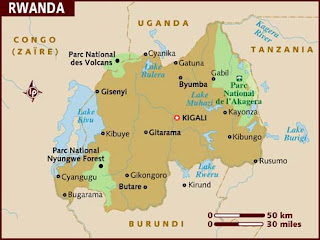
Greetings from Rwanda! This is my first time in this beautiful country!
Many years ago (2001), my late husband Bob visited Rwanda as he was feeling a call to Africa and there was a position opening that would be a good fit for him. It was the first African country that he had visited and I was unable to accompany him (I was not yet feeling the call!). He came away from that trip feeling that living in Rwanda would be very difficult, especially because of the language challenges (French). Since then, Rwanda has changed to have the official language be English, and under the leadership of President Paul Kagame, Rwanda has made amazing progress economically! According to the World Bank, which assesses each country on the "ease of doing business," Rwanda is doing better than the US in a number of areas (taxes, registering property, and protection of minority investors)! This is quite a contrast to their neighbor, Burundi. The per capita income in Rwanda is $2100, whereas in Burundi it is $780.
Both Rwanda and Burundi are amazingly beautiful countries, with rolling hills and mountains.
We are here at the invitation of one of our partners, Global Advance, who adopted DML as one of their key ministries a couple of years ago. Last August, their Rwandan leader, joined us for a workshop in Tanzania and became convinced that DML was the way forward for the church in Rwanda. Bosco is a business man as well as a leader of a nonprofit that is helping with poverty alleviation in Rwanda. Bosco is not a man who sits still, and as I write, I am quarantining in what Bosco describes as a "DML hotel."
We are excited to be here. I think if there is any world leader that I would be interested in interviewing, it would be President Kagame. What he has done in his 20 years as president is quite remarkable, especially giving the genocide that happened just before he assumed power. Yesterday as we drove in from the airport, his entourage drove by and I wanted to stop it and meet him, but was advised that it might not be the best approach! (Kidding, of course!)
View from hotel in Kigali
During our time in Burundi, we were amazed that there were leaders present from 15 of the 18 provinces, with a total of 434 pastors and church leaders, from many denominations. The response was very positive and Burundi as a whole seems to recognize both the problem and the opportunity in understanding that work is to be done as an act of worship. The DML team in Burundi did an amazing job in organizing the events, and we have heard that the government has been discussing DML as they have been frustrated that the church has been focused on salvation only and not on the flourishing of people while on earth.
Below are some pictures of our three workshops, from Bujumbura, to Ngozi, to Gitega. On Wednesday, we fly to Dar es Salaam in Tanzania, and then will drive to Dodoma (the capital) to do a workshop, then on to Mwanza. Please continue to pray that the right people may be in attendance and that the Holy Spirit may go before to open the hearts of those who hear this forgotten message of Genesis 1 and 2!
We thank God for our safe arrival in Burundi. The trip included an overnight in Nairobi, and then a drive from Bujumbura to Ngozi (about a 2.5-hour drive on a very curvy road, uphill most of the way, with numerous blind spots and lots of people and bikes on the road). To boot, our car has the steering wheel on the right, even though they drive on the right side of the road. All that to say, when we say we are thankful for safe arrival, we really mean it!
On Sunday, I was blessed to lead the commissioning service at a Baptist Church in Ngozi for 25 Marketplace Ministers who had just completed their training. Dr. Walker led a commissioning service in Gitega which commissioned 28 new Marketplace Ministers. What a privilege to commission people to be ministers in the Marketplace, doing their work as an act of worship, with integrity and excellence! And what a blessing to hear the congregation say that they will support, pray for, and encourage them in their various parishes, stretching their hands toward them in blessing.
I was also able to give the message on our call of working every day to bring the Kingdom of Heaven on earth. I talked about how God's work brought order, beauty, provision, joy, and potential to creation, and how we do the same thing in our work. But I got a lot of laughs when I pointed out that the corn that I had eaten for breakfast that morning gave me the energy to be able to preach right now! And I thanked those in the congregation who grow maize, as it might have been from them! The resources that God has given us in creation, and how we interact with them, give potential for many things and great flourishing!
Monday and Tuesday we will have our foundational workshop in Ngozi for about 150 pastors and church leaders. Then we will drive to Gitega, where we will do the same workshop for about the same number of people. Then we will drive to Bujumbura, where we will do it again! Right after Saturday's workshop, we will fly to Rwanda, where we will have to quarantine for a short time, before beginning a training in Kigali.
I'll let pictures tell the rest of the story. Thank your prayers, and please keep praying!
A Burundian government official praising the church for doing DML to help the people. We have been told that the Burundian government has been critical of the church for only caring about people's salvation and not life on earth. This government official is going to write the cabinet about the work of DML in the churches.
View from the back seat. Tight corner up ahead!
Abundant farming in Burundi!
The church in Gitega with their Marketplace Ministers.
These two men plus one more went through the TOT in Burundi last August and have now been going throughout the district with the Friends (Quakers) church to bring the message of DML. The executives of the Friends Church will be in our training this week.
Gotta have the picture of the cute kid on the worship team!
I received an email reflection recently that talked about how Jesus is recorded as asking 307 questions in the Gospels. In contrast, He directly answers only three of the 183 questions that He was asked. Just three.
Jesus asked questions that could be easily answered, as well as questions with no obvious answer. He often answered questions with more questions, either to make a point, expose deception, or get people thinking.
This, from the Son of God. The One with all the answers. He doesn't rush to teach, to explain, to solve, to inform. He doesn't teach all that He could with every question asked of Him. His approach is RADICALLY different.
It made me pause and wonder why. I know that asking questions is a good approach to learning about people, but Jesus already knew their heart. Asking questions is a good approach to get people thinking, and certainly that happened. Asking questions is a good way to prompt conversation, and that happened as well. But was that necessary 307 times? Isn't that a bit extreme in approach?
The author then said that Jesus uses questions to "confer dignity on people." Ah. Now that makes sense. Jesus saw the people around Him not just as a people in need, but people made in the image of God. He desired for them to understand their capacity and potential. He didn't want a dependent people but a people with a deep knowledge of God and in that deep knowledge, an understanding of their own place in joining with God to be part of the solution.
So often I feel compelled to give answers. Sometimes I give answers when there hasn't been a question! And I know how I feel when someone "mansplains" something to me - I feel belittled and patronized. When this happens - either with me "mansplaining" or someone else doing that to me, the truth is that I end up being deaf to what is really going on around me.
Jesus only answered three questions.
In his book, Jesus Asked, author Conrad Gempf refers to Mark 13, which is the chapter in which the disciples are asking Jesus about the end times. Their question is, "When will this happen and what will be the signs?" In typical fashion, Jesus does not answer their question, but rather tells them how to look, referencing the fig tree. Then, in verse 32, Jesus admits that He doesn't know the answer to the question. In this, we see that Jesus had given up omniscience as well as omnipresence in becoming man. But it is not a sin not to know something. Not for Jesus. And not for us.
How difficult to tame the tongue! How difficult to ask questions or admit that we don't know.
I don't want to be deaf to what is going on around me. I want to ask questions and learn to listen and grow from everyone nearby - not just the sages and wise teachers. From adults, and teens, and children. Especially about their frontline - where they spend most of their time: What is the culture of your frontline? What are the values that shape it? Who are the heroes? What do you like and dislike? How can it become more Kingdom like?
I want to practice starting conversations with, "I wanna ask you something..." What an invitation to listen and learn.
I want to be more like Jesus.
On Thursday, I leave for East Africa, where we will be doing workshops in Burundi, Rwanda, Tanzania, and Kenya. We have a very tight schedule of back-to-back workshops and travel, so please pray that all travel may go smoothly, especially in light of COVID. Thank you!
If you have spent any time around Rev. Dr. Johnson Asare from Northern Ghana, you will have heard him say that it is "risky not to take risks." This is a man who has taken many risks in his life, as a businessman, a pastor, a Muslim-turned-Christian, and a community leader. He knows what he is talking about. While others have said something similar to this, hearing him say it has stuck with me because of his testimony, and I find myself repeating that phrase from time to time.
Especially in the beginning of a new year with lots of planning to be done.
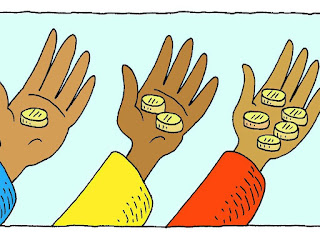
I was recently reminded of that line relating to the parable of the talents as told by Jesus in Matthew 25, where the master leaves and gives three servants three different amounts of gold according to their abilities. As you probably know, the one with five bags of gold puts it to work and earns five more; the one with two bags of gold puts it to work and earns two more, but the one given one bag just buries it. He doesn't spend it, doesn't waste it, but neither does he invest it or increase it. The master is pleased with the first two, but not at all with the last one, to put it mildly.
This parable reminds us that it is a sin to squander what God has given us. He has given us three main resources: time, treasure, and talent, and all three work together for the flourishing of the world, for the flourishing of ourselves, and for the glory of God. This parable reminds us that we are not to wrap or bind up those opportunities and bury them for fear of losing them through risky ventures or doing things "incorrectly."
I see this over and over in my work. Doing business is risky and I have watched many people take those risks. Unfortunately, many businesses do fail, but there is much to be learned in those failures. But we take risks in more than business: being in relationships is also risky, as is being in a church, accepting a new job, or investing yourself in your community. Living involves risk. It is an investment of ourselves to people, places, and things.
We are accountable for the investment of our lives. We are responsible to God, to ourselves, and to each other.
We may sympathize with the person who received one talent, but we must always remember that the source of that conservatism, as author R. Paul Stevens says, was his "inadequate view of God."
Think about that. The servant with one bag only saw his master as someone who was "a hard man, harvesting where you have not sown and gathering where you have not sown seed." Because of that perspective, he "was afraid and hid the gold in the ground."
I have heard people describe God in this same way. They might say, "I didn't ask to be born and now I have to work for him? And if I don't, hell for eternity?"
But this is based on an inadequate view of God. He has given each person unique combinations of time, treasure, and talent. And has crafted us in a way that when we use these resources with integrity and love, it is a win-win-win. And when we don't use them with integrity, when we confess, He forgives us and cleanses us from all unrighteousness.
As I head into this new year, I wonder what risks I will take with my time, treasure, and talent. I wonder which ones I will cower at, which ones I will embrace, and which ones I will bury. I'd like to think I will embrace them all, but I know myself better than that!
But my heart's desire is to embrace them and to remember that I am accountable not just for the risks I take but also for the risks I don't take. Playing it safe doesn't work when following a call from God to join Him in the work of helping this world flourish.
We serve a God who wants us to take risks and we are accountable for the risks that we take AND the risks we do not take.
As you enter 2022, I hope you join us in taking risks for the glory of God!
I have itchy ears. Both literally and figuratively.
In both cases, itchy ears are annoying and distracting. They are annoying because you really can't talk about and it's not socially acceptable to scratch your ears in public. It's also distracting because there can be all sorts of good things going on and yet if your ears are itchy, that is all you are thinking about.
It is the figurative sort of itchy ear that is more challenging and that is what I have been really preoccupied with of late.
My ears are itching to hear a gospel that goes beyond a "get them through the door" evangelism, beyond "my relationship to God is the whole message of salvation," to a robust discipleship that recaptures a vision of the fullness of redemption. I long to hear that in messages and sermons when the church is gathered, and when I don't hear it, my ears begin to itch. It's annoying and it's distracting. It's annoying because it feels like I'm being critical of the church, and I don't want to be critical. It feels distracting because there still often is still a good message for me and for the church in the message being shared, but I'm distracted by my itchy ears.
Articulating the problem does help. I'm calling out and confessing that I have itchy ears.
When I scratch at the itch a bit, I realize that there are a few things Biblical irritants. In Genesis 3, we discover that three things were broken in the fall: our relationship with God, with others, and with work/creation. Yet the large majority of messages and sermons that I hear focus only on our relationship with God and largely ignore our need to be discipled and redeemed in these other key areas.
Gary Black, Jr, in a book called Whatever You Do for An Integrated Life writes this:
One key motivation for this lack of attention to discipleship is imbedded in a misapplication of a key biblical doctrine. When the theological tenets of justification by faith are thought to be the beginning and end of the gospel story, then sanctification becomes a non-essential add on to the Christian life. A biblically valid understanding and application of Christlike discipleship, and the habits of sin it seeks to address and transform, is becoming progressively lost to mainstream evangelical congregations, universities, and seminaries. Sin, it turns out, doesn't preach very well to a consumer driven society. In sum, Christian discipleship demands surrendering to the process of holistic transformation of character as an inescapable priority of the gospel Jesus preached. In this way the gospel is how Jesus provides for human beings to experience the unbridles wholeness god originally intended for us to experience and share.
We know how deeply embedded sin is in our lives and cultures. Our character can't help but be shaped by this, and when our brief times on Sundays focus on knowing better who God is, but not knowing better who we are in Christ, we come away having better head or heart knowledge of God but not transformed or sanctified further in vocations and callings.
That itch is further exacerbated when I spend time with believers who express their frustrating with work, who are unable to see God in their workplace and see their work as an occasion of serving Him. They desire meaning in their work and yet are often frustrated by it being a form of drudgery. This past week I had a chance to speak to some college students who asked how they can find fulfillment in their work and what path they should take to get there. It's not unusual at that age to be hungry to find a vocation with meaning, yet we rarely hear significant attention given to the meaning of our work lives given from the church, even though work involves the majority of our awake time every week.
There are long reaching impacts of our relationship to work and how it can become corrosive to human flourishing that must be addressed.
Spiritual formation is incomplete without this important emphasis. And the world cannot be reached when we only grow in our understanding of God as a personal Savior, but not in personal sanctification through discipleship that reaches into every corner of life, from the home, to the workplace, to the marketplace.
So my ears continue to itch. And while I feel bad about their itching, and while I sometimes feel like I'm a "noisy gong or clanging cymbal" (1 Cor 13:1), yet they are likely to continue to itch. I'm beginning to accept it and recognize that there is something from God in the itching. Some itches are meant to be scratched. Some itches are meant to be caught as the underlying reason for the itch remains and must still be addressed.
I'm now asking God to reveal what good can come from this.
Last week I mentioned the drought in Tanzania, but in the advent of Giving Tuesday, it may have lost some of the importance of our request for prayer for this crisis. Thanks to many of you, our supporters, we were able to send money this past week to our partners in East Africa to help mitigate the challenges to farmers because of this drought. But let me share more about the situation now.
We are told that Kenya has received only 30% of their normal rainfall at this time, making it the worst rainy season in decades. Many have lost up to 70% of their livestock and the remaining are too skinny or sick to be sold. The price of cows has gone from $357/cow to $45/cow.
Droughts often happen on a five-seven-year cycle in this area, which allows for water bodies to fill up again. But the last drought was just three years ago, which was not enough time to regenerate the water supply. Women in Northern Kenya are often responsible for fetching water, and it is estimated that they now have to travel an average of 14km or 8.7 miles to get water (‘We will all die’: In Kenya, prolonged drought takes heavy toll | Climate Crisis News | Al Jazeera)
From the BBC, this short report and then a link to a video, which may be disturbing to some as it contains images of dead animals:
A t least 26 million people are struggling for food following consecutive poor rainfall seasons in the Horn of Africa.
Drought conditions in northern Kenya, much of Somalia and southern Ethiopia are predicted to persist until at least mid-2022, putting lives at risk.
The situation is already so bad that wild animals are dying in their hundreds and herders are reporting losses of up to 70% of their livestock.
The BBC’s senior Africa correspondent Anne Soy reports from Wajir in northern Kenya.
WARNING: This video contains images of dead animals which some people may find distressing.
Please pray for rain for this region. If you are a business owner or work in a business, you can imagine the devastation of watching your hard work die before your eyes. The poor are often those most affected by the impact of climate change. If droughts are expected to be more frequent and longer, there are things that can be done to mitigate those challenges, but they do take a lot of money and infrastructure. But our God is also able to hear the prayers of His people and send rain where it is needed most.
Friends, we have an amazing opportunity on Giving Tuesday this year. Two businesses, Belstra Milling (Indiana) and Alsum Farms (Wisconsin) have each agreed to match, up to $10,000, any gift given on Tuesday, November 30. BUT if you give to DML through Facebook on Tuesday morning, your gift will be met with a fourth match by Facebook.* That means if you give $100 through the DML donation website, it will turn into a $300 gift, and if you give through Facebook your $100 gift will become a $400 gift! That is amazing! We are so thankful to Belstra Milling and Alsum Farms for this opportunity!
(*Facebook will match the first eight million dollars given through FB starting at 8 am, and after that they will match 10% of gifts given. Last year they had $50 million given through FB on Giving Tuesday, so if you want that fourth match, please give early!)
We are excited to finish 2021 strong and lead into 2022 with continued growth and opportunities in new areas. Please consider joining us!
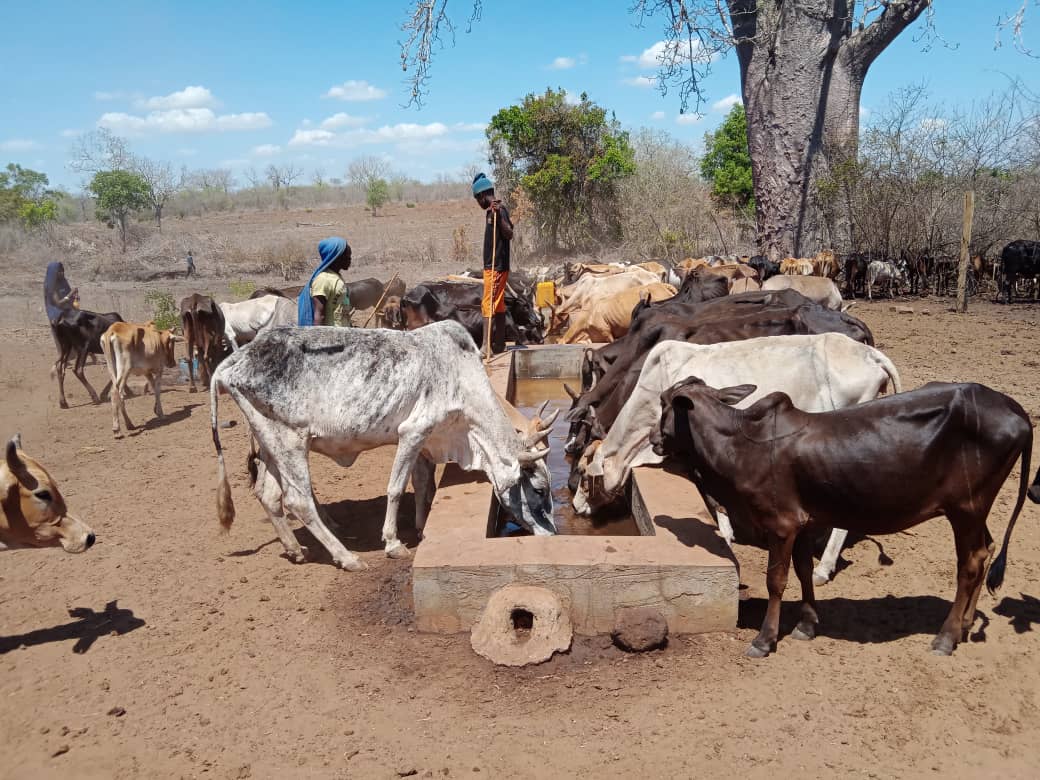
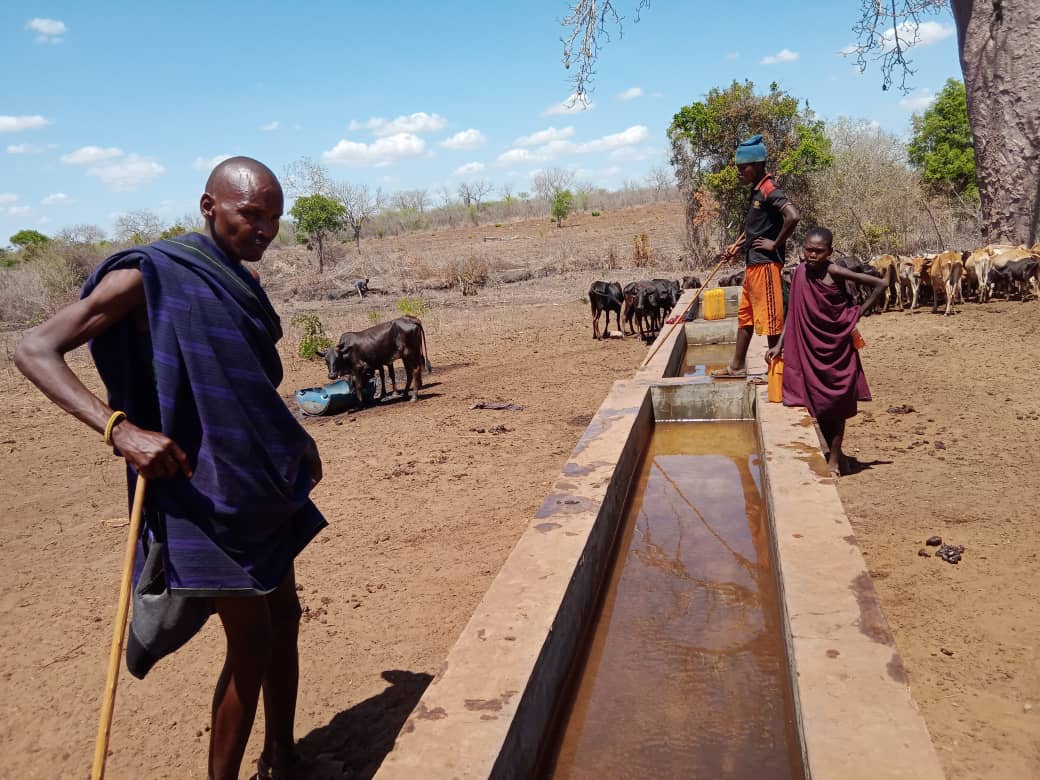
And for our prayer partners, we received word over this past week from our partner in Tanzania of an ongoing drought throughout Tanzania. They told us that the Masai pastoralists with whom they have been working, pictured below, are losing many of their livestock due to this drought.
The DML team in Tanzania was able to put a well in, and it has turned out to be a great help. All the Masai and Mang'ati in the area are running here. Before they were not mixing but they are now coming together in harmony:
Before it was a little bit green in this area, but not now:
Pastor Anthony also sent this message this past weekend of the effects of the drought in Dar es Salaam:
Frank's project is one of the unique projects through which many people are going to learn how to raise chickens (egg layers), pigs, and cows in Dar es Salaam environment. Sadly, Frank has experienced a very bad disease in his project which has led to the death of more than 350 chickens. Thanks to God, government veterinarians have intervened in medical support. The main challenge now is water availability. WE NEED RAIN. Let's uphold East Africa before the LORD Praying for rain 🌧️🌧️ 🌧️ Drought has affected many social and economic activities. It has led also to serious power cuts due to hydroelectric power dependency. And when there's no power, many businesses remain stagnant. Pictures to follow:
Friends, please join us in prayer for rain in Tanzania! Thank you for your partnership in prayer and financial support for the ministry of Discipling Marketplace Leaders!
Last week I had the privilege to be in Hamilton, Ontario (Canada), visiting several members of Immanuel Christian Reformed Church in their workplace. Someone asked me during that week, "Where does your joy come from?" I had to enthusiastically reply that it comes from meeting with people at their workplace. I love learning what people do and how faith and work intersects for them. So my days in Hamilton were very enjoyable.
Let me give you an example of why I love this so much:
Bob and Lynn are a brother and sister who run a Hamilton-based residential appraisal business that was started by their father. Residential appraisals are unbiased professional opinions, done to determine the real value of a property, as each property is unique. These appraisals are often done for loan purposes.
I asked Bob and Lynn to share what they love about their work and what is challenging in it. It was quickly apparent that there is a rich opportunity to fulfill an aspect of God's character in this work, and to be part of the flourishing of customers that they serve.
If you look at the purpose of appraisals described above, they are "unbiased professional opinions." There is a science to it, but it is ultimately an opinion based on experience and various criteria. Bob very quickly began to tell stories about the high need for integrity in this business - he is serving the home owner but also the mortgage company. The home owner would often like for the number to come in high, while the mortgage company wants it to be very realistic.
Before long, they began talking to me about their customers. This year, starting in January, they saw a surge in appraisals needed for divorces - people had hung in there through the holidays but in January started to call it quits in their marriage after the stress of 2020 covid pandemic. Customers were often crying, and pressuring for a low or high number, depending on their position. Other customers are engaged with needing an appraisal for the settlement of the estate of a parent or loved one. Again, customers who are in pain, often fighting with other family members, pressuring for a high or low number, depending on their position. Others are getting a second or a third mortgage, knee deep in debt and showing signs of drowning in it. Bob and Lynn have strongly recommended against homeowners having an appraisal done (even though they would make money from it) if it looks like the number will not come in at what the homeowner wants in order to refinance.
These ministers in the Marketplace speak words of comfort and reality to people in pain on a daily basis. They are helping people to flourish by presenting the reality of a value of the property. They are able to pray for the customers who are struggling through divorce, death, and debt. God is a God of order, and they help to bring that order to the people they serve. They often walk away from a day of work feeling the weight from the result of sin in the lives of their customers.
I left that office amazed by the opportunities that are present in being the hands and feet of Jesus in fulfilling the work of residential appraisals.
And that is just one business I visited. I could tell you many more stories.
On Sunday, I was able to give a message about why Marketplace Ministers need the church on Sunday. While the church is scattered from Monday-Saturday, we need to carry in our joys and laments from those days when we gather again on Sunday. Bob and Lynn need to carry and share the weight of what they have seen in the Marketplace, in the safe company of fellow believers in Christ, and be fed and equipped again to go out of Monday. If you are so inclined, you can watch that service here:
Very thankful to Immanuel CRC in Hamilton for the opportunity to spend this time with them!
And in this week of Thanksgiving in the USA, we want to express our thankfulness to God who has allowed us to join Him in this work, and to each of you for your care, concern, prayer and support of this ministry! Happy Thanksgiving!
This past week we had our DML Global Team Retreat. We met daily through Zoom with about sixty of us from eleven countries and it was such a joy! We could hear so clearly that the message of our commitment to bringing the Kingdom of Heaven on earth is deepening and growing in the hearts and minds of our DML leaders.
Pastor Nokoson from Cameroon led us in devotions on Wednesday and he started by telling us that it is time for us to move from John 3:16 to 1 John 3:16. I don't remember hearing the tying of those passages together but it caught my ear.
John 3:16 is probably one of the most famous verses in Scripture, especially in evangelism. It says:
For God so loved the world that He gave His one and only Son, that whoever believes in Him shall not perish but have eternal life.
The essence of the gospel in one verse!
But 1 John 3:16 takes us further, as we strive to become more like Him. Some say that this is the critical second half of the gospel:
This is how we know what love is: Jesus Christ laid His life down for us. And we ought to lay down our lives for our brothers and sisters.
These two texts show a journey of awakening that is critical and essential to the whole story. We move from an adolescent faith to the maturity of love, which IS the fullness of Jesus Christ. This changes our calling while on earth from simply waiting for heaven, to being the hands and feet of Jesus in every place and every space.
Helping people requires us to show up and respond. Loving people goes so much deeper: being in relationship, listening, and building trust.
But laying down your life for others? A depth that is difficult to describe.
Yet that is what we are called to do. We can't rely evangelistic events to do this. We can't do it from the church building. We do it as we are "going" about our business. We do it as we meet people, listen to them, learn from them, and share with them. As we do our work with excellence, bringing about the flourishing of humanity, using the gifts and talents of a creative God, we help to bring the Kingdom of God to earth. We are the picture of God's love.
In Genesis 3, three things were broken as a result of the fall: our relationship with God, our relationship with each other, and our relationship with work and creation. Many of the messages we hear from church are about our relationship with God and understanding Him better. But 1 John 3:16 makes it urgent that we also learn how to take that relationship, mature it, and apply it to our relationships with others, with work, and creation.
One would think that it would naturally flow, but the lack of transformation in nations and societies that are predominantly Christian tells us that it does not. We need teaching and preaching and practicing of how to live out this great gift on Monday, Tuesday, and so on. We need to develop the muscle that can answer the question, "What does it mean to love people where we work - the dishonest person, the unmotivated person, the negative person? And what does that look like?"
2 Corinthians 5:14 says that Christ's love compels us - because we have been loved much, we too need to love much, even to the point of laying down our lives. May God bless you this week as you live this out!
Last week, I was blessed to have a conversation with Tom Nelson, the senior pastor of Christ Community Church in Kansas, president of the organization Made to Flourish, and author of several books, including The Economics of Neighborly Love. The mission of Made to Flourish is to "empower pastors and their churches to integrate faith, work, and economic wisdom for the flourishing of their communities." How this resonates with the work of Discipling Marketplace Leaders!
In 2014, Christianity Today printed the following article from Tom Nelson, entitled "The Day I Confessed to Pastoral Malpractice." The article is well-written and tells the story of Pastor Tom's journey into discovering the need to equip Christians for what they are doing for the majority of the week.
This article tells his story, but maybe you just want the quick summary - if so, watch this three minute video. It will be worth your time!
Confession is good for the soul, but it’s hard for pastors.
At least it was for me. Years ago, I stood before my congregation to make a
heartfelt confession. It was indeed difficult to do, yet it would prove
transformative for our entire faith community.
More than a decade has passed since that day, but I still
remember it clearly. Against a backdrop of pindrop silence, I asked the
congregation I served to forgive me. Not for sexual impropriety or financial
misconduct, but for pastoral malpractice. I confessed I had spent the minority
of my time equipping them for what they were called to do for the majority of
their week.
I didn’t mean to engage in pastoral malpractice; my pastoral
paradigm had been theologically deficient. As a result I had been perpetuating
a Sunday-to-Monday gap in my preaching, discipleship, and pastoral
care. I blurted out what my heart had been holding back for way too long.
With a lump in my throat, I feebly grasped for the right
words. I wanted to confess that because of my stunted theology, individual
parishioners in my congregation were hindered in their spiritual formation and
ill-equipped in their God-given vocations. Our collective mission had suffered
as well. I had failed to see, from Genesis to Revelation, the high importance
of vocation and the vital connections between faith, work, and economics.
Somehow I had missed how the gospel speaks into every nook and cranny of life,
connecting Sunday worship with Monday work in a seamless
fabric of Holy Spirit-empowered faithfulness.
Journey to Wholeness
What led to this realization? Let me share just a bit of my
journey. I was privileged to grow up in a devoted Christian family and as a
young boy experienced a transforming conversion to Christ. I was blessed to be
part of an evangelical church that believed and taught the Bible and whose
members wholeheartedly sought to love Christ with mind, heart, and hands. After
graduating from college, I joined a campus ministry devoted to evangelism and
discipleship.
In addition to a decade of parachurch ministry, I attended
and graduated from a fine evangelical seminary. During seminary while studying
Hebrew my mind and heart were drawn to a Hebrew word that frames God’s creation
design for human flourishing. This Hebrew word is tome or tamim.
We usually translate tome as “blameless.” The challenge with
this English translation is we often associate blameless with an external
ethical perfection. But the Hebrew word actually speaks of a broader concept of
ontological wholeness.
From the early pages of the biblical story, we encounter
the tome or integrated life as the life God designed for us,
the life Jesus would come to a sin-ravaged planet in order to redeem. As a
young church planting pastor, this theological framework from the biblical
narrative still informed much of my thinking. Yet just a few years into
ministry, I began to have a great deal of heart-level dissonance. My own
spiritual formation anemic at best, and I was seeing little true transformation
in my parish. What I saw behind the nice Sunday smiles was a
troubling lack of spiritual maturity, a shallow sanctification shrouding a
dangerous disconnect between Sunday belief
and Monday behavior.
Something was awry—but what was it? If God had originally
designed us to live lives characterized by tome, and if Jesus had
gone to the cross to make this kind of life possible, why were so many in my
congregation living such fragmented, disconnected lives? Why was our
understanding of the gospel not speaking to every area of life? Why was our
discipleship not transforming everything we were and did?
Faced with these uncomfortable truths, I began a quest to
more fully grasp the kind of holistic faith taught from Genesis to Revelation.
I also began to look more closely at Protestant Reformers like Luther and
Calvin who not only recovered the authority of Scripture and the gospel of
grace, but also connected Sunday to Monday with a rich
theology of vocation. Reading the Reformers made me pay closer attention to the
bookends of the biblical story—original creation and future consummation. I
wrestled deeply with how the gospel tied the entire biblical narrative
together. Through prayerful study of the Scriptures, I began to see human
vocation as integral and not merely incidental to biblical revelation. I
started to grasp that faith, work, and economics were woven together in the
fabric of faithful gospel ministry.
As this realization dawned on me, I started to see the
Scriptures afresh. Seeing Jesus as a carpenter brought a new fullness to the
doctrine of the incarnation and reinforced the dignity of everyday work.
Studying the book of Philemon, I began to see more clearly how the gospel
transforms not only the worker, but the workplace and work itself.
Looking more carefully at Jesus’ parable of the Good
Samaritan expanded my understanding of what neighborly love truly requires. The
Good Samaritan exhibited more than compassion. His diligent labor, wealth
creation, and wise financial management allowed him the economic capacity to
generously meet some else’s critical need. Jesus’ teaching on neighborly love
brought together the threads of faith, work, and economics in a seamless way.
Working for Change
On the day I stood before my congregation, I did more than
ask for forgiveness; I promised that, by the grace of God, things were going to
change. Our language was going to change. Any hint of language that connoted a
sacred/secular dichotomy would disappear. Pastors would affirm everyone’s
calling and not just their own. We would abandon the language of “full-time
ministry” that had previously been reserved for pastoral or missionary work. We
would change how we talked about work. In fact, our definition of work was
going to change. It would be understood as being about contribution, not merely
remuneration. Our discipleship curriculum was going to change. From cradle to
grave, our commitment was to equip our parishioners with a robust theology of
vocation and to help them see their vocational stewardship as a high priority
of gospel faithfulness.
Our pastoral care was going to change, too. Pastors would
not only make hospital visits, we would make workplace visits. We would learn
about our members’ work worlds. We would encourage them in their work, we would
pray for their work, and we would celebrate their work. We would see our
congregants’ work as the primary work of the church. Everyone’s work would be
regarded as mission.
How have things changed in our local church congregation?
Over the years we have seen greater numerical growth and expansion to a
multisite presence in our city. But more importantly, we have seen greater
spiritual growth and more effective gospel mission. We now teach a robust
theology that informs our congregants’ work, have a regular liturgy that
affirms their work, and make relational investment that applauds their work. We
are now deeply committed to equip our congregation for what they are called to
do the majority of their lives. Our pastoral staff work hard not only to
connect Sunday to Monday, but to
bring Monday into Sunday. Our Sunday worship services
reflect the reality that the gospel speaks to and transforms all of life
including our work, and that the gospel speaks to wealth creation, wise
financial management, and economic flourishing.
Extreme Makeover
We are still learning and unlearning as we go, doing our
best to navigate what it means to narrow the Sunday to
Monday gap. But I’m encouraged when I receive an e-mail from a CEO or a
stay-at-home mom or a student or a retiree in my congregation who now sees
Monday lives through the transforming lens of a biblical theology of
vocation. I find increasing joy in seeing congregants embrace their paid and
non-paid work as an offering to God and a contribution to the common good. Many
of my parishioners have a bounce in their step and a new excitement about all
of life. For them, the gospel has become coherent and more compelling. They
look forward to sharing it with others in various vocational settings and
spheres of influence throughout the week.
With our kids heading off to college, my wife, Liz, wanted
to do a major remodel of our kitchen. At first, I was reluctant. Our kitchen
was just fine, it seemed. Sure, the green countertops were dated and the
cupboards were aging, but I was used to it. It was the only kitchen I knew.
Yet Liz saw something I couldn’t see. Thankfully, I listened
to her and we forged ahead with our remodel. I will never forget when I saw our
remodeled kitchen for the first time. It was beautiful. Simply designed and
wonderfully welcoming. As I stared at our remodeled kitchen, for the first time
I realized how ugly and drab it was before. How had I not seen it? How had I
been so content to live in this kitchen for so long?
The best way I know to describe the journey our congregation
has experienced is to compare it to that remodeling project. Looking back I
can’t imagine how I had served for so long with such an inadequate pastoral
paradigm. The newly remodeled congregation I serve now is more beautiful in its
expression and more effective in its mission. I have the joy of knowing I am
being more faithful to my flock. Making the transition wasn’t easy, but looking
back, we sure are grateful we did.
I was supposed to be in Canada last week but the required COVID test to cross the border came back as positive therefore I was not able to enter Canada. I ended up with mild COVID symptoms and after five days of feeling lousy, I began to feel better. Very thankful that I did not spread this to my mom and others by visiting Canada!
I was still able to record my message for Immanuel CRC on the Church Scattered (if you would like to listen to it, you can find it here: Wilderness Wanderings (libsyn.com). To watch it (video and ppt slides), please go here: Sunday Worship - October 17, 2021 - YouTube). Lord willing, I will be back in person in mid-November to do the follow-up message on the Church Gathered: Incorporating Work into Worship.
In the meantime, God has been opening doors for Discipling Marketplace Leaders in a couple of different ways.
First, DML had its first foundational workshop in Chad! Chad is in North-Central Africa, with French as the official language. About 3/5ths of the population of Chad identifies as Sunni Muslim, about 1/5th are animist, and 1/5th are Christian (Chad - Religion | Britannica).
Our own Pastor Theophile Pare from Burkina Faso went to N'Djamena last week to meet with pastors and church leaders. Below are some pictures from his time with them. We look forward to see how the work might grow through these 60+ pastors who met to hear and discuss this forgotten truth from Genesis 1 and 2.
Additionally, we have been partnering for close to two years now with an organization out of Texas called Global Advance, and over the past couple of weeks we have been conducting a training of trainers from their country leaders who are implementing the DML ministry. The leaders that we trained from Global Advance were from India, Sri Lanka, Bangladesh, Bhutan, Brazil, Guatemala, Rwanda, and Uganda, and we had our own trainers as well from Nigeria, Uganda, and Ghana. We thank God for the opportunities to spread the message of Work as Worship, and to see the Global Church be empowered to equip the saints for the work of ministry from Monday-Saturday.
Please pray for these seeds that have been planted, and for shalom (vigorous well-being and abundant flourishing) may happen in these nations and churches!
Last week, while in Florida, we rented a car and were given a 2020 Toyota Corolla. When I drive, I love to use cruise control as it helps me stay consistent with my speed. When I don't use cruise control, and just go with the flow of traffic or am distracted by my surroundings, I can often find myself going much faster than the speed limit. Cruise control helps me relax a bit - it's one less thing to watch on the road.
But the cruise control in this rental car seemed to have a mind of it's own. It would slow down and speed up on it's own. Frustrated, I would turn it off, then turn it back on again and reset it. Before too long, it would do the same with thing. What was going on with this car?
Then I decided to try to learn what it was doing. I watched when and where it was slowing down, and when and why it would speed up. I learned that the car had "dynamic radar cruise control" that wouldn't allow me to get any closer than three or four car lengths to the car in front of me before slowing down, especially if that car was going at a slower speed than me. If I moved into the passing lane where there was no car, it would speed up to the set speed. Amazing. This smart car was helping to keep me safe.
One time, a car was turning left in front of me, and I could see that it was safe to keep cruising at the same speed, but the car freaked out a bit and put the brakes on hard to avoid a crash. It couldn't see the whole situation. There was no on-coming traffic, and the vehicle ahead of me was moving out of the way.
Lessons from a rental car.
I began thinking about this car in terms of my relationship with God. He has put things in my life to help safeguard me, for my protection, like this dynamic cruise control operates in the car. Because I'm not aware of what He is doing, I get frustrated, grumble, and try to do things my own way. I turn away from Him and try to fix things myself. I wonder why He isn't helping. I miss the bigger picture.
On the other hand, just like the cruise control doesn't mean that I don't participate in the driving, He does expect me to keep alert and pay attention. I am not in a driver-less car. This is where I disagree with Carrie Underwood's song, "Jesus Take the Wheel...I'm letting go." As a co-creator with God, He expects me to keep my hands on the wheel. I don't get to simply sit back and enjoy the ride, but I participate with Him to achieve the purpose for which He has created me. The cruise control is an aid, not a substitute. God helps me in various ways, but I am not a passive observer.
It was a good reminder for me.
I am thankful to be alive at a time like this and witness the amazing ingenuity that God's co-creators continue to develop through technology. They may not give Him the credit for that ingenuity but you and I know that being made in the image of God, maker of Heaven and Earth, makes for pretty amazing people as well.
This past week, we were privileged to join the Global Alliance for Church Multiplication (GACX) Forum in Orlando, Florida; one hundred and ten organizations intent on fulfilling the Great Commission, planting churches all over the world participated. These people are passionate about God and acting that all may come to know Him! GACX reports that 150,000 people die every day without knowing Jesus as Lord and Savior. If you are from Grand Rapids, our very own Nate VanderStelt serves as the Executive Vice-President of this organization, which functions under CRU (Campus Crusade for Christ). Bekele Shanko is their President, an Ethiopian man who has been a trailblazer for Christ in many ways, particularly in church planting.
GACX has been growing in it's appreciation of the intersection between the Church Gathered and the Church Scattered (in the Marketplace). DML was invited to hold a couple of workshops as well as lead the Marketplace Engagement Strategy Session. Unfortunately, many church planters, including those attending this event, still believe that working at the intersection of church and marketplace merely amounts to helping church planters become bi-vocational and less dependent on fund-raising. This is very far from the incredible potential that equipping every member for the work of the ministry from Monday-Saturday holds in fulfilling the Great Commission.
As most in the church planting networks of GACX don't yet grasp this, attendance at our sessions was not what it could have been. We have our work cut out for us. We need to keep preaching this message!
I was reminded this week of a book called Out of the Salt Shaker, written by Rebecca Pippert. We use this illustration often in our workshops as seen in these pictures. Most of us like salt in our food. But we never put the food in the salt shaker. Rather we need to shake the salt out of the shaker so that there is an even and broad distribution of salt throughout the food.
Too many churches try to put the food in the salt shaker. The church focuses all too often on getting people into the building, rather than equipping the saints to be the salt every day of the week, out of the saltshaker and into the world.
I heard a business person once say this: "I only go to church because it's expected of me. To be honest, I bring little to church and take away little. I'd quit altogether if I could culturally acceptable." If the church doesn't find a way to engage business people and employees in meaningful ministry in and outside the church, then business people, and others working in the marketplace will continue to exit the church. We will lose them. And where will they move to? Some will leave the church permanently. Some have and will form parachurch organizations which will serve as their "church." There are 1200 faith and work organizations in the US alone. Business people are getting their needs met outside the place where discipleship is meant to take place. Parachurch organizations are great but they are not the same as the church gathered, which is called to address all walks of life in holistic discipleship.
Michael Baer writes in his recently released book, The Pastor and the Business Person, that he saw the following on a sign at the missionary training school he was attending:
No soul is so poor As he for whom Not a single person is praying.
He goes on to say, "How tragic to think that there are many people in the world of work for whom this is true. As a pastor, you can change that!" Most people feel alone in their workplace, and don't have prayer support empowering them to be a change agent, fulfilling a quadruple bottom line in that place. Workplace believers need specific prayers; prayers empowering them to be mature, passionate persons of integrity, prayers for them to keep a good work/family balance, and more are needed. The workplace is where 99% of church members spend the majority of their time each and every week.
But Michael Baer goes on to say this: "However great an opportunity BAM is to the 21st Century missions, both local and international, I also see it as a great threat to traditional church ministry: If, on the one hand, pastors can get in front of it and engage its practitioners and help lead the movement, the blessing will be immeasurable; on the other hand, if pastors withdraw from it or withhold their endorsement, many practitioners will simply walk past them on their way to serve Jesus as they feel called" (page 57).
At Discipling Marketplace Leaders, we agree. The faith and work movement, which is critically important, has operated outside the church in many ways and the church does not understood both the impact this has on marketplace believers and the missed opportunity this leads to in terms of the church's impact "out the saltshaker."
It's not too late.
Rebecca Pippert in Out of the Salt Shaker, puts it this way:
To get the salt out of the saltshaker begins not with the people but with the pastor. When you get out of your office and into the sales office, when you get out of the pulpit and into the plumbing supply shop, then your world will change, your members' worlds will change, and then the world at large will be changed. Will you do it?
Jesus did it for eighteen years (from the age of 12 to 30), spending his time as a business man, a carpenter/stone mason, in sales, marketing, and also training his brothers as apprentices. This impacted how he preached and taught, and how he related to people. Let's continue to pray for opportunities for seminaries and Bible schools to teach church leaders about the importance of making a workplace ministry part of the DNA of every church.