

Out of the Woods
Weekend before last, the four Reeds returned to the Hermitage (see March 30 post) for two and a half days of quiet. Our purpose was to introduce silence to our 14 and 16 year-olds. We thought it a good time to take Noah and Hannah away from the noise and to struggle a bit with the challenges that come to the  soul when there is little to distract us. Actually, they did pretty well with the experience. I think Noah in particular was happy when it was over, but the very fact that silence was not easy for them was eye-opening.
As for Yers Trooly, I was once again struck by the enormously healing and grounding properties that come from simply being in a natural setting. Being silent in the Creation always seems to make it so clear how far off center I can get. While out there, I alternated from simply being to reflecting, so I was able to again grab a better perspective on life. A few thoughts emerged, and since this is a slow week, I thought I’d pass along some to you. I do not consider my ponderings particularly profound or climactic, but they are the kind of things that bubble up when I get quiet. From the notebook I took along:
After living for 54 years, and paying attention for 40, I find myself ti red and occasionally angry, a victim of sorts to a ironic paradox. 40 years ago—or more precisely 39 years ago—I set out on a quest. Terrified by my own mortality, of the thought that this incredible thing called life would end , I sought the truth—wherever I found it. I was particularly interested in the unseen truths. I wondered: was there a god, an afterlife, consciousness after death? But really, any truth would help, I assumed, as I journeyed. I hungered and thirsted for it.
After 40 years here are a few observations that have proven themselves worthy of being called true.
-Non attachment is the wise course through life. Attachment leads to loss of awareness and disconnect from self.
- Quietness with patience is wise. Quietness with patience clarifies and allows truth to emerge.
-Distraction from being centered within ourselves is the great evil. Being centered fosters patience, distraction leads to loss of self.
- Truth is found in many places, but it is always found in beauty.
- Non attachment, patience, quietness and centeredness are great principles, spanning thousands of years across civilizations and religious traditions.
- There is a Truth that especially honors patience, quietness and non attachment.
- This Truth seems to be conscious and interactive. I call it God.
- The Christ event (Jesus of Nazareth’s life and resurrection from death) actually happened and is the central event in human history.
The irony or paradox is this: for years I’ve aligned myself with a religion that—in i ts American expression— often distracts me from my pursuit of truth. American culture is not patient, centered, unattached or quiet, and these characteristics have permeated and saturated American Christianity. My observation is that American Christians are quick to speak, reactive not reflective, noisy, slow to listen and seem thoroughly distracted by social and cultural activities. And I find myself frustrated because I feel like I’ve joined a club of lost yet busy people, fully attached to the trappings of the surrounding culture, casually convinced that all is well. And then I become judgmental, and at that point my own pursuit of quietness and non-attachment gets derailed.
What did Jesus’ death and resurrection accomplish? Was it not to simply restore us to fellowship with the Father? And once restored, how are we to live our lives? Is it not at least to allow us to remain connected to spiritual principles that have remained constant across cultures and millennia?
For 10,000 years-- 99.9% of our time here-- we lived close to the earth, close to the sometimes beautiful, sometimes painful reality of the created world around us. For 10,000 years, we lived as part of the creation and in small communities. Our tasks were basic, in front of us, and simple. Within just the last few hundred years, that “close to the earth” way of life changed profoundly, first for thousands, then millions, eventually for billions of us. And for billions of others, still living close to the earth, many seek to live in the distracting, options-laden world spawned by the great Industrial and technological revolutions.
Could it be that humans are not spiritually equipped for this high tech, options-laden life – separated from the earth, from the creation? Could it be that we do not function as well with the distractions and choices of wealth and acces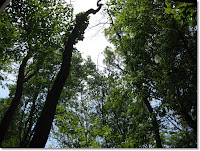 s? Could it be that we are in over our heads? How will we be able to find truth in the cacophony, without access to simplicity and natural beauty?
And by the way, how do we fight for justice while remaining quiet and centered?
Anyway, those are my musings from the woods. I’d love to hear yours on this subject.
 soul when there is little to distract us. Actually, they did pretty well with the experience. I think Noah in particular was happy when it was over, but the very fact that silence was not easy for them was eye-opening.
As for Yers Trooly, I was once again struck by the enormously healing and grounding properties that come from simply being in a natural setting. Being silent in the Creation always seems to make it so clear how far off center I can get. While out there, I alternated from simply being to reflecting, so I was able to again grab a better perspective on life. A few thoughts emerged, and since this is a slow week, I thought I’d pass along some to you. I do not consider my ponderings particularly profound or climactic, but they are the kind of things that bubble up when I get quiet. From the notebook I took along:
After living for 54 years, and paying attention for 40, I find myself ti
 red and occasionally angry, a victim of sorts to a ironic paradox. 40 years ago—or more precisely 39 years ago—I set out on a quest. Terrified by my own mortality, of the thought that this incredible thing called life would end , I sought the truth—wherever I found it. I was particularly interested in the unseen truths. I wondered: was there a god, an afterlife, consciousness after death? But really, any truth would help, I assumed, as I journeyed. I hungered and thirsted for it.
After 40 years here are a few observations that have proven themselves worthy of being called true.
-Non attachment is the wise course through life. Attachment leads to loss of awareness and disconnect from self.
- Quietness with patience is wise. Quietness with patience clarifies and allows truth to emerge.
-Distraction from being centered within ourselves is the great evil. Being centered fosters patience, distraction leads to loss of self.
- Truth is found in many places, but it is always found in beauty.
- Non attachment, patience, quietness and centeredness are great principles, spanning thousands of years across civilizations and religious traditions.
- There is a Truth that especially honors patience, quietness and non attachment.
- This Truth seems to be conscious and interactive. I call it God.
- The Christ event (Jesus of Nazareth’s life and resurrection from death) actually happened and is the central event in human history.
The irony or paradox is this: for years I’ve aligned myself with a religion that—in i
 ts American expression— often distracts me from my pursuit of truth. American culture is not patient, centered, unattached or quiet, and these characteristics have permeated and saturated American Christianity. My observation is that American Christians are quick to speak, reactive not reflective, noisy, slow to listen and seem thoroughly distracted by social and cultural activities. And I find myself frustrated because I feel like I’ve joined a club of lost yet busy people, fully attached to the trappings of the surrounding culture, casually convinced that all is well. And then I become judgmental, and at that point my own pursuit of quietness and non-attachment gets derailed.
What did Jesus’ death and resurrection accomplish? Was it not to simply restore us to fellowship with the Father? And once restored, how are we to live our lives? Is it not at least to allow us to remain connected to spiritual principles that have remained constant across cultures and millennia?
For 10,000 years-- 99.9% of our time here-- we lived close to the earth,
 close to the sometimes beautiful, sometimes painful reality of the created world around us. For 10,000 years, we lived as part of the creation and in small communities. Our tasks were basic, in front of us, and simple. Within just the last few hundred years, that “close to the earth” way of life changed profoundly, first for thousands, then millions, eventually for billions of us. And for billions of others, still living close to the earth, many seek to live in the distracting, options-laden world spawned by the great Industrial and technological revolutions.
Could it be that humans are not spiritually equipped for this high tech, options-laden life – separated from the earth, from the creation? Could it be that we do not function as well with the distractions and choices of wealth and acces
 s? Could it be that we are in over our heads? How will we be able to find truth in the cacophony, without access to simplicity and natural beauty?
And by the way, how do we fight for justice while remaining quiet and centered?
Anyway, those are my musings from the woods. I’d love to hear yours on this subject.


 Some of the women of the 18 Mountains Region, where Dea serves.


 A fierce competitor, Trokon takes on Romeo in football.
 He does not like inactivity. He always brightens when he had things to do. Here making a toy truck entirely out of bamboo-- tires courtesy of discarded flip-flops.
 He was forever hassling me to harvest coconuts and palm nuts from our trees. He trimmed the husks and sold them from a wheelbarrow for about 20 cents a piece.
 Squaring off with Hannah. "Oh yea? C'mon then!"
 Monitoring a footwashing holding Bandit the puppy. Eastman's feet were in terrible shape, and needed antibiotic care and also jigger removal.
 There were some wacky moments-- I'm looking down on him at our small gate; he's covered in sticky red mud, trying to get in to give me a sloppy hug.
 Decapitated by friends.
 A very early shot. The secret to capturing this reaction? Get the camera ready, train it on the kid, and then suddenly and loudly pass gass.
 Trokon and the Monk. He was rightly nervous around her, but he enjoyed provoking the viscious lil' whirlwind when at a safe distance.
 A moody moment in the rice fields of Kakata.
 His home. He calls them family but he knows his real mother is somewhere else, unable or willing to care for him. This abandonment was always a source of pain and anger for him.
 See what I mean? Perfect.


