Wednesday, December 16, 2009


.
.
.
Spending Season


Both Renita and I have been getting a fairly regular stream of gloomy financial news from our respective home offices for about six months now, and after cutting and reducing, there may even need to be personnel layoffs. It’s a sign of the times, but as hard as we get hit personally, we are ok. We are grateful for past tough times that have convinced us without doubt where real security lies. Living in West Africa also helps keep things in perspective, and we have good support from co-laborers who sometimes have a way of saying things that clarify and give courage. What follows is from Renita:


Every Tuesday morning, I join the rest of the LEAD team on the phone, and for a half hour all we do is pray together on a Skype call joining folks from the US, Liberia and Ghana. David Graf is the leader of this call and has been part of LEAD Grand Rapids since the beginning. He is passionate about prayer and has pushed us to pray regularly as a team (for those of you who know David, you know what this means - cajoling, demanding, pleading, imploring, whining, teasing:-).) The time has become precious and dear to those of us who regularly call in.


Yesterday morning our list of prayer requests (which we receive every Monday) included praying for the children in Liberia. UNICEF tells us one in every nine will die before the age of five, that 40% of kids are stunted in their growth due to malnutrition, that one in three young women between the age of 15-19 has a child, and one in seven of those children will die within the first year. We also had some specific medical concerns for persons with whom we work in Liberia. All in all, some pretty sobering prayer requests.


Then we prayed about the loss of Christmas, a season that once celebrated the free gift that we have received, forgiveness, grace, salvation -- and has become a time when we overspend, overeat, over consume. While Christian humanitarian organizations have to cut back, and the children they serve continue to struggle without basic nourishment, millions of relatively wealthy Christians carve out another obliviously happy moment of family excess. Even in West Africa, the season ruins our priorities. The streets are filled with plastic toys that will break after a few days; we marvel at how much people go into debt over this season even in ultra poor Liberia, a place where men are ashamed to go home because they don't have their children or spouse's “Christmas.” Another incongruent picture. Stark needs. Innocents dying. Stark waste. Insane priorities.


So we prayed. And as we prayed, David said something that spoke very powerfully to me: "Father, give us the courage of Abraham, to walk up the mountain with nothing to sacrifice but our own."


Initially, not very comforting words. Abraham, the Hebrew patriarch, was a very wealthy man. For years, he had no children, and then, miraculously, God granted him a son, Isaac. Isaac would inherit Abraham's wealth and carry the promise God had given Abraham into the next generation. Isaac was Abraham’s Treasure. And then, God told Abraham to sacrifice Isaac on a mountain alter. Think about that... this man of great wealth, this patriarch of all, so close to God... walking up the mountain, with nothing to sacrifice except his very own, his only son, in whom he had placed his entire future. (Of course, God was only testing Abe-- Isaac was spared. But that's a another blog.) Suddenly there came the realization for me that despite my initial reaction to David’s prayer, I found great comfort there. Life has always really been simple when I remove the distraction. Life is about allegiance and obedience to the only One who offers true security. I can't control what other people spend, how others treat Christmas, what people give or keep for themselves. In the end, I need to walk up the mountain with my sacrifice. In the end, it’s about spending my treasure on the Word of Love. If I’m doing that, nothing else matters.

Monday, December 7, 2009

An Exercise in Incongruity


ReedNews Update: Holiday Faux-Orphan Edition


We have certainly rounded the seasonal corner and are beginning to experience the Accra dry season. Or should I say the hot season, because unlike the rest of Ghana, in Accra it seems dry all the time. Although not as hot as it will get in March and April, it is already plenty hot enough. Back in Michigan, I remember complaining when it was still 75F by 10:00pm. Here, the coolest it gets all night outdoors is 80F, and in our bedroom, we haven't seen it below 85F in weeks. So, we start every day at around 85, and usually it reaches 95 by the time it begins to cycle back. The beloved breeze of the wet season is pretty much over by night when we need it most, but it blows nicely throughout the day. Bedtime is bearable with fans, but when the power goes out at night, there is just no sleeping. The humidity, while moderate most days, is nothing, and I mean nothing, like the palpable and stifling air of Monrovia-- and therein lies the saving grace of this place. As I like to say, "No matter how bad it gets, at least its not Monrovia."
The 1st semester of school for Hannah and Noah is just about over, and our two A students are looking forward to three weeks off. As a family, we'll travel a bit around, and have some neighbors over for dinner, while the kids-- especially the Hannah kid-- will have a pretty full social calendar. Both of them have developed a nice circle of friends, so we will be doing the teen transport thing a lot these three weeks.

We are getting ready for Christmas, although Christmas is even less visible in the Ghanaian culture than it was in Liberia. But we got our little fake tree up with stockings, and we play Christmas music all day long. We'll have more on this as we get closer to the Day.

Now, to a more serious item. As most of you know, Renita and I have an interest in the problem of orphanages throughout Africa, and how children are abused and exploited all over. Many are used as pawns for organizations to raise funds from ignorant but kind hearted Westerners. Now a report from Save the Children is out, shining an authoritative and international spotlight on orphanages in many developing countries. To begin with Save the Children states that 4 out of 5 "orphans" are not orphans at all, but have at least one parent available. In addition, the treatment of these "orphans" is often deplorable. The BBC reported that Save the Children found that West Africa and in particular Liberia was one of the worst offenders, with orphanages involved in fraud, child trafficking, and the abuse and neglect of children. Renita and I saw this from the first week we arrived in Liberia back in 2005, and worked to close orphanages and return kids home, while at the same time trying to find reputable facilities.
.
If you go to Google Images, and type in "African orphanage," you will discover what may be near the heart of the problem: hundreds of photos of white people-- virtually all white women--holding a black baby or child, most of them smiling much more broadly that the children. I constructed the collage on the right just from from the first four pages of my Google images search. There were 180,000 pages. Why would an "African orphanage" search produce so many of these images? (You may click on any of these small images to enlarge them.)

The Save the Children report identified North Americans as unwittingly contributing to the rapid growth of orphanages in recent years. In Liberia, while there is no evidence that the number of orphans have increased over the last decade, orphanages have multiplied ten-fold. Orphanages have become economic opportunities, ways of earning money from naive donors far away. The reasons parents release children to orphanages are complex and not necessarily in bad faith. Some honestly believe they cannot take care of their children and they trust orphanages to help them out. But many orphanages are not only unequipped to provide care, but they exploit the children in their facilities for economic gain. North Americans-- particularly white Christian women-- are so moved by the raw humanity of the children, they often neglect to look deeper, to engage what I call their "crap detectors." No one can fault the compassionate desire to touch and hold these kids or to provide funds for their support. But for so many, it really doesn't work out that way. After the touching, the holding, and the photos, Westerners return to their homes and the children return to hunger, squalor, disease, abuse, and worse. Reactively sustaining and sponsoring most orphanages as they exist today amounts to enabling one of the great humanitarian scams in history.

I guess by starting this blog off on a light note and ending with orphan abuse I'm being incongruous. I usually stick to a theme. But the truth is, the world is an incongruous place. We laugh and prepare for the holidays, and around us millions suffer in silence. We pour our time and money into orphanages, only to discover there weren't any orphans after all and we were scammed. We hold a child today, and tomorrow she is sold into slavery. I'm not trying to ruin anybody's holiday moment by talking about this. Really that is not my intent. It's just on my mind.
.
But on the other hand, if the only thing that comes out of reading about this stuff is that somebody gets knocked out of feeling all Christmasy, maybe it's the least I can do.
.
For a moment at least, the world will be more congruent.

Monday, November 23, 2009

Parting Shots

Weather: Hot, hazy and humid, although the evening haze coupled with an occasional northern breeze suggests an early Harmattan. Otherwise, daytime temps in the mid 90sF (mid 30sC) and lows at night around 80. In the house, it rarely gets below 85F at night, and last night we lost power so-- no fans! Mid day breezes mostly out of the SW at around 10MPH. The breezes die down at night now.


A Few More Images from The Coast of Ivory


Renita is home after visiting our western neighbors for a couple weeks. Its good to have her back with us. I said last week she had a successful time. She strengthened new relationships and enjoyed her longstanding friendships with others. She came up with a few more pictures, and even a couple of her spirit-and-body numbing night motorbike ride through the back roads of Liberia.


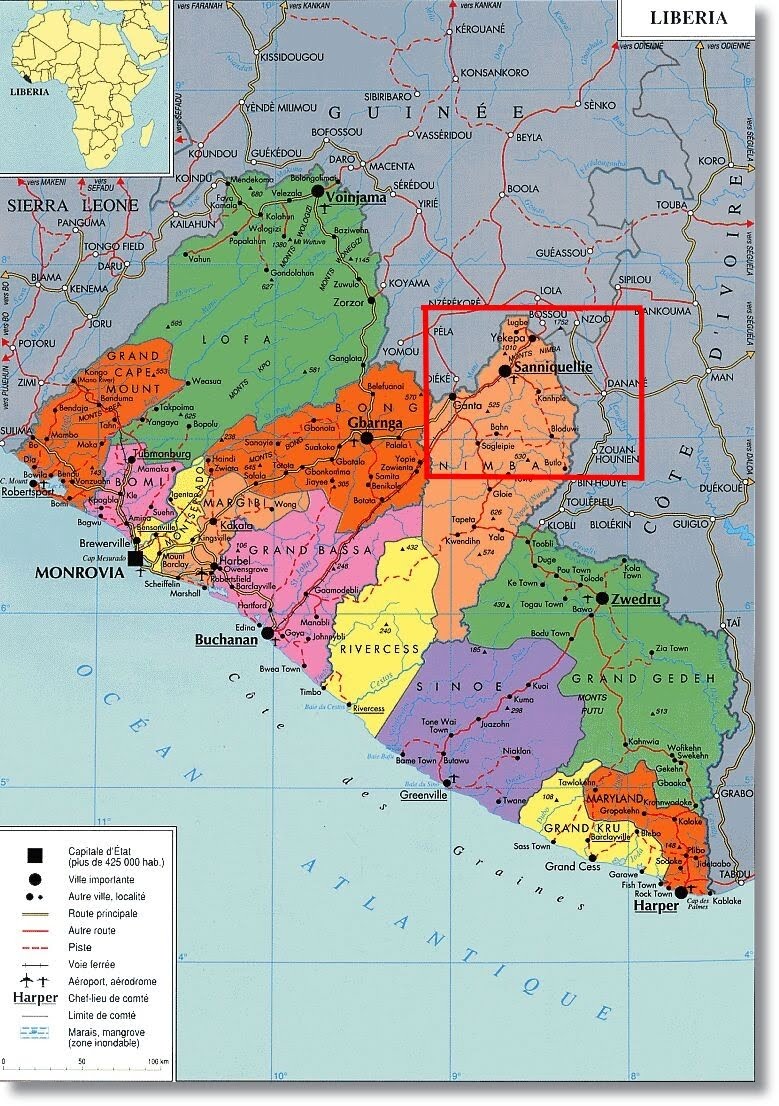
Cote d'Ivoire's 18 Mountains Region, around Danane'. These roads are the main arteries connecting village to town, town to city. In the Northwest region, they are dusty in the dry season, an often impassable in the rainy season.

Some roads, which the locals know so well, are barely wide enough for a single vehicle to pass.

Nice evening shot of one of ACLCP's demonstration farms. Farmers come from all around for training in better methods for a variety of crops and livestock-- including snails and large rodents called grasscutters.


In the neighborhood, boys pounding something. Where's mom? Daily life in West Africa.


The roads never let you rest. While you are trying to enjoy the sights, the jarring and rattling never stops. A trip of more than an hour becomes something of an ordeal.
You never know what you'll face coming the other way. These guys almost didn't make it. Simple physics: the higher you stack the truck, the higher the center of gravity, and the easier it is to tip. Note the guy up top leaning with his arms to his right. He'd be much more helpful if he jumped off.
.

Much of Renita's travels around Danane was in the back of a pickup truck.


It afforded her some over-the-side shots. This wall becomes mud in the rainy season, then collapses together with the wall on the other side, making the road a three-foot deep lane of sticky muck.


Renita, leaving Danane' and heading toward Ganta-- three hours away-- last week. She handled a really dangerous ride with her typical plunge-in style. At one point they had to follow a tanker for miles, throwing up thick dust, at another point they almost flipped on one of Africa's famous log bridges-- the front tire almost wedged between logs.


As darkness falls, one last shot of our intrepid saint, bouncing and banging, sputtering and coughing into the sunset. This is maybe my new alltime favorite picture of Renita. Few shots capture her determination, passion and courage so well.
Monday, November 16, 2009

She's gone, oh, still gone


3 Hours of Bad on a Bike


.
.
.
.
.
If Renita's journey from Ganta Liberia to Danane' in Cote d 'Ivoire was a tiring ordeal, her return trip to Ganta was truly exhausting. Leaving Danane' from long farewell ceremonies, she arrived at the border after a jostling ride only to find there were no taxis at the border. She was in the middle of West African nowhere, it was getting dark, and she was lugging a large suitcase. The only vehicles around were small motorbikes. So for the next three hours, over some of the worst roads we are willing to travel, holding her suitcase with one arm and the bike with the other, Renita traveled the 40 or so remaining miles to Ganta. In the total darkness and choking dust of the Liberian wilderness, stopping and starting through bone rattling holes and bumps, she and her driver bounced on. I'm sure no one needed to tell her how vulnerable she was. In an area where borders don't mean a lot and Ivoirian rebels and Liberian rogues watch the roads, a little motorbike is an obvious target. But she made it. She arrived in Ganta around 9:00pm, filthy, probably a bit angry, and too exhausted to be relieved.
.
When writing about our work, I usually don't focus on us. The work and our activities are not about us. We are not in West Africa to have adventures, though an adventure it has been. When I tell our story, or in this case Renita's story of her battering trip, I'm really hoping the reader gets that this is really just everyday life in West Africa. The motorbikes and taxis are there every day, every night. For Liberians and Ivoirians living in the area, the dangerous, dusty, joint jarring travel is the norm. As proud as I am to part of a work that takes us to forgotten places, sometimes even hazardous places, I remain deeply in awe of the people that live in places like Danane', Ganta, and especially in-between. So many are profoundly resilient, flexible, adaptable, and strong. We are just traveling through, and these places kick out butts (literally). Yet our West African friends call these places home.
.
The five days of workshops in Danane' were successful, as were the many meetings that went late into the night. Renita and the board and staff of ACLCP worked hard at reaching deeper levels of understanding-- sometimes through sharply different viewpoints. When it was over, she had the sense that she had made new friends.
.
As I write, on Monday 16 November, Renita is on the road again-- first the three hour trip from Ganta to Gbanga, then the three hours from Gbanga to Monrovia, where she will spend another week. She'll be meeting with the folks from LEAD, visiting new business sites, and hopefully, getting some rest.

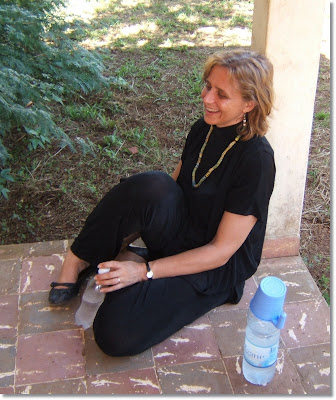
During the workshops, Renita takes a break.


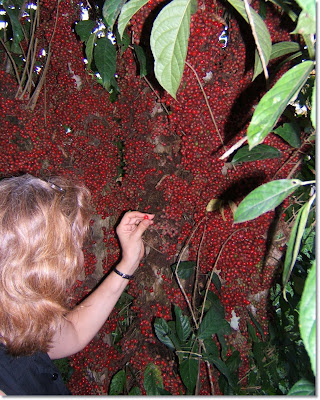
Blue Boy.


I'm unfamiliar with these small, tart, grape-like berries. Any ideas?


The whole team, including the Kollenhovens, a Dutch couple from Canada, and in the green in back, Dea Lieu, director of ACLCP (Roughly translated from the French: Christian Association Fighting Poverty)

This was Renita last week enjoying a motorbike ride from one of ACLCP's board members and a pastor. After her recent nighttime trip to Ganta, she'll never look at these bikes the same way.

Accra Weather: While thunderstorms rumble just to the north, Accra remains dry and dusty. Daytime high typically in the mid 90sF, with a light 10mph SW breeze all day, then temps drop to the upper 70s to lower 80s at night. The breezes are quieter in the evening than in the wet season.

Tuesday, November 10, 2009

Gone! Oh, gone...


She Left Me


.
.
Renita is gone. Left me Saturday. I can't really blame her. I know I'm kind of a bum. Of course, she didn't leave because of that, but I miss her anyway. She's gone for two long weeks, back to the works in Liberia and Cote d' Ivoire. In her role as regional director, she needs to maintain frequent contact with the activities in Ghana, Cote d' Ivoire, Liberia, and future West African Partners Worldwide collaborators. Our jobs both will take us away, individually, about six to eight weeks each annually. Unfortunately, though both of our jobs are regional, we never cross paths. Maybe someday back in Liberia.

This week, she is working in the northwestern hinterlands of Cote d' Ivoire, with her friends from ACLCP. ACLCP provides economic development assistance for the people in and around Danane and the 18 Mountains region. Once a center of Cote d' Ivoire's culture, the West of the country-- now governed by military groups or "rebels" operating under the banner French Nouvelles-- is becoming more stable after the recent troubles. ACLCP is a national NGO dedicated to giving Ivoirians the resources and tools necessary to stabilize communities and families as well.


Danane'

Renita's part is to provide the same exceptional training that has proven so successful in Liberia with LEAD. The trainees will be community leaders, pastors and business people about managing and running a profitable venture. The full days of workshops run from today (Tuesday the 10th) until Saturday. The hitch-- Cote d' Ivoire is Francophone. The national language is French, so the entire training, including handouts, curriculum, visual aides, and power points had to be translated into French. So for the past few weeks that is what she's been doing. My wife, whose French is choppy at best, the French translator/trainer. Fortunately for her voice, a businessman from the states who is fluent in French will join her, plus the ACLCP staff will be doing the hard work of making it practical with follow up.

So back home, we muddle through without the Rock of Red Deer. I'm lonelier without her, but good things happen. I think I've mentioned it before, but when Renita's gone, the three of us seem to draw closer. We seem to look out for each other more. Predictably, we are less tidy around here with Mom gone, but the way we look at it, loosey-goosey is one of the compensations we get for being without her for so long. (Its very nice having Douglas here for three days each week. He covers a multitude of sins.)

Renita heads to Liberia next week, for all day meetings and planning with LEAD, the now model NGO she helped birth. See, she's got family all over the place, so I need to be thankful to get her when I can. Here are some shots of her world.
Biohazard.


Rice. Nice.


In Danane. This hill is probably made of near solid iron ore.


Her host 's homey home.

The workshop opens. Next week, she's back in Liberia.

Extra! This just in! Her first Email!

Hi hon. Hope you are doing well. I got in last night after a loonngg drive from Ganta to Danane. The road was very bad, we had to wait for the taxi to fill up, the taxi had no brakes (thankfully got them fixed on the way), dealt with many immigration stops, had some issues at the border, and then had a very bumpy ride in Cote d'Ivoire. Today's training was okay - about what I expected. Some good things, some frustrating things.

There is a line up for the internet - it's 10 pm now and everyone is weary so I don't dare hog it too long.

Hope you are all doing well. I miss you and love you very much.

Hopefully I can write more tomorrow.

Love,

Renita


Weather: Mid 90sF-- Mid 30sC. Hot and bright Tuesday, less humid with a light breeze from the SW. Nighttime lows in the mid 80sF. Thunderstorms to the north, but very little rain here.

Tuesday, November 3, 2009

Ghanaians

Weather: Had a great rain the other day; it accomplished more in a hour for our garden than what we've been trying to do for weeks with a hose. Daytime temps in the 90sF, nighttime lows around 80F. Variable moderate breezes from the SW, as always, provide relief. Afternoons are sweltering, but mornings and evenings are often heavenly.

Note: Electricity and Internet have been off and on for a week or so, with either being off for up to ten hours at a time. Often, when one is running, the other is not. Thus the blog gets out on Wednesday. Thus is life in developing Africa.


The Way it Feels

It's always tricky to characterize a people or a culture. It is easy to over generalize, to fall into stereotypes, and to apply those generalizations to specific individuals. Just because a people group tends to exhibit a certain characteristic, does not mean everyone in the groups shares it. Not all Italians talk with their hands, not all Russians drink vodka. That said, one cannot help making general observations about a place after a period of time. A place and its people influence individuals living there over time, and an ethos, a feel if you will, is created. All places, all people groups, have a feel.

I like the feel of Ghana. I like the feel of Ghanaians.

For me, there is a contrast between the feel of Ghanaians and the feel of, say, Liberians, with whom I lived for three and a half years. Liberians, coming out of twenty five years of despotic rule which included fourteen years of instability, displacement and war, cannot help but show the effects in their daily lives. Our friends in Liberia were open, even eager to know Westerners, particularly Americans. After a time, we came to see that for many, this extroverted openness had less to do with hospitality than it had to do with the hope that in their western friend, there would be a sponsor of sorts, someone to help fund their daily needs. Liberians (Remember, there are many individual exceptions) as a whole seem to believe that they cannot make it without an other, wealthier party coming in and supporting them. It is as if self reliance has been shaken. We saw this everywhere, from the taxis sporting slogans that said "No Friend, No Money," to most of our neighbors coming to us with requests for gifts and loans, to Liberian officials siphoning off what they could from USAID grants because of their meager government salaries. I think decades of trauma have taught Liberians that tomorrow may blow up in their faces, that even the little they have today might be taken from them. I get the sense that Liberians are more fatalistic than others, that they see themselves at the mercy of forces beyond their control. So understandably, they have learned to schmooze, to adapt, to seize opportunities, and to cut corners.

I get a different feeling from Ghanaians-- at least the Ghanaians in and around Accra. Since independence in 1959, they have built something-- a country-- that has remained at peace with itself and its neighbors. Even the coups were peaceful, by coup standards. The nation is strong, growing, and independent. So are the people. Where Liberians tend to hang on Americans, Ghanaians seem to ignore us. Liberians wanted our help, wanted NGOs from North America to come in. Ghanaians don't seem all that interested in what we have to offer. Its as if they are boldly saying-- and they are right to say it-- "We are doing fine without you, thank you. We really don't need you." Ghanaians seem to believe they hold their future, that they are at the mercy of no one but themselves. That makes me happy. In contrast to what we felt in Liberia, Ghanaians are more aloof, more self-sufficient, more confident, and have a more definite and clear identity in themselves as Ghanaians. They are proud of themselves. I can feel it. Of course, most of our work will not be with Ghanaians, so it works out ok that we are not being bombarded with desperate sounding appeals. But when we do work along side our national hosts, I think it will be less because they need us, and more because they see how we can simply serve the people they serve.

I need to repeat how important it is to avoid applying these general observations to individuals. Many Liberians we met are invested in sacrificial service toward rebuilding their country. We know, because we are working with them right now. By contrast, not all Ghanaians are self-reliant and independent. I'm simply saying Ghana feels different, maybe healthier that another place we've lived. And that, plus that lovely breeze, makes being here a pleasure.

Monday, October 26, 2009

It's a Honkin' Whale!


LEAD Lands a Very Big Fish


The press release was from Washington DC. On September 29, 2009, The United States African Development Foundation www.adf.gov released this headline:
.
USADF Signs Two Grants to Support the Under-Served in Liberia:
Grants Create Jobs, Enhance Quality of Life for Workers


It was big news, and even bigger for our "Little NGO that could," LEAD Inc in Liberia. A grant Renita had co-authored, one of only two approved for the entire country, went to that organization that just five years ago did not exist. The news release went on to say,
"After reviewing the grants, newly appointed USADF Chairman Jack Leslie stated, 'Funding economic development at the grassroots level is vital to USADF’s work and to the under-served people of Africa. These grants do just that – they provide funding that enables grassroots groups to grow and sustain their projects and give them the means to enhance their quality of life.'”

The three year grant is for $246,000 USD and will help LEAD do the following:
· Open two new offices – one in Grand Capemount County and one in Margibi County, bringing the total number of counties served in Liberia to six (other counties served are Bong, Grand Bassa, Montserrado, Nimba).
· Hire six new staff for these two counties, as well as one IT person for the main office, with salaries for these seven positions for 18 months.
· Purchase of new vehicle (Remember our 94 Red Pathfinder and that 2001 gray land Cruiser? These are all LEAD had to use, so now they will finally have something more trouble-free.)
· Purchase a motorcycle for each county to make it easier for the staff to get around to business clients.
· A little over half of this grant ($125,000 USD) goes toward LEAD’s revolving loan program. LEAD has three loan programs:
-- Providence Empowerment Initiative (PEI) designed for microbusinesses who have been in existence for six months are given a two day training, save in groups of five businesses, and start with a loan of $100 USD; upon successful completion, they can go to a $200 loan, and then to a $300 loan;

-- Nehemiah Empowerment Initiative (NEI) designed for for small and medium size businesses (SMEs) who go through a 36 hour training over the course of 12 weeks, saving for six months, and then receiving a loan for $300-$1800 US depending on their savings. (Graduates from the first program can move up to this program.)
-- Agricultural Empowerment Intiative (AEI) designed for agricultural development and is a new program that will be be launched with this grant.

The majority of the funds given from this grant are for the microbusiness loan program, and a much smaller portion for the agricultural development. Up until this time, all loan funds donated have been for the second loan program and we have been borrowing from this loan fund to help grow the micro businesses to the SME level, so this will provide great support.
· Some funds are also given for training, equipment and other supports.

A big question is how many people will be impacted by this? It’s difficult to say. The beautiful thing about this work is the idea of leverage – if we help one business, that business often supports many people – if the business owner employs three persons, and each person is responsible for five family members, that means that 15 people are now being helped with food, school fees, medicine, etc. What's more, the money that is given for loan funds gets used again and again. It goes out, comes back, goes out again, supporting, returned, supporting, with no reason to end. LEAD has trained over 1300 businesses and given out 1000 loans, so the people impacted already are potentially 5000 and multiplying exponentially.

Please keep this in your prayers as “to whom much is given, much is required.” It is always a challenge in places where poverty abounds to make sure every dollar goes where it is intended. Pray that the staff may be able to handle these additional responsibilities.
.
Weather: The hot season is looming, and temperatures are on the rise. Daytime temps in the 90's with evenings cooling down to the upper 70's to low 80's. SW Breezes are diminishing a bit, but still in the 10 to 15 mph range throughout the day.

Monday, October 19, 2009

Two Months In


ReedNews Update: October Edition


Weather: Monday begins with heavy overcast and 77F. The weekend was hot and sunny, with daytime highs around 90F and nighttime lows in the upper 70sF. Breezy, with winds most of the day around 15mph, gusting to 20 or so. Today will turn to partly cloudy by noon, then likely clear up by sunset. Temps will be cooler all day, but humid, with highs in the mid 80sF.

The Reeds have hit a normal stride, and I think its fair to say the four of us have adjusted quickly and well to life in Accra, Ghana. We like Ghana. There is a certain pride Ghanaians take in themselves as Ghanaians, and a certain pride they take in the accomplishments of their country. Here is what's been happening on the home front:

Work-- Renita and I have signed a consulting contract with a Ghanaian NGO called Theovision. Theovision has received international recognition for their work in translating Christian scriptures to many language groups throughout Africa. Our work would be in community assessment and in capacity building. In other work news, we'll be traveling more into Ghana soon, then Renita goes to Liberia and Cote d' Ivoire in month, then further out I'm off to Mali then Nigeria.

The Kids-- Even though they don't like to admit it, both Hannah and Noah are doing well here. Both have made good friends and are active with groups every weekend. Hannah especially misses friends back in the US, but when the internet is up, she takes full advantage of Skype and Facebook. Three of us have Facebook pages-- Renita is almost ready to take the plunge.

Utilities-- This last week prepared us for the long hot season. Electricity was out nearly every day for an hour or so, and Sunday we were sans juice for about six hours. It would come on for ten minutes then shut off for an hour, come on for thirty minutes, shut off for another hour. We do not have a generator as of yet, but methinks we will need one soon. As for water, well, we've been getting by ok. The water from the city is often off for a day or more, but with our tanks, we can operate as normal. If the water is off for several days, we need to call in a tanker to fill us back up. Every once in a while, I send Hannah up the ladder to see how much is left in the tank.

Fo
otball-- Soccer is big in Ghana-- really, really huge-type big-- so Friday was loud in the streets after Ghana's "under 20 team" beat Brazil for the U-20 World Cup. We watched on TV, and every time something good happened, we could hear the neighborhood react. It's fun, and even though we never cared much for soccer before, we are getting in to it now. Attention is now on the 2010 World Cup-- the big one-- in South Africa. And both the USA and Ghana are in the 32 team playoffs.

Mutts-- All three are doing fine-- and they are barkers! As you may recall, Dusty almost died a while back, but after constant care she turned the corner a few weeks back and is now fully recovered. At her sickest she weighed 3.7 pounds (down from about 10), but she’s almost up to her previous weight now. She’s certainly the Alpha around the dog dishes. Faith and Jack each outweigh her by 15 pounds, but neither dares mess with her.