Monday, April 26, 2010

Widowhood Rites - not Rights

[One of the things that Bob and I have strived to do with this blog is to present a fair and accurate picture of West Africa, as much as that is possible for a couple of outsiders to do. When I wrote a few weeks ago that I wondered if I could do the blog without Bob, many of you interpreted that statement as my questioning my ability to handle the grammar or word choice, but in actuality, I wondered more about having a sounding board for the content we present. We never want to misrepresent West Africa, making it look better or worse than it is, promoting negative stereotypes or giving unhelpful information. This is one of those blogs that I feel like should be written but I wonder about how it will be received. This is the blog for which I need Bob’s feedback. We would debate it back and forth over the course of the week, finally coming up with something agreeable to both of us. Of course, we know that we will misrepresent West Africa. It’s impossible to not. It’s made up of too many countries, people groups, religious groups, cultures, etc. It’s too easy, especially for those who have never been to Africa, to paint the entire continent with one paint brush. So I ask you to read the following entry and pay special attention to the qualifying and quantifying words. Thanks.]

Two days after returning to Ghana, I was informed by a Ghanaian that culturally, if a husband suddenly dies, it is typically assumed that the wife had something to do with it. I immediately felt sick to my stomach. I recalled the six witch camps in the northern part of Ghana filled with hundreds of women who have been assigned blame for bad things that have gone wrong in their village and have been exiled to these camps. Soon after that conversation, I was speaking to someone in Cote d’Ivoire and asked him if that was a practice that he found in his area. He indicated that his tribe does not do anything like that, but a tribe not far from them will fine the widow a large sum of money if her husband dies, because it is assumed that she was not taking good care of him, and the extended family has now lost a source of income. (The sum mentioned could be around $10,000 US.) I then emailed several Ghanaian-Americans to ask their opinion; they quickly informed me that I should not worry about it and should disregard that information. I accepted their advice, but was still curious about the statement and the possibility that Ghanaians would view me in that light. So I decided to do a little research.

I discovered that the advice I received was correct – the information that I received can be disregarded for me as an American, but I also discovered that practice of widowhood rites (rituals) does exist for some Ghanaians, although it does vary based on the individual family, religious beliefs, education, and the relationship between the widow and the in-laws. The reasons for these widowhood rites range from love for the man to the obedience of tradition. I also discovered that Ghana is not alone in this practice – it happens in many countries. In fact, it wasn’t that long ago that women were being accused of being witches in the US either (Salem witch trials). However my focus was on Ghana and in my searching I came across a research paper that was based on the greater Accra area. The widowhood rites practices described can be applied to both men and women, however research shows that it’s rare for men to be subjected to them. These practices can be in violation of the widow’s human rights and there are attempts being made to raise awareness and lower the incidence of these practices.

Some of the widowhood rites are listed below, although variations within each do occur:

· Period of one year is observed for mourning the dead. During this year, the wearing of black clothes is observed; during that year the widow is not supposed to remarry and/or have an intimate sexual partner. At the end of this year, a memorial service is held in which the widow wears white to signify the end of the mourning period.

· Period of confinement in which the widow is kept in a room for a number of days or even weeks. The time she may come out is restricted to one time during the early hours of the morning when she comes out for a bath. The widow is made to use a stone for her pillow. The period ends with the widow being brought out to bathe with the ghost of her husband in the presence of his family. Two buckets are there and after the bath, the period of confinement is over.

· Drinking the water that was used to bathe the corpse in order to prove innocence.

· Sleeping with the corpse through the first night to show that the widow really loved her husband while he was alive.

· Crying loudly most of the time until the husband has been laid to rest. If the widow does not cry, it will be induced or forced by the family by putting pepper or some hot ointment in the eyes.

· Heckling of the widow after the burial to help the family relieve some of the pain of the loss. In most cases someone strangles the neck of the woman from behind with a cover cloth until someone from the widow’s family comes to her rescue.

· There are also reports of being forced to marry the husband’s brother, having their children taken away, and a loss of inheritance in the home and possessions.

I resumed teaching the business class that I started just before Bob’s death and this past Wednesday our topic was Biblical worldview versus cultural worldview. The 45 business owners in the class were to get into small groups and go through a number of topics: wealth and money, sickness, success and failures, women, work, time, spirits, freedom, death, etc., as it relates to the dominant cultural belief; later they were given Bible texts with which they were to compare and contrast the Ghanaian cultural worldview to the Biblical worldview. While a number of Ghanaian cultural worldviews lined up with the Bible, a good number did not (as is the case in most cultures). Specifically, sickness, failure, and death are almost always attributed to a curse or bad spirits. I informed them of what I learned regarding how I might be viewed regarding Bob’s death, were I was Ghanaian, and the room erupted as they were very surprised that I knew about that and they laughed at themselves as it relates to that belief. It was good for me to get that out in the open. I was able to contrast that with the American culture which does not seem to believe at all in Satan or the powers of darkness and therefore we need to explain everything very scientifically. One man shared the following story,

I had put in a bid for my company to receive a government contract. After my bid was submitted, I started getting sick. I believed that others who had also submitted a bid for that same contract had put a curse on me, so I went to my pastor and others and we began praying in earnest against that curse. I received the contract.

My response to him was that it seems that a blend of both cultures might be in order – both praying against(and acknowledging) the powers of darkness as well as exploring potential medical causes. He then added this to his story:

That’s very true. After I received the contract, I still remained sick. After a while, my friends encouraged me to see a doctor and I discovered that I was allergic to a particular food. I cut that food out of my diet and wasn’t sick again.

As I continue through this period of grieving, I am aware of how blessed I am in not having to fear retribution or punishment for Bob's death. My heart goes out to the many widows who do bear this burden throughout the world.

(Pictures below from www.geographical.co.uk/Magazine/Witches_of_Ghana_Aug_06.html)

Ma'Asana Mahana, the head outcast in the Gambaga Witch Camp.

Yahaya Wuni, chief of Gambaga. An earth priest, he performs the ritual that decides if women are witches. The camp is on his land and the women work in his field and provide him with firewood.

Friday, April 16, 2010

A Reed Family Update...of sorts

Saturday, April 17, 2010

My dear,

Saturday marked four weeks since you were last with us. Much of the time it still doesn’t seem real. It seems like just yesterday you were sitting here with me, having coffee, talking about our day, processing your trip, catching up with each other. It seems like just yesterday you were making your regular Friday pizza. It seems like just yesterday I was washing your clothes, cutting your hair. Is it all really over? Never again?

The house is so quiet. No loud singing coming from the shower…no “Hey Renit” coming from various rooms in the house…no exclamations of “jes drippin’” throughout the day as you sweat. Mornings are the worst as Hannah, Noah and I are all exhausted and don’t have much to say. You always helped us wake up in the morning, making the kids breakfast, singing your wacky songs.

The kids started back at school on Monday. They are emotionally drained and trying to catch up from two weeks of missed classes, which isn’t easy. [And I know you'll appreciate this, to top it off, it’s 96 F with a heat index of 108 F and the air conditioning isn’t working at the school.] The three of us have pulled close together which has been great – I only hope it lasts. We are doing a grief journal each night, which helps the dialogue a bit, but they so need you here now to help them process this. Noah is trying to be strong – his finished his meds for staph and so we are now just waiting to see if any new spots appear. Hannah is also trying to be brave but is getting angry at the “elephant in the room” that is so real to them but that most other people don’t notice. She turns 17 next Sunday - it's hard to believe our little girl will be seventeen. It's even harder to believe that you won't be here to celebrate it...or her 18th birthday...highschool or college graduation...wedding...

There are so many “I wishes” that I go through each day. I wish you could have heard the testimonies given on the impact that you had on peoples’ lives at the memorial service, in person, by email, cards, letters, comments on the blog. Do you know that a blog reader from Australia sent you flowers? That notes of condolence were received from over 20 countries? Did you hear your brother, Don, and your Uncle Lloyd say how proud they are of you?

I wish I had known how close the end was – I would have looked in your sweet brown eyes and told you I love you and helped you leave this world, instead of helping the nurse try to make you more comfortable. Did you feel alone in that moment?

I wish I knew for sure what you were experiencing right now…after all the conversations that we have had about dying. But then we wouldn’t call it faith, right?

I wish we had bought an air conditioner for you so your last few days would have been more comfortable.

I wish you had a chance to make that dish that you were so excited about when you came home from Nigeria – Bobotie - we still have all the ingredients in the house but I just can’t bring myself to make it without you here to eat it.

I wish…I wish…I wish...

I can’t put anything of yours away yet. I know I’m choosing to remain in denial but I just can’t do it. Your shoes are still by the door, waiting for you [of course, I put them by the door from where they had been kicked off in the middle of the room, but I digressJ].

Remember how many times you said to me about various things you do, “You’re going to miss that when I’m gone.” You are so right. What I would give to have one more day…one more hour with you. To think that I won’t have that chance on this earth is unbearable right now.

I love you.

me

ps - I have to admit that the camera has gathered some dust. I haven't been in the mood to take pictures, even though I've heard your voice telling me to; but I did find this great video clip of you and Noah...[Subtitles: You don't know what it's like; you don't know what it's like; to love somebody, to love somebody, the way I love you. (Lyrics from the Bee Gees)]


Sunday, April 11, 2010

To blog or not to blog...

Since Bob's death, many people have asked me whether or not we will keep the blog going. My first reaction was to say no. Bob was a unique, gifted writer. Neither I nor the kids could continue the blog in the same gifted way. Not to mention that the amount of time Bob put into the blog would put an added stress on an already stressful situation while I assimilate the role of single parent and missing my husband/best friend/partner in ministry.

But in this last week, I've been rethinking that initial response. First of all, Bob didn't start the blog because he was a profound, provocative, pithy, and poignant writer. He simply started it to stay in contact with friends and family when we moved to West Africa. The blog became an encouragement to him as he tried to see things through the eyes of folks back home. It made him feel close to people while being far away.

I could use that feeling of closeness right now and I believe that many of you would like to stay in contact with us as well. And if it is an encouragement to me, I know it will become a priority to find the time. It probably will be therapeutic for me as I will probably spend a chunk of time processing Bob's death.

But I continue to struggle with the question of whether I'm able to write or keep people interested. And then I hear Bob's voice, "Stop apologizing. You're a good writer." He said those words to me a week and a half before he died. I had written the two blog posts while he was in Nigeria. In that first post, I gave a disclaimer for my writing. He chastised me for that on the phone that week and told me I shouldn't do that again for the second blog. So, I hear his voice encouraging me to do this. Of course, I would want to remind him that I usually edited his writings, as he did mine; posting something without his filter will make me a little nervous. [Side note - the night he came home from Nigeria, he took issue with me for the titling of that first blog, "What is Poverty". We spent about 1.5 hours that evening debating this - he said that question was akin to asking "Who is my neighbor?" in the sense that it could be viewed as a way to get out of our responsibility by trying to define it too closely. He was thinking of writing a blog on it, so I thought I'd pass that on. I will miss those daily debates but have learned to look at word choice very seriously.]

So I will try to keep the blog going - the kids promise to write now and then as well. I know that this change of writers will mean that some of you will move on - I fully expect that and it is okay. The truth is that the Reeds have been shaken violently by the Wind...but there are three of us still desiring to follow that Wind, blowing where it will.


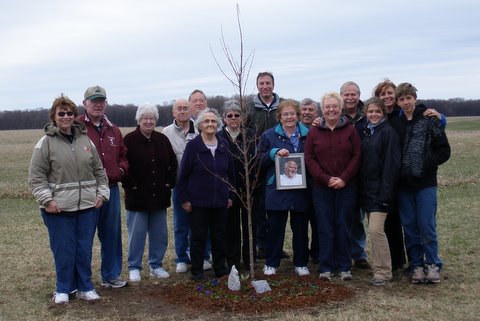
Bliss, Michigan - Wednesday, April 7, 2010: A place by Mackinaw City where Bob spent many of his summers growing up. As a family, we spent many summers camping at Wilderness State Park and visiting Bliss. Bob's Uncle Lloyd has a place there in an open field that Bob loved. Near to this field is a batch of trees, full of birds in song. He had said to me many times that he hoped that some day we could live in one place long enough to watch a tree grow. So we decided to plant a red maple tree in that field and bury his ashes there. In this picture, Hannah, Noah, and I get to work on digging the hole for the tree, while Bob's brother Don and brother-in-law, Dave, watch while willing to give wise guidance.

A picture with the tree. Bob's mother is holding the picture; Pastor Dave is behind her, and the surrounding people are members of Bob's extended family. It seems a little odd that we are standing there with such big smiles, but Carolyn (in the burgundy coat) had a tough time getting the camera timer to work, so we had a good laugh. I think Bob would have chuckled as well.

[This blog can be sent to you every week by email. If you would like that option, please email us at reedsinthewind@gmail.com and put "Subscribe" in the Subject line.]

Monday, April 5, 2010

Memoirs

In times like these, when words don't come easily, others are able to articulate what many of us feel. I asked Hannah and Noah to write something several days after Bob's death. Their thoughts are below. Also, two poems have been sent to me by members of our home church, Madison Square Christian Reformed Church, who knew and loved Bob. They have given me permission to share them with you. Hannah, Noah, and I will return to Ghana this Saturday; your continued prayers are appreciated.
Bob as a baby

Noah: Wow, I can’t believe this. As many of you know my father, Robert Allen Reed, passed away on Saturday March 20, 2010. It’s a day that will haunt me forever. I didn’t know anything was even wrong because I was still asleep when they left. Then someone came to our gate and said he was told to bring us to the hospital. At this point I knew that either something was very wrong or he had died. When we arrived at the hospital my mom greeted us, in tears and told us that he had died. I was stunned. I had braced myself for this but I was not ready at all for it. I had to see his body for myself. I can’t put into words what it felt-like looking down at my dad whose normal spark of life was gone. I don’t know what I am going to do without him. I wish I had spoken to him more, told him I loved him more. The day before he died, Friday night, he came into my room at 4 am to get his computer. He said to me; “Noah, I really love you, you know that? I wish we could spend more time talking to each other”. Now that he’s gone, I am thinking about this a lot.

Dad, I too wish I could have spoken to you more. I miss you so much. I don’t know what we are going to do without you around to mess around and guide us. I never told you but I bet you knew that you were my hero. You were the person I could always rely on and look up to. I feel that even more now, as I see how many lives you’ve touched and how many people care. You were a strong Christian too; I could go to you whenever I had questions or doubts. It’s definitely going to be hard without you dad…I miss you so much and love you so much, I hope you are having a great time in your new body in heaven. Good-bye for now, I will see you soon.


Hannah: Robert Allen Reed. To those in Liberia he was Uncle Bob. To his bloggers he was Yers Trooly. To countless others he was just Bob. To me, he was Daddy, and he was the best daddy a girl could ever ask for. I was very blessed, growing up, to have to loving, intelligent, faith-driven parents who taught me about God and about life, from many perspectives. My dad was a professional counselor and as such, he always knew when something was bothering me and he was always there to talk through it. Although that majorly annoyed me when I just wanted to stay ticked off, I really love that. He would pull me into his ‘office’, a.k.a. his bedroom, sit me down, and 9.7 times out of ten, I would come clean. I got along so well with my Dad. He was so funny, walking around the house, yelling out a song or a quote from a movie, typically with his own spin that made it hilarious. I was always impressed with how smart he was. He was one the smartest people I’ve ever known, if not the smartest. Dad was the go-to guy. He knew it all, but he always said don’t ask him for help in math cause he just couldn’t help with that (I don’t blame him, math isn’t my favorite either. Not by a long shot). But almost anything else, if you asked him, he’d either know the answer or he’d have one after some time. He also applied that intelligence to his faith. He was so grounded in it, he didn’t base his faith on emotions or on others’ opinion, but he thought it out, learned all he could, read thick books about faith and God. He knew why he believed what he believed. I admire that so much about him, because so many times people will ask questions that I just don’t have a ready answer for. But another good thing was he was also ready to accept that he doesn’t know the answer and just go on faith. My dad was a great man. I love him so much, and that will never change. I am happy for him. He’s celebrating, and learning even more and just having a great time. But I still miss him, and will always love him.

Daddy, you are an amazing man. I love you so much, and I’m happy that where you are there is no sickness, no pain, no suffering of any kind. You are very missed here already, by everyone you came into contact with. Thank you for your love and guidance. It made me the person I am today. There will always be a place in my heart that belongs to you, and no matter how many years pass by that will not change. I love you forever, I like you for always, as long as I’m living, my Daddy you’ll be. I love you.


For Robert Allen Reed
1954-2010
(by Dorwin Gray)


The desirable life is...
To be emulated, not exalted.
To exhibit the possible,
in the exercise of faith.
To exemplify candor in compassion,
kindness in correction.
Truth in love.
Love above all.
To be one, through which, the One
loves the many, without reservation.
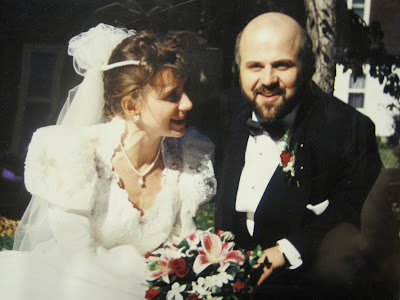
[Bob as a young man...yes, that is his real hair! ]
Goodbye
(Written Tuesday, March 30 by Michael Thomson)
Sometimes the presence,
In quiet voice,
In mystic song,
Will gently convince,
A gentle breeze,
A tranquil ghost,
The sweetness of incense.


Sometimes the numinous,
Like thunderclap,
Like avalanche,
Will openly discuss,
A blazing light,
The shaking soil,
The truth can be as thus.
Sometimes there is a Type,
That shatters glass,
That peels the skin,
And such will take a swipe,
Not suffering fools,
No nods to lies,
But every tear will wipe.


Sometimes there is a man,
That breaks the mold,
That loves his Lord,
And makes a loyal stand,
With healing words,
With stinging salve,
Yet he seeks to understand.


Sometimes there is a friend,
A soul-mate to one,
A father to two,
The life that he did spend,
Painfully brief,
Fully poured out,
A parable that will portend,


The way,
The truth,
The life,
The love,
The greatest of these is love.


Goodbye Bob,
Until.


October 20, 1990


Thursday, March 25, 2010

Obituary for Bob Reed

Dear Friends,

Hannah, Noah and I leave tomorrow (Friday, March 26) for Grand Rapids. It will be so good to get home and be with family. This week would be difficult for anyone losing a spouse, but the added complications of handling death arrangements while being an American in West Africa has made it even more difficult. But the body of Christ has really reached out to us here (especially in the person of Laurie Korum, a dear sister in Christ who is also a nurse at the US Embassy in Ghana) but we long to be with family and friends in Grand Rapids. We have felt the prayers from many people around the world and want to thank you for your kind words, encouragement, and support.

I wanted to correct something from the last blog I wrote relating to the cause of death - it turns out that Bob did not die from a pulmonary embolism as the doctors had believed; rather it appears instead (although the facilities are not here to determine it conclusively) that the Staph infection had invaded not only his lungs (as I had suspected), but also his stomach, liver, and spleen...resulting in Multiple Organ Dysfunction Syndrome. For those of you who like to know the details, the full name of the type of staph infection Bob had is Methicillin-Resistant Staphylococcus Aureus (MRSA) and it is known as the "superbug". MRSA is a bacterium that is resistant to a large group of antibiotics and is responsible for the death of 18,000 Americans annually. The fact that he was fine Friday night and had no fever at all, in my limited medical knowledge, can be explained by his immune system completely shutting down, allowing the superbug to travel and multiply freely.

Additionally, for those of you who do not live in the Grand Rapids or Lansing area, I wanted to pass on the obituary that will be in the newspaper this Sunday:

Robert "Bob" Allen Reed, age 55, a child of God, went home to be with his Heavenly Father on Saturday, March 20th, 2010 after a sudden illness in Ghana, West Africa. He will be lovingly remembered by his wife of 19 years, Renita (Kranenburg); children, Hannah Adriana and Noah Allen Reed; mother, Lucille & stepfather, Keith Mosher, his brother, Don (Carolyn) Reed, his sister, Sandy (Rick) Dingwell, his brother, Steve (Patricia) Reed, his brother, Bryan Reed as well as his father & mother-in-law, Pastor Peter & Marrie Kranenburg, many other brothers and sisters in law, nieces and nephews, and friends around the world. He is preceded in death by his father, Floyd Allen Reed and his sister, Brenda Beck.

Bob was born on August 9th, 1954 in Lansing, MI where he graduated from Everett High School. In November of 1975, he gave his life to Christ and went to Moody Bible Institute, where he received his B.A. in 1980. He then attended Azusa Pacific University, receiving his Masters in Student Development in 1986, and Michigan State University, receiving his Masters in Counseling in 1992. He worked for fifteen years as a counselor at Calvin College, established the Madison Square Counseling Ministry in 2002, and then followed a call from God to move to West Africa, working with the Christian Reformed World Relief Committee (CRWRC) addressing peace building and conflict resolution, justice and advocacy, and mental health issues.

His greatest earthly love was his wife, Renita and his children with whom he shared his call to travel from Grand Rapids, MI to Monrovia, Liberia to Accra, Ghana and now, he has arrived at his final destination that of being home free with his Lord and Savior, Jesus Christ.

A memorial service to celebrate his life will be held on Tuesday, March 30th at 7 pm at Madison Square Christian Reformed Church (1441 Madison SE, Grand Rapids, MI 49507) with Pastor David Beelen officiating. The family will receive relatives and friends at 6 pm. Memorial contributions may be made to a memorial fund for funeral expenses and the education of Hannah and Noah Reed (c/o Partners Worldwide, www.partnersworldwide.org ) or to the West Africa Ministry Team of CRWRC for their ongoing work (www.crwrc.org); please place "In Memory of Bob Reed" in the memo section.


Hannah and her Daddy, in 2005

Noah and his Dad at the silent retreat last year, 2009

I thank God for the 19 years I was blessed to have with my best friend and partner.


Monday, March 22, 2010

Robert Allen Reed, 09 Aug 1954 - 20 Mar 2010


I can’t believe I have to write these words. It’s difficult to even get my fingers to move on the keyboard. My dear friends, “Yers Trooly,” Robert Allen Reed, passed away on Saturday, March 20, at 2:00 pm GMT, of a pulmonary embolism. He came home from Nigeria on Thursday evening, feeling great. He had so enjoyed the workshops that he had facilitated there, with Christians and Muslims, talking about one of his favorite topics: peace building and conflict resolution. It felt like such a key time for him to be there with the recent conflicts. This past year had been a little dry for him, with being in the US, moving and getting set up in Ghana, not really having any connections in Ghana. This trip to Nigeria seemed to breathe new life into him. I was thrilled to see him so animated.

As you may remember, he had been battling a staph infection on and off since September. Privately, we called this his “year of pain” as it seemed to be one thing after another for him – infections, bulging discs, malaria, bursitis, etc. While the staph infection had given him a break in Nigeria, for some reason as soon as he came back to Ghana it exploded again, and Friday evening I counted seventeen painful sores on his head. But he repeated to me that he wasn’t angry about being sick again – he was embracing this year of pain as something from God, learning what he can from it. Saturday morning he informed me that he was feeling very uncomfortable – his head felt like it was on fire and it hurt for him to breathe deeply. Fearing that the staph infection had moved into his lungs, we decided to go to a clinic. But it was very difficult for Bob to get out of bed – he was not getting oxygen and kept saying he would pass out if he got up. We finally got him in the car but on the way his speech started slurring and his lips turned blue. We rushed to the hospital instead. Once there, they got him on oxygen, did some lab tests confirming staph, and concluded that it was staph pneumonia, even though he had no fever nor did his lungs sound congested. They started him on antibiotics; about an hour later he started complaining of severe chest pain and started fighting to breath. The doctor again listed to his chest and suddenly heard what he thought could be a pulmonary embolism. They immediately gave a shot to dissolve the clot, but about thirty minutes later, Bob passed away.

Hannah and Noah were brought to the hospital by a friend, where we all were able to spend some time crying and saying goodbye. One of the Reed family traditions is that when anyone goes on a trip, we all gather around that person, lay hands on them and pray – we had just done that two weeks earlier when Bob left for Nigeria. At Bob’s bedside, Noah said, “This is just another journey that Dad has gone on. We’ll see him again.” So we laid hands on him and prayed.

We know that he was received into the loving arms of his Savior with a loud exclamation of, “Well done, thou good and faithful servant.” We know that he is having the time of his life exploring heaven, meeting many saints, asking many questions of people who have gone before him, and probably getting into many debates. But we also know that his time here was too short. There was parenting still to do, partnering still to do, and ministry still to do – all of it in a way that could only be done by Bob Reed.

Why did this happen? I don’t know and can’t afford to go there right now, except to acknowledge that I trust my Father in heaven – who loves me and my children more than Bob did. And He loves the people of Liberia, the people of Nigeria, the people of Madison Square Church, our neighbors from Prospect Street….so we have to trust that even though Satan may have meant this for evil, God will use it for good. Whether we see that or not, I don’t know.

To those of you who have been faithfully reading his blog, I’m sorry for your loss as well. He loved you and doing the blog was a very important part of every week for him. Thank you for your faithfulness in reading and encouraging him through this forum.

Memorial Service celebrating Bob’s life will be Tuesday, March 30, 2010, 7:00 pm, at Madison Square Church in Grand Rapids, MI.

Monday, March 15, 2010

More from Renita

Poverty Eradication Myths
Bob returns from Nigeria on Thursday. Today he is beginning his third round of workshops, this time in Makurdi which is about 250 kms south (or so) of Jos. Overall he seems to be doing well and enjoying the dialogue with those he is meeting. He had one chance to get online since leaving and left the following post on Facebook:

Bob Reed In Jos now. A sobering place, so many angry people. Our workshop on justice and conflict was fitting, and we had many lively conversations. Curfew dusk to dawn. Visited the villages and areas where so many lost their lives. The city is tense as rumor fly each night about more coming attacks. Picture is of the parsonage of the church Renita and I attended while here in 2008.


We are thankful to God that there has been peace in Jos but continue to pray for wisdom as fingers are pointed and rebuilding begins.

The rest of the family is doing well in Ghana. It’s been a little cloudier recently and the breeze seems to be picking up again, so we have hope that the rainy season (and a break from the heat and humidity) is on its way.

I want to add one more piece to the “What is Poverty” piece from last week. I just finished the book, Out of Poverty by Paul Polak, who talks about “Three Great Poverty Eradication Myths” that I wanted to share. Just as last week I commented that there are more questions than answers, we can’t help but look for answers and we all know that people have been talking about this for decades. In this book I found three responses to poverty that this author claims do not work…unfortunately, no answers here either (although I do like his approach – you have to read the book for thatJ).

1. We can donate people out of poverty. This is something that has been discussed over and over again, but we tend to continue going back to this method. Mr. Polak writes, “To move out of poverty, poor people have to invest their own time and money. The path out of poverty lies in releasing the energy of Third World entrepreneurs. The good news is that the small-acreage farmers who make up the majority of dollar-a-day people are already entrepreneurs and they are surrounded by thousands of other small-scale entrepreneurs operating workshops, stores and repair shops. All these entrepreneurs are willing and able to invest in creating their own wealth if they can gain access to opportunities that are affordable and profitable enough to attract them.”


2. National Economic Growth will End Poverty Polak writes, “If sustained economic growth does end poverty, how is it that India and China, two developing countries with admirable sustained growth rates, still have some 575 million people who live in extreme poverty, most of whom also experience hunger? It is because most of the poor people in the world live in remote rural areas that will likely continue to be bypassed by successive waves of urban-centered industrial growth…But it is economic growth in remote rural areas on one-acre farms where poor people live that we need, not generic per capita GDP growth that takes place primarily through industrialization in urban areas.”


3. Big Business will end poverty. Mr. Polak writes, “…twenty-five years ago, poverty workers saw multinational corporations as evil oppressors of the poor, and business as the enemy. Now many see them as white knights ready to slay the poverty dragon…But a multinational corporation is inherently neither of these. It is an organizational structure for doing business. If most multinationals continue to operate the way they do now, the belief that big business will end poverty will remain nothing more than a tantalizing myth…Very few multinationals know how to make a profit serving customers who survive on less than a dollar a day, who may be illiterate, and who have no access to mass media…To make an impact on poverty, big business has to learn how to provide affordable goods and services capable of increasing the income of very poor people, do it in volume, and make a profit doing it.”


Women in Danane, Cote d'Ivoire, working with coffee beans.
Rick Slager and Dea Lieu do a little bridge repair on our way
to the border of Cote d'Ivoire and Liberia.

Monday, March 8, 2010

What is Poverty?

[As Bob is traveling to Jos, Nigeria, I (Mrs. Yers Trooly) have been assigned to write the blog for the week. While in the past, it would leave me feeling inadequate, I have now realized that the role I play in the blog is to help you look forward to his return:-). Please pray for the situation in Jos, as the massacre yesterday has left tensions very high. Please pray for peace.]

One thing I love about the work that I am involved in is that it continues to challenge me by offering more questions than answers. I am realizing that I am not the type of person that could work in a job with much routine or predictability. I just completed 20 days with seven North American guests, taking them through Ghana, Liberia, and Cote d’Ivoire. It was great to travel and converse with them as we spent many miles on the road together.

One of the conversations in particular has stayed with me. On the way to Gbarnga, in Liberia, James Nowell asked the question, “How do we know when there has been enough intervention for poverty reduction?” This started a long conversation/debate that continued on and off for the rest of the trip. Here is an example of what James was referring to: as we drove by a village, we saw a young boy playing with two rusty cans and a piece of string. My heart immediately went out to him as I thought about all the nice Fisher-Price toys that my children played with…but then I also immediately realized that he was probably happy playing with that toy. So how do we know where to intervene and when… when is enough, enough…and when are we beginning to impose our (Fisher-Price) culture on someone else’s who may understand contentment better than us?

We concluded that Maslow’s hierarchy of needs comes into play – every human being should have food, water and shelter…but then we struggled with what those words mean. Should every human being have meat in their diet every day or is some form of protein enough? What does “access to clean water” mean – does it mean it should pass every water test, or is a closed well that kills most things good enough? Is a mile from a home too far for a well? And regarding shelter, is a mud house with a thatch roof the standard? Or should everyone at least have a zinc roof?

And what about health care? Education?

Just as I came to a conclusion about a toy, the same could be said about food. For example, in Cote d’Ivoire, Rick Slager and I were walking with Dea and Pastor Dah through a market when we saw something strange being sold. When asked, Dea said, “Oh, that is our manna.” When asked further, he explained that those are termites – there is a time of year when the rains fall and the huge termite mounds begin to cave in and the termites all fly out. Somehow people know this and at four in the morning they will gather and by flashing a light, they are able to collect millions of these and then fry them, dry them, and salt them for a tasty snack. Should we pity the family feeding termites to their children?

We then debated that all these things could be up to individuals to decide should they all have meaningful labor and access to work. Then their individual initiative and work ethic would decide what type of food, shelter and water to have access to. But then we ran into debates about meaningful labor…..

You get the picture. Lots of driving…lots of talking…lots of questions…not a lot of answers. The fun thing about this trip was that it was not all North Americans doing the talking because everywhere we went we had Liberians, Ghanaians, or Ivoirians with us.

One thing we are convinced of is that the goal is not to create mini-Americas.

Upon our return to Monrovia, we picked up a newspaper and found the following piece, which again left us with more questions than answers:

Letter to God with Festus Poquie

(published in The New Democrat, Friday, February 26, 2010)

I’m Poor, Waiting to Enter Your Kingdom

Dear Father,

So many things are happening in this Your Creation that I am no longer in the position to understand. Frustration is not the word. Try despair and anger. And if I cannot understand them, then why should I bother You, Almighty, with endless complaints?

I am very much aware of the many burdens on your shoulders such as caring for the people of Haiti suffering from the after-effects of some of Your curses – the earthquake, for I know that only You are capable of throwing such calamities on man or ending them.

Perhaps it is due to that country’s every-backward slide into the past, as the first black republic, that Your anger has erupted on its poor creatures as a warning. It is listed as one of the most corrupt and violent black-man run states on the face of Your Creation. Is this the punishment for that, Father? But why didn’t You send the wrath for the rulers alone, since they are the main pillars of its problems? Why the poor, the children and the old?

If it is the price for corruption, then it is left to be seen what You have in store for this other black republic, the first in Africa. Did You not say in your laws that “Thou shalt not steal”? Yes, You said it. And since You said and decreed it, what do You do to those who steal? I know You have decreed punishment for them, but in this Your Creation, I have seen none. The more they steal, the more they get. Is this the meaning of him or she that has more shall be added? They are really added more from the loot of the war years. Times are so good for them, Father, that You must believe on this one.

You said it is harder for a rich man (or woman since the women are getting richer here now that they are in power) to enter Your Kingdom than a camel to pass through the eye of a needle. That makes me feel good, because I live in Doe Community in one zinc shack. I eat once a day, if I get it. I have no possessions except my miserable clothes, just a few of them. So the rich should envy me, right? But this is not the case, Father. Do You know what they do even in Your houses of worship? They buy seats, special places for them to sit so that simple and lesser beings in their eyes cannot mix with them. Are they not already in Heaven, Father? But they think so. When they get headache, they fly out of the country to the best hospitals while people like me, waiting to enter Your Kingdom, cannot get simple tablets. The schools here are amongst the worst. But do You think they care? Their children and grandchildren are elsewhere in school, some of the best ones.

But I feel good. My time is coming. When I enter Your Kingdom and see them at Hell’s flaming door, smiles will not do.

Makes you think, doesn't it?


Manna? Or pest? (Termites in Cote d’Ivoire, sold as a snack food – tastes like sesame seeds)

Cooking hut on a farm outside of Ganta, Nimba County, Liberia. Kitchen doubles as a place to dry rice, which is hung up after harvesting and is slowly smoked and dried as the daily food is cooked. Adequate kitchen?

Cassava Farm in Aden-Krebi, Ghana. Machete as a tool – 19th century tool or appropriate technology?