Monday, June 7, 2010

What Do You Do?

How many times do we hear that question in our life? How many times growing up do we think about ways in which we would like to answer that question? Recently, I have heard a new word thrown into it when the question is directed to me: What exactly do you do?

I love what I do so writing about it is easy. The problem is that it is so intertwined with what I believe that I will have to work at not preaching as I describeJ.


The short answer to this question is business development. I write “business consultant” on my immigration cards as I travel from country to country. The actual title for my position is West African Regional Facilitator for Partners Worldwide. What does this mean? Well, to understand that you need to know a little bit about Partners Worldwide (www.partnersworldwide.org). The mission of Partners Worldwide is “Business as ministry for a world without poverty.” The vision is to “encourage, equip, and connect business and professional people in global partnerships that grow enterprises and create sustainable jobs, transforming the lives of all involved.” This is where I imagine people thinking, “That sounds good, but what does that really mean? What exactly do you do?”

Here is an image that illustrates the work. The foundation of this structure is the belief that God is the Maker and Creator of business. The first enterprise was the Garden of Eden, and Adam and Eve were the managers (God is always the owner). God’s plan included setting up a working enterprise – in this case a farming business, an environmental exploration business, and a management firm, through which humanity’s needs would be met. And just as a reminder, this was set up before the fall! What would this world look like if we behaved in a way that showed that God is the owner and we are the managers. How would our ethics, our stewardship, our care for employees, customers, suppliers, and competitors change? What type of evangelism could take place if we viewed ourselves as evangelists in the workplace, a natural setting for people of all faiths to come together? You get the point – I am passionate about this and could go on about Business as Mission, a core component of why we do what we do. On this foundational belief, we build partnerships between groups of people in both the developing world and the developed world. Each country in which we work has a partner group, most of whom are from North America, for the purpose of mutual transformation and growth.

These two groups then join together to work through the four pillars of the actual work: training for small and medium size entrepreneurs, teaching business as mission and all key components of running an effective business; mentoring which is done through a tiered approach using local, regional, and international mentors; advocacy, working to right economic injustices by appealing to our Father in Haven through prayer but also governments, sectors, and other groups; and access to capital, making sure businesses have the access necessary to build their business, usually through loans that match the savings done by the business owner. The old adage is, “If you give someone a fish, they will eat for a day. If you teach them to fish, they will eat for a lifetime.” I like to add the question, “But what if they can’t get to the pond because the rich owners won’t let them pass? What if they can’t buy a fishing boat or fishing nets?” That is where access to capital plays an important role; doing it through loans instead of grants or gifts accomplishes the goal of allowing the individual to maintain their dignity by doing it themselves, as well as allowing for a loan fund to revolve, blessing people over and over again.

The goal of these four pillars is job creation which then will result in poverty alleviation.

So what I do exactly is work with our partners in Liberia (LEAD INC, www.leadinliberia.net), Cote d’Ivoire (ACLCP, http://dealieu.blogspot.com), and Ghana (Hopeline Institute, www.hopelineinstitute.org) in fulfilling the objectives in these areas and assessing the progress we make. Check out their websites if you want more info or to see video stories. And, of course, since each in-country group has a North American partner, I also work with folks from various states in the US, as well as individuals in Canada. I view my position as a bridge between two worlds, making it easier for people to walk across, to get to know each other, arching toward God as they pass. Much of my time is spent in meetings (mostly on the phone since I am in Ghana), writing reports, writing grants, and training. I spend about 50% of my time on Liberia, 20% on Ghana, 20% on Cote d’Ivoire, and 10% on Partners Worldwide, although on a week to week basis this changes based on need.


What I find so exciting about this ministry is the empowerment aspect that work provides. When people work, they can take care of their own children (lowering the number of social orphans in orphanages), pay their own school fees, medical treatment, buy food, clothing, etc. thereby significantly reducing the need for outside aid and dependency. Creates a healthier world.

By the way, if I may have a moment to brag, both of my children finished their school year on the honor roll. Noah’s grade point average is a 3.9, Hannah’s grade point average is a 4.0. This was despite missing two weeks of school in March for Bob’s funeral and fighting depression and exhaustion for the remainder of the school year. I couldn’t be prouder of them and I know Bob would be very proud of them as well. Here are some pictures from the awards ceremony and graduation.

They left last night for the US to spend some well deserved rest time with family and friends. I miss them already. Hannah and some of her friends from school: next to her, Wylee from Cote d'Ivoire; Sonya from Ethiopia; Elisamuel from Puerto Rico, and Daichi from Japan.
Noah and his good friend, Armand from South Africa; in the middle is Olivia Korum, Hannah's good friend who just graduated.

Award ceremony at the school - Hannah receiving the Distinguished Christian High School Student award for outstanding achievement in Academics, Leadership and Christian Service.

The American International School of Accra High School Graduation 2010. Only three graduates - Hannah is at the podium reading one of the biographies of the graduates. On the right is the principal, the Minister of Education, and other dignitaries.

Monday, May 31, 2010

Why Stay in Africa?

Since Bob’s death, many people have asked whether or not I will stay in Africa. My response has pretty much been, “I will stay in Africa until God tells me differently.” The calling that we had to Africa was one given to both Bob and myself, as a couple and as individuals. Because I believe I still have work to do here, I will stay. But as with any good question, it does make me think. Beyond feeling called, why do I want to stay in Africa? Why do I not want to live in North America? Additionally, I have recently had a number of people ask me what exactly I do in Africa. I will address that question next time.

The truth is that I like Africa better than North America (and Bob did as well). Our plan was to stay after the kids go to college, but be able to move away from the capital cities that we find ourselves in due to schools or Internet needs, to more remote areas. My hope has always been to be able to move to a village and learn to live very simply. I don’t know if words or even pictures can answer why I like it better. The first time we landed in Liberia in 2004, it didn’t take me long to turn to Bob and say, “I feel like I’m home.” I don’t know where that came from. Obviously, not everyone who visits Liberia feels that way or there would be a population explosion. So what is it?


I would have to say that the predominant reason is that life feels so real here; the struggle for survival is palpable and in your face. I am reading a book called, The Blue Sweater by Jacqueline Novogratz who talked about what struck her when she visited Uganda, “I couldn’t recall ever feeling so fully alive getting ready for a day…there was a rawness and a beauty here that brought every emotion right to the surface, and I loved the feeling, loved being in this place where the best and worst of everything seemed to coexist…I was stunned by the resilience of everyone I met…and was awestruck by the Ugandans’ ability to endure suffering and still embrace great joy.” I certainly resonate with her words. I love driving down a road that is packed with human beings involved in so many aspects of life – conversing, selling, buying, cooking, doing laundry, bathing, arguing, crying, and laughing – so many people laughing. I often can’t believe how many people I see laughing. The best and worst coexisting – poverty, struggle for survival, and yet laughter and a seeming contentment.


I love living in a community with open windows - all the time, everyone, 24/7, 365 days per year. You hear life around you constantly, you smell what others are cooking, you hear which baby is sick by the crying, you hear children laughing and arguing, adults conversing, dogs barking, roosters crowing. As I drive into more remote areas, I look with curiosity and longing at the villages, wondering what life is like for them, wanting to experience what they do - the closeness and struggles that they face.


I remember when we moved back from Liberia to the US, pulled into the garage of the rented house we were using, closed the garage door behind us and entered the home. The silence was deafening. I remember how Bob and I looking at each other, wondering at the silence and how empty it was. Driving down the streets in Grand Rapids, there were very few people out. Everyone in cars. No wonder we turn so much to the TV to get a sense of community.


I feel more alive here. I feel closer to God. I feel closer to my neighbor. In fact, it’s easier for me to figure out who my neighbor is here. I am less tempted by my own wants and desires. There is less to do and therefore more opportunity to be. Every day, as I go about my work and my natural sinful nature wants to complain, within seconds I am reminded of how blessed I am. I can’t feel sorry for myself here for very long, despite the difficulties in doing the simplest of tasks. I am more grateful for life, for health, for food, for water.


Sometimes people tell me that they think I’m strong for living in Africa. I often think that I am too weak to live the way God has called me to live in America. This place is easier for me.

I don’t know if this makes sense to anyone reading it. These pictures might help. Take time to look at the faces.


These children are hard at work with palm nuts. Not an easy job. Yet they laugh freely.


These children are carrying babies on their back yet still finding joy in play.

Women working together.

These children don't appear to have much but look at smiles and the laughter.

Monday, May 24, 2010

In the Valley of the Shadow of Death

I always thought that the verse from Psalm 23,

“Even though I walk through the valley of the shadow of death…”
was meant for the person dying.

I felt bad reciting that psalm to Bob about an hour before he died

because I didn’t want him to think he was dying.

I didn’t think he was dying.


I now realize that the verse is intended for those who are grieving.

We are walking in the shadow of his death.

The shadow of that death makes the valley very dark.

A valley is already dark. The sun doesn’t stay long.

The shadow makes it darker.

The shadow is depressing, oppressing, heavy.

It’s difficult to breathe.

It’s difficult to move forward without tripping, stumbling, faltering.

There are puddles, low hanging branches, rocks in the path.

I am muddy, scratched, bruised, and bleeding.


I tumbled into the valley, with no warning signs…

No gradual decline; it was like falling off a cliff into the valley.
It was light and then suddenly dark.
There was no map provided; no trip planning.


I hear the voices of people on either side of the valley, at the top,

rushing here and there, going on with their lives.
I wonder how they can.

Don’t they see me down here? How can life go on so quickly?

But it’s dark down here. I’m in the shadow.

I realize that when I die, when anyone dies, it will be the same.

A blip of people remembering and then rushing on with their lives.


What is the point?

We struggle, fight, try to do the right thing,

day after day after day, hour after hour,

and it vanishes in an instant.

Seemingly meaningless.

Stop. Don’t give me platitudes. I’ve heard them all.

Most of them start with the word, “Just”.

This valley I’m in is nothing new.
King Solomon, the wisest man, said “Everything is meaningless. All go to the same place; all come from dust, and to dust all return.” (Ecc. 3:19b-20)

Psalm 39:5 says, “Each man’s life is but a breath.”

I want to curl into a ball and rest

But the air is so thick that it’s hard to breathe.

And I hear the voices of Hannah and Noah.

And I see those suffering around me to a much greater extent.

And I hear the voice of my Master saying, take the next step.


If it’s a valley, there should be a time when I begin to climb out.

But for now it’s dark. And I’m tired.


[The pictures below were taken by Bob in Liberia. Note how dark the shadows are in comparison to the brilliant light above it.]


Monday, May 17, 2010

Switching from Elephants to Grasscutters

We thought it was time to take a brief break from filling you in on our grief work to bring you an update on the other work that is going on at the Reed household. Although it has been difficult to give our full attention and concentration to other work, it has been a necessary distraction at times from the grief work.

Hannah and Noah are finishing up 11th and 10th grade, respectively. Exams start in two weeks and then they will fly back to Grand Rapids on June 7. Thankfully, we happened to book the same flight as another missionary family (the same family who was so helpful after Bob's death - Jeff and Laurie Korum), so Hannah and Noah will fly with someone they know. Noah will spend a few weeks with long-time friends, the Steenwyks, and have the opportunity to work on their farm. Hannah will stay with her aunt and uncle, Janette and Dale VanderVeen, do some volunteering with the Grand Rapids Public Library, and hang out with her Potters House friends. I will finish the class that I am teaching in Ghana, spend a week in Liberia, and another week in Cote d'Ivoire, then join the children in Grand Rapids for a little rest and relaxation. We will return to Ghana on the first of August. It's hard to believe Hannah will be a senior and Noah a junior. Hannah will be making decisions soon about college.

In the meantime, my work has continued with Partners Worldwide in Ghana, Liberia, and Côte d'Ivoire. In the five weeks since I've returned, there have been various projects that I have worked on for each of our partner countries. One of the more major projects was to finish something that Bob and I had started prior to his death - the delivery of grasscutters for a demonstration farm in Côte d'Ivoire. What exactly are grasscutters? Not lawnmowers as some people have guessed, but an animal, known also as a cane rat, from the genus Thryonomys. Grasscutters are valued as a source of "bush meat" throughout West and Central Africa. Our partner in Danané, Côte d'Ivoire, with Director Dea Lieu, was working on re-establishing their demonstration farm where they had produced hundreds of grasscutters prior to the 2002 war. While they looked at options to buy these in Benin, we realized that it would be much cheaper to buy them in neighboring Ghana. With Bob's agreement to help me (since he's the animal lover), we started meeting with grasscutter farmers in the greater Accra area. That was then interrupted by Bob's death, and the team in Danané patiently waited until I returned to Ghana.


Once back in Ghana, it didn't take long for me to realize that I needed to get moving on this project on my own. Thankfully, a Ghanaian from the affiliate with whom we are working, stepped in to help me, and before long we had arrangements to buy six colonies (4 female, 1 male), the boxes constructed for transport, the medical certificates from a vet, and in the process I also had to become certified as a "Wildlife Exporter" with the government of Ghana (yet another strange thing I can add to my resume). Déa and I agreed to meet at the border town of Elubo, about 150 kms from Abidjan (750 kms from Danané) and 350 kms from Accra. Early that morning, as I prepared to leave, I needed to feed the grasscutters before getting on the road. As I reached in to put a second bunch of grass in one of the boxes, to my horror, one grasscutter got out. As I froze, in a split second, a second one escaped. I quickly recovered and shut the gate on the box, all the while yelling for Noah (at 5:45 am) to get out and help catch them. The dogs (all three) very quickly decided to "help", caught and killed one within seconds. Hannah got out of the house first and tried to hold all three dogs - not an easy task to do when they are on the hunt - while Noah and I tried to catch the other grasscutter. Noah eventually caught the other one and it was returned safely to her box. In hindsight, it was probably quite a comedic sight as we chased dogs who chased grasscutters; then we chased grasscutters while the dogs were trapped inside the house. The grasscutters are now safely in Danane where we hope and pray that they will bring the needed protein to the people there. Danane is still in rebel held territory and the people of Cote d'Ivoire continue to be a nation divided as they wait for an election (since 2005). Poverty and malnutrition are on the rise in this country and we ask for your prayers.

The black line indicates the road we took from Accra to the border town of Elubo.
Here are the cute little rascals, looking all innocent while mischievously plotting their escape.

The road going through Cape Coast.

The road to Elubo, the border town between Cote d'Ivoire and Ghana. Note the great shape the road is in - the road was good almost the whole way, only about 20 miles were a little rough.

Déa Lieu, the Director of ACLCP, giving direction to Pastor Dah, the Chairperson for ACLCP, on how to place the grasscutters. Delivery is complete!


Monday, May 10, 2010

The Elephant in the Room - reflections from Hannah

[Weather: The rain has begun to fall several times a week in small amounts. The weather today is 91 degrees F, with a humidity of 89%.]I have an elephant. I carry it with me everywhere I go. The weight of my elephant is immense, it’s almost unbearable at times, and yet I can’t put it down. It’s huge and it’s amazing to me how it can go everywhere I go. But what is even more stunning is how nobody seems to notice it. Every day, I go to school and I expect someone to comment on it, to talk about it or ask me about it. When the weight gets heavy, I wait for someone to notice the pain this elephant is inflicting, but they usually don’t. They avoid the topic, when all I want to do is talk about it. I don’t want their sympathy, because the thing is, I don’t need sympathy. It won’t help me. All I want is for someone to acknowledge my burden, to talk to me as an equal, not as someone who is so crippled by this weight and pain that I need what sympathy they can offer. I don’t want their sympathy- though there is a time and place for it- but I also don’t want them to avoid the issue entirely. People walk by it every day, avoiding it or maybe so consumed with their own issues and lives that they fail to notice it. Maybe they have forgotten that it’s even in the room. I don’t want my elephant to be all people think about. I just don’t want it to be ignored.

Grief is crippling. Not entirely in the physical sense, but very much in the emotional and psychological sense. The elephant is just as much that of the mind as that of the body. It is the burden of everyone, and everyone has their own elephants; be they tremendously big or very small, our elephants are key parts of our lives. They shape us and help us grow, and if the weight of the elephant doesn’t kill those on whom it inflicts pain, it certainly makes them stronger.

My elephant has become a part of my life. I don’t think that I’ll ever get rid of it. It will always be present in my life, no matter how old I get, or where I live, or who I marry. But after time, it will get smaller. The weight will decrease and become less crushing. It will help shape me and will integrate itself into my lifestyle. It will become my pet instead of my burden. But until then, I must press on. The weight feels unbearable right now, but in time, it will lessen. Day by day, the weight will slowly decrease. In the meantime I will focus on the goal- that is God and all He has to offer. He sometimes feels distant, sometimes His voice isn’t as loud, but I can’t wait to see what His plans are for me, and how He will use this elephant to make me into a child of God and a servant of others.


A brief ‘us’ update. School continues to be a challenge, as all high schools are, but now with an added burden. Each day is hard to face and each night I fall in to bed completely exhausted. Depression is present, and though its strength comes and goes, it is always there. I’m having some anxiety when it comes to school and when I think about the work I have to do. My mom has been amazing, though she would never say so. I admire her strength and her abilities more than ever, as she takes up the challenges of each day with grace and a certain strength that blows my mind. There are people supporting her who I deeply appreciate- they have given her great peace of mind and have helped her work through many a problem, such as lack of sleep, how to deal with the stress that Noah and I are experiencing, and finding time to grieve in days that are so hectic. Noah is doing similar to how I am- sad, grieving, still in shock and very stressed. We’re all holding up as good as can be expected. Which is not that great, but we don’t really expect much else.

Monday, May 3, 2010

Bob's words on Life and Love

One of the things that I did after Bob’s memorial service was spend time in the basement of my sister’s house, digging through our many “memory” boxes. I took some of what was there back to Ghana – our family movies, many of the pictures from our “cloud of witnesses” (Hebrews 12), and the letters Bob wrote me over the years. I have been allowing myself to be immersed in the past, maybe in a way of avoiding the future. So I thought I would let Bob write this blog by sharing an excerpt of one of his letters as well as a brief family video clip.

[I do feel like I need to share with you the internal struggle I have with sharing personal information in such a public forum. There are two reasons that I have determined for my motivation to do this: one, it helps me to share my pain – there’s a part of me that wants the world to know what I am missing, what you are missing, what the world is missing. The second, more altruistic reason (since the first is pretty self-indulgent), is that I have heard from many people since Bob’s passing that this event has caused them to draw closer to their spouse, examine their preparedness if this were to happen to them, and/or examine their relationship to God and their calling. So my prayer is that this sharing will be a blessing to someone in a way that enriches their life, their love, and their relationship to their Creator and Savior.]

Since much of our relationship was long distance prior to our engagement, we wrote many letters – his letters were often more than ten pages. This letter was written almost exactly twenty years ago, a month before Bob proposed to me in June of 1990. This excerpt was found on page six, as he pondered our future together:

“We are going to laugh and play and work and think and rest in each other’s arms when the day is done.

We will walk and talk and smile and fight and touch and lose our minds together.

We will hold hands and dishes and children and diet Cokes and diet Pepsis and each other’s hearts. And we will model love to everyone who touches our lives.

And someday, when I am eighty-five and you are seventy-one, and the end of our lives is just ahead, we will still be holding hands. I will know you and you will know me, and we will look into tired eyes, still full of joy and longing, and we will be so glad, so supremely happy we walked this path together.

I never want to say goodbye to you, Renita.

I want to be clumsy with you, clunky with you and klutzy with you. I want to be corny (like now) with you and embarrass myself with you.

I want you to see me fully, as I am without attempts to impress. I want us to share – not the facades not the attempts to be what we are not and never could be – no, I want us to share what we are, I want us to be ourselves with each other, and still love each other deeply and passionately. And oh! How healing that will be!

We are going to do it right. We are going to find out what love means, and we are going to do it right.

We are going to test the promises of God with each other, and with His help, we are going to prove that love is the greatest gift of all.

Am I being pie in the sky? Or am I letting my idealism run wild without check? No! For it is in insecurity and doubt, in looking for problems that failure exists! It is through confident faith in God and each other, in not allowing doubt to sidetrack us that “doing it right” finds full flower!

So I have a vision for us. We will love each other, dearly and deeply and kindly and warmly and passionately and truly. We will do it right.

Not because we can. Because with God’s help, we know we can.

No! We will do it right because we will to do it right. When we go into this, we must go into it absolutely committed to being the very best we can be for each other. We must go into this without self doubt nagging at us. Our insecurities and doubts will always exist, but they must not set the tone for our relationship. Our love and our faith and our values and our vision for perfection must set the tone!

You with me?

If so, I have something to say to you. And something to ask you.

But not right now.

I don’t know if we "did it right." We did work hard at not letting our insecurities and doubts set the tone for the relationship – but we didn’t always succeed. We seriously questioned on a number of occasions whether or not we had lost our minds – or at least whether others thought we did. We worked hard at letting our love, our faith, our values, and our vision set the tone – but there again, we didn’t always succeed. Bob had a vision for us and he courageously pursued it. We didn’t make it to 85 years old and 71 years old. Only God knows why. Bob got his wish in not saying good-bye. I wish I could say the same.

I now have to have a new vision and the words from the hymn “Be Thou My Vision” keep going through my head:

Be Thou my vision, O Lord of my heart
Naught be all else to me, save that Thou art
Thou my best thought by day or by night
Waking or sleeping Thy presence my light


Be thou my wisdom and Thou my true word
I ever with Thee and Thou with me, Lord
Thou my great Father, I, Thy true son
Thou in me dwelling and I with Thee one

Be Thou my battle Shield, Sword for the fight;
Be Thou my Dignity, Thou my Delight;
Thou my soul’s Shelter, Thou my high Tower:
Raise Thou me heavenward, O Power of my power.

Riches I heed not nor man's empty praise
Thou mine inheritance now and always
Thou and thou only first in my heart
High King of heaven my treasure Thou are


High King of heaven my victory won
May I reach heaven's joys, O bright heaven's Sun
Heart of my own heart whatever befall
Still be my vision O Ruler of all

And now a few words from Bob in 1995, on his 41st birthday, reflecting on life and death. [For those of you with kids, you should be used to listening through a child fussing - for those of you not used to it, it may be more difficult to hear:-).]


[If you who were not able to attend Bob’s Memorial Service and would like to hear it, an audio recording is available at the Madison Square Church website at www.madisonsquarechurch.org (along with other great messages!); click on resources, then on sermon recordings, then find 2010-03-30, Bob Reed Memorial Service.]

Monday, April 26, 2010

Widowhood Rites - not Rights

[One of the things that Bob and I have strived to do with this blog is to present a fair and accurate picture of West Africa, as much as that is possible for a couple of outsiders to do. When I wrote a few weeks ago that I wondered if I could do the blog without Bob, many of you interpreted that statement as my questioning my ability to handle the grammar or word choice, but in actuality, I wondered more about having a sounding board for the content we present. We never want to misrepresent West Africa, making it look better or worse than it is, promoting negative stereotypes or giving unhelpful information. This is one of those blogs that I feel like should be written but I wonder about how it will be received. This is the blog for which I need Bob’s feedback. We would debate it back and forth over the course of the week, finally coming up with something agreeable to both of us. Of course, we know that we will misrepresent West Africa. It’s impossible to not. It’s made up of too many countries, people groups, religious groups, cultures, etc. It’s too easy, especially for those who have never been to Africa, to paint the entire continent with one paint brush. So I ask you to read the following entry and pay special attention to the qualifying and quantifying words. Thanks.]

Two days after returning to Ghana, I was informed by a Ghanaian that culturally, if a husband suddenly dies, it is typically assumed that the wife had something to do with it. I immediately felt sick to my stomach. I recalled the six witch camps in the northern part of Ghana filled with hundreds of women who have been assigned blame for bad things that have gone wrong in their village and have been exiled to these camps. Soon after that conversation, I was speaking to someone in Cote d’Ivoire and asked him if that was a practice that he found in his area. He indicated that his tribe does not do anything like that, but a tribe not far from them will fine the widow a large sum of money if her husband dies, because it is assumed that she was not taking good care of him, and the extended family has now lost a source of income. (The sum mentioned could be around $10,000 US.) I then emailed several Ghanaian-Americans to ask their opinion; they quickly informed me that I should not worry about it and should disregard that information. I accepted their advice, but was still curious about the statement and the possibility that Ghanaians would view me in that light. So I decided to do a little research.

I discovered that the advice I received was correct – the information that I received can be disregarded for me as an American, but I also discovered that practice of widowhood rites (rituals) does exist for some Ghanaians, although it does vary based on the individual family, religious beliefs, education, and the relationship between the widow and the in-laws. The reasons for these widowhood rites range from love for the man to the obedience of tradition. I also discovered that Ghana is not alone in this practice – it happens in many countries. In fact, it wasn’t that long ago that women were being accused of being witches in the US either (Salem witch trials). However my focus was on Ghana and in my searching I came across a research paper that was based on the greater Accra area. The widowhood rites practices described can be applied to both men and women, however research shows that it’s rare for men to be subjected to them. These practices can be in violation of the widow’s human rights and there are attempts being made to raise awareness and lower the incidence of these practices.

Some of the widowhood rites are listed below, although variations within each do occur:

· Period of one year is observed for mourning the dead. During this year, the wearing of black clothes is observed; during that year the widow is not supposed to remarry and/or have an intimate sexual partner. At the end of this year, a memorial service is held in which the widow wears white to signify the end of the mourning period.

· Period of confinement in which the widow is kept in a room for a number of days or even weeks. The time she may come out is restricted to one time during the early hours of the morning when she comes out for a bath. The widow is made to use a stone for her pillow. The period ends with the widow being brought out to bathe with the ghost of her husband in the presence of his family. Two buckets are there and after the bath, the period of confinement is over.

· Drinking the water that was used to bathe the corpse in order to prove innocence.

· Sleeping with the corpse through the first night to show that the widow really loved her husband while he was alive.

· Crying loudly most of the time until the husband has been laid to rest. If the widow does not cry, it will be induced or forced by the family by putting pepper or some hot ointment in the eyes.

· Heckling of the widow after the burial to help the family relieve some of the pain of the loss. In most cases someone strangles the neck of the woman from behind with a cover cloth until someone from the widow’s family comes to her rescue.

· There are also reports of being forced to marry the husband’s brother, having their children taken away, and a loss of inheritance in the home and possessions.

I resumed teaching the business class that I started just before Bob’s death and this past Wednesday our topic was Biblical worldview versus cultural worldview. The 45 business owners in the class were to get into small groups and go through a number of topics: wealth and money, sickness, success and failures, women, work, time, spirits, freedom, death, etc., as it relates to the dominant cultural belief; later they were given Bible texts with which they were to compare and contrast the Ghanaian cultural worldview to the Biblical worldview. While a number of Ghanaian cultural worldviews lined up with the Bible, a good number did not (as is the case in most cultures). Specifically, sickness, failure, and death are almost always attributed to a curse or bad spirits. I informed them of what I learned regarding how I might be viewed regarding Bob’s death, were I was Ghanaian, and the room erupted as they were very surprised that I knew about that and they laughed at themselves as it relates to that belief. It was good for me to get that out in the open. I was able to contrast that with the American culture which does not seem to believe at all in Satan or the powers of darkness and therefore we need to explain everything very scientifically. One man shared the following story,

I had put in a bid for my company to receive a government contract. After my bid was submitted, I started getting sick. I believed that others who had also submitted a bid for that same contract had put a curse on me, so I went to my pastor and others and we began praying in earnest against that curse. I received the contract.

My response to him was that it seems that a blend of both cultures might be in order – both praying against(and acknowledging) the powers of darkness as well as exploring potential medical causes. He then added this to his story:

That’s very true. After I received the contract, I still remained sick. After a while, my friends encouraged me to see a doctor and I discovered that I was allergic to a particular food. I cut that food out of my diet and wasn’t sick again.

As I continue through this period of grieving, I am aware of how blessed I am in not having to fear retribution or punishment for Bob's death. My heart goes out to the many widows who do bear this burden throughout the world.

(Pictures below from www.geographical.co.uk/Magazine/Witches_of_Ghana_Aug_06.html)

Ma'Asana Mahana, the head outcast in the Gambaga Witch Camp.

Yahaya Wuni, chief of Gambaga. An earth priest, he performs the ritual that decides if women are witches. The camp is on his land and the women work in his field and provide him with firewood.

Friday, April 16, 2010

A Reed Family Update...of sorts

Saturday, April 17, 2010

My dear,

Saturday marked four weeks since you were last with us. Much of the time it still doesn’t seem real. It seems like just yesterday you were sitting here with me, having coffee, talking about our day, processing your trip, catching up with each other. It seems like just yesterday you were making your regular Friday pizza. It seems like just yesterday I was washing your clothes, cutting your hair. Is it all really over? Never again?

The house is so quiet. No loud singing coming from the shower…no “Hey Renit” coming from various rooms in the house…no exclamations of “jes drippin’” throughout the day as you sweat. Mornings are the worst as Hannah, Noah and I are all exhausted and don’t have much to say. You always helped us wake up in the morning, making the kids breakfast, singing your wacky songs.

The kids started back at school on Monday. They are emotionally drained and trying to catch up from two weeks of missed classes, which isn’t easy. [And I know you'll appreciate this, to top it off, it’s 96 F with a heat index of 108 F and the air conditioning isn’t working at the school.] The three of us have pulled close together which has been great – I only hope it lasts. We are doing a grief journal each night, which helps the dialogue a bit, but they so need you here now to help them process this. Noah is trying to be strong – his finished his meds for staph and so we are now just waiting to see if any new spots appear. Hannah is also trying to be brave but is getting angry at the “elephant in the room” that is so real to them but that most other people don’t notice. She turns 17 next Sunday - it's hard to believe our little girl will be seventeen. It's even harder to believe that you won't be here to celebrate it...or her 18th birthday...highschool or college graduation...wedding...

There are so many “I wishes” that I go through each day. I wish you could have heard the testimonies given on the impact that you had on peoples’ lives at the memorial service, in person, by email, cards, letters, comments on the blog. Do you know that a blog reader from Australia sent you flowers? That notes of condolence were received from over 20 countries? Did you hear your brother, Don, and your Uncle Lloyd say how proud they are of you?

I wish I had known how close the end was – I would have looked in your sweet brown eyes and told you I love you and helped you leave this world, instead of helping the nurse try to make you more comfortable. Did you feel alone in that moment?

I wish I knew for sure what you were experiencing right now…after all the conversations that we have had about dying. But then we wouldn’t call it faith, right?

I wish we had bought an air conditioner for you so your last few days would have been more comfortable.

I wish you had a chance to make that dish that you were so excited about when you came home from Nigeria – Bobotie - we still have all the ingredients in the house but I just can’t bring myself to make it without you here to eat it.

I wish…I wish…I wish...

I can’t put anything of yours away yet. I know I’m choosing to remain in denial but I just can’t do it. Your shoes are still by the door, waiting for you [of course, I put them by the door from where they had been kicked off in the middle of the room, but I digressJ].

Remember how many times you said to me about various things you do, “You’re going to miss that when I’m gone.” You are so right. What I would give to have one more day…one more hour with you. To think that I won’t have that chance on this earth is unbearable right now.

I love you.

me

ps - I have to admit that the camera has gathered some dust. I haven't been in the mood to take pictures, even though I've heard your voice telling me to; but I did find this great video clip of you and Noah...[Subtitles: You don't know what it's like; you don't know what it's like; to love somebody, to love somebody, the way I love you. (Lyrics from the Bee Gees)]


Sunday, April 11, 2010

To blog or not to blog...

Since Bob's death, many people have asked me whether or not we will keep the blog going. My first reaction was to say no. Bob was a unique, gifted writer. Neither I nor the kids could continue the blog in the same gifted way. Not to mention that the amount of time Bob put into the blog would put an added stress on an already stressful situation while I assimilate the role of single parent and missing my husband/best friend/partner in ministry.

But in this last week, I've been rethinking that initial response. First of all, Bob didn't start the blog because he was a profound, provocative, pithy, and poignant writer. He simply started it to stay in contact with friends and family when we moved to West Africa. The blog became an encouragement to him as he tried to see things through the eyes of folks back home. It made him feel close to people while being far away.

I could use that feeling of closeness right now and I believe that many of you would like to stay in contact with us as well. And if it is an encouragement to me, I know it will become a priority to find the time. It probably will be therapeutic for me as I will probably spend a chunk of time processing Bob's death.

But I continue to struggle with the question of whether I'm able to write or keep people interested. And then I hear Bob's voice, "Stop apologizing. You're a good writer." He said those words to me a week and a half before he died. I had written the two blog posts while he was in Nigeria. In that first post, I gave a disclaimer for my writing. He chastised me for that on the phone that week and told me I shouldn't do that again for the second blog. So, I hear his voice encouraging me to do this. Of course, I would want to remind him that I usually edited his writings, as he did mine; posting something without his filter will make me a little nervous. [Side note - the night he came home from Nigeria, he took issue with me for the titling of that first blog, "What is Poverty". We spent about 1.5 hours that evening debating this - he said that question was akin to asking "Who is my neighbor?" in the sense that it could be viewed as a way to get out of our responsibility by trying to define it too closely. He was thinking of writing a blog on it, so I thought I'd pass that on. I will miss those daily debates but have learned to look at word choice very seriously.]

So I will try to keep the blog going - the kids promise to write now and then as well. I know that this change of writers will mean that some of you will move on - I fully expect that and it is okay. The truth is that the Reeds have been shaken violently by the Wind...but there are three of us still desiring to follow that Wind, blowing where it will.


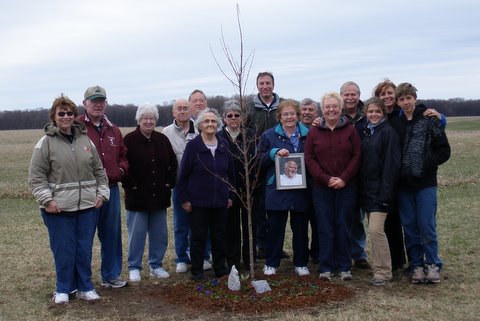
Bliss, Michigan - Wednesday, April 7, 2010: A place by Mackinaw City where Bob spent many of his summers growing up. As a family, we spent many summers camping at Wilderness State Park and visiting Bliss. Bob's Uncle Lloyd has a place there in an open field that Bob loved. Near to this field is a batch of trees, full of birds in song. He had said to me many times that he hoped that some day we could live in one place long enough to watch a tree grow. So we decided to plant a red maple tree in that field and bury his ashes there. In this picture, Hannah, Noah, and I get to work on digging the hole for the tree, while Bob's brother Don and brother-in-law, Dave, watch while willing to give wise guidance.

A picture with the tree. Bob's mother is holding the picture; Pastor Dave is behind her, and the surrounding people are members of Bob's extended family. It seems a little odd that we are standing there with such big smiles, but Carolyn (in the burgundy coat) had a tough time getting the camera timer to work, so we had a good laugh. I think Bob would have chuckled as well.

[This blog can be sent to you every week by email. If you would like that option, please email us at reedsinthewind@gmail.com and put "Subscribe" in the Subject line.]