Monday, November 15, 2010

Village Savings and Loans

In a book titled, Portfolios of the Poor, How the World's Poor live on $2 a day, the authors make some startling observations.  Of the 40% of humanity (2.5 billion people, of whom 1.1 billion live on $1/day) who survive on this amount, two realizations changed their perspective on world poverty.  First, money management for the poor is a fundamental and well-understood part of everyday life.  [I imagine that the poor have much to teach the wealthy about money management and budgeting - actually, I don't have to imagine it.  I've seen it - both in Africa and in Grand Rapids.] The second realization was that most households in this category rarely consume every penny of income as soon as it is earned - they manage their money by saving when they can and borrowing when they need to.  [The US has been at a negative savings rate - with Americans spending more than they earn - for some time, until just recently with the economic crisis.  Then suddenly people are able to save.  Very interesting dynamic.]

A major frustration among this group of people in poverty is the poor quality or low reliability of the instruments that they use to manage their meager incomes - for both savings and loans. In West Africa, it is very difficult for the poor to get loans, not to mention micro businesses, and even SMEs.  Bank interest rates in Ghana vary from 37-43%; the average in microfinance institutions is 50-60%; the more informal way of saving, often called a susu, has interest rates up to 120%.  Not to mention that if you save with a susu, you normally have to pay the susu man, so you are paying to save instead of being paid to save (as with typical savings accounts in banks).  And it's not unusual for the susu man to run away with the money, leaving you with nothing.

A VSL group in Dodowa
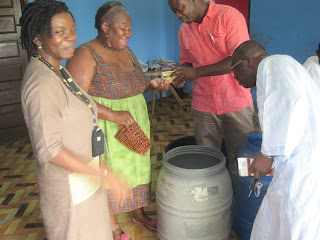
Another VSL group in Akropong
Hopeline Institute, the partner with whom we work in Ghana, has a program that addresses this dilemma very well.  It is called "Village Savings and Loans" (VSL) and they are currently using this methodology in 94 villages.  Each village has a group of 25 persons who have organized themselves, appointed executives, adopted a constitution, all for the purpose of saving and loaning to themselves.  The money goes into a box, held in the box keeper's home, with three different padlocks on it, and each key is held by three other members of the group.  The group saves by buying shares - they decide among themselves how much a share can cost (usually around 25 cents to $1) and each person can only buy 5 shares per week; these shares are marked through stamps in a book.  Once this has gone on for several weeks, people can begin taking loans at an interest rate decided by the group (usually 10%), at no more than three times their savings.  VSL groups are designed to last for nine months and then the share out happens, where everyone cashes out their shares and the interest paid (as well as fines) is divided among group members.   So you can imagine if the share is $0.50 and every person buys five each week for 36 weeks, that is $2250, a good amount for loans.  Additionally, each group charges a social fund fee, usually around $0.20 each week, which goes for sickness, death, or other things that may happen to a group member during the nine months.  While the buying of shares is optional, the social fund is not.  I was quite surprised that most groups still had most of their social fund money by share out time (around $180 US) and they use it for celebration at the end of their work together.

Last week, we also had our second batch graduation of the Small and Medium Enterprise(SME) class with Hopeline.  As a reminder, a person might start working with Hopeline through a VSL group, then move to a micro-finance solidarity group, where a little business training is given and the loans are a little larger than with the VSL.  Then a business owner might move to the SME training, where they receive more in-depth training about running a business and develop a business plan for their business.

Mariama Issah is part of a VSL in Abokobi.  She owns a provision shop and graduated last week from our SME class.  The women in her VSL group is so proud of her that she went through this class.  She stated at the graduation that she is not very educated and didn't think that she could do it but is very proud that she did and she's thankful that she now has a white friend!
Rev. Philip Tutu, national leader of the Global Leadership training for Willow Creek, commissioned all SME graduates as marketplace ministers.  This was a powerful time where business owners committed themselves and their businesses to God, to serve as ministers in the market, working to restore it as Jesus redeemed it.
This precious woman wept throughout her entire statement at the graduation as she shared how she was ready to quit her business and took this class out of desperation.  Through this class, she has felt God's call on her to view her business as a ministry.  She shared the joy in discovering that the work she does can have value in God's eyes and that she has worth as well.  She vowed to view God as the owner and her as the manager.  Praise God!
The second SME class for Hopeline Institute. 

Monday, November 8, 2010

A November Reed Update

Weather:  I know Bob was very good about sharing the weather with you weekly and I tend to forget.  So let me give you an update.  We are transitioning from the rainy season to the dry season.  This rainy season has lasted a little longer and we have seen more rain than we did last year, which has given us more comfortable weather.  Average weather has been in the mid-80s during the day and low 80's at night.  As we edge toward the dry season, the temperature will begin creeping into the 90's.  The forcast for today is 90 F with humidity at 89% and dewpoint at 73%.

This has been a busy and stressful time for the Reed family and as I write this, we are not bearing it up very well.  In addition to a crazy work schedule and traveling, there has also been a number of guests coming and going in our house.  While we love them individually, it takes a toll on the three of us and how we operate as a family unit,  especially as introverts.

Additionally, there have been other stresses as well.

October 20, 2010 would have been our 20th wedding anniversary.  I took a sick day and spent the day mostly in bed sleeping and hoping it would be over soon.  This was not how I had hoped to spend our 20th wedding anniversary.  In the evening we watched the wedding video together, which we hadn't watched for years and years, and Hannah and Noah got a big chuckle over how young we all looked and acted.

On Monday, October 25, my father was moved into a nursing home, which was a difficult decision for my mom and siblings.  As I may have shared before, he has Alzheimers and it had become increasing difficult for my mother to care for him.  We are so thankful to God that the transition seemed to go well and he has settled into his new home fairly quickly.  He celebrated his 82nd birthday yesterday (November 7) and all my siblings were able to gather with him to spend time together.  The picture is of my dad in his new room, along with my brother Henry.

On Friday, October 29, I received word that Dea Lieu, our Affiliate Manager for Cote d'Ivoire had seen a doctor in the US and was informed that he has one week to six months before his kidneys shut down.  My heart feels so sick for Dea, Charlotte his wife, and their five children.  The North American team with whom he works (from Iowa) has been great in quickly rallying to support him, but the process of how acquiring a kidney transplant for someone with no insurance, who is not a citizen of the US, living in a country that cannot offer good follow-up care, is not an easy task and we ask for your prayers for Dea and this team as we work to find an answer.  This picture is of Dea and his family and their kids.  It's a few years old, and the kids are bigger, but you can still imagine the impact of this news on their family, especially as they are separated now by thousands of miles.  We are thankful that the voting in Cote d'Ivoire was peaceful so the family is safe at this time as they await the runoff elections at the end of this month.  Please keep them in your prayers.

Monday, November 1, 2010

Images and thoughts from last week with Laura

More thoughts from Laura:  

Well, I am here in Liberia but I am going to talk more about my experience last week in Ghana--

Renita has given me reading assignments :-) One booklet I am reading (as time allows), is "Against All Hope: Hope for Africa", I am perplexed that a continent as rich as Africa is not reaping the benefit of its own riches.  I am trying to understand the impact of colonialism today, the impact of the transatlantic slave trade today, and I am sure there are other dynamics, so I will keep reading . . .  I am considering the slave trade, especially after I visited the Elimina Castle and the Point of Return.  The Point of Return is located in a village/community near Cape Coast, there is a trail that leads from Sweet River, the last place the enslaved Africans washed and were shaved before they walked the last 45 kilometers to the Elmina Castle in Cape Coast, where they were held in dungeons before they walked through the Door of No Return.  Walking in my barefeet the trail that my ancestors walked, was difficult because, although I was with others, I felt alone on this journey, because no one with me could understand my pain, so I held my tears back I did not to make a spectacle of myself.  Many Ghanaians have heard the slave story many times, but me I feel the impact, Renita had her own perspective as a white woman, but I was the lone African American, it was not easy.  And it was the same way at the castle, although most of my tour group was brown-skinned like me, none of them had lived the African American experience, once again alone in a very strange way.  It is my hope that next year I will have this experience with a group of African Americans and Africans, and that we can dialogue after the tour, but for now it was lonely.

I had the opportunity to spend the day with a Ghanaian gentlemen, who took me out to have a real Ghanaian experience, so the first thing we did was stop at the roadside and drink coconut water, a little warm for me but sweet none the less, I even scraped and ate the coconut from the inside of the fruit.  We stopped at a metalworkers stand and watched him make all kinds of metal baking pans, for bread, cakes and the like.  Then we went to the waterside where the indigenous people lived and their livelihood is fishing.  There were 4 women who were happy to explain the fish smoking process to me and they were all about the photo opps!  I met one woman as she was gutting a fish . . . and then I was ready to go.  As I walked through this community, I saw just that, community--children, the men gathered, the women working, teenagers, socializing.  And then I thought, Lord you know each and everyone of these people, you love them, you understand their words even though I don't.  And you, (Lord), don't assign greater or lesser value to any of us . . . "for God so loved the world" means the world equally.  Wow!  The last note about that day, I loved hanging out with Captain Amponsah Gyima, proud to be a Ghanaian, proud to have served in the military for his country and currently working for the United Nations, and proud of his children.  He said, (something like), "my country may be poor, but I love my country and my people," that expressed the attitude of the typical Ghanaian, a very proud and independent people.

Here are just a few word snapshots of Ghana--really, really bad side roads; motorway, (expressway)-fast, slow through a town, then fast fast again; people walk along the side of the motor way; every billboard has people who look like me; police checkpoints on the motorway; every major intersection has folks selling anything and everything; businesses with names like "The Lord is My Shepherd" photo shop, "To God be the Glory" dress shop, bible verses on the back of taxis; goats along the side of the road; small herds of cattle; people selling snails and ground hogs; roosters and chickens here and there.  Oh and did I mention when you gotta "go", you can "go"  especially men, just right along the roadside.  I asked if women could do the same thing, and I was told yes just a little further away from the road in the tall grass . . . hmph, needless to say I was very careful on long trips.

I just want to say that I was blessed to spend two weeks with the Reed family.  Renita, Hannah and Noah are fairing well.  I watched Renita working hard for Partners, taking care of her children, taking care of other family stuff, taking time for herself, accommodating me and still grieving the loss of her husband, her children's father, our brother, Bob . . . I am amazed at how God has made this woman!  I see God's strength in Renita Reed and thank God for this, my sister.  Keep praying for her and the kids as they continue to walk this valley.

I will stop there, I will tell you about my experience in Liberia, next week, Lord willing.  God bless!
Laura gets her hair braided...for five hours!  Tylenol was in order.
Hannah, Noah, and I watched in amazement as they set the ends of her braids on fire.
After it was done - Laura looking beautiful although a little stupefied after the abuse her skull just took.
The next day she enjoys her first coconut water drink.  Thousands upon thousands of these are consumed every day on the side of the road.  People loudly proclaim the benefits of this drink and the seller will cut it open in front of you so you know it's fresh.
On Thursday, we spent the day in Cape Coast, the place where much of the slave trade passed through in West Africa.  Here we are at the Slave River, or some call it "Sweet River" where those captured had their last bath after walking hundreds of miles in their bare feet.  We removed our shoes out of respect for where they walked. 
Sweet River, a somber and sobering place.


From Sweet River, those captured walked to one of three castles, the largest of which is Elmina Castle, once owned by the Portuguese, the Dutch, then the British.
                                   
This sign, on the wall of the castle, proclaims the desire for such atrocities to never happen again.
The fort, across from the castle, built by the British, who didn't want to be overtaken by surprise as they did to the Dutch.  Brown house in the front right was for the mothers and children of those made pregnant by the slave owners.
Meanwhile, at home, Noah and Douglas battle a water monitor found in our yard by the dogs.  This type of monitor can grow up to ten feet!  We are thankful it was only a baby when we found it.  We aren't sure how it got into our yard as there is no significant body of water around.

Tuesday, October 26, 2010

Thoughts from Laura Carpenter...thanks to Nate VanderStelt

Last week, when I shared that Laura was going to be in Ghana, one of the regular readers of the blog asked if I could have Laura, as well as Fanny and Allen, share some responses to some specific questions.  

Below is the beginning of Laura's thoughts on these questions..

What are some of the things that give these brothers and sisters great joy when they experience other cultures?

I love the accent, the formal way of greeting and even engaging in conversation, I am Madame, younger women curtsy when they meet me, the homes that I have visited range from quaint to really nice.  I love the way I see extended family living together.  I love seeing mixed income neighborhoods (that’s good and bad).  Of course I have eaten really good Ghanaian food!!!  To see folks who represent my heritage; to some how in a strange way connect in a deeper way with my history.

What gives them concern, pain or brokenness?

It is becoming painfully clear to me in my travels that many Africans do not understand the African American struggle.  This makes me angry and want to teach African American History classes, because when I start to share some things they don’t know about our history, they are surprised, appalled, sad and feel misinformed or not informed at all. I don’t mean to sound angry, but I am!  I have not gone to Cape Coast yet (to the slave castles) but I am still feeling some pain.  Ghana is a pretty strong country compared to other African countries and Ghanaians seem to be independent, not desiring a “hand out”.  However, I still see the evidences of a struggling 3rd World country – intermittent electricity and water supply, corrupt government, extremely poor people, sick people, mentally unattended, orphaned children, Chinese and Lebanese with the big contracts like road construction and building (I believe) . . .  It also makes me sad to see BET offered as one of the television stations, so Ghanaians can get a skewed image of African Americans, compounded with what they are told by some whites prior to coming America about lazy, violent, drug-abusing African Americans, and they should have no dealings with us, its true!  Many Africans I meet tell me that.

How do they see God’s people rising up (or not rising up?) in each context?   

I see a woman like Fanny Atta-Peters, she is the executive director for Hopeline Institute, the NGO that Renita works with to help develop, train, mentor African business owners.  I have met some ingenious, entrepreneurial folks like Gallant Kwame the Yummy Cashew Company owner, Rev. Theophilus Quartey who owns a mushroom farm and leads a growing group of mushroom farmers, who are making a mushroom juice (it’s actually pretty good and good for you), mushroom flakes, even mushroom powder; there is Alberta, who owns Albie’s Shoes (yes, I had to get a pair); the brother who is middle man for manufacturers and trains folks to sell all kinds of products from cutting boards to camping lanterns, and the list goes on . . . I am so proud to now know these determined folks.

My final thoughts . . . for now . . . for real this is just the beginning and patchworked thoughts
Some might say why focus on taking just an African American team to Africa?  I believe from past experience with teams and my own personal experience, if we don’t focus on and encourage African Americans to see the value that they/we bring to this work, we opt out, really without much thought.  Here are some of our thoughts: It sounds good, but I couldn’t do that, will they accept us, it’s do dangerous, I’ve never done anything like this before . . . and the list of negative thoughts continue.  I really truly believe this way of thinking is a result of being socialized in a racist society.  A socializing that tells me who I am, who I can be, and the worse thing is tells me that I have nothing to do with those people on the other side of the Atlantic......and that just is not true.  And it tells our African brothers and sisters they have nothing to do with us, until one of starts to talk to the other and we find that a bridge needs to be built between Christian Africans and African Americans especially.  I want to help build the bridge; I know by the power of the Holy Spirit it can be done.
View from Aburi, north of Accra overlooking a project of family housing that an orphanage is building to better serve the orphans in a more foster family setting.
As Laura was missing her grand-daughter, she had a hard time keeping her hands off the babies.  I have the same problem!
Mushrooms growing out of bags.  This mushroom farm can hold up to 6000 bags of these mushrooms and harvest mushrooms on a daily basis.
Rev. Theophilus, a former pastor now farmer who trains people in mushroom farming as part of his business as a mission.
Yummy Cashews - a picture that captures the spirit of the day, lots of learning and laughing.  On the left is Fanny Atta-Peters (Director of Hopeline), then Laura Carpenter, then Ebow Graham (program manager for Hopeline Institute), then the owner, Gallant Kwame,  He has 22 employees and processes 2.5 metric tons of cashews per month.
Alberta is a fiesty SME owner and a great participant in our SME class.  Here she is in her shop, and it was the only time during the day when we "lost" both Fanny and Laura as they got caught up in shopping instead of listening to this business owner's story.:-)
Sunday at Elim Family International Church, Laura led worship.  And we really worshiped.  It was beautiful and if you know Laura, you aren't surprised.  She received many invitations to move to Ghana and do this on a regular basis.  It was another Reed family thing as well - Hannah is in the back singing backup and also played the flute with me, I'm on the far left, and you can't see Noah, but he was doing the data projection.  What a blessing to do this together!

Monday, October 18, 2010

Seeing Through New Eyes

I returned on Friday from a ten day whirl-wind trip to the US where I spent countless hours in conference, meetings, conversations, and trainings surrounding the work of Partners Worldwide.  It was a very blessed time with opportunities to watch networks form before my eyes, lightbulbs go off with new ideas, and intense dialogue regarding the work that we are doing.  I was especially pleased to see how strong the West Africa team is and how they got to know each other and develop relationships with each other.  I am blessed to work with such gifted and committed people.
I had the opportunity to travel to the United States with both Fanny Atta-Peters from Ghana and Allen Gweh from Liberia.  For both of them, this was their first trip to the United States and it was good to see Grand Rapids through their eyes.  Places that are so familiar to me look somehow different when you imagine seeing them for the first time.  On my way back to Ghana, I traveled with Laura Carpenter, the Director of Diversity and Worship at Madison Square Church.  While Laura has been to Liberia and Senegal, this is her first trip to Ghana so I also have a chance to see Ghana through her eyes as well.  Pictures can't portray the experiences we shared together but they may be able to show you a little.  Enjoy!
Our venue for the conference.  Grand Rapids is beautiful, especially in the fall.
A trip to the US has to include trying out a Big Mac and fries from McDonalds.  Here we were able to enjoy this at John Ball Park Zoo before going to enjoy the animals.
On Friday night, Robert and Kathryn Shane (and baby Eli) had us over for a West African team dinner.  In the back row, from left to right, is Derek Hoogland (intern in Liberia), Saidou Ba (Senegal), Jeremiah Yongo (Nigeria), Rick Slager (working in Agriculture throughout West Africa), Allen Gweh (Liberia), Robert Shane (NA team leader for Liberia).  In the front row, Mrs. Yers Truly, Fanny Atta-Peters (Ghana), Bonita (friend of Saidou), Marietta Yongo (Nigeria).
Tina Oh (on the left) has agreed to be an intern in Ghana with Hopeline Institute!  We are so happy to have her join us in February 2011.  Welcome, Tina!
After both Allen and Fanny have so graciously welcomed me to their churches in their respective countries, I was very happy to take them to Madison Square Church and introduce them to my church family.

Brett Pfister (left) is a new intern for Liberia who will be moving there in January, 2011.  Derek Hoogland will be returning for an additional six months of internship in November.  We thank God for both of them and ask for your prayers.
Art Prize was in Grand Rapids, which was a pretty amazing collection of art from many places in the world.  It made for a great time to walk around Grand Rapids.  In this picture, Allen is listening to and "feeling" the music in this interesting piece.  Both Allen and Fanny thought this piece should win first place (it made the top 75:-).
This beautiful tree was in front of my sister Janette's house.  My kids have not seen a fall since 2004 and while I hesitated to take such a picture because it would make them miss it even more, this tree was too beautiful to pass up!
Laura Carpenter joins our family (and Jack sneaks in the picture) and will spend a couple weeks with us exploring Ghana before going to Liberia.  Her objective is to pave the way for groups coming from our church beginning next year who will learn about African culture and heritage focusing on African-Americans making the trip.

Saturday, October 2, 2010

A Reed Update: October 2010 Edition

On October 7 and 8, Partners Worldwide will be holding their International Conference, called Marketplace Revolution, at DeVos Place in Grand Rapids.  This conference will have international attendance from over 20 countries and I am happy to say that West Africa will be represented as well.
Dea Lieu (left), Director of ACLCP from Danane, Cote d'Ivoire, left already two weeks ago and is spending some time traveling in the US visiting various supporting churches and friends.


Allen Gweh (right), National Director of LEAD, will leave Liberia today (Saturday, October 2), fly to Accra and join me on the flight to Grand Rapids tomorrow (Sunday).

And Fanny Atta-Peters (below),  Director of Hopeline Institute in Ghana, will also join Allen and I on that flight.  We are still hoping that another staff person from Hopeline, Ebow Graham, will be able to come.  He has been waiting approval for his visa for 12 days now, still without a definitive "yes" or "no". 
This will be a busy time, with many meetings before and after the conference, taking my West African friends around my home town after they have been such good hosts in their countries, and many other events.  If you are in Grand Rapids, please join us on Sunday evening at Madison Square Church where we will be showing the documentary, Pray the Devil Back to Hell and having a dialogue with Allen and other Liberians in Grand Rapids.

While I am in the US for about ten days, Hannah and Noah's teacher and his wife, Ryan and Melissa Von Hoyningen Huene (yes, that is one last name - no, it's not a combination of two names) will be staying at our house with Hannah and Noah.  This is their second year teaching in Ghana and I am very thankful that they are willing to stay with the kids while I travel. While I am gone, Hannah will be taking her last SAT and Noah will take the PSAT.


In other news:
And then there were three.........
Back to three dogs.  Ah...suddenly three dogs (which felt like a lot before) seems like so few.  All seven puppies found homes, Hannah raised a little money for her senior trip, and we are not tripping over puppies when we walk outside, while trying to avoid little puddles and droppings.  Here is a picture of the first puppy who found a home, along with several of Noah's friends.  From left to right they are:  Noah, Ravindra, Armand, and Kojo.


A cultural event...
I was able to attend a play at the University of Ghana, entitled "Emancipated Captives".  It was very well done, in an outdoor theater [which was risky given that we are the end of the rainy season - and unfortunately during the last 20 minutes of the play it rained so we all huddled together while the players (who had a roof) finished their act.]  The play covered a good portion of Ghanaian history and was humorous as well.  I took a brief clip of some of the dancing for you to enjoy - this dancing was happening in the context of a lament over traditional dancing becoming a lost art as more Ghanaians begin turning to Latin American dances.

Monday, September 27, 2010

Mom Story #2: A Peculiar person, Rick Slager

One of the things that I enjoy about my job is the opportunity to meet people from so many different places and backgrounds.  I was telling my mom about one of these persons this summer and she encouraged me to write a blog about him as it may be inspirational to others.  So, here is Mom Story #2.

Rick Slager is a business man from Fond du Lac, Wisconsin.  He grew up on a dairy farm until his early teens and has lived in Wisconsin all his life.  He and his wife, Dawn, have been married for 20 years (they actually share the same anniversary as Bob and I - October 20, 1990:-).  Dawn is a teacher.  They have two beautiful daughters, Sadie and Ella.

When I met Rick, about a year ago, he owned three businesses, with sales of over $500,000 annually.  He describes himself as an entrepreneur at heart.  In 2001 Rick had the opportunity to travel on a short-term mission trip to Senegal with a group of strangers from North Carolina.  He has since been to Senegal ten times, to the DR Congo once, and has decided to sell all of his businesses and go into ministry full time.  That's right - you read it correctly - sell all his businesses and go into ministry full-time.  And yes, he and Dawn are still happily married. I'm excited to announce that he had decided to work with Partners Worldwide, specifically in West Africa, to do agriculture development, specifically as it relates to appropriate affordable technology for small scale farmers.  His program is called the Rural Empowerment Initiative and he will be first working with Liberia and Cote d'Ivoire, and then hopes to add Ghana and Senegal.  You can read about Rick's work and story at www.ruralempowermentinitiative.org.

What makes people like Rick do radical things like this?  I think the only answer can be God.  But it also takes a courageous person to follow the promptings of the Holy Spirit.  1 Peter 2: 9 says that we are a "peculiar people" (Ok, I know, some versions say "chosen people" but I kind of like "peculiar".  Pastor Dave often reminded us of how peculiar we are!)  Rick gave his life to Christ only fourteen years ago - his time before that was not easy but I'll let him tell that story.  Since he gave himself to Christ, it seems to me that his life has been an exciting roller coaster ride leading him places that he probably never imagined he would go. 

Here are two cartoons that Rick had up on his blog that seem to represent some of the call on his life.  I thought I'd share them with you:   


 Rick and his family have decided to leave the big picture results up to God and to step forward in faith to see what one person (family) can do and let God handle the rest.  Rick will be at the Partners Worldwide conference on October 7 & 8 (for more info on that, go to www.partnersworldwide.org) in Grand Rapids.  He hopes that his story will encourage other people to "get out of the boat."  I encourage you to get in touch with him if you are trying to figure out what the water is like.

Monday, September 20, 2010

Six months today since March 20, 2010

My Dear,

Today is the sixth month anniversary of your death. 

Man.  Six months...death.  Those words just don't seem right.  How can it be at the same time so unreal and yet so real?  How can it still feel like you are coming back and yet its been six months without hearing your voice or seeing your face?  And still it feels like these last six months have been an eternity.  Many people told me it would take three-six months before I felt somewhat normal.  And for the most part they are right.  Of course, they also add it won't ever really feel normal again, and that feels right as well.

When people ask how I'm doing, I'm not really sure what to say - especially because it ranges from day to day, sometimes hour to hour.  The range is from depression, to anger, to loneliness, to feeling overwhelmed, to feeling normal.  I have stopped trying to take care of you, which is good, and I now feel like I have to be in the business of surviving. That means putting some things away that are visual, painful reminders of your absence - like your toothbrush and your shoes.

I'm not having coffee outside as often as I did the first few months after your death.  I think I'm avoiding it.  I haven't really accepted "Jesus as my husband" yet.  I'm just not ready to, I guess.  It seems so serious - not playful or light at all.  When you and I had coffee every morning, the routine varied (one of the things I loved about you - you were anti-routine:-).  We would read the Bible, or pray, or talk about parenting, or debate poverty or other issues, or talk about the dogs, or talk about our days or whatever.  When I imagine having coffee with Jesus as my husband, I imagine the conversation to go like this:
 Renita:  So, Jesus, what does your day look like?
Jesus:  Well, today is like any other day:  millions or prayers to listen to, thousands of operations and accidents to attend, four births every second, two deaths every second......of the 146, 357 deaths today, only one-third will enter heaven.  Peter and John are covering a good portion of those but there are some I want to welcome personally.  
Suddenly my day looks pretty un-noteworthy.

I know - He would be focused on me and would care about my day and the issues...but I still miss you and want you as my husband.  I miss the dialogue, the banter, the audible responses, and the ability to process the oodles of issues that arise every day.

The kids and I miss you especially at night when we do our devotions and get into various debates.  Last night they were debating NeoMarxism versus Secular Humanism versus Cosmic Humanism and other 'isms' as well.  Noah was wishing that he was a Cosmic Humanist so that he wouldn't have to do homework as writing on paper would be injuring a god:-).  [That kid really has your mind and your sense of humor!]  You know me - by 10 pm I'm ready to sleep so getting into heavy debates at that time of evening is not my forte.  You loved those debates and the kids missing having those debates with you. 

Time moves on so slowly on a daily basis and so quickly when looking back.  Know that we miss you.  And we love you.

Monday, September 13, 2010

Eid ul-Fitr

Friday was a National Holiday in Ghana and in many countries around the world with a high Muslim population.  The Muslim population in Ghana is around 15%.  The name of the holiday is Eid ul-Fitr, which is Arabic for "festivity concluding the fast", and marks the end of Ramadan.  Ramadan is a thirty day fast from eating, drinking and sexual relations from dawn to sunset that Muslims partake in for the purpose of learning about patience, humility, and spirituality. During this time, Muslims ask for forgiveness for past sins, pray for guidance and help in refraining from everyday evils, and try to purify themselves through self-restraint and good deeds.  Charity and prayer are important parts of this time.

As Hannah and Noah did not have school on Friday, we decided to attend the Eid prayers at the Madina Central Mosque, not too far from our place.  [I use the term "we" loosely - if you remember in an earlier blog, I wanted this next year to be a year of learning more about Ghana.  The kids agreed, in theory.  Actually going out of our comfort zone is another issue.  But after some negotiation, they agreed to get up early on their day off from school to attend these prayers, and they were both good sports about it.]  We arrived at 8 am, when we were told the prayers were supposed to start, but only a handful of people were there.  We passed through a long line of people waiting to receive alms and then sat down to wait and do some people watching. After some time passed, people began to stream in - women were on the side of the building that we were on, while the men went to the other side.

Everyone was dressed in beautiful clothes and the women all wore a white head wrap.  The stream of people after a while was amazing and I was surprised how many Muslims were in this area of Greater Accra, especially when I found out that there was another Mosque, just down the road that was full also.  After a while it suddenly got very quiet and the prayers began.  The prayer time was actually quite short and immediately after that people began to break their fast.

It was a good experience, especially as we have been intentionally learning more about Islam over the last few weeks - a good number of students at Hannah and Noah's school are Muslim, as are business owners with whom I work.  I appreciate their discipline and desire to serve God.  There is very little I know about the Qur'an and I think it's important that we become knowledgeable about it.  John 10:16 says, "I have other sheep that are not of this sheep pen.  I must bring them also.  They too will listen to my voice, and there shall be one flock and one shepherd." 
Noah went on his own to the men's side, as he didn't want to stay with all the women - and then had to fight the flow of humans to make it back to us. 
Hannah and I both wore a head wrap (even though we didn't have white - thankfully there were some who also weren't wearing white) as a sign of respect for their beliefs.

 By the way, today is the 82nd birthday of Bob's mom, Lucille Mosher.  Happy Birthday!