Monday, February 7, 2011

A Palm Kernel Processing Factory

Dear Friends,

As I mentioned last week, we have had a team of Canadian business women here, learning about the work of Partners Worldwide and Hopeline Institute in Ghana.  On the first day of the visit, we went to visit a Village Savings and Loan group (VSL) [ for more info on the VSL, please click here].  This particular VSL is a group of 16 women who run a palm kernel processing factory.  When we informed the team that we were going to see a palm kernel factory, a different picture came to mind than what they actually saw.  See below.
The group of women, getting ready for their meeting, right at the factory site.

Here are bunches of palm nuts, after they have been cut down from the palm tree.  These bunches are on their way to the market.
As we stopped to look at the palm nuts, there was a woman with a baby.  I learned, when traveling with a group of women, that I needed to beware if any baby was in the area - all focus would be lost on what we were observing and all focus would be on the baby!
This picture is actually from Liberia, but here you see the palm nuts being processed to produce the red palm oil but also what is used in palmbutter soup.
Here we are arriving at the Palm Kernel Factory.  This is Fanny, Director of Hopeline, and the Field Officer, Nesto, who is in charge of this VSL as well as about 30 others VSLs.  You can see the piles of palm nut kernels on the ground - this is what is left after the red palm oil has been taken from the nut.
The first step is to crack the kernels in the machine.
The cracked nuts then get sent here where this woman is preparing to wash the cracked nuts in clay water - the clay helps to hold down the shells and allows the nuts to float.


She is holding a sieve, which will collect the floating nuts.  This work is not easy - we left this woman to visit another group and drove by again four hours later - she was still at it.
The women then sort through the nuts by hand to take out any shells that might have remained after the clay water washing.  The nuts are then washed in clean water.
The nuts then go to be roasted over a fire.  There is no waste here, folks.  The fire is made from the shells of the nuts.  Very hot work - it's already 90 F with an 80% humidity.  After this roasting, they are then sent to another machine where they are ground into a paste.
The paste is added to a large pot of boiling water where eventually the paste will turn into an oil that separates from the water and can be skimmed off the top.
And here is precious oil that will be used for eating as well as for soap and other products - if you've every used Palmolive soap, you may have used palm oil from Ghana. I believe they told me that they make 15 of the yellow 5 gallon containers that you see here, every two weeks.  Each of the containers is sold for about $20 US, so $150/week for 16 women.  And yet they are able to save money in this VSL and help themselves.
The women talked about how hard the work is - you can see the effect of it on their body and skin.  They shared with gratitude how much this business has done for their families in terms of allowing them to put food on the table and pay school fees.  They also shared how the VSL has helped them over the last nine months. 

Some of the members of the Canadian team wondered when the last time was that these women were pampered - given a retreat, had their nails done, hair done, etc.  Who knows? 

Wednesday, February 2, 2011

Partners Worldwide Canada

As many of you know, I was born and raised in Canada.  Most of my family is still in Canada.  And now, Partners Worldwide is also in Canada!  In the past couple of years, there has been a growing interest in Canadians of the work of Partners Worldwide, and last summer John Denbok stepped forward to lead the charge and serve as the Partners Worldwide Canada president.

Since then, our participation from Canadians has grown.  In fact, this week's blog has been delayed as I have been spending time with a group of seven Canadian business women who have come to spend a week with us in Ghana.  The week before that I had a visit from another Canadian businessman;  in a couple of weeks, after the conference in Liberia, John Denbok will be coming to Ghana to visit; and shortly after that, a group from my parent's city of Georgetown will be coming.

Since I have been busy from sun up to sun down with this group that is still here, let me just put some images up of our trip and tell you some of the stories next week.
This is the group at the Elmina Slave Castle. 
On our first day together, at Hopeline Institute's office, we spent time sharing our stories.

We then went out to visit some of the Village Savings and Loan groups.  This group processes palm nut kernels together for oil - more about that next week.
This VSL group recently started their second nine-month savings and loan journey together and shared with us what each of them do in business.
On Saturday, we spent the day visiting our small and medium size entrepreneurs.  This is Georgina, who runs a tailoring and decorations business.  Here she is finishing the dresses for a wedding the next day.

Ravena was next, who runs two businesses - one making beautiful jewelry and one training teachers in Early Childhood Education.  We spent the longest time here - too much shopping for the women to do!
On Sunday, we went to Fanny's church, Lighthouse Chapel in Adenta.  The pastor took time to meet with us after their service.

One of the women, Lynn, is blind - born to a blind mother and an alcoholic, abusive father.  When she was a young girl, she stopped talking and it was determined that she was uneducatably mentally disabled and was placed in a mental institution.  She is a mother, grandmother, wife of 40 years, and a successful business owner.  She gave an inspirational talk to about 70 people, including a number of people from the blind school.  She then gave radio and television interviews - one of the journalists who interviewed her was also blind.  Being blind can be seen as a curse in West Africa and it was truly inspirational for them to see someone who is blind be successful and determined. 

After Lynn's workshop, all the women then went with a business person in their own field and spent the rest of the day with them.  Elma, a nurse and medical adjudicator from Ontario, went with one of our SME clients who is a hospital administrator struggling to keep her business profitable despite the number of people who can't pay.  She had the opportunity to witness a Cesearean section while at the hospital!

Monday, January 24, 2011

Crap Detectors

Pastor Dave and the Crap Detector
The pastor of Madison Square Church, David Beelen, who has been my pastor since 1986 has taught his congregants for years that they need to have "crap detectors".  My children used to giggle when they were younger and heard that phrase - in fact, if it offends you, I apologize and suggest that you stop reading this blog post now.  My father, who was a pastor, probably would never have dared to use the word "crap" from the pulpit.  But Pastor Dave believed in it so much that he used to have a visual image of a crap detector at the front of church for some time to illustrate his point.  He encouraged us to always have our crap detectors on, even when listening to his sermons.  We needed test everything we heard within the context of the Bible - to measure people's words against the Word.

Bob also had a pretty sophisticated crap detector, being a therapist.  He could smell someone being manipulative a mile away and didn't hesitate to call people on it, as I'm sure some of you can attest.  So crap detectors are on pretty constantly at our house and that causes many debates.  I'm so thankful that Hannah and Noah have had this important tool taught to them at both church and home.

Sometimes it does lead to trouble though.  What do you do when it goes off?  Having it go off is good for you personally and allows you to do research into Scripture to test what is being presented.  But does the knowledge then remain there?  What do you do when you believe the person talking, teaching or preaching is "full of crap"?  When the forwarded email sent to masses has the crap detector beeping so loudly it hurts your ears?  Ahhh, there's the dilemma.  Do you keep it to yourself?  Do you dare to assert your own "opinion" about whether it is crap or do you debate that wisdom based on the fact that you might be full of crap yourself?

For example, a while back, our church in Ghana had a guest pastor who showed a YouTube video called "Muslim Demographics".  Hannah, Noah and I kept looking at each other throughout the video as our crap detector was going off pretty loudly - we thought it might be disturbing others but it didn't seem to be.  We debated it on the way home, and then found a rebuttal on YouTube from the BBC, called "Muslim Demographics:  the Truth", refuting much of the "evidence".  So, what do we do with that?  Can we believe the BBC?  Is it fair for the church, in a position of authority, to show something that presents a "truth" that doesn't appear to be based on facts without being challenged? Do we have a responsibility to those who have no crap detectors, or underdeveloped ones, to point out the smell?

This past week, I received two email messages sent to large groups; both from well-meaning Christians - good people.  But both presenting information that had my crap detector going off...so much so that I lost sleep over it as I debated whether to keep my mouth (or fingers in this case) shut or to speak up. Oh crap - what to do?!

If you know me, and you know the impact that being married to Bob for 19 years would have on anyone, you probably know my decision.  What I actually did is irrelevant though.  The important thing, in my opinion, is the presence in all Christians of a crap detector...and the courage to use it. Ephesians 4:114-15 says,
Then we will no longer be infants, tossed back and forth by the waves, and blown here and there by every wind of teaching and by the cunning and craftiness of men in their deceitful scheming.  Instead, speaking the truth in love, we will in all things grow up into him who is the Head, that is, Christ. (emphasis mine)
So...do you have a crap detector?

Is it on?

Did it go off while you read this blog?

If so, let me know!

This flower has been inspiring me for the past two weeks.  It is growing on the road by our house - with no care, no water, just dust and dirt.  It reminds me of the saying, "bloom where you are planted."  The only One who planted this flower was God.

Monday, January 17, 2011

Reed Family Update - January 2011

Weather:  Very hazy.  Temps continue to be in the low 90s F (low 30s C) during the day and low 80s at night.  Humidity is around 50%.

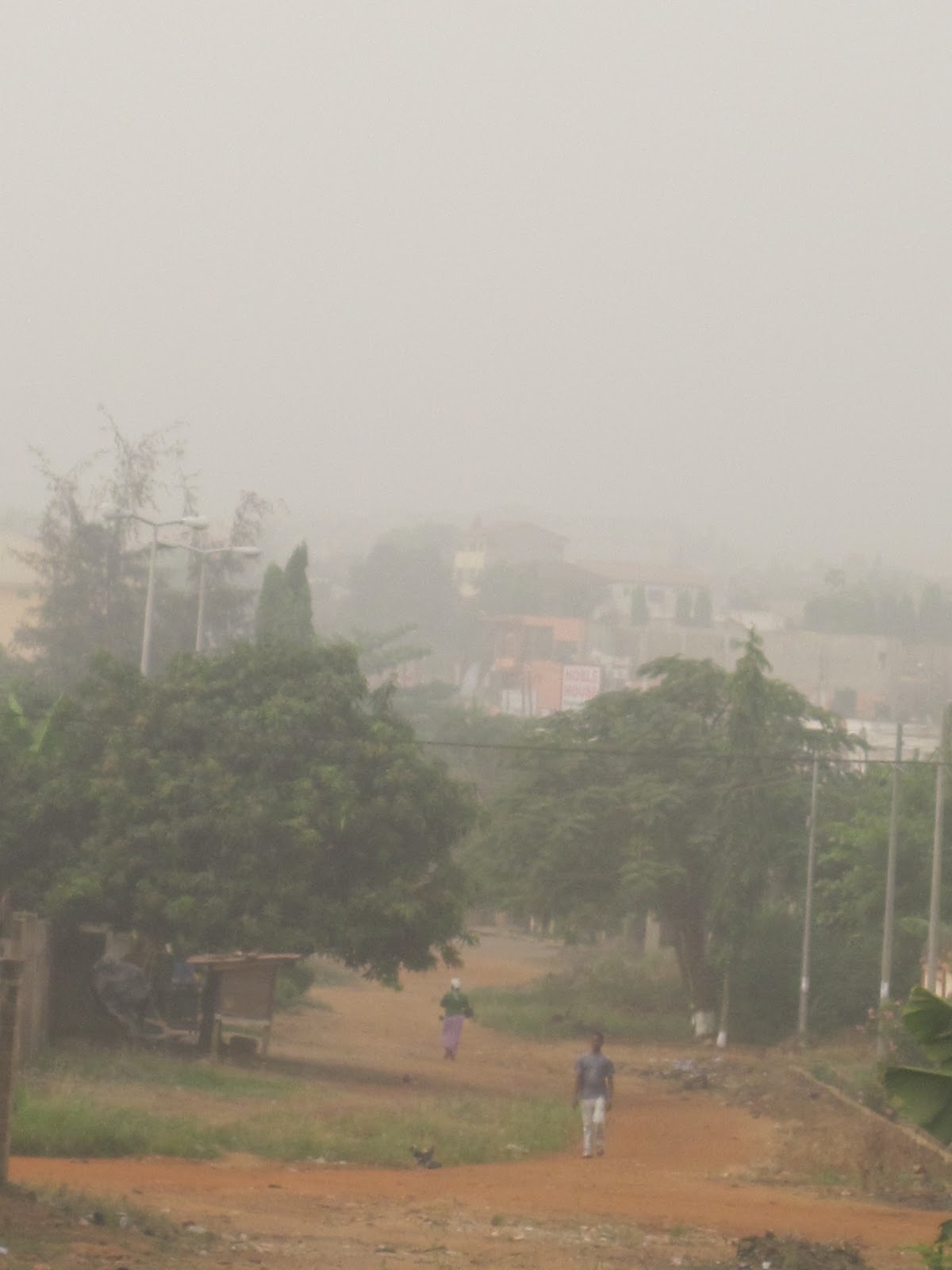
The White Stuff Keeps Falling!  Visibility is limited, flights are delayed or canceled, it is darker in the morning and generally all day long...is Ghana experiencing the same weather as the US?  No, but there are definitely similarities.  This is the worst Harmattan winds that I have seen and many Ghanaians report that this is worse than normal.  As you can see by the picture, the dust is so heavy in the air  - you can dust things in the morning and two hours later it is covered again with a fine white dust.  Imagine dust raining in your house - you leave footprints when you walk.  It's a dusting nightmare!  People are coughing as we breathe it in all day, eyes are burning with it.  The picture taken at the sun was at mid-day - you can easily look directly at the sun without it hurting your eyes because there is so much dust in the way.  The weather is still warm enough that you don't want to shut the windows but it makes me rethink the air conditioning debate of February 2010 that Bob wrote about...

Hannah has been oh-so-busy applying to colleges and also scholarships.  She found out that she was accepted to the two colleges of her top choice - Calvin College and Eastern University.  When she learned that she was accepted to Calvin, I think people within a five mile radius could hear her scream of excitement.  Clearly she is favoring being in her home town, with friends, her aunt and uncle, her beloved church and pastor, and of course, lots of familiarity.  She continues to do well in school but does seem to be fighting a little bit of "senioritis".  She is currently in the Model United Nations, along with many highschool students from the West Africa region, and this year was assigned to represent the United States Security Council.  Should be a good learning experience again. 

Noah turned 16 years old on Sunday, January 16!  It's so strange to think of him that age!  He spent the weekend with five other young men, playing Xbox, basketball, guitar, watching movies, and played a great board game called "Quelf" - this board game is lots of laughs and is great for a group.  They stayed up all night on Friday night will probably be paying for it for a few days but they had fun.  He is starting the second semester of his junior year - the year that is important for grades as that is what colleges look at.  They just received their first semester report cards last week and he continues to do well.

Managing Relationships with LOVE (Limits, Obligations, Values, and Education) - For the past ten days, we have had a visitor from Judson University in Illinois, Dr. Marsha Vaughn.  We met Marsha at the Partners Worldwide conference in October and she expressed interest in the boundaries class that we teach as part of our business curriculum.  She is also doing research on the impact of business on women and their families in developing countries, so a trip here would allow her to continue that research as well as offer a workshop that would go deeper into the boundaries issue.  The first few days were spent visiting women-owned businesses, with the focus of learning about the impact on the woman herself.  I learned a lot about Ghanaian marriages and the role of the extended family.  It was enlightening to visit businesses from this context.  We then had a three day workshop, on the above named topic, with leaders who both need boundaries for themselves as well as find themselves in positions where they need to counsel people.  This was then followed by two days of counseling appointments for these leaders, for them to experience being a counselee as well as to learn more directly from Marsha.  The time was powerful, productive, and eye-opening.  We thank God for Marsha and her willingness to spend some time here.  The pastors are now planning on how to follow this up and create more supports within their churches. 
Marsha and Georgina, owner of Lexgina Tailoring shop, Lexgina Vocational School, and Lexgina Medicine Shop.  The amount that women juggle in terms of family, home, and business is amazing.


This is Grace and the young men who work for her.  Grace owns a business processing the refuse of tuna fish from the Starkist plant in Tema, outside of Accra.  She drys and grinds the tuna refuse and sells it to those who make poultry feed.  Grace was a Muslim and became a Christian a few years ago, which resulted in many trials for her - she renamed herself "Grace" and has an incredible story.  She hopes to join our next SME training with Hopeline and also hopes to write a book about her story at some point.
About 40 people attended this three day workshop - SME business owners, many pastors, church leaders, community leaders.  This slide has info about limits - the highlight of the workshop - learning that it is right, good, stewardly, and even Godly, to set limits.
The obligatory group picture
A shot of the Aburi Botanic Gardens, northeast of Accra - the majesty of some of the trees was beautiful.This is a 160 acre reserve, with about three acres developed into a formal garden.
A huge tree at the Aburi Gardens - I believe it is commonly known as a Rubber Shade tree, or a Ficus Elasticoides. 

Monday, January 10, 2011

La Cote d'Ivoire

 Weather:  The Harmattan winds have moved into Accra.  These winds are dry and dusty and as they pass over the Sahara, they pick up fine dust particles.  This dust limits visibility and blocks the sun,  while depositing a fine layer of dust on everything.  Noah reports that his lips are cracking and he needs a mask to keep the dust out of his lungs:-).  These winds have lowered the humidity from about 80% to 45%, and temperatures remain in the low 90s.

Ghana's neighbor to the west, Cote d'Ivoire, has been very much in the news in recent months.  Because of our work in Danane, on the western side, close to Liberia, I have been following this news very closely.  I thought I would highlight the current situation this week and ask for your prayers.

Brief History - Cote d'Ivoire became independent in 1960 and was lead by Felix Houphouet-Boigny from 1960 until his death in 1993.  During that time, Cote d'Ivoire became known for its religious and ethnic harmony, as well as a strong economy.  Since his death, the country of 20 million has seen several struggles for power as the country faced a democratic process for the first time, leading up to a civil war in 2002, primarily between the mostly Muslim north and the mostly Christian south, although the dispute was not over religion.  Much of the fighting had to do with voting rights.  Because of the economic success of Cote d'Ivoire, the country attracted a lot of foreigners, and by 1998, 26% of the population was made up of Africans who were not from Cote d'Ivoire.  56% of the 26% were from Burkina Faso, their poorer neighbor to the north.  The catalyst for the war happened in 2000, when the government declared that the parents of a presidential candidate must both be Ivorian born.  This excluded the northern candidate, Alassane Ouattara.  The fighting came to an end in 2004 however the country remained split between the rebel held north and the government held south.  Things remained tense until a peace agreement was signed in 2007.  Since then the country has waited for elections, which were delayed six times, mostly over the exclusion of names on the voting lists.

Current situation:  On October 31, 2010, an election finally took place, resulting in the need for a run off election on November 28,2010 between the incumbent president, Laurent Gbagbo, who has been in power since 2000, and Alassane Ouattara.  The Independent Electoral Commission declared Ouattara the winner, with 54.1% of the vote, while Gbagbo received 45.9%.  This was then overturned by the Constitutional Council, the highest court in the land run by the president's allies, who claimed "massive vote rigging" in four regions of the north, and declared Gbagbo the winner.  Both candidates were sworn in as president and have been in a stand-off ever since.  Most nations around the world have declared their backing for Ouattara and have requested, urged, and demanded that Gbagbo step down.  But so far, that has not happened.  Gbagbo has the national army.  Ouattara has the rebel army, the French contingency and the UN mission behind him. 
 
Laurent Gbagbo (left)*
  • Age: 65
  • Southerner, Christian
  • Former history teacher, president since 2000
  • Declared president by Constitutional Council
  • Backed by security forces
Alassane Ouattara (right)*
  • Age: 68
  • Northerner, Muslim
  • Economist and former prime minister
  • Declared winner by Election Commission
  • Backed by former rebels, UN, African leaders and the West
*(taken from BBC News)

So far, at least 22,000 refugees have fled to Liberia - mostly women and children - of differing political views - some who support Gbagbo, some who support Ouattara, but both who fear civil war and retribution for their vote.  Various foreigners have been expelled from the country, prices have risen, and there have been reports of some violence and killing.

There is only one country who has declared that they would not take sides and would support either government.  The country?  Ghana.  President John Atta-Mills declared this on Friday, stating that there are one million Ghanaians living in Cote d'Ivoire who would be victims in a military intervention.  Ghana would normally be one of three countries (the others being Nigeria and Senegal) who would be expected to take a leading role in a military intervention from ECOWA, which is the union of West Africa States.

In terms of reference, Liberia is slightly larger Tennessee, Cote d'Ivoire is slightly larger than New Mexico, and Ghana is slightly smaller than Oregon.   So if you happen to live in the North America, it would be like a neighboring state or province beginning a civil war. 

Please keep this on-going tense situation, affecting millions of people, in your prayers.  Pray for wisdom and discernment for the key leaders, a resolution that doesn't include fighting, and provision for those who suffer in the midst.

Monday, January 3, 2011

2010 in review

New Year's Day has come and gone.  I didn't want it to happen.  Changing to a new year feels like going farther away from Bob.  If anything I want the clock to go the other direction.  I approached New Years like a dog on a leash who does not want to go for a walk.  But it came anyway and now it's 2011. 

I realized that I only saw Bob for 33 days in 2010 - we were together for the first two weeks in January and then Bob went to Mali for the West Africa Ministry Team meeting with CRWRC.  We then had two weeks together in Ghana before I traveled to Liberia/Cote d'Ivoire for two weeks; we had two days together again and then Bob left for Nigeria.  Then a day and a half together again before he died.

After that, there was a loud crack in the atmosphere and the rest of the year is a blur.  It's amazing that anything got done at all.  I have pictures for what happened for the next nine months but it really has been a blur.  The blog attests to ongoing work and life.  That I still have a job and that work was done is only from God.

I am thankful that even though we don't know what 2011 holds for us, we do know Who holds 2011.  I'm thankful that we have the opportunity, through forgiveness, to start this new year without guilt or anxiety, looking to the Shepherd to lead us.  May God grant each of you a blessed year in 2011.

Here are some pictures that didn't make it to the blog.
Picture of Bob in Mali in January 2010.  If you knew Bob, you would appreciate that he is being "tongue-in-cheek" whenever you see him pointing to some sort of scenery in a picture.  Obviously he didn't have to point at the scenery behind him:-). 
He loved taking pictures from airplanes.  I can't count the number of cloud shots that I have from him.  I'm happy for him that he gets to see this perspective much more often now. The new background on the blog is a tribute to his love of clouds.  The deep blue of the sky was also his favorite color.

The last picture I have of him.  I have no idea who the man is with him.  Taken March 18 just before leaving Nigeria to return home.
A few days after his death, in Grand Rapids with my incredibly supportive family.  I'm showing some pictures that my friend Laurie took of Bob after his death.  My brother Henry is beside me, my mom next to me, and Henry's wife, my sister-in-law, Marnie next to my mom.
This picture of flowers from the memorial service has a bit of a story with it.  On our first Valentines Day together, in 1990, I was in Canada and Bob was in Grand Rapids.  He sent me one daisy on the 13th, saying that our love was simple and beautiful like a daisy.  I thought it was sweet, although I wondered at sending just one flower.  The next day, he sent me a dozen roses, saying that while our love was simple and beautiful, it had exploded into something breathtaking and powerful.  Every year after that, while we lived in the US, he sent me a dozen roses with one daisy on Valentine's Day.  [However, I regret to say, that when we were in the US in 2009 for Valentine's Day, I wasn't happy to receive them because of the high price - after living in Africa, it seemed wasteful.  I'm so sorry, Bob.]  At the memorial service, my sisters bought this dozen roses with a daisy for me to remind me of his love. 
When we scattered his ashes, I scattered the rose petals and daisy on top of the ashes, before placing the tree on top.
After the ash ceremony, Hannah and I share a hug at Lake Michigan - near Bliss, Michigan - one of Bob's favorite spots.
My sister, Janette (who many people seem to think is my twin!  She was hugged by many people this past Christmas when at Madison Square Church who thought she was me.  Others looked suspiciously at her husband, Dale, wondering if I had moved on already!).  After Bob's death we were looking in the basement for some pictures and I ran across a bottle of wine that we had been given on our wedding day.  We had been instructed to drink it at our ten year anniversary.  However, we didn't - I don't know why not - and I wondered what to do with it.  So, after we got back from ash ceremony, we opened the bottle, and we all toasted Bob (even the kids, although they didn't like the wine).

Monday, December 27, 2010

Grief Work continued...

I told myself after the six month mark, September 20, that I wasn't going to write about the grieving process again until we got to the year anniversary of Bob's death.  I felt like I was being a little too honest, a little too open, a little too me-centered instead of celebrating the work being done and highlighting the situation in the majority world.

But I want to write this post about grieving.  It's now been nine months since Bob died.  In the past eight weeks, I passed our 20th anniversary, Thanksgiving, the day after Thanksgiving which was always "decorate the house for Christmas day", my birthday, Christmas and soon New Years.  Each of these events have spun me through a cycle of grieving that wears me out.  I have written before that Dave Graf and Judy King have been listening/counseling/praying with me every week since Bob died.  Jackie Venegas (wife of Dante Venegas) and Mary Katerberg (wife of Norm Katerberg) have now joined this group.  If you followed our Reeds in Liberia blog (www.reedsinliberia.blogspot.com) you will remember the posts that we did when each of their husbands passed away - both Pastor Dante and Norm were near and dear to our hearts.  I have had very little contact with other widows and have had no access to grief support groups, so when Jackie and Mary offered to be on calls with me, I quickly said yes.

It has been so helpful, especially in normalizing what I'm learning to see is the "new normal".  I have learned about "widow brain", which I had been experiencing and worrying about but hadn't known about.  If you google it, it will say "it is a side effect of grief where your brain tries to protect you from pain - unfortunately it causes you to forget pretty much everything."  I can't tell you how often Hannah has said to me in the last few months, "Mom, I already told you three times."  I was reminded that the grieving process is a matter of many private mini-crises - which I really experienced on the trip through Southern Africa with countless reminders on a daily basis when spending time with married people who talked and laughed about marriage, retirement plans, filling out forms at the border that give choices like "married, single", etc.  Normal things but each time felt like a punch in the stomach.  Not something that you share with people but deal with privately, every day, multiple times a day.  I was told that grief is a jagged hole in the soul and the heart - eventually the jaggedness smooths out but the hole never goes away.

But one thing that I have been surprised at (and has been confirmed by other widows) is how few people ask me how I'm really doing.  How few people ask about what happened.  How some people who knew Bob, haven't seen us since his death, will spend time with us and never mention his absence.  I bring it up, hoping to engage a conversation about it - because much of the time, that's all I'd rather talk about - but no bite.

I wonder why that is.  Are they really trying to take care of me by not wanting to "cause me pain"?  Or are they really trying to take care of themselves and avoid being uncomfortable?

I guess that's why I wanted to write this blog - to encourage communication between grieving people and those who love them.  I can't speak on behalf of all those who are grieving or even all widows, but my sense is that more questions, more people entering the conversation that is going pretty much non-stop in our heads anyway, more people joining us in the acknowledgement of our loss, would be a good thing. If we cry, it's because we need to, not because you made us.  If we don't want to talk about it, we can let you know. 

Jackie Venegas surprised me when I was home in October by giving me a copy of an email that Bob had written to her after Dante died.  It was like he was writing it for me and I want to share it with you.

June 26, 2007

Dear Jackie,
I'm sorry to hear about the pain you are experiencing.  And I'm sure you knew in your head, this is the beginning of the most painful part of Dante's death.  Is it not more painful even than those last four months?
 You are absolutely right - before you can even think about a "new phase in life," you must do what you need to regain strength and stamina.  Your primary life task is to mourn, to grieve.  That takes an enormous amount of energy.  I agree with those who have told you (and you have told others grieving, I'm sure) to rest.  When you are tired, rest.  If you need to talk and you trust there are people to listen, then by all means talk.  This will help by giving vent to the emotion produced by overwhelming memories and the sense of loss.  I suspect you will need to vent.  A lot.  Perhaps far more than you think you "should."  Well, I hope you already know this:  when it comes to grief, there are no shoulds, no rules, no books.  Everybody writes their own.
Believe it or not, you are not going crazy.
There is almost nothing else I can say.  If I were there, I'd just sit with you.  This terrible part of your grief journey is inevitable, and it is yours alone (though you are not alone).  No one can ease the agony, no one can enter in at the level you experience it.  And no one knows how long the acute deep pain will last either.  But it will ebb in time.  the ebbing of acute pain will bring new challenges, but those are for that time, not to be spoken of now.
Your friend,
Bob Reed
It's great to hear his "voice" about this issue.  He's exactly right that I need to vent.  But the person I need to vent to is him.  I don't have family, friends, or support groups in Ghana.  So that means a huge amount of stuffing emotions every single day.  Which is exhausting.

I miss him.  But having my mom here over Christmas has helped a lot and I thank God for her.

Meanwhile, during Christmas...

...baking together became a challenge as Noah and Hannah frequently chose to attack their poor mother.

...someone (I won't mention any names) decided it would be a good idea to give Noah boxing gloves...hmmmmmmm....
Hannah is delighted to find makeup and manicure sets under the tree.  Before....
And after!  [Note the curly hair - she did NOT curl her hair at all - she got a hair cut this week and discovered the joy (finally!) of the effect of humidity on her natural curls:-)]
Waltzing in the kitchen during last minute baking details.

Tuesday, December 21, 2010

Welcome/Ngiyanemukela (Zulu)/Welkom (Afrikaans)!

When you tell your 10-year-old and 12-year-old that you are moving to Africa, there are two pictures that most likely come to their minds - animals and poverty.  Hannah and Noah have seen a fair amount of poverty in the past five years of living in West Africa, but as they recently pointed out to me, no animals to speak of.  Since Hannah is leaving Africa in June, and we don't know if or when she will come back to Africa, I thought it was time to rectify the situation.

Hannah will share with you our week long vacation in South Africa last week in the words and pictures below:

So, as most if not all of you know, we, the Reeds, along with my Oma spent the last week in the beautiful country of South Africa.  Since pictures are worth a thousand words, there will be more on this than usual, and they will hopefully do a lot of the talking for me.  But here’s an overview of the week in South Africa:

Tuesday, Day One: We arrived in Johannesburg in the morning, and spent most of the day resting and exploring the area around the hotel we were staying at. 

Wednesday, Day Two: This is where the excitement started.  We awoke bright an early at 6 am, and were on the road to Kruger National Park by 7.  We were going on safari for three days!  It was a very long drive, but in gave us time to get to know our guide.  His name was ‘H’.  Not really, but that is what he said to call him, because he said it would be easier.  We got to the Kruger in the mid-afternoon, and started off with a lot of excitement.  Within the first couple hours, we saw impala, giraffes, zebra, beautiful birds, and a black rhinoceros.  The black rhino was the most exciting, as it is extremely rare to see one.  We got to our bungalows and put our luggage down, then went out on safari again, this time seeing hyenas, baboons, and even some hippos and crocodiles from a distance.  We had a delicious South African dish for dinner, and went to bed around 9:30.

Thursday, Day Three: We got up way too early, around 4 am and were on the road by 4:45, as H told us that early in the morning was a great time to see animals before it got too hot.  So we drove around, looking every which way for animals, in the open jeep H picked us up in.  We all got fairly cold, but warmed up with some hot chocolate a couple hours later.  It was in this early-morning time that we had one of the most exciting experiences, if not the most exciting experience, of our trip.  We were driving along a dirt road and up ahead of us we saw a huge bull elephant standing in the middle of the road.  As we approached, he moved off onto the side of the road, and began eating the leaves of a tree, still only maybe 10 meters away from our vehicle.  Then, all of a sudden, he moved directly in front of our jeep, so close that he was touching the front of it, just calmly eating.  It was very tense in the car, as elephants will scare easily and are big enough to tip and trample our car.  But H made the decision to turn on the jeep and quickly back away, and as he did the bull elephant backed off too, waving his huge head and he strode back to his tree and began eating again.  Since the road was a narrow one, and the way back was long, H moved forward again, coming to stop again so we could watch the elephant eating.  Since the elephant was still riled, we had to be very careful and not make a sound.  Then, when H believed that he was calm again, he started the engine of the jeep.  As he did so, the elephant charged!!  It was only a mock charge, but he came so close he almost rammed into the jeep!  It was terrifying, and exhilarating.  We got away and the elephant, thankfully, decided not to chase us.  It wasn’t until we were a good distance away that my hand came away from my mouth and H stopped shaking.  Mom’s reaction?  To burst out laughing.  So anyways, after a while longer, we went and had breakfast, rested up a bit at the bungalows, and then in the evening, went out on safari again, this time with a larger group.  We started out as the sun was going down, and would be gone until after dark.  It was fairly uneventful at the start… until we heard about the lions that had taken down an impala.  So the man driving (not H this time, since we were with a large group) started driving.  It took a good 45 minutes, but the time was well rewarded as we came across a beautiful male lion up the road.  We pulled up alongside it and when it roared, which it did several times, you could feel the vibrations throughout your whole body.  It was terrifying, and awe inspiring.  A couple miles further, and we came upon the lion’s pride, noisily devouring an impala.   Once we turned around and headed back, we came across another elephant in the road.  It left the road once we came, but it trumpeted several times while still close to us.  That sound, like the lion’s roar, was incredibly loud, and extremely cool to hear.  The matriarch of that herd mock-charged us, and we quickly left.  When we got back, H was waiting, and we went to eat dinner.  

Friday, Day Four: This day happened to be December 17, mom’s birthday!!!  Happy Birthday Mom!!!! We got up at 4:30 this time (yay, an extra 30 minutes!!), packed our stuff, and headed out of the Kruger.  It was hard to say good bye to such a peaceful, beautiful place.  But the day’s excitements had just begun.  On the way back, we had a couple stops planned to see some of South Africa’s beautiful sites.  The first stop was at an absolutely breathtaking waterfall, called Lisbon Falls.  The second stop was at a place called the Three Rendevals.  Neither of these places could possibly be described with words, and even pictures won’t do them justice, but hey, we tried.  They were absolutely breathtaking.  We got back to the hotel after hours and hours of driving, at around 4 pm and rested for the remainder of the day.

Saturday, Day Five: We got to sleep in on this day, until an incredible 8 o’clock, and left at 9 to go to South Africa’s Apartheid Museum.  The Apartheid Museum is filled with everything to do with the apartheid in South Africa, which started in 1948 and ended in 1994.  It showed videos, pictures, and had lots of information about what apartheid involved, how it began, and how it ended.  After the museum, we went to the Gold Reef City, an amusement park literally next door to the museum.  We went on some rides, which is always fun, but the main attraction for us there was the gold mine that the park was built over.  We got to take a tour down into the mine and saw and learned about the lives of miners in the mines, and how the mine worked.  It was fascinating to actually be in the mine, where it was dark and damp, with rock and dirt all around.  At about 5:30 we headed back, and stopped off at a restaurant to belatedly celebrate mom’s birthday.

Sunday, Day 6: This was supposed to be a ‘relax at the hotel’ day, and it turned out to be just that for Mom and Oma.  The huge storm that rolled around in the late afternoon was unexpected, but they were still able to rest after the business of the days before.  For Noah and me however, it was a fun-filled day that also turned out to be the kind of fun that’s restful.  We went over to Noah’s best friend’s house, a good friend of mine too, and hung out there for the day.  We swam in a pool that was close to his house, I watched him and Noah jam on the guitar and failed miserably when they gave the guitar to me to try, we went on their boat out onto the dam they live next to, went knee boarding, and watched him go wakeboarding and bruise his ribs after falling.  All in all, a very fun day, and Noah and I went back to the hotel happy and sunburned in the evening.

Monday, Day Seven: Our last day in South Africa.  We spent this day at the mall, doing some shopping for goodies that are difficult to come across in Ghana.  We left for the airport around 1:30, ate KFC after checking in, and got on the plane around 4:45.  After a 5 and a half our plane flight, we arrived safely back in Ghana, luggage in tow and happy to be home.

These were the first animals we saw upon entering Kruger park.  They are Impala, which are plentiful withing the park and fall prey to many of the animals within the park.  They are part of the antelope family and are very beautiful and graceful.
This was one of our more exciting sightings, a rare black rhinoceros.  White rhinos are more common.  Even H, our guide, had never seen one before at Kruger.  (Hannah spotted it - good eye, Hannah!)
One of our first sightings of zebra, with the added bonus of seeing a giraffe as well!  Both are calm animals, and as you can see, get along pretty well.
A troop of baboons, hanging out by the side of the road.  they babies were so funny as they tried to play on the rail and kept falling off!
Just a boring ol' picture of us, in the open jeep where we spent most of the safari.
At mom's startled cry of "Ohh!", this Kudu took off running, but not before we got a glimpse of him and his massive horns.
A huge heard of buffalo crossing the road.  And I mean, it was huge - hundreds of buffalo.  Very cool to watch.
Our first elephant sighting!!! It was a small herd of only 3, and they were a distance away, but still very exciting.
This was the elephant that mock-charged us first.  It was so close, absolutely terrifying and awesome at the same time.
This shot is of the elephant starting to charge the vehicle.  Thankfully, we got away with no injury to ourselves or the jeep.
This lovely little cackle of hyenas (yes, a group of hyenas is really called a cackle.  Guess what a group of zebras is called?  A Dazzle.  Guess what a group of giraffes is called?  A tower of giraffes.  Cool huh?) was relaxing by the side of the road just waiting for their picture to be taken.


This is the lion that we saw on the evening safari.  It was an awe-inspiring thing to hear it roar.  [Video of this is below.  If you carefully at the end, you will see Hannah in the rear-view mirror, looking awed!]

The bungalows where we stayed.
These are the guys who helped us with the tour in Kruger.  On the right is Jonathan who cooked some delicious meals; in the middle is Hilke (or "H"), our awesom tour guide, and on the left is a guy from Australia who hung ouut with us on our 2nd night in Kruger.
This is the beautiful Lisbon Falls.  The picture does not do real justice to its beauty.  Surrounded by mountains, and beautiful green fields, it is in the mountains of South Africa.
A picture of the Three Rondavels.  It was dizzyingly high, but absolutely breathtaking.  There just aren't words for the beauty of this area.  BTW, if you have ever watched the movie The Gods Must Be Crazy, this is where the bushman throws the coke bottle off the edge of the earth.  Often clouds will fill this place.

Us in front of the Three Rondavels.