Monday, May 14, 2012

Is it worth the weight?

When Andy DeJong gave our wedding message in 1990, his recurring phrase was, "Was it worth the wait?"  At the time that irritated me a little, as it was clearly directed to Bob, who was 35 years old, but I was only 21 and had not waited that long!  However, that phrase has now come back to me but with a different spelling.

Bob usually left the packing to me:-)
I am beginning the packing process.  When we leave, Noah and I will each get to carry two 50 lb. suitcases of our household belongings, for a total of 200 lbs.  When we moved here, we had four of us, and because we were frequent flyers with Delta, we each were able to take three 50 lb. suitcases, for a total of 600 lbs.  For our tip back in June, we were able to get a better price on a different carrier, not Delta, so we will only be able to carry two bags each.
Leaving for Liberia in 2005

So I am beginning the "is it worth the weight" debate as I consider the many and various items in our house.  Clothing is heavier than you might think.  Add to that books? Pictures?  Electronics?  Files?  Receipts?  Favorite beddings, towels, kitchen items?  Gifts received in-country - especially unique carvings that are heavy?  But where the weight debate really gets weighty is in making decisions regarding things about Bob.  I have finally been able to give his clothes away, except for a few favorite items.  But as I sort through the contents of a drawer or closet, I find more things that remind me of his life in this house:
  • his doodles and drawings and comments and notes in countless journals and papers - in many ways he was such an artist...these will certainly add up in terms of weight...Is it worth it?  The alternative would be the trash - seems harsh.
  • a glass 9 x 13 baking dish that has gone from Prospect Street to Liberia to Ghana.  This was a debate item for us because I knew that we could purchase that item in-country AND there was the risk of it breaking , but Bob loved that baking dish, and so it made the journey.  It is sad to think that the glass dish outlived Bob.  But now, is it worth the weight?
  • a box of pens that has only three of his red felt tip pens left in it.  Again, not much weight but an open box of pens from someone who loved writing and was so good at it...is it worth the weight?
  • cords upon cords that I have no idea where they go to or what they were from...no sentimental value here but I would love to ask him what they go to...I also fear getting back to the US, having Noah ask where the cord is for this or that, and I realize that I trashed it.
  • an almost empty perfume bottle that Bob gave me
  • passport pictures of Bob - again, not much weight but since the alternative is trash, do I really throw those away?
Of course, the most painful thing is that I am about to leave the last place that Bob lived.  Never again will I experience the simultaneous joy and pain of opening a drawer and finding something from him.  Never again will his imprint be on the things that make a home a home.  Even if I took a lot of these pieces back and scattered them around a new home, I would know that they were place by me and not him.  And so, it's like losing him again, with each decision I make of suitcase versus trash. 

One of our favorite movies is the Shawshank Redemption.  At one point in the movie, the main character utters the haunting phrase, "Get busy living, or get busy dying."   The idea behind this quote is that we can spend our time looking backward or looking forward.  I need to get busy living and I am determined to do so.  But the next few weeks may involve dying just a little.

Monday, May 7, 2012

May 2012 Updates

It's time again for updates from the Reed Family:

Noah's graduating class
Noah is graduating from high school in just three weeks!  Prior to his graduation, he will be going on his senior trip to Barcelona, Spain for six days.  Noah's trip, in large part, was sponsored by our dogs, Jack and Dusty, who faithfully contributed puppies that were sold, as well as through candy sales donated by relatives and friends.  I'm sure they will have a great time on their trip.

Another shot from the graduating class
Noah graduates on May 31st, and the very next day we get on a plane to head back to Grand Rapids, arriving on Saturday afternoon.  On Sunday we will have his open house. [You are invited - see invite below!]  Noah starts work with Spring Hill Camp on Monday, June 4, so there is no time to lose!  It will be quite a full and exciting few weeks for him.  On the left is a picture of the graduating class - quite a diverse group of fun young adults!

Hannah is finishing her freshman year at Calvin and is looking forward to taking a summer class as well as continue working at the Calvin library full-time over the summer.  She is hoping to get some time off for vacation at the end of the summer but in the meantime is keeping her nose to the grindstone.  Thankfully, some of her friends live in Grand Rapids so she will be able to continue to hang out with them during her off time.  We will have the not-at-all-unique challenge of having one car with three working individuals, all working in different places!  I'm sure the Rapid will come in handy.  She is also volunteering at Bethany Christian Services and was given the dress she is wearing in this picture by family with whom she is working.

 As for me, I have decided to come back to the States to continue in my same position as West African Regional Facilitator with Partners Worldwide until December of this year.  It has been quite a process over the past few months to reach that decision, but through prayer and consultations, I think it is the best decision.  During this time, I will be praying about my next field placement.  I will be taking an unpaid sabbatical during the months of July and August in order to have a silent retreat, spend some time with my parents as well as Bob's parents, focus on being a parent, and try to figure out this next phase of my life.  My father has been in a nursing home in Canada for the past nineteen months and I have only been able to see him once.  Bob's step-father, in Lake City, has been seriously ill for the past six months and needs help getting to dialysis three times per week.  It will be good to spend time with them and help out where I can.  From September - December, I will be both at the central office in Grand Rapids, as well as back on the field, continuing the work of our partnerships in West Africa. 

And now in other news...

The trial of Charles Taylor, which began in 2007, finally came to a close as he was found guilty of eleven counts of war crimes and crimes against humanity during the civil war of Sierra Leone.  These war crimes include murder, rape, mutilation, sexual slavery, and the conscripting child soldiers.  While this conviction brought relief in Sierra Leone, it did cause some strife among Taylor supporters yet in Liberia.  It has gained some world attention as Charles Taylor is the first former president to be found guilty by a modern international tribunal.  He will be sentenced on May 30 and it appears that the prosecution will be looking for an 80 year sentence.  The 64 year old Taylor will serve his sentence in the UK, and, of course, it is expected that his defense team will appeal.

What was very interesting was that during the two hour reading of the verdict, a rainbow appeared around the sun in Liberia for about an hour, which caused quite a stir.  According to the news, this same rainbow around the sun occurred when Taylor was extradited from Nigeria to Liberia in 2006 before being charged with the war crimes.  We were in Liberia at that time and I don't remember that, but many are viewing this as a sign of blessing from God. 

Ghana has become the first African country to pioneer two vaccines of the most deadly infant diseases:  rotavirus, which causes diarrhea, and pneumococcal, both of which kill 2.7 million children worldwide each year.  Ghana continues to do well on the Millennium Development Goals and these vaccines will help in cutting child mortality by 2/3rds by year 2015.

In work news, the fiscal year for Partners Worldwide is coming to an end, so all of us are busy looking back at how we did on our plans for the past year, and looking forward to what we hope to accomplish in the new year.  It is always an exciting time to take a step back and look at the big picture to see the effects of our efforts.  It's also fun to look ahead and imagine what we would like things to look like a year from now.  To seen a Reed update letter, as well as a story from one of our businesses in Ghana, please click here.

Monday, April 30, 2012

Becoming African...

Weather:  The rainy season has arrived!!  I love the rain. During the rain, the temperatures can drop to the mid-70s - downright cold!  Unfortunately, after a few hours it gets pretty steamy as temps climb up again to the mid-80s or 90s.  But a nice change of pace!

The countdown is now on for when we leave Ghana - just about one month left.  As we prepare to leave, after living in West Africa for seven years, Noah and I have been having discussions about if there are parts of us that are now more African than American.  After reflecting on that a bit, I thought I'd share of my own reflections/changes.  Some are obvious, others not so much.  Some people have called me African-American...but I think American-African might be more appropriate:-).

Some of the changes are:
Football - Most of the world understands football to be what Americans call soccer.  Most of the rest of the world is in love with soccer, yet Americans continue to be in love with football.  Some West African friends have told us that American football should be called handball - they don't understand why it is called football.  I have grown to love this sport - the amazing talent in the footwork that you see on the field is akin to a dance of sorts.  The skill, talent, and energy for this sport is immense and impressive.  So I definitely prefer this game of football to American football.  Additionally, just as in the US, watching this sport is a community activity.  The difference here is that since many people gather together to watch/listen to it around shared televisions or radios.  And since most of us have year-round open windows, we hear celebrations all around us when there is a goal.  For example, during one game, there was a penalty kick-off, and our coverage was about two seconds behind the coverage that our neighbors were getting, so just as the person kicked, we knew he had scored!  I will miss the constant access to football. 

Protocol/Formality - They say that the American culture is one of the least formal in the world.  West African culture is definitely more formal.  There are processes and procedures that must be observed when communicating.  While it definitely took time to learn, and I'm sure I still make mistakes, I have grown to appreciate the formality and procedure.  In fact, it is now frustrating to me when working with Americans when protocol is not observed - I have to catch myself to remember that it is not part of the US culture.

Food - spicy and ricey.  I have grown to love my food spicy - all of it (except for sweets of course).  I even put hot pepper on popcorn.  My kids are amazed if I ever say that something tastes hot to me, as I usually eat my food very spicy.  When I go back to the states, I have to find a way to spice it up or it tastes bland.  Maybe I need to start carrying hot sauce in my purse.  Also, I have become very accustomed to having rice every day.  I'm not to the point yet, like Liberians, who say that if you haven't had rice, you haven't eaten that day.  I can go a day without it, but it has become a staple. 

Respect for elders - While respecting elders is important in Liberia, Ghana carries it to a whole new level.  Respect for elders does not mean respect for those who are elderly (or over the age of 65), but respect for anyone who is older for you.  That means, when I arrive at a place and get out of my car with my computer bag or other items, someone younger than me will rush to carry it in for me.  [Several American guests have been alarmed at someone rushing out to take their bags from them - off their shoulder, out of their hands, without any explanation:-).]  At first I thought it was because I was American or a woman, but then I came to realize that it is done for everyone.  I remember arriving at a place where a woman, seven months pregnant, and about ten years younger than me, rushed out to take my bags.  When I told her there was no way I was giving her my bags (she's a friend and colleague so I could be direct), she laughed and told me that she must help her elders!  The down side of this is that if one is a manager of a business and you have employees who are older than you, you cannot correct them.  That is why when you read in a business plan that employees will be 46 years old or younger, for example, it is because the owner is 46 and he or she can't hire someone older than them!

Appreciation for the lack of separation of church and state  - I love the increased tolerance for religion that I have experienced in West Africa.  Meetings will start and end in prayer, regardless of whether it is a government meeting or community meeting.  I don't have to worry about being a Christian or offending anyone when talking about my faith.  I know that is not the case in all parts of West Africa, of course, but for the most part I have experienced this in both Ghana and Liberia.  Our work has been with both Muslims and Christians, and there has been a pretty open dialogue and acceptance of differences.  I know that doesn't make the news very much, but I'm thankful that it has been my experience here. 

Global news - I love that I live in much more of a global world while in West Africa than what I experience it the US.  I have access to BBC all the time here and all of the news is much more comprehensive to what is happening around the world.  One thing that I find so difficult is to listen to the news while in the US - 90% of it seems to be about the US and much of it is focused on celebrities or one particular crime.

Individualism versus Community Minded - By far and away, one of the major differences between North Americans and West Africans is the mindset toward the community.  North Americans tend to be individualistic - my goals, my dreams, my job, my kids, my possessions, my income.  West Africans tend to view things from the community perspective, balancing their own wants and needs in terms of what is best for the immediate family, extended family, church, and community.  I have seen the pros and the cons of both ways - there are things that are both healthy and unhealthy about both ways.  So I've learned to switch between these depending on the setting that I find myself in.

Time - I believe that I have managed to hold on to my own sense of time, while becoming much more relaxed about other people's sense of time, at least for Africans.  I no longer arrive early for meetings but usually right when the meeting is about to start.  But I have learned that it is appropriate to not be so focused on time as to pass people without greeting them, to start a meeting without finding out how people are doing, to ask about their families, etc.  This also relates to a warm culture versus a cold culture - it takes more time to be in a warm culture as it is more relational. 

Spirituality - West Africans tend to be much more spiritual than North Americans, seeing the work of spirits in many areas:  sickness, success, failure, death, and many other areas.  North Americans tend to undermine the role of any spirits in these things, looking to science for the answers.  I have come to appreciate this heightened sense of spirituality; growing up we did not spend much time being aware of demonic activity, yet Jesus spends much of his time casting out demons.  While I don't agree with the extent that this reaches (i.e. sickness or death as a result of curses or witches instead of malaria or sanitation issues, activity of deceased ancestors in daily life, etc.), I do appreciate their understanding that "our struggle is not against flesh and blood but... against the powers of this dark world and against the spiritual forces of evil in the heavenly realms." (Ephesians 6:12)

I think in conclusion, that I remain more American than African.  Probably not a surprise as I spent so much more time in the US than in Africa...not to mention that even while living in West Africa, I tended to still live as an American.  However, my preferences in many areas have changed, and of course, I have changed.

Monday, April 16, 2012

BBC Post - Reading Liberia through colourful billboards

 I read this post from the BBC the other day and thought that I couldn't do better than it in describing some of the conditions in Liberia.  This article was written by John Humphrys of the BBC and can be found directly by going here.  LEAD has an office in Bong County and so we know the roads and these billboards well. This article reminds me of the importance of our work in business development, creating jobs, and poverty alleviation.

Reading Liberia Through Its Colourful Billboards

Five billboards in Bong County, Liberia, 9 April 2012
Since many Liberians do not read newspapers, the government uses billboards to pass on vital information
Like many African countries, Liberia exudes potential but has little to show for it. As BBC Radio 4's Today's programme begins a year-long focus on the challenges facing just one part of the country - Bong County - presenter John Humphrys considers what the region's many distinctive billboards tell us about its ambitions.

It takes a long time to get anywhere in Liberia. There are only a couple of narrow tarmac roads and the further you get from the capital, Monrovia, the more dangerous they become - pot-holes like jagged craters so steep and deep you'd never survive hitting them at speed. You have to do a lot of very violent swerving.

But there's one good thing about travelling by car (there's virtually no public transport) which is that you learn an awful lot about the country: its past, present and what they hope will be its future.

Relatively few people read the newspapers. The rest have huge public billboards at the side of the roads that tell them what the government wants them to know, how it wants them to behave.

Simplistic propaganda it may be, but if these messages do get across, the country will be a better place.  Let me take you on a drive through Bong County, starting in the state capital, Gbarnga, and introduce you to some of the billboards and their messages.

Here, as you leave the town, is my favourite: "Share ideas. Don't miss out. Go to school." What a lovely idea - a government exhorting its people to share ideas.

Civil war scars

But going to school is easier said than done. It's not just the young children who need to learn to read and write and do their sums. A generation of men and women had their young lives stolen from them by the civil war that tore this country apart over a bloody 14 years.

Two young men in school, Bong County, Liberia, 9 April 2012When it ended in 2003 there were vast numbers who had never been to school - sometimes because they'd been forced to flee their homes and their parents had been killed, and sometimes because they themselves had been forced to become fighters.

I talked to one young man in a primary school. He is now 18 but he is in the same class as 11-year-olds. His parents were butchered in the war. Yet he is determined to get an education. He wants to be a doctor.

Here's another billboard: "The police is your friend." Well, that rather depends on who you are.  This billboard is at one of the many checkpoints on the main roads where drivers are routinely stopped. We're close to the border with Guinea, and Liberians worry about what they call aliens and drug dealers coming in. They found someone with some drugs in his car here the other day and beat him to death.

And here's another on the same theme. "Make Liberia gun free. No more guns… but the ballot". Again, it's hard to avoid a slight sense of wishful thinking.

Although people in a rural area like this are incredibly friendly to strangers like us, you sense that violence is never far below the surface. So many of the young men you meet have hard eyes. Did they fight in the civil war? Probably. They had no choice.
 

Rats in hospital

Health is a big subject for the billboards: "No woman should die while giving life because you know what to do". Many do die in childbirth. Another one for pregnant women: "Every full belly should be checked for HIV". Aids is another big killer.

A toddler in hospital is tended by two women, Bong County, Liberia, 9 April 2012And here's another billboard a little further on: "Germs are the killers of human beings. You cannot see them". Now that's a message that has yet to be learned if the mortality figures are to be believed - and not just in this country.
 
It's estimated that half the hospital beds in sub-Saharan Africa are filled with people suffering the consequences of bad sanitation. In Liberia, six out of seven people use the bush as their toilet. There is no running water and no sanitation.

In Gbarnga you can see a big water tower but it hasn't worked for years because it was badly damaged in the war. Most people either have to pump water by hand from wells and bore-holes if they live in villages in the bush, or they get it from creeks and rivers and streams. And they are horribly contaminated by fecal matter. Almost as many people here die from diarrhea as they do from the biggest killer, malaria.

The health service is in a wretched state. The county of Bong has a population of 350,000 people and only four doctors and four ambulances, and there is only one general hospital. It's gloomy and rather smelly and has virtually no equipment. There are no defibrillators or ventilators.

In the waiting area there is a mammogram machine. It's been there a year and has never been used. No-one knows how to use it. It's still in its wrapping. It was a gift from a misguided charity.

As I walked into an operating theatre a large rat scuttled across the floor in front of me. The doctor who was showing me around did not flinch. Yes, he said, we have a problem with rats.

Shopping by lantern

Man leans on car door next to river, Gbarnga, Liberia, 9 April 2012
Beneath a bridge, young men try to earn a living by washing cars.
As we leave Gbarnga we approach a bridge over the river. A big gang of boys and young men are working beneath this bridge. They're here all day, several of them trying to get you to leave the road and drive down to the river bank so that their colleagues can wash your car in the river. They charge very little and they earn about a pound a day. It's better than nothing.

The truth is, it's very hard to see how the mass of people make a living in this country. Unemployment is hard to estimate. I was told by many people that it's probably more than 90%. Looking at the number of young men wandering the streets with nothing to do, that's not hard to believe.  I've never seen so many little ramshackle stores and tiny shops all selling pretty much the same stuff for a few pence.

Some of them will stay open as we drive into the night - mostly using lanterns or torches because there is no national grid, no mains electricity. Some of the bars and restaurants have their own generators so, as you look out of the car's windows, you see little patches of light here and there in the villages and the bush.

But even as you drive closer to the capital you get the sense of a country that in some ways slipped back into the dark ages. Civil war does that.

Yet it's also a country that is now clearly - visibly - capable of diagnosing its problems. It knows what needs to be done and it is using the messages on the billboards to proclaim its intentions and exhort its people to move on.

Monday, April 2, 2012

Food, Glorious Food

In sorting through pictures recently, I realized that we had written a blog on Liberian food dishes while in Liberia but have not yet written a blog on Ghanaian food dishes.  So it is time to reveal the delightful cuisine of Ghana.  Prepare your taste buds for an exciting journey.

Many Ghanaian meals involve a food that is pounded in a large wooden mortar, with a pestle.  Early evenings are frequently filled with the sound of pounding as food is prepared.  Most food is also quite spicy, served with a sauce called Shito (pronounced Shee-toe), which can be made a variety of ways but typically has the following in its base:  tomatoes, garlic, onion, ginger, pepper, herring and shrimp.  Be careful - it can be very hot!
Banku (on the left) and Tilapia
First on the list is Banku and Tilapia.  Banku is femented corn/cassava dough mixed proportionally and cooked in hot water into a smooth whitish consistent paste.  It is often served with soup, stew or a pepper sauce with fish (often Tilapia).  If you were to eat this in a restaurant, it would be served as is shown in the picture.  You are given a bowl of water and soap to wash your right hand; you then eat the food with your fingers with your right hand only.  The fish is served whole, with head and tail intact. 

Kenkey
A second favorite is Kenkey, which is a fermented maize meal traditionally prepared by boiling balls of mixed portions of fermented cooked maize meal and raw maize dough wrapped in cornhusks.  The picture shows a table of Kenkey, which can be found and purchased on the side of the road. It is often served in a similar manner to Banku.

Fufu and pepper soup.
Fufu is a conventional West African dish made by boiling starchy foods such as cassava, yam, or plantain, then pounding them into a glutinous mass.  In Liberia, fufu was mostly fermented cassava, but in Ghana it is not fermented and can be a variety of the above mentioned items.

Red Red
Red Red is a baked bean stew and is Noah's favorite. Though we eat it with rice, it is typically served with boiled plantain.

Waakye
Waakye (pronounced wat-chee) is another popular dish, made of rice and beans, and cooked with a spicy sauce of prawn and tomato.  

Kelewele
Kelewele is my favorite.  Because it is fried in oil, I have to restrict myself to eating it just once a week but it is soooo good.  It is prepared from ripe plantain well seasoned with ginger, chilli, cloves and fried in hot oil to give it a great mouth-watering flavor.

Just in case your stomach is now rumbling and it's not time for lunch yet, let me distract you.  While in the process of sorting through pictures, I also was sorting through videos in preparation for Noah's graduation slide show and video.  I ran across the cutest video of Noah, at about eleven months, falling asleep while he eats.  Not Ghanaian food, but cute none-the-less. 

Monday, March 26, 2012

Follow up to last week's post

I want to start this post by thanking so many of you for your thoughtful comments and prayers after last week's post.  The amount of support that I have received over the past two years (or that we as a family have received over the past seven years) has been amazing.  I am so thankful for my family and friends around the world.

After further reflection, I do want to add a "post-script" of sorts to last week's post.  

I have learned that what I am going through at this time is very normal.  This is comforting for me to know that while I am homesick for me, as I wrote last week, this identity crisis is not unusual for those who have experience loss.  And it makes sense, if we think about it.  If God has ordained that in marriage, the two shall become one, then when one person dies, it is like an amputation.  When two have truly become one over the period of nineteen years, the lines between where one person starts and ends become blurred.  This is reinforced by Jerry Sittser, in his book A Grace Disguised, who talks about how catastrophic loss is like undergoing an amputation of our identity, leading to a confusion of identity.  He says, "The people who defined me, who played the role opposite me, are no longer there.  The self I once was, this familiar self, cries out for them, like nerves still telling me that I have a leg or an arm, though only a stump remains." 

Sittser goes on to say that, 
"Catastrophic loss cannot be mitigated by replacements.  One cannot escape it simply by finding a new spouse, a new job, a new life.  A convenient passage to a new identity is usually out of the question...This crisis of identity, however, can lead to the formation of a new identity that integrates the loss into it.  Loss creates a new set of circumstances in which we must live...Loss forces us to see the dominant role our environment plays in determining our happiness.  Loss strips us of the props we rely on for our well-being.  It knocks us off our feet and puts us on our backs.  In the experience of loss, we come to the end of ourselves.  But in coming to the end of ourselves, we can also come to the beginning of a vital relationship with God."
There are so many things in that quote that jump out at me - no convenient passage, what determines our happiness, stripped of props, coming to the end of ourselves...I believe that I am in the midst of what this paragraph is referring to right now and while it is painful, it is also good - or can become good.

To be honest, I have struggled with this process and the accepting of it.  I believed that I was a strong, self-assured person, knowing who I am and what I am about, ready to continue to march on in the role to which God has called me, including being a widow.  I now think that was more about pride.  I think I have finally accepted that there is no convenient passage through this; it will take time and there is some level of contentedness even in the midst of this, if that makes any sense.

I will close with some words from Dietrich Bonhoeffer:
Who am I?  This or the other?
Am I one person today and tomorrow another?
Am I both at once?  A hypocrite before others, 
and before myself a contemptible woebegone weakling?
Or is something within me still like a beaten army
fleeing in disorder from victory already achieved?
Who am I?  They mock me, these lonely questions of mine.
Whoever I am, Thou knowest, O God, I am thine!

Monday, March 19, 2012

Homesick

This Tuesday, March 20, marks the second anniversary of Bob's death. In many ways, that sentence alone is surreal.  Two years seems so long and so short at the same time.  It seems like forever since I've felt "normal" and yet it seems like yesterday that I heard his voice.

And since December, I've been very much aware of the fact that I am homesick.

I've never been the type of person to get homesick.  In fact, I'm one of those persons that has a hard time defining where home is.  By the time I left Canada at the age of seventeen, I had lived in five cities and three different provinces.  In 2009, I became an American citizen in order to keep working in West Africa or else I would have to give up my green (or resident alien) card for the US.  I've lived in West Africa for the last seven years, both Liberia and Ghana.  So, when people ask me where I'm from or what my citizenship is, I often don't know what to say.

But that's never really bothered me.  Because I've moved so much, I am not that attached to things - I rather enjoy the purge of getting rid of stuff every few years when we move.

Despite all the geographical and physical changes of moving, the core ingredients have remained the same.  Myself and my immediate family.  And now, of course, Bob is gone.  Hannah is in college.  Noah is leaving for college in a few short months.  Home now needs to be completely redefined.  But the scariest thing for me is that I am no longer the same either.  The past two years have changed me.  And I am homesick for me.  It's been two years since I've felt like myself.  And I believe that I'll never be the same person that I was when I was with Bob.  His life and death has changed me.

People who have experienced significant loss have expressed that various years can be the most difficult - the first, the second, the fourth, etc.  Since this is only my second year, I can only compare the first with the second.  The first year was comprised of shock, grief, and survival.  This past year has been characterized more with me trying to figure out who I am without Bob and where I belong.  Unfortunately, even though we have reached the end of the second year, that is still a work in progress, in no small part further complicated by our children leaving home for college.

The song, Homesick by Mercy Me, has been giving me some release over the past few months as it does a good job of expressing my feelings, so I decided to put it to pictures.  I know that this is a process and I continue to trust God to give me the "strength to make it through somehow", knowing that He will continue to walk with me and help me define a new "home."

Monday, March 12, 2012

And now, in the headlines...

Before the facelift...
Hopeline Gets a Facelift
And after.

The government of Ghana has created a new category, called a Financial Non-Governmental Institution (FNGO) and Hopeline Institute (our partner in Ghana) has been following the regulations necessary to fit within those guidelines.   One of the requirements was to have the building better identified, which Hopeline just completed.  It looks beautiful!  As an FNGO however, Hopeline is not "allowed" to charge an interest rate that is below the bank interest rates.  Bank loan interest rates are currently at around 38% and the government has mandated that Hopeline charge above that amount.  This interest rate is prohibitive for businesses and goes against one of the reasons for Hopeline's existence - which is to reach out to the marginalized so that they can increase their profitability, sustain their families, and create jobs.  Interest rates that exceed the bank rates will not do that.  So this is something that Hopeline will need to work through - balancing the needs of the people, the needs of the government in streamlining NGOs, and the needs of Hopeline as an organization. 

The Hoophouse is Happy...
Unhappy, stressed tomato plants outside the hoop house.
Earlier this year, we told you about the construction of a hoop house both in Liberia and in Ghana.  Rick Slager, working through Partners Worldwide with the Rural Empowerment Initiative, spent the last six weeks in Ghana and Liberia and has declared that the hoop houses in both places are very happy (as are the plants and the owners:-).  In the pictures, you can see tomato plants that were planted just outside the hoop house at the exact same time as the tomato plants were planted inside the hoop house.  Quite the difference!
Happy, stressfree tomato plants, inside hoop house, with farmer/owner Nicholas and Rick.

 LEAD gets Bee-sy
The research farm of LEAD (our partner in Liberia) continues to make good progress.  On the right you can see a picture of land recently cleared by the Bangladeshi contingent of the UN, of about 1.5 acres if land that LEAD will use to build their training center and dormitory (once the funds are raised).  We hope to get them back to the farm to clear another hectare of land so that we can put in a six crop rotational system that can demonstrate appropriate crop rotation as well as new crops that we believe can do well in Liberia.

The next picture shows some of the new construction that has been able to take place with the funds raised from the Research Farm catalog (for more info click here).  On the left is the pig barn, with a second pig barn ready to be constructed behind it.  In the middle is the hoop house, and on the right a new building in which we hope to house a palm kernel processing business as well as storage.  As our pig production increases, we hope to start giving out pairs of pigs to area farmers who also want to raise pigs.  Pig feed is a challenge though, and so we are meeting that challenge by starting a business creating palm kernel cakes, which are high in protein for pigs.  The groundhog barn will be built behind these structures - the funds have already been raised and construction should begin soon.
Additionally, the next picture shows the cabbage farm of one of the 100 farmers with whom we are working.  In the background you can see corn growing.  This is one of a number of farmers that LEAD has given a high quality corn seed to in order to create pig feed.  So already, with the research farm as young as it is, the impacts are starting to roll out to farmers.  First with corn, then with pigs.  The hoop house as also gained a fair bit of attention from other organizations and farmers who are interested in replicating it. [By the way, when LEAD started working with farmers, many said it was too risky.  LEAD just gave out their third round of loans to farmers, and if it weren't for the death of one of the farmers, would have a 100% repayment rate!  There are more than fifty farmers on the waiting list for loans, so pray with us that we get more loan funds to lend out to these farmers - especially now with the food shortages around the Sahel in West Africa.]

Another new addition to the research farm is five new bee-hives, made in a typical West African style.  Bees will help with pollination on the farm and can significantly increase yield, not to mention the production of honey. Our goal is to get the number of beehives up to about fifteen, which should significantly assist in our crop development.  Henry, the assistant farm manager, is smiling proudly by the beehive, while still figuring out how brave he will be to work with the bees!

The government of Liberia is also getting more organized in their approach to micro-finance and has newly established a branch dedicated to this within the Government.  Last week, Allen Gweh, the National Director for LEAD was elected as Secretary-General to the Micro-finance Network of Liberia, which will serve as the liaison between the Government and Micro-finance organizations in Liberia. 

 In Other News...
Dea Lieu, the Affiliate Manager of ACLCP, our partner in Côte d'Ivoire, who had a kidney transplant in January, has been told that it looks likely that he will be able to return home to Danané in June.  He feels great and is very ready to go!  It will have been almost two years since he took a trip that should have lasted for about one month.  We thank God for his healing and look forward to his ability to join his wife, Charlotte, and their children again.  My guess is that neither Dea, nor his wife, will want him to travel again soon!

Jeremiah Yongo, our Partnership Manager in Nigeria, reports to us that four of the affiliates in the Plateau region will be completing their business training in the next few weeks and will be having a graduation, with just over 40 businesses.  This is despite the unrest and stress that Nigeria has been experiencing in recent months.  We hope and pray that these business owners will be able to see growth and development in their businesses.

Tuesday, March 6, 2012

Conference in Ghana

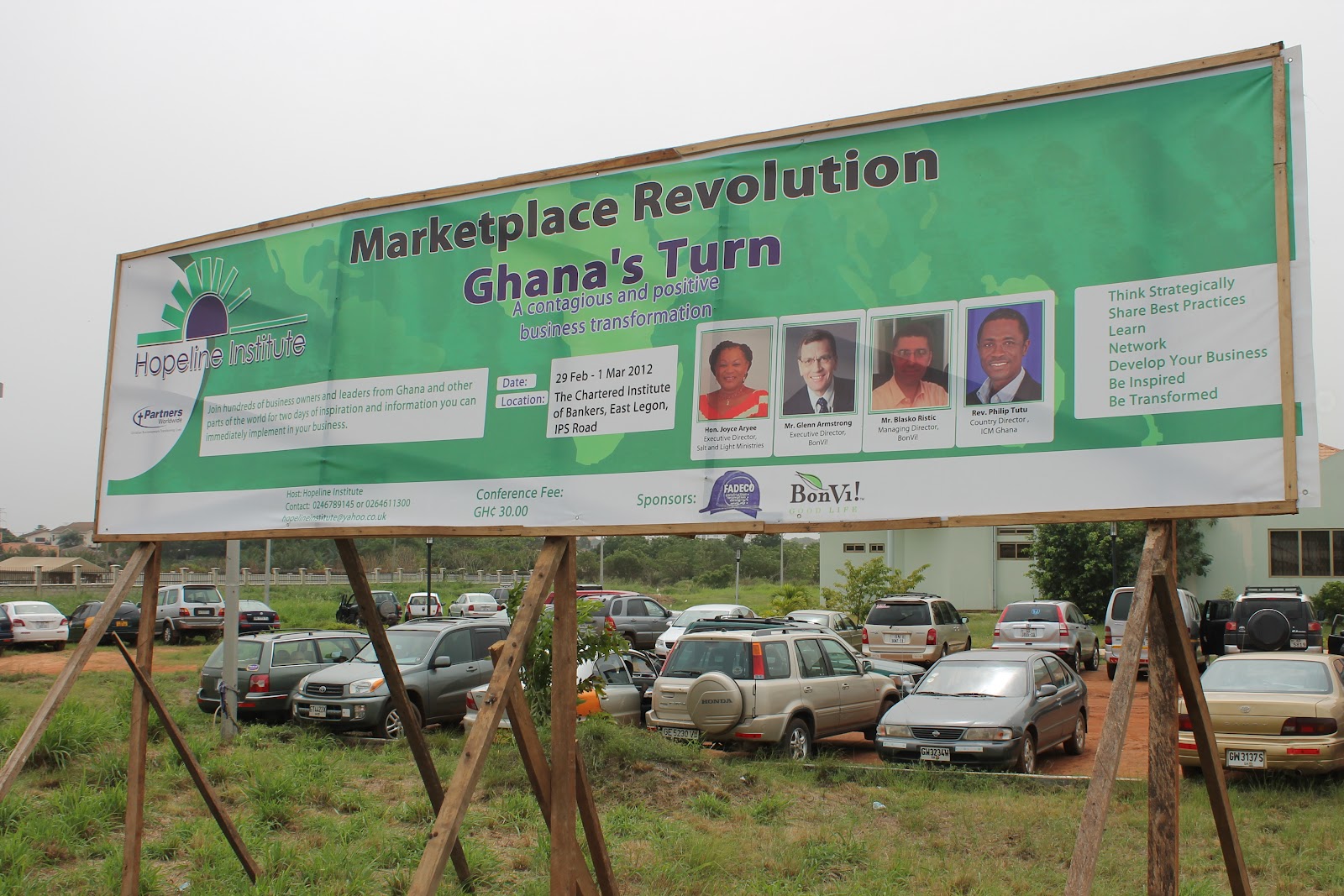
It has been a very busy few weeks, with a ten day trip to Liberia, immediately followed by the conference week in Ghana.  The last guests left Sunday evening and as the dust begins to settle, I thought I would send some images from the conference. (Pictures courtesy of Kris VanderStelt:-) 
Banner in front of the venue.

The Very Rev. Helena Opoku-Sarkodi, gave us our opening devotions each morning and did a fabulous job.  Very energetic and focused on business as mission.  She captivated the crowd and was a tough speaker to follow!
Cultural performances from the School of Performing Arts, University of Ghana, started and closed the program, with explanations of the historical meaning of the dances. 
Dr. Joyce Aryee was our first of three plenary speakers.  As the African Female Business Leader of the year (2009) and former Minister of State, she had many challenges and words of encouragement to offer us.
The hall was filled with business owners of all sizes.
Rev. Tutu, of International Christian Ministries, commissioned us to be Marketplace Ministers, reclaiming the redeemed marketplace. 
The amazing Hopeline Institute and Partners Worldwide team, who worked together to pull off this event. 

Monday, February 20, 2012

And now a word from Hannah...

When you send your children off to college, you expect their mindset and worldview to be challenged.  It's what makes college an exciting time, as they encounter new people, new thoughts, and independence.  This happened for Hannah during her first interim class at Calvin this past January, and although I wasn't expecting it to be on this topic, it's great to hear her so passionate!  And now, Hannah... 

As humans, most of us would call ourselves omnivores.  Others, those who enjoy meat to an extreme level, proclaim that they are carnivores.  Others are herbivores, shying away from meat and, at times, even all animal products.  Until recently, I was one of the majority and considered myself an omnivore.  Recently, however, I changed from your average omnivore to an herbivore.  I became a vegetarian.

The reactions to the word “vegetarian” or “vegan” are usually reactions of distance.  Most of us do not have a good understanding of the reasons behind being vegetarian, much less a vegan.  We may respect this lifestyle for its potential difficulties or be curious as to what encouraged the change, but for the most part we do not consider this lifestyle as a calling on our own lives.  It may seem extreme, or meat is just too important nutritionally and esthetically to give up.

I was of the same mindset.  I respected vegetarians, did not really think much about veganism, and continued chewing my hamburger.  But don’t you just love those moments when a random choice ends up exploding your whole life and shattering the perspectives you have contentedly held for good portions of your life?  I do not hold any particular fondness for those moments, but God sure does.  It is one of the many reasons that I love Him.  Earth-shattering is not fun to experience, but after the dust settles the view is much better than it was before.  

My random choice that resulted in this explosion was when I decided to take a class in January with some friends that was entitled “Peaceable Kingdom” and included learning about our relations with animals and working to restore those relations.  It sounded cool.  I have always loved learning about things in nature and have been something of an environmentalist since about sixth grade.  The real draw, however, was taking a course with some good friends.  These good friends knew a little more about the class and decided to try vegetarianism for the month of January just for fun.  I am rarely one to shy away from a challenge, so I decided to do it with them to prove to myself that I could.  I entered the class and, KA BLAM, my world was rocked to its core.

At first, I was going to attempt to squeeze everything I had learned over the class into one post, but realized as I got to the third page and still had a lot more to go that I would need more than just one blog.  So there will be a subsequent blog.  I hope no one views these blogs as an attempt to manipulate or spread “vegetarian propaganda.”  I am simply very passionate and excited about what I learned and would love to share it.  Feel free to email me with any questions or comments (har5@students.calvin.edu); I love talking about this now. :-) 

This entry is about the theological perspective of vegetarianism.  Upon entering the class, my understanding was that God had given us animals to use for food.  I knew the story of Genesis and had heard for most of my life that animals were created for humans both to care for and to use.  When, in a high school Bible class, I learned that in the beginning humans were vegetarian, I was shocked.  After thinking about it, I realized that it made sense, but the concept was so foreign to me.  It wasn’t until this class that I was told that it was only after the flood that God condoned meat-eating.  Noah came hundreds of years after the Fall and therefore eating meat was not simply allowed by God as a result of the Fall.  He allowed it hundreds of years later.  Why?  My professor taught us and gave us readings of the opinion that by this time, man had been eating meat with reckless abandon, killing and eating without thought.  God had a problem with this way of life, but understood that we humans are bent on sinning.  So instead of banning meat, He put parameters on meat-eating so we could be healthy and thoughtful about meat consumption.  It was a concession - not something God wanted to happen. 

The concept of God’s continuing desire for us to refrain from meat consumption, even after the Fall, snapped me to attention.  I figured eating meat would have been no problem.  We were out of the garden and needed the nutrition provided by animals.  Isn’t that what animals are for?  It seems from this passage, that that conclusion is the wrong one to draw.  Animals were still important and valued by God as more than fodder for humans, even after the fall. 

As I have grown older, I have learned that when God wants or decrees something there is good reason for it.  Though the Israelites did not understand it at the time, there were sanitation reasons as to why the latrines had to be a certain number of feet away.  There were health reasons for preparing food in a certain way.  And I believe there are good reasons for His desire for us not to eat meat.

Next time a blog of mine goes up, it will be about the incredible abilities that animals have.  Too often I think we view animals as tools for our use and miss the incredible abilities that all animals have, from a pig to a chimp, from a chicken to an eagle.  Viewing animals in this light really opened my eyes to what exactly I was eating when I bit into a steak.

Monday, February 13, 2012

February 2012 Update

Traffic and dust in Accra
Weather:  After a couple of weeks of some dust relief, the dust is back in full force, with a visibility of 0.3 miles.  Because pictures just can't capture it, let me try to explain this better:  I live close to the airport.  Normally, when I sit in my office, I can see the planes going by and can tell which carrier it is.  When I have guests arriving, I wait to see their plane go by my house before I get in the car and drive to the airport (just to reinforce how close I am to the airport and how low the planes are).  Right now, I can't even see the planes when they pass - I can only hear them.  They have been closing airports in Ghana because of the dust.  I have shake the dust from the top sheet of my bed at night...there are footprints in my house at night, after sweeping in the morning...amazing.  Will probably last until March. 

He looks so tall here!
Noah is currently involved with the Model United Nations, and this year is representing Turkey.  He is on the committees dealing with the Millennium Development Goals as they relate to gender equality (Goal #1 of 8 for MDG), full and productive employment of disabled persons (Goal #3), and transnational organized crime.  He has really been enjoying it and was given the "Most Diplomatic Award" - so maybe this is in his future.  And surprisingly, he has enjoyed wearing suits!  (For those of you who know Noah, this is quite the change from ever-present black t-shirts, black jeans look!  Of course, he still had to do a "Men-in-Black" look with the shades, but I think  he cleans up very well!)  I love how this program encourages young people to think at a global level, research policies and write resolutions, learn the art of debate in an orderly fashion, and dress for success.

Larry, with the Queen of the Yam Market
Research being done in Ghana on various types of compost pellets.
As for my work, we recently had two guests here from Alsum Farms and Produce in Wisconsin: Larry Alsum (Owner and CEO) and Derrick Smit (Human Resources/Staff trainer).  [If you would like to know more about this business, link to their brief video on YouTube.  I'm always amazed at the technology in the US and this business is another great example!]  While they were here, they studied the value chain, from "field to fork", visiting with farmers, food processors/packers, informal markets, and formal markets.  They then gave a presentation to about fifty farmers and Ministry of Agriculture officials as to the challenges and opportunities of food packaging, production, and distribution.  It was a great time of networking and idea sharing.  Ghanaian farmers are eager and ready to take their farms to the next level, and we will be exploring opportunities to develop a community supported agriculture approach in the next few months.  After spending a week in Ghana, Larry and Derrick spent a week with LEAD in Liberia, meeting with farmers there and spending time on the research farm.  

On Wednesday, I will be heading to Liberia for about ten days to do an intensive training with the LEAD staff.  James Nowell, Chairman of the North American partner for LEAD in Grand Rapids, will be joining me from Kalamazoo, MI.  He will be working with me on some office audits, leading several sessions on Business as a Mission with LEAD staff, networking with the LEAD Liberia board members, and visiting the research farm.  James was last in Liberia in 2010 - the picture to the right is James and Betty Shannon, Board member for LEAD Liberia.  

I will be returning to Ghana on February 25.  On the 26th, guests from various countries will begin arriving for the West Africa conference with Hopeline Institute and Partners Worldwide.  We are excited about this conference - the speakers and workshops look to be great.  Pray with us that it will be a time of great networking, dialogue and growth.  More on that later!