Saturday, May 6, 2023

Release of paper: BAM and the Church

On Saturday, May 6, I left for a one-month trip to East Africa, starting in Kenya, and from there going to Tanzania, Ethiopia, and Burundi.  There will be a good number of exciting meetings and trainings during these visits.  I thank God for the opportunity to meet the amazing teams that are growing and maturing in each place!

In other exciting news, a paper that we started writing as a global consortium of BAM Global has finally been released!  We started the process of writing this paper in April of 2021, completed our portion of the writing by June 2022, and since then it has been undergoing edits and revisions. 

It is very exciting to see it come out now and we hope and pray that it will be read by many who are looking for the role that the global church can play in the growing Business as Mission (BAM) movement.  

The paper can be downloaded here:  BAM and the Church – BAM Global.

We divided the paper into three key segments to discern the opportunities and challenges in the relationship between BAM and the Church, and in each area, we addressed a way forward.  The first section explored dealt with the theological challenges, the second section explored structural challenges in the local church, and the third section explored cultural challenges.  We also shared stories and testimonies of churches who have embraced BAM and the impact that is being had on the church itself.

We invite you to read this and share it with others as well.  And let us know your thoughts!  We would love to hear how this resonates with you!  


Monday, May 1, 2023

Enough Pallets to Whet your Palate!

Maybe you have been receiving the DML emails this past month as we have been raising funds for scholarships to help pastors and business owners attend the DML trainings.  These trainings release them to do work as an act of worship, with support and discipling from the church.  Last year, we trained more than 3,000 pastors, 4,200 seminary students, and 8,800 business owners in fourteen countries!  We couldn't do this without you!  We have not yet reached our goal of raising $30,000 in 30 days for scholarships and so we submit this request for your prayerful consideration.  Please go here for more information.

While the scholarships go to those who are not able to pay for the training themselves, we continue to see and hear that this ministry is needed in the global church, irrespective of income or location.  The stories that DML has been telling over the past month have been focused on the majority world, but today I want to tell you a story that is much closer to home.

Bill was a member of my church in Grand Rapids.  He and his wife faithfully served as the church bookkeepers for thirty years.  As a former deacon and member on council, I got to know them in that capacity.  I knew that Bill's wife, Nancy, worked at an architectural firm as she helped my daughter get a summer job there, but I never learned (or asked) where Bill worked.  To be honest, as an accountant, I assumed he worked in an accounting firm.

But we all know what happens when we assume.  And yup...that happened to me here.  

Bill and Nancy have been regular supporters of DML and Bill will often send a short response to my blogs, which always encourages me.  A few weeks ago, he responded to one of my blogs from India, saying that he thought recycling pallets might be a good business idea for India.  Curious, I asked him where such a random idea came from.  And that was when he told me that he worked for a company called Kamps Pallets for the past thirty years.  After looking them up online, I immediately asked him if he could give me a tour of the place and he obliged.

And wow.  Amazing stuff!  This company was started by the owner (a Christian) who noticed pallets in the dump here in Grand Rapids and pulling them aside to repair and sell them. It has now grown into having 400 national facilities across the US, with more than 2000 employees.  This makes them one of the largest pallet companies in the country.  Much of their work includes recycling everything, right down to the used nails!  I watched the employees put together a pallet from recycled wood in about 30 seconds!

As I heard the story, I could hear the Christian values that underlie how this company works.  I saw the scripture in the conference room.  Bill told me that you don't have to be educated or speak English to work at this place, and since the work is "piece-rate pay" (which means that every pallet dismantled, built, or board cut is paid a price for the unit that is completed), they don't have to spend as much money on supervisors as everyone is internally motivated to be as productive as they can be - and they are therefore well-paid!  It seemed clear to me that this company is a very large parish, with the potential to do good work that helps businesses, is good for the environment, caring for many employees and therefore their families, with a desire to serve God.

At the end of my tour, I asked Bill whether he felt the support of the local church in this work, and like most others, he said no.  He had been affirmed for the bookkeeping work that he did for the church but he wasn't even sure how many people (including me!) knew what he did from Monday-Saturday.

I believe it is high time for this to change!  The purpose of the church is to equip the saints for the work of the ministry, which doesn't just happen in the four walls of the church, but it happens as we each enter our own mission field, in our own unique settings, during the week.  

If that message resonates with you, and you would like to see people supported and discipled by their church, please join us by giving to our scholarship campaign today!  And if you have already given, thank you!  And if you can't give financially, please continue to pray for our teams and trainers who continue to reach as many people as they can with this empowering message.

Tuesday, April 25, 2023

Trees: Twisted, Tangled, yet Triumphant

The Hermitage is a retreat center, about an hour outside of Grand Rapids.  I have visited this place quite a number of times over the years.  In 2011, a tornado touched down in the area and impacted a lot of the trees on the 62-acre property.  

Michael and I spent a few days there this past weekend on a silent retreat, and it so interesting to walk through the trails and to see the twisted shapes of the trees.  I began to see the trees as metaphors for our lives and even for our relationship with God.  

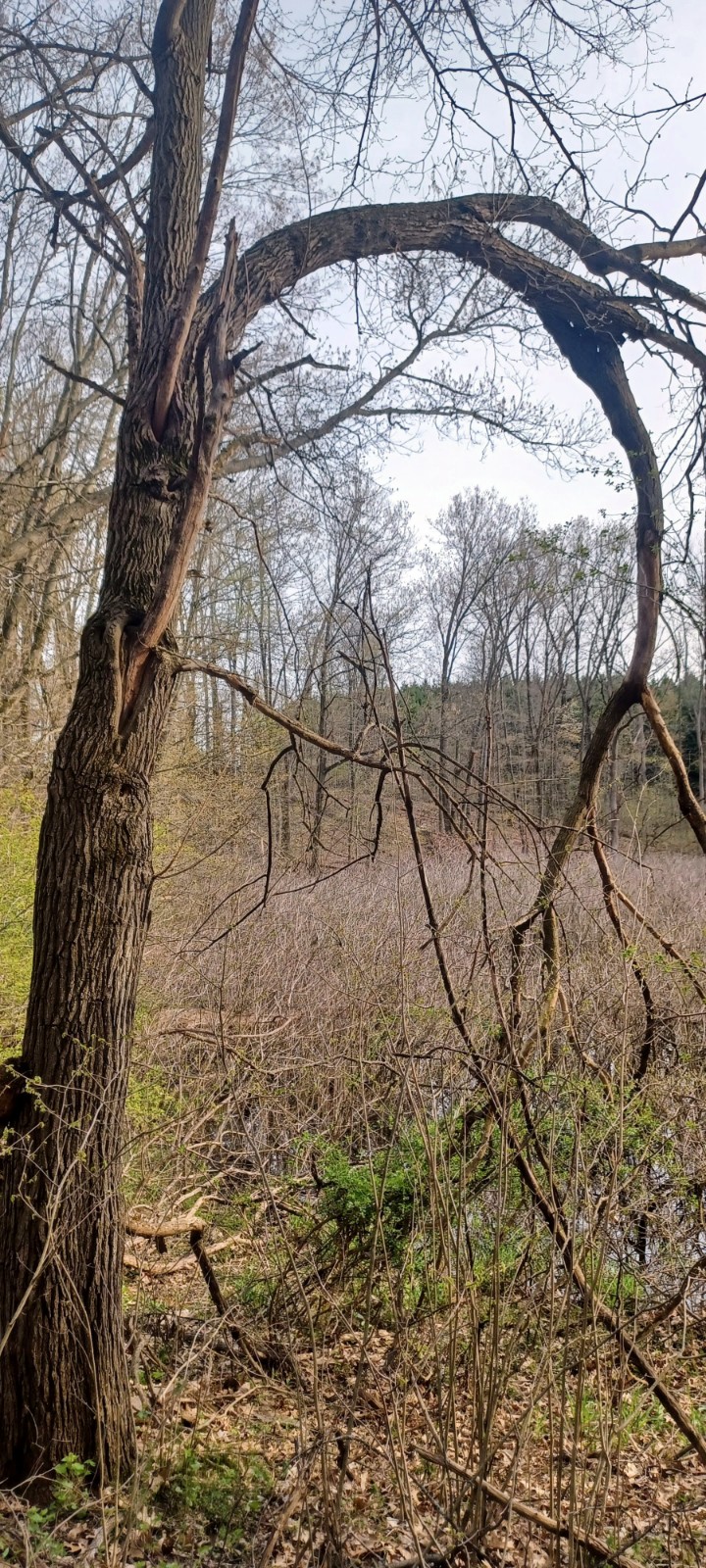
The tree that especially caught my attention is the first one pictured here. This tree was twisted downward, reaching toward the marsh below, in what seemed to be a painful arch. It has clearly been through something significant.

At the same time, out of several knots or splits in the trunk, new branches were growing.  Amazing.

My spiritual director at the retreat reminded me to reflect the journey that I have been on throughout my life with God at the helm.  The face of Renita has changed over the years.  There have been many seasons of growth and change.  There have been storms that caused twists and turns that were uncomfortable.  Yet there has also been new life and growth after those storms.  Like this tree, which bears the visible evidence of challenge, there is also beauty in the release of potential through the new growth.

The release of potential is not only for me but for every person.  Our journeys, our pains, our celebrations, are different but important.  And the trees reflected this as well.  

Here is another tree that is growing completely out of a dead tree.  It is a good size tree and you can see that there is nothing below the dead tree that indicates roots going into the ground, yet the tree growing out of it is probably forty feet high!  The tenaciousness of growth is not only in trees but in our own capabilities to overcome.  

This is the remarkable thing about the human spirit.  This is the remarkable thing about trees.  This is the remarkable thing about creation.  And this is the remarkable thing about God.  

Below you will see a picture of several trees twisted together, arching all the way over.  It was as if they said, "If we go down, we go down together."  It spoke of love and commitment to me, even until death.

Creation is beautiful and it tells a story if we pay attention.

Sunday, April 16, 2023

The Kingdom without the King

Understanding the Kingdom of God is one of the keys to understanding what Christianity is all about.  I read somewhere that Jesus spoke about the Kingdom of God more than 120 times, but of the church only three times.  The ministry of Jesus was done in Kingdom terms.  Andy Crouch says this, "His good news foretold a comprehensive restructuring of social life comparable to that experienced by a people when monarch was succeeded by another.  The Kingdom of God would touch every sphere in every scale of culture.  It would reshape integrity in business and honesty in prayer."

As Christians, we understand that we are part of a tribe that follows a King who has comprehensively restructured life...and it is good!  It is good for creation.  It is good for all people.  And it is good for the King!

The Lord's prayer calls us to pray for "thy kingdom come, they will be done, on earth as it is in heaven."  We are to be about bringing the kingdom of heaven on earth.  We are to long for and work toward the kingdom of heaven on earth, through reconciliation and restoration.  That is our work!  

Paul Stevens, in his book The Kingdom of God in Working Clothes, says that the Kingdom is the missing dimension in most presentations of the gospel and the marketplace.  Yet it is in the coming of the Kingdom of Heaven on earth that we see human flourishing as one of the most wonderful outcomes.  

Every Christian is in fulltime ministry of bringing glory to God.  And every Christian fulfills this fulltime ministry through their unique placement, in those places of work or influence where we spend our time.

Of course, as we look around the world, we see different people, different cultures, different nations in various stages of this work and therefore things can look and feel different.  Some countries are still in a pre-Christian majority, some fully in Christendom, and some in a post-Christian culture.  

In the post-Christian cultures, we hear that "we want the Kingdom without the king."  Almost all people have an innate desire for the flourishing of all people, for righteousness and justice, and for peace.  But in the midst of those good desires, we want to choose what is right and wrong for ourselves.  We don't want someone forcing their views on us.  We want to be able to judge for ourselves.  We begin to worship freedom instead of the King.

This is not new, of course.  This has been since the fall!

But if our call and our joy is in announcing the Kingdom of Heaven on earth, it must come with the announcement of the one true King.  It is from this King that righteousness and justice flows.  It is this King who is the author of peace and love.  And it is this King who has designed this world for the flourishing of all.

The Kingdom with the King.  The way it was meant to be.  I am going on a silent retreat this week for a few days and my prayer will be that God will continue to show me where it is that I resist His Kingship while making it look like I am seeking His Kingdom.  

Monday, April 10, 2023

Restoration and Reconciliation

Thirty-four days on the road during this recent trip to India included twenty-two days of teaching, seventeen flights over the course of eight days, and six partners in five cities.

India continues to amaze me.  It is a country that is one third the size of the United States in terms of geography, but four times the size in population.  I kept trying to imagine how much water is consumed daily in this country...how much trash is produced...how many coconuts are consumed daily...how much grain...etc.  There are governments who struggle to govern 7 or 9 million people and this government seeks to govern 1.4 billion people.  No small task.  There is an immense need for infrastructure, jobs, economic and educational opportunities, and so on.

It is one of 190+ countries in the world that is engaged in this time of restoration and reconciliation, caught between the "now" and the "not yet" that we think through during this time of Easter.  The "now" looks at the amazing potential of eight billion people to work toward the flourishing of all people and all of creation.  The "not yet" acknowledges that we fall very far short of this goal because of our own sin and selfishness.  

Every day we have the opportunity to participate through our work in the restoration of how it should be, from Genesis 1 and 2.  Every day we have to deal with the need for reconciliation between how it is and how it could be.  What an opportunity and calling!

May God continue to grant us the grace needed to embrace this calling daily, to seek to glorify Him in all we do, seeking to do our work as an act of worship.

I leave you with some pictures of businespeople I met while in India:

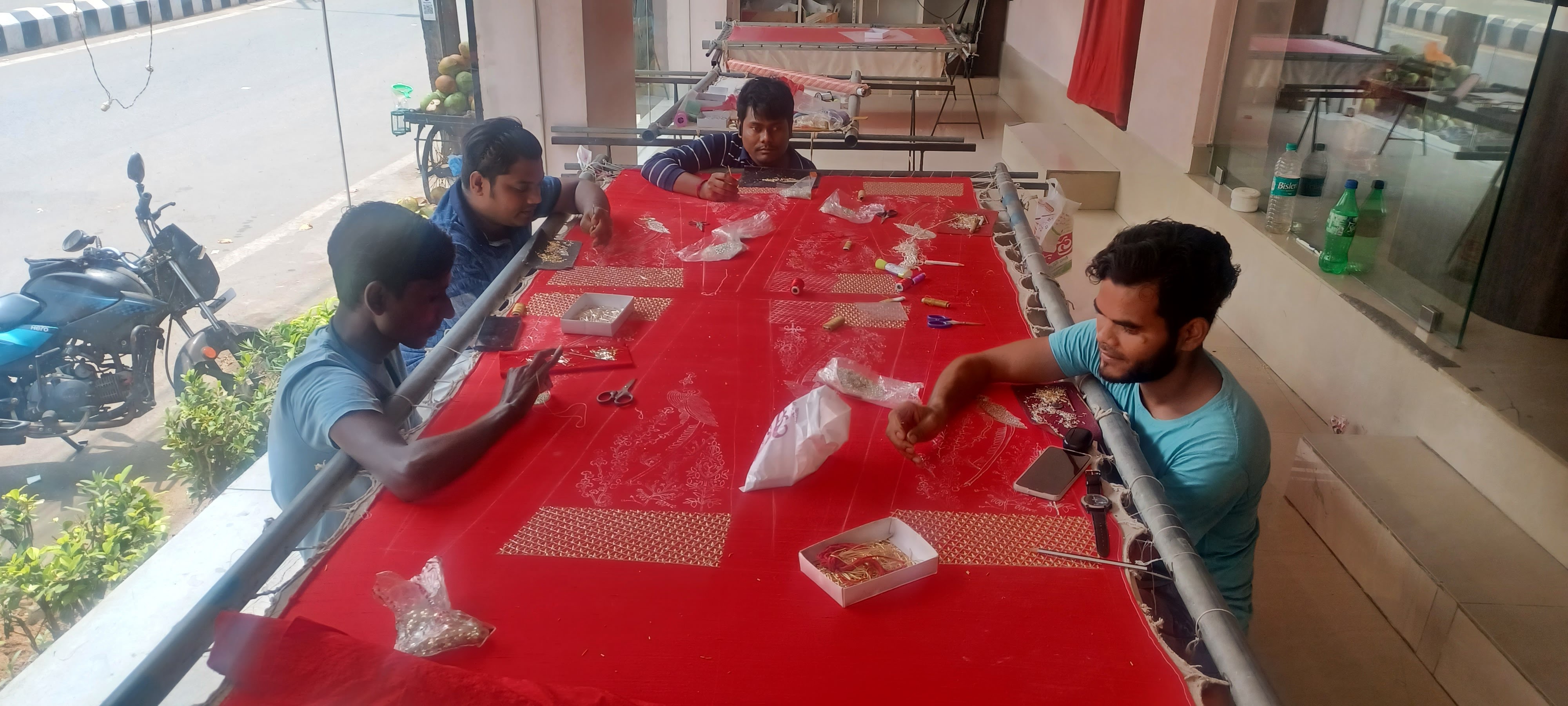
Four men from a lower caste work two-three days, hand embroidering beads on this material for a sari.

This man and his brother have a great business of making all sorts of different size plastic containers for soaps, foods, fertilizers, etc.  So interesting to watch!

A small start-up beverage business serving a local community.

Monday, February 27, 2023

Elections in Nigeria

On Saturday, February 25, Nigeria had their presidential elections.  Our global team has been praying about this for the past two weeks, as it is a very important election.  

Here are some brief facts about Nigeria:  

Nigeria is the most populous country in Africa, with more than 214 million people.  Half of the population is under the age of 18.  It is also the country with the highest number of people in extreme poverty, with 70% living below the poverty line. There are more than 250 ethnic groups in Nigeria and more than 500 languages.  There is an almost even split between Muslims and Christians in the country (with Muslims mostly in the north and Christians in the south). 

Nigeria has significant safety concerns, with Boko Haram in north and central Nigeria.  Kidnappings, muggings, and theft are widespread, with ongoing challenges of corruption and high unemployment. Inflation in 2022 was 19%.  National debt has doubled in the last ten years, while the amount of oil production has halved.

Add to that a rush to change currency notes in the last six weeks, created a shortage of cash, leaving people no cash to make their purchases.  People were unable to withdraw cash and electronic payments also stopped as they were unable to cash out these transactions.  People were not able to get medical help, food, and basic needs met if they didn't have cash, despite what they might have in a bank.  This has caused desperation and a lot of angst going into an election.

It's a lot for any leader to tackle.  

We continue to say that "people are not the problem, they are the solution." Nigeria has a TON of potential that can be unleashed to help Nigerians and all of Africa to flourish. 

But figuring out how to unlock that potential is a challenge.  

Saturday's election could mean a significant change, or it could be "same-old, same-old."  There are two candidates who look like "same-old" while one candidate has captured the attention of the youth and seems to be drawing out record number of voters.  This candidate is younger than the other two (61 years of age), a Christian, and from a political party that is not one of the main two, which is unusual.  Should he win, it could bring significant opportunity for positive change.

And so we pray.  Results are not expected before Tuesday and we continue to pray for honest and transparent results.

I left on Sunday for one month in South Asia and covet your prayers.  I will not be able to provide a lot of details on this trip while I am gone, but it will be busy and full.  I thank God for the opportunity to join Him in what He is doing!  Enjoy the sunset view from the plane - what an amazing sight!

Monday, February 20, 2023

Dog 'n Cat Theology and the Glory of God

Maybe you've heard of Cat 'n Dog Theology.  I'm not sure where it originates from but I've heard it quoted from a number of different people over the years.  It says:

 A dog may look at you and think, "You feed me, you pet me, you shelter me, you love me - You must be God!

But a cat looks at you and things, "You feed me, you pet me, you shelter me, you love me - I must be God!

The theology explains the way many of us behave.  We think that God, the world, our prayers, our work, and everything else, revolves around us.  We are like cats.

In every workshop we teach for DML, we ask people why Jesus came to earth.  99% of the time, the response is "to die for our sins."  Cat theology.  John 12:27-28 tells us that Jesus' primary purpose was to glorify the Father.  Dying for our sins was one way in which He did that.  It's not about us.  It's about God.  Jesus came to restore the glory of God that was lost in the Garden of Eden.

Over the years, we have asked many people why they work. The most common answers are:  to put food on the table, to stay busy, and for identity/self-esteem.  Cat theology.  These answers are all about me and what work does for me.  Yet we have been created to work to bring glory to God.  As image bearers, we are part of the work of restoring the glory of God which was lost in the Garden of Eden.  We are to participate in bringing the Kingdom of Heaven (Shalom) on earth.

When we pray, we focus on what we need and want.  We present our requests and move on before God has a chance to get a word in edgewise.  Cat theology.  

We get so caught up in naval gazing.  Our flesh quickly wants to put ourselves at the center of the story.  

Sometimes I feel like I'm a cat in dog's clothing.  I want to pretend that it's all about God but really, under the surface, it's all about me.  I start the day wanting to act like a dog, but time and again, by the end of the day, I look back and seen that I've behaved like a cat.

Yet there is such joy, freedom, peace, and contentment when God is the center.  And that's the irony.  When it's all about me, I am petty, small, egocentric, impatient, easily annoyed and frustrated.  When I lift my eyes from my naval, I am more content with a deeper joy.  I am willing to suffer frustrations and annoyances because there is something bigger going on.

Because of this, I need daily reminders, even hourly, that it is all about the glory of God.  Every day, I get to worship God by doing my work for His glory.

So I have a "work as worship" sticker on my phone.  And on my laptop.  And in my office.  As with everything, we start to not see something that is familiar after a while, so I will need to change it up.  I have been receiving some requests for these stickers and want to make the offer that if you would like me to mail some to you, please write me at renita@dmleaders.org.  We will do our best to get them to you (provided you are in a country where DML has a team!).  We have them in English, French, and Spanish.

May we all continue to strive to be like dogs - understanding that this world exists, and we exist, for the glory of God.  And that is a very good thing.

On Sunday, February 26, I leave for South Asia, where I will be working with six partners over the course of four weeks, returning at the end of March.  Please pray for those who will be listening and learning on this trip, that it may be to the glory of God!

Monday, February 13, 2023

The Bad and Good News: Less Economic Freedom Globally

I have received numerous emails regarding the recent Economic Freedom of the World Report, which indicates that global economic freedom has declined, wiping out about ten years of economic progress. This particular report scores economic freedom relating to five areas:  

  1. Size of government (relative to the size of the economy)
  2. Legal system and property rights
  3. Sound money
  4. Freedom to trade internationally
  5. Size and scope of regulation
When government is big and regulatory burdens are oppressive, innovation suffers.  When legal systems are not egalitarian and property rights are difficult to secure, entrepreneurship suffers.  When currencies are not stable, international trade suffers.  And when the size and scope of regulation and ability to trade is costly and onerous, business suffers.

On the other hand, when economic freedom is high, people are able to exchange in trust. When freedom and property rights are secure, innovation and entrepreneurship are able to flourish.  When innovation and creativity are encouraged, people are able to permanently escape poverty.  Society then flourishes and a country's economy can grow.

The top ten countries for economic freedom are (in order): Hong Kong, Singapore, Switzerland, New Zealand, Denmark, Australia, United States, Estonia, Mauritius, and Ireland.

The bottom ten countries for economic freedom are (in order):  Democratic Republic of Congo, Algeria, Republic of Congo, Iran, Libya, Argentina, Syria, Zimbabwe, Sudan, and lastly, Venezuela.

Economist Anne Bradley says, "Because economic growth is the only way to permanently escape poverty, the freedoms that engender it are moral imperatives." 

Economic growth as a moral imperative.  It doesn't always fit our way of thinking, but there is truth in that statement.  Deuteronomy 8:18 says, 
But remember the Lord your God, for it is he who gives you the ability to produce wealth, and so confirms his covenant, which he swore to your ancestors, as it is today.
Wealth creation is part of God's covenant.  He gives us the ability to produce wealth.  Wealth is a means to an end - it is the working, productivity, flourishing, and subsequent generosity that was part of God's original design in Genesis 1 and 2.  But we are not to forget him in the process.  We are not to hoard.  We are not to work for selfish gain.  We work for the glory of God in the system that He designed and created.

That is why DML believes that the church must be engaged in helping people to have economic freedom, with a solid theology of work, leading to the flourishing of all.  We need to be engaged as contributing members in these systems, not remaining outside and being only critical.

Anne Bradley continues by saying this, "If we want to help the poorest in society, whether that's in the US or anywhere in the world, we must advance economic growth by fostering more economic freedom.  We've been heading backward, but the good news is that we can reverse course."  (Anne Bradley, writing in the Common Good magazine - www.commongoodmag.com). 

For the sake of our brothers and sisters living in countries with less economic freedom and more poverty, we continue to pray for economic freedom, as if it depends on God, but we also work for economic freedom, as if it depends on us.  As the hands and feet of Jesus in a world with great potential to be good for ALL people, reflecting the Glory of God in ALL places, we need to be about both faith and action in our participation towards a flourishing world.

Tuesday, February 7, 2023

Faith Declarations for the Marketplace

I returned safely from West Africa this past Friday, but unfortunately picked up a COVID bug along the way.  It's not unusual for me to get sick after a very busy and stressful trip, so I'm not too surprised.  And as I sit with a cloudy head, I smile at the forced rest that I am given, knowing that the Father knows that I am not always wise about rest and may need to be forced.

In going through some papers on my desk, I found one entitled, "Five Faith Declarations for the Marketplace" that I picked up from one of our partners.  This document had been created before they knew about DML and I again smile that God is bringing His people together, in His time, and in His way, and we simply get to join in what He is already doing in and through His bride, the Church.

These five declarations, written in a language I do not speak, are translated as follows:

  1. I am important to the Kingdom of God; therefore, I will be an ambassador for him.
  2. My business is my ministry; therefore, my work is a form of worship to him.
  3. My business is my mission field; therefore, I will shine the light of Jesus Christ.
  4. God's Kingdom is my priority; therefore, I'm blessed to be a blessing.
  5. God's anointing is my competitive advantage; therefore, I will seek His presence in my business.
There are two things that strike me as I reflect on the words on this page:

One, I am struck by the theme of "therefore" in each declaration.  God has called us to action, blessing us to be a blessing; calling us to be His hands and feet to the world around us in whatever sphere of influence He has allowed us to be.  Every day is an opportunity to do my work as unto the Lord (Colossians 3:23).

Two, I am struck by the use of the words "Kingdom of God" rather than the term "church."  This is where we are to perform the "therefore(s)..." mentioned above.  I have been reading a book called, The Kingdom of God in Working Clothes, by R. Paul Stevens, who reinforces the Biblical emphasis on the Kingdom of God, which unifies everything we do in every space, in every sphere of culture.  He states that Jesus spoke about the Kingdom of God 129 times but only three times about the church.  God intended to exercise His sovereignty through His entire creation and commissioned His God-imaging creatures to bring in that Kingdom.  

And so as I sit in my quarantined room, reflecting on what God is doing, I find myself humming a familiar tune:

What a fellowship, what a joy divine, leaning on the everlasting arms
What a blessedness, what a peace is mine, leaning on the everlasting arms...
Oh how sweet to walk, in this pilgrim's way, leaning on the everlasting arms
Oh how bright the path grows from day to day, leaning on the everlasting arms!

Note on above pictures:  I was privileged to meet parents on this past trip, who helped to inform, lead, teach, and guide their children to be men and women of God!  The first picture is Dr. Sublime's father from the DRC and the second picture are Pastor Theo's parents from Burkina Faso.  What an honor to meet these parents!

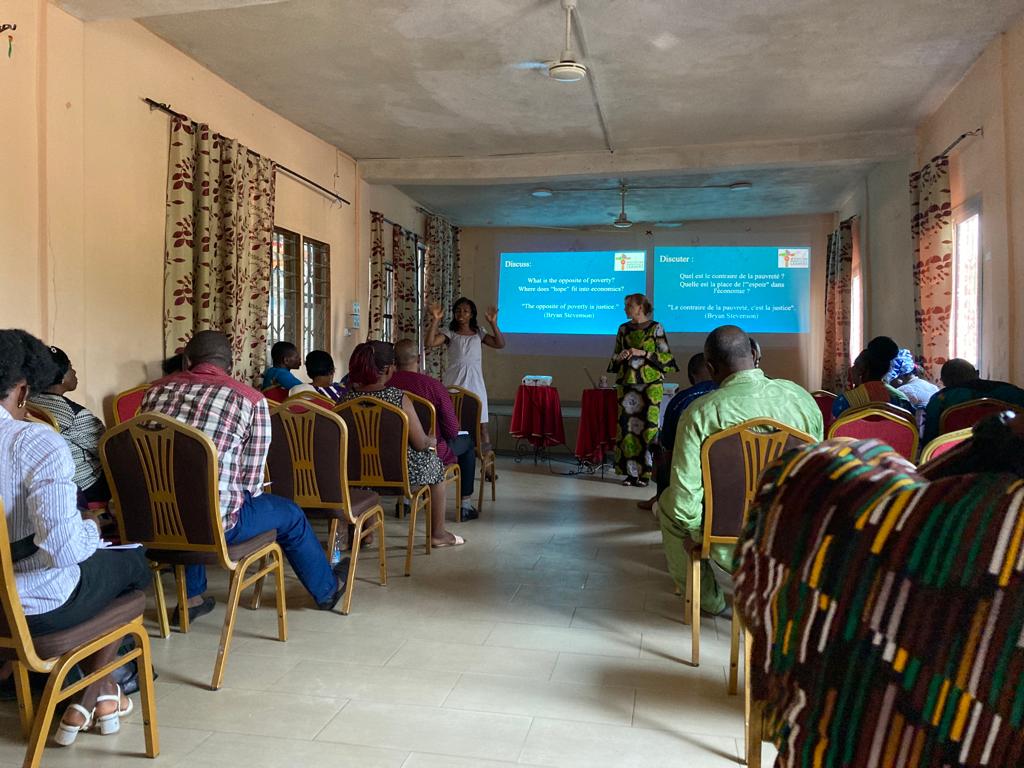
Uganda Financial Freedom class, small group work.  Note the caption on the t-shirt of the woman sitting in this DML discussion group.  We are seeing people making and wearing these messages on t-shirts across Africa!


Monday, January 30, 2023

From Joy to Lament...Hearing to doing...

From Burkina Faso to Cote d'Ivoire, we are now on the last leg of this four-country journey in Francophone West Africa.  

We have heard joyful testimonies of work turning into worship.

We have heard the surprise and amazement from those realizing for the first time that they have been called to work and that it is a good thing!

We have heard the lament and pain from those working in positions where there is little joy to be found, surrounded by ethical challenges with pressure from all sides.

We have received affirmation from new ministries and denominations who feel that God is calling them to join in this work.

We have heard the frustration of those who are trying to get the paradigm of the "church as building" to shift to the "church as people," but realizing that it can be a long and sometimes slow process.  We are creatures of habit.  We like to do activities.  We don't necessarily like discipleship. 

We continue to be convinced that God is doing something in His Church.  People are longing to know that their lives and their work have relevance and meaning beyond a paycheck.  They desire to know that the God they are serving sees them as part of His solution - not part of a problem.


Ecole Biblique de Koubri, Burkina Faso

Discussing integrity with the shareholders of the Avodah (Work as Worship) Poultry Farm in Burkina Faso.  Most of the shareholders are professionals who are diversifying their income streams.  It was great to be outside of the city, teaching in the open air.

Great discussion with these professionals working in many different sectors.  The challenges of doing work as worship in difficult environments is real, and we continue to pray for strength!  We hold on to the knowledge that greater is He that is in me, than He that is in the world!

Monday, January 23, 2023

What is in your hand?

We are now in Cameroon, teaching the DML Economics of Hope course to some key DML leaders from both Anglophone and Francophone areas.  Cameroon is in its sixth year of civil war between the Anglophone and Francophone regions.  The government refuses to negotiate, calling the Anglophones "terrorists" and the citizens on the Anglophone region (20% of the population) continue to have significant struggles.  Hundreds of thousands are in Internally Displace Persons camps, or have fled to neighboring countries, or shelter in place in fear.  The weariness of a six-year conflict can be seen in the faces.  Those I met in 2017 from that area are fatigued, stressed, and losing hope. 

[The only "good" thing that I have heard come out of this so far is that the Ambazonian fighters (as they are called) are requiring everyone in that area to "strike" on Monday in protest of the situation.  If one dared to open their business, it would be torched.  No one dares to go outside on Mondays, and parents have said that the whole family is under the same roof for an entire day which has caused them to grow closer!]

It's a good time to teach the Economics of Hope.  Hope is critical to finding a way forward for everyone.  We get up, we work, we take action because we have hope that there can be a result from our efforts.  My experience in working with people in poverty for 25 years is that there is often a significant loss of hope in the heart.  Our goal is first to affirm everyone's primary calling, including that of Jesus (John 12:27-28), which is to glorify God.  By affirming this, we begin to lift our eyes from our current situation to something much bigger.  Then we move to how to glorify God - we understand God to be a working, creative God who has given us the call as image bearers to work and be creative as well (Genesis 1:28 and 2:15).  We study how economics works - government, education, and the church are there to support those in business, but primarily wealth creation (which is the opposite of poverty alleviation) are going to come from businesses.  

We need to ask, "What is in our hand?"  We find this type of question many times in the Bible.

It is the question that Elisha asked the poor widow.  In 2 Kings 4:1-7, Elisha asks, "What do you have in your house?"  Then he tells her to go and leverage her relationships with neighbors for jars. He started with her oil and her relationships. 

In Mark 6, we read the story of Jesus feeding the 5000 with a few loaves and fishes.  But his first statements to the disciples, when they raised the issue of people being hungry, was, "You give them something to eat."  They protested.  Then Jesus said, "How many loaves do you have?  Go and see."  He didn't try to solve the problem FOR them.  He tried to solve the problem WITH them.

The difference between "for" and "with" is where we spend a lot of time.  "Shut up and listen" is what we need to do!

Much of poverty alleviation is building capacity.  Breaking down poverty relating not just economics, but relational poverty, educational poverty, spiritual poverty, social poverty, and more.  Social poverty is a very large factor of poverty in Africa, as entire genders, tribes, or people groups are not given equal/fair access to the very things that will allow them to develop their own capacity.  

And so, we emphasize that the opposite of poverty is NOT wealth.  It is justice.  As justice is being sought, we need to work on helping every person see their own capacity, as image bearers of a working, creative God.  

On Tuesday, we leave for Burkina Faso.  We ask for your prayers for both Cameroon and Burkina Faso, where so many people are dealing with conflicts in these countries.  May God heal our lands!

Monday, January 16, 2023

Francophone and Anglophone African Countries

During this current Discipling Marketplace Leaders trip in West and Central Africa, we will be in four francophone (French-speaking) countries:  Togo, Cameroon, Burkina Faso, and Cote d'Ivoire.  While I learned a bit of French growing up in Canada, there is always extra stress when you are in places that speak very little English.  We have to have all of our materials translated (and updated as we are always seeking to improve them), projectors projecting in both languages, translators, and more.

But of course, there are other differences beyond language.  One of the differences has to do with the impact of colonization in these two areas.  When working in Anglophone (English) Africa, we hear less and less talk about the impact of colonization (most of which ended in the 1960s).  But in Francophone Africa, I still seem to hear a lot of references to the impact of colonization which seems to still be felt directly today.  

I have placed a map of the countries that colonized Africa as of 1939 (also knowns as the "Scramble for Africa), and the major color in West and Central Africa is purple, which is France.  

There seems to be good reason for the different realities today based on the country of colonization.  France seemed to make an effort toward full assimilation, colonizing not only the economic resources of a country but also the culture.  France desired to change the colonies at a much deeper level, from faith to dress to food and more.

English colonists tended to give much more freedom as long as English law was followed and loyalty was given to the King.  

From those with whom I speak in Francophone Africa, this has had an impact on work and jobs.  In Francophone Africa, because of the lack of freedom, people seem to be more risk-averse and less inclined to start a business.  Also because of the lack of independence, success was found in finding work at an existing business and not working for oneself.  There was a stifling of creativity, of flourishing, and of thriving.  

This is not to say that things were perfect in countries colonized by the British, but it is one difference that seems to have trickled on through the generations!

Francophone Africa also complains that it has been neglected by the evangelical world.  This is largely due to the low percent of Protestantism in colonizing countries of France and Belgium.  Francophone Africa has been through (and continues to go through) significant violence in the past decades, with a great expansion of Islam as well.  

There is therefore great opportunity and great need.  As the Lausanne Movement writes, "The future of the Church in the French-speaking world depends upon the Church in French-speaking Africa." 

That is why DML has hired French speaking leaders like Dr. Sublime and Rachel Mabiala as our African coordinators.  

That is why DML is focused on growing in and through Francophone Africa.  

And that is why we covet your prayers so that we can continue to equip and empower the French-speaking Church.

During this visit we hope to connect with Campus Crusade for Christ in Togo and Cameroon, and with the Assemblies of God in Burkina Faso and Cote d'Ivoire.  Both are very influential ministries with the potential to carry the message of work as worship far and wide in the church gathered and scattered.

Monday, January 9, 2023

New Year, New DML Team Members, New Opportunities!

As we start a new year, there are new friends and opportunities that we would like to share with you as well!

At the end of this week, we leave for West Africa where we continue our work in Cameroon, Burkina Faso, and Cote d'Ivoire, but we will also introduce Discipling Marketplace Leaders to a new country through Life Ministries Togo (Campus Crusade for Christ).  Togo is a small country in West Africa, neighboring Ghana and Benin.  Togo has a population of eight million, approximately 48% of whom are Christian, and the official language is French.  [This means that this upcoming trip will be four French countries.]  The economy in Togo depends mostly on agriculture, growing coffee, cocoa beans, and peanuts.

This year also sees some new members of the Discipling Marketplace Leaders team, whom I would like to introduce to you at this time.

Brenda DenHouten joins us as our Community Outreach Coordinator.  She lives in Grand Rapids MI and has many years of experience in working with nonprofits in communications, program and staff development, and development.  She worked for many years with Resonate Global Mission and also worked internationally with a nonprofit in South Africa. She is passionate about building the church and seeing the flourishing of people around the world.  We are thankful that she has joined the US DML team!

Dr. Sublime and Rachel Mabiala join us as our Africa Team Coordinators.  Sublime is originally from the Democratic Republic of Congo (DRC) and Rachel is from Detroit, Michigan and they currently live in Abidjan, Cote d'Ivoire. They met at Fuller Theological Seminary where both were studying Missiology and International Development. Sublime has his PhD in International Development and Rachel is finishing her Doctorate in Business Administration.  Their passion in their mission was to bring economic development to the local church and then they learned about DML!  We couldn't ask for a couple that is more equipped to join in this ministry, bridging between theology and business!

Lastly, 2023 sees some new initiatives for Discipling Marketplace Leaders.  We are excited to launch a new research project in Burundi, to study the impact of DML on youth over a five-year period.  Secondly, we will be focused on digitizing DML in 2023, moving toward more social media and video spots instead of written documents.  Lastly, while we focus on digitizing, we also want to focus on making sure that DML materials are available easier for oral learners.

Thanks to you, we were able to meet our challenge match at the end of last year and now we look forward to getting to work in 2023.  Thank you for being part of this team!

Monday, January 2, 2023

Finding Shalom: Nothing Secular in 2023

Happy New Year, dear brothers and sisters in Christ!  I am trusting that you, like me, have been reflecting on 2022 and translating those reflections into some anticipations for 2023.  Like any good SWOT analysis, there were strengths that need continued growth, weaknesses that need to be addressed, opportunities that need to be prioritized and pursued, and threats that need to be mitigated.  These reflections are both personal as well as for Discipling Marketplace Leaders.

During the Christmas break, I had the opportunity to read a new book by R. Paul Stevens, called The Kingdom of God in Working Clothes, which is an excellent book (highly recommend!).  If you have read this blog before, you have heard me mention the "sacred/secular divide" many times, relating to the chasm that exists in how we view the world.  

But Stevens makes the statement that there is nothing secular.  He says that everything was created sacred in Genesis one and two.  Therefore, there is only sacred or desecrated.  Nothing is secular.  He says, "This world was created to be a temple for the presence and purpose of God...what was once one and whole has become divided and separated."  The Oxford definition of "desecrate" is to "treat something sacred with violent disrespect."  Stevens then reminds us that "integration as a Christian task, Apostolic mission, and a divinely given mandate to find everything in all creation unified under Christ, is simply to live and work sacramentally...finding God in everyday things...in the everydayness of work, worker, and workplace."

This restoration of sacredness, this pursuit of wholeness, will bring us to finding shalom.  Shalom is full restoration or a fullness/completeness of all things.  For us, at Discipling Marketplace Leaders, that means a restoration of our call to work.  It means recognizing that there is nothing secular in our spheres of influence - there is only sacred and that which has been desecrated.  

And we get to be part of bringing shalom.  We are invited AND equipped AND mandated to do this.  How exciting!

May God bless you in 2023 as you seek to bring integration to what has been separated, restoring sacredness into every place and space.

Monday, December 19, 2022

Advent in Burkina Faso: Volunteer Army

Advent is a time of waiting.  Waiting in a time of darkness, a time of longing.  We see a picture of that in Burkina Faso.

Discipling Marketplace Leaders has two very strong leaders in Burkina Faso, a land-locked nation in West Africa, with a population of 21.5 million, one of the ten poorest countries in the world. This country has had a difficult year, to put it mildly.  January saw a coup d'état with an army general taking over from the elected president due to slow-to-no progress fighting the continued terrorism by a jihadi insurgency which has caused the country to lose close to 40% of their land.  This terrorist fight has been ongoing since 2015.

Unfortunately, this particular army general didn't have much success either, and was overthrown in a second coup d'état in September, just three months ago, by another military leader.  Both coups were relatively peaceful, which is quite something.

But this particular army leader has done something different, acknowledging that the army of Burkina Faso does not have the resources or manpower to be successful against the terrorists, and therefore called for volunteer army at the beginning of November.  They were hoping to have 50,000 civilians join but received 90,000 civilians sign up to join the fight.  I'm told they are young men and women, middle aged men and women, and older men and women, from age 18 to 77 years of age.  They were to receive fourteen days of training and then sent out.

Just pause and think about that for a minute.  What would it take for a civilian to respond to such a call for service?  What level of frustration, anger, sadness, despair would cause 90,000 people to put their own lives at risk after just 14 days of training?  It tells you that the frustration and pain run very deep.  

Our DML prayer team has been praying in earnest for Burkina Faso in this last week.  I keep imagining an 18-year-old young woman who signed up under protest from her parents.  She went in with lots of passion and energy, and now may be wondering what she got herself into, especially as she sees people who signed up with her killed in the line of battle.  She is out there in a strange place, so far out of her comfort zone, maybe wishing she had never signed up.  But abandonment is not an option, and so she presses on, wiping tears from her eyes as she feels overwhelmed but what she is doing.  

Oh Lord, how we need you as the Prince of Peace.

This week on of our leaders shared that his home village is being taken over by the terrorists and needs to be evacuated - all 35,000 people that live there.  They were trying to move them as fast as possible to Ouagadougou, the capital.  He was able to get his parents and family out, but then comes the additional challenge of housing and feeding.  More than 1.7 million people have been internally displaced in Burkina Faso due to this ongoing terrorism.

While I wonder at times how to celebrate Christmas in the midst of so much pain, I'm reminded that we are in the season of Advent, a time of waiting.  This waiting happens in the context of darkness, as the need for Jesus is recognized and longed for.  The world wants us to think that Christmas is all about lights and food and gifts, but that was not the environment in which Christ entered.  And at this time, it's okay to sit in lament and ask, "How long, Lord?  Will you forget [them] forever?  How long will you hide your face...?" (Psalm 13)

Please join us in prayer for our brothers and sisters in Burkina Faso, that their voice of longing may be heard by the Prince of Peace and that 2023 may be a year where the citizens of Burkina Faso may return to a time of flourishing, able to do what God has given for them to do. 

Monday, December 12, 2022

Christianity Shrinking - Local Missionaries Increasing

Within the space of about an hour the other day, I received two articles.  One, from LICC, was called, "The Census Results:  Should We Panic?" and the other, from Christianity Today, was entitled, "Finding Your Place in the Global Mission Field."

Both presented the same sobering picture and both provided the same exciting potential.  The sobering picture is that the proportion of people calling themselves Christians is shrinking.  The census data from the UK shows that those who self-describe as Christians dropped from 71% in 2001 to 46.2% in 2021.  The historic role that Christianity has played in politics and culture is changing dramatically and it is obvious to most Christians around the world.  COVID certainly played a part in that, but it isn't entirely the fault of COVID.  

At the same time, both tell the story of the church changing the way we define missions, from global to local.  It tells the story of missions in North America and argues that perhaps the church gathered has made the Great Commission too complicated.  We have emphasized "going" by sending individuals or groups on short- or long-term mission projects to other parts of the world, rather than a local approach.  The article in Christianity Today says this:

Arguably, the most effective missionaries are the local pastors and Christians working day in and day out to minister to their communities. These local missionaries have organic relationships with the people in their care and a built-in knowledge of language and culture that allows them to convey the love of Christ effectually. 

When you are local, you understand the language, the culture, and the protocol in order to be effective.  It is easier and more cost effective to have every Christian be equipped to be the church every day of the week rather than raising support to send someone halfway around the world.  While there is a growing awareness of the need for this equipping of all members, there continues to be a clinging to the old model of missions.  We certainly have seen that in the work of Discipling Marketplace Leaders.  Changing the paradigm of the church gathered to the church scattered is not fast or easy.

But changing this model could reverse the trends that we are seeing of the decline of Christianity in the world.  Understanding that evangelism isn't something you do like a program, but rather it's the life that you live, can be transformational.  We have the opportunity to fulfill the Great Commitment, Great Commandment, and Great Commission every day of the week while at our workplaces.  And we have certainly seen that in Discipling Marketplace Leaders with testimony after testimony of what God is doing in and through His members when they are equipped to be the church in their workplace!

The article talks about the Lutheran Hour Ministries changing the way they do missions to include this.  At DML, we continue to see more churches and denominations recognizing not only the potential but the need for this change, not only for the benefit of the world but also for the benefit of the church, both local and global.  We believe in 2023, there will be significant movement in this direction in several key denominations in Africa.

God is moving His Church and is calling us to remember the purpose of our creation: to glorify Him by bringing the Kingdom of Heaven on earth, little by little, day by day, for every person who claims Jesus as Lord and Savior.

As we come to the end of this year, we look forward with excitement to what God seems to be doing in His global church.  Our sixteen local teams are working hard across Africa, Nicaragua, and India to help this word go out.  If you would like to share in this message going further, please consider a year-end gift to Discipling Marketplace Leaders.  We have a generous donor who has offered to match gifts up to $30,000 through December 31st.  We about halfway there right now and need your help to get all the way!  Please join us or email me for more information (renita@dmleaders.org).  

Thank you!

Sunday, November 20, 2022

Eight billion people: Not problems, solutions!

This week the world's population reached 8 billion people.  It is a marvel to see how rapidly the world population has changed in the last seventy years!

The very brief video below (30 seconds) shows how population has increased from 1.5 billion in 1950 to a projected 11 billion in 2100.  It took all of humanity's history to get to 1.5 billion people in 1950, and then just 150 years to see it grow seven times that number.  That is really amazing.  By the year 2100, one in three people in the world will be Asian; one in three people in the world will be African; and the last third will be everyone else.

But as you watch the video, pay attention to what is happening in Africa.  While almost every other geographic area in the world is decreasing in terms of population, Africa is growing rapidly.  

When we ask people in Africa, "Is this a problem or an opportunity?" we are often met with a resounding, "This is a problem!"

To which we say, "People, made in the image of a working, creative God, are not the problem.  They are the solution."

But a few more facts yet.  By the year 2100 (or now they are saying even sooner, 2080), the world population will begin to shrink.  People are having less children and fertility rates are falling below replacement rates (think of two parents having two children - flat growth rate; once two parents have on average 1.8 children, declining population).  And the world is getting older as there are less children being born and people are living longer.

The median age in the US is 38; in the UK is 43; and in all of Africa the median age is 17.

Where will we find the future work force?  Where will innovation and creativity come from?

We see it coming from Africa.  People, made in the image of God with creative capacity, solve problems.  As populations grow, countries actually begin to flourish more, not less.  

One of my favorite lines from the video series the Poverty Cure says this: "Human beings are not mere mouths.  They are not like animals, getting up to search for their food every day.  Human beings have been created for a much higher purpose.  To take the world and move it forward."  

It's time we stop seeing people as a problem.  Let's get excited about what problems will be solved and what flourishing will take place in the next seventy years.  And watch out for Africa.  They will be the leaders.

Monday, November 14, 2022

Thank you, God! DML Global Summit 2022, Tanzania

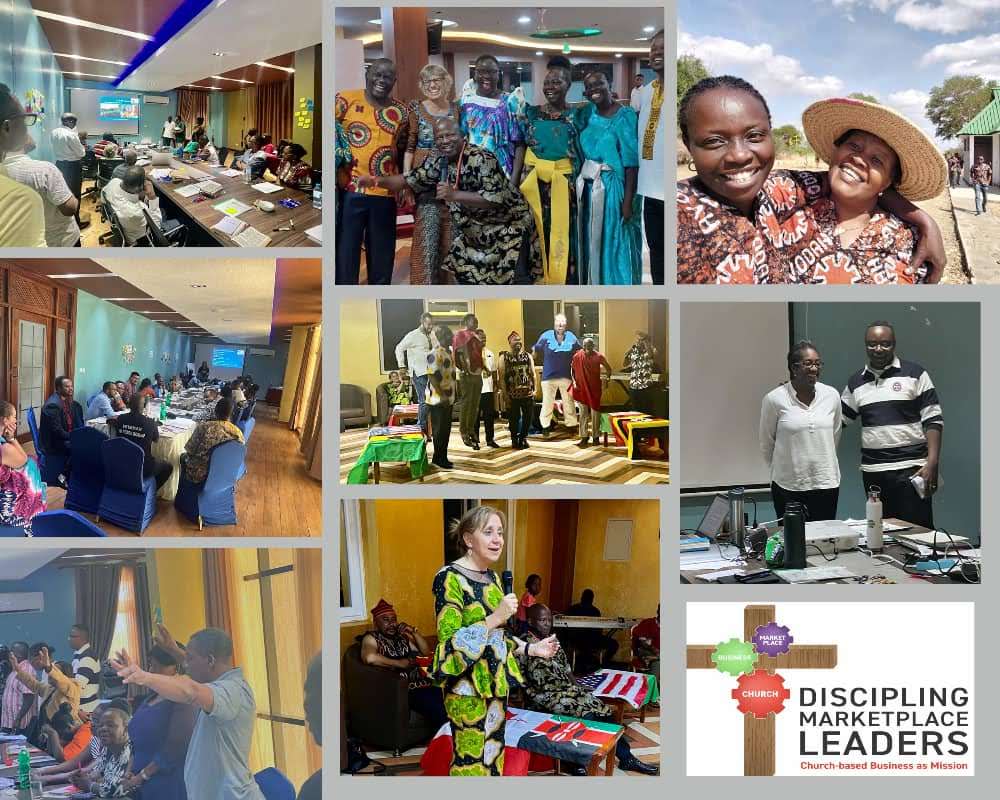
It was all we hoped and prayed it would be and more.  The joy of being with each other in person again cannot be measured.  Bonds that have grown deeper by regularly praying together allowed us to very easily and quickly feel safe with each other and have good and challenging conversations.  

We laughed and cried.  We prayed and sang.  We celebrated what God is doing in the Marketplace across the world and marveled at the idea that He would include us in this work.  We re-examined WHY we do this ministry.  We re-examined for WHOM we do this ministry.  And we brainstormed and shared best practices for HOW to do this ministry.

We saw the work of the Tanzania team in action in a Masai village as well as a church in Dar es Salaam which has implemented DML in a way that is changing lives in the community.  And we had fun.  We went out to a game park for one day, filled up five jeeps and enjoyed the majesty of God's beautiful creation and creativity in animals.  

Words can't express how thankful to God I am for the richness of this summit.  Thirty-seven delegates from twelve countries arrived and departed with almost no problems.  That, by itself, is a miracle! We had prayed for a spirit of wisdom and revelation for our time together, and God answered that prayer.

Words can't express how thankful I am to donors who supported this gathering.  I admit that I struggled with the cost of the summit prior to the event.  But I'm convinced that it was worth every dollar spent.  

And I'm thankful for every DML team member who showed up.  It is clear to see that DML is not just a program that these teams are doing but it is a lifestyle that they are owning and adopting within their own family, community, church and beyond.  We heard story after story of these leaders making disciples who make disciples, and doing work as an act of worship.  God has blessed DML with leaders who love God and love His Church.  

God is good, all the time.  And all the time, God is good, and that is His nature.