A couple of weeks ago, I shared that our DML Global team gathers three days a week for prayer, following the ACTS format (Adoration, Confession, Thanksgiving, Supplication). In those sessions, I discovered a profound aspect of our team dynamics: the power of personal confession.
While prayer sessions typically involve acknowledging our collective shortcomings, we've found that confessing our own sins, individually, has been remarkably transformative. It's a vulnerable experience, looking in the mirror before our colleagues. Doing it once a week is one thing, but engaging in this practice three days a week has allowed us to truly understand one another. We've become familiar with each other's persistent struggles, or as we refer to them, our "thorns in the flesh."
During one of these confession sessions, I had an enlightening moment. I realized that we were often confessing our own "shadow." What does that mean exactly? Let me explain.
I believe every person is endowed with unique gifts and talents that, when combined with their network, culture, and community, create a distinctive contribution to the world. However, I also believe that every gift has a shadow—a potential for both light and darkness.
For instance, my strong inclination towards organization is a gift, but when it's projected onto others or interferes with other values, it starts casting a shadow. This, I believe, is true for most, if not all, gifts. How many of us have experienced a trait we once loved in someone becoming a source of frustration?
My revelation was realizing that the confessions I was hearing were part of the gifting in that person—a dimension I value. For example, a passionate team member often confessed struggles with anger, which is understandable given their passionate nature. Another person, appreciated for their logical approach to life, confessed a lack of sensitivity to their loved ones—a trait expected from someone with a cerebral approach.
The profound realization was that the more I get caught up in my gifting, the longer that shadow becomes. However, when Christ is central in my life, directly overhead, there is no shadow. I use my gift for Him, read the room, and recognize the place of my gift in relation to others.
My goal is to have no shadow, keeping my eyes focused on Him and not on myself. This brings us back to the hymn, "Great is Thy Faithfulness," acknowledging that "there is no shadow of turning with thee; Thou changest not; thy compassions, they fail not; as thou hast been, thou forever will be."
Last fall, I was invited to contribute a chapter to a book relating to women and sustainability. I was given some freedom regarding the direction of the chapter, and I elected to write on impact of Christian women on global sustainability. There was some pushback on this topic as most people have an idea that there should be a separation between faith and these topics. But I like to argue the opposite. We need to see faith not simply as proselytizing but as a lifestyle. We need to re-embrace or redefine how we see religion - not something to shy away from in fear, but a lifestyle of values and behaviors that generally contribute to the flourishing of the world.
This is true across most religions, but since Christianity is the largest social demographic in the world, the importance of the contribution of flourishing through Christians should not be overlooked. In fact, it should be celebrated and promoted, by both believers and non-believers.
In the chapter, there are a number of facts shared, including that 85% of the world's eight billion people identify with a religion; of that number, 2.38 billion are Christian, 1.91 billion are Muslim, and the next largest religions are Hinduism, Buddhism, Judaism, and then others.
Also, women tend to be more religious than men, often by wide margins. For Christianity, 51.6% are women. This translates to a number of 1,228,080,000 Christian women in the world. This is not a small number!
Having established that, we now look at women and their influence/contribution to business/economics/workforce.
As it relates to business, nearly one in three entrepreneurs are women and women are more likely to be solopreneurs (1.47 women solopreneurs for every man). Women make up 43% of the global agricultural work force, with that number rising to 60% in parts of Asia and Africa. Women are more likely to offer innovative new products and services in lower and middle-income countries.
Women also tend to consider social and environmental sustainability more than men and prioritize sustainability over economic goals. This usually means increased flourishing of employees and the flourishing of the creation. (For references to these statistics, send me an email and I'll be happy to send them to you!)
So what does this mean? We need to be encouraging Christian women in business. We need to help equip and empower them for the flourishing of creation, employees, individuals, communities, and families! Let's not leave them out of the mix! Let's not overlook the contribution of Christian women in the flourishing of this world through business. God is a working God and is the God of business, as can be seen throughout Scripture. The gifts of our faith reach beyond the building to the public square.
The church, when gathered, can and should equip the church, when scattered, to do business to the glory of God.
As Gerd Miller, the Federal Minister for Economic
Cooperation and Development, writes,
Religion plays an integral part
in all societies and is the most important source of values for many
people.Any development policy that
respects people as individuals must also respect their individual world views.For most people, this world view is
fundamentally shaped by their religion.
Author Edward Brown, in his book, Our Father’s World, says,
“Whatever the source of the problem is, religion has to be part of
the solution…My conviction about the role of the church in this [environmental]
crisis comes from a belief that environmental problems are sin problems. We
have a spiritual problem, and we need a spiritual solution. Solving spiritual
problems is what the church is all about, and that’s what we can bring to the
table in this crisis. (Brown, 2018, p. 18)
In late December, while taking our two five-month-old puppies for a walk, a German Shepherd in a back yard a house a few blocks away, scaled the six-foot chain link fence and attacked us. Thankfully there were no physical injuries, but there are some emotional injuries that will take some time to heal. The response of the alpha puppy, Pepper (right in the picture), is very different than the more emotional puppy, Ginger. Pepper, we believe, has fully bounced back, while Ginger shows more fear. (As for me? Well, let's just say I'm not walking by that house again! Oh, and my son Noah quickly bought me pepper spray to put on the leash should it ever happen again.)
Since that time, when I walk them and they show some fear at the loud snowplow or a big dog barking, I do what I normally do, which is to say, "It's okay. You're okay." Recently when I say those words, I see Ginger glance back at me, as if to say, "You've said that before and it wasn't!" Now, her response may be my imagination, but as soon as my reassuring words leave my mouth, I'm very quickly aware they might sound hypocritical. I wasn't able to protect them that day and it wasn't okay.
And feeling brings me back to a much more significant time in my life where I also lost the right to say, "It's okay," or "It'll be okay." That time, of course, is when my husband Bob died, thirteen years ago. I lost the right to say that to my children. And ever since then, whenever I have left on any international trip, especially to some more risky countries, and I want to reassure anyone, especially my children, I always have to stop myself from saying, "It'll be okay."
Of course, I know that I was not responsible for either of these events. But protecting and comforting those we love is instinctual. It's how we were made, especially for those whom we are primarily responsible.
And so daily, again, I'm reminded of my inability to guarantee safety and security.
As I've been processing that, I realize that this is the case for millions of parents/caretakers around the world, who are exposed to much worse. How threatening, scary, and humbling it is to not be able to say those words. But those living in war zones, in conflict, in poverty, dealing with racism, sexism, and so much more are also unable to promise that "it'll be okay." Bad things happen.
Letting go of control with loved ones is something we all go through. It increases my faith in God, reminding myself that He does not have grandchildren, only children. And the same instinct we have to love and protect our children comes from God, who does the same.
He doesn't do it in the same way as us, as His perspective and long-view are much broader, but that He loves us is undisputable as seen in the gift of His own son, who endured mocking, bullying, torture, and ultimately a terrible public death.
In the end, it was more than okay.
PS - In case you are wondering, the dogs are from a shelter, and are half Red Heeler (Australian cattle dogs), 1/4 doodle, and 1/4 something else.
PPS - I didn't really want puppies. I feel like there is enough to do in this world without taking care of the daily need of dogs. But the dogs are what I call my "DML tax." In order for my generous husband to allow me to travel as much as he does, he needs company for those long months when I am gone. So in some ways, these are DML dogs!
Our DML Global team continues to meet for prayer every Tuesday, Wednesday, and Thursday for one hour each day. We spend the first thirty minutes going through ACTS (Adoration, Confession, Thanksgiving, and Supplication), and the next thirty minutes going through a text and how it applies to us personally, to our local ministries, and to the global church or DML Global.
We have grown in love and in community by using this format, which began when COVID broke out in March 2020. We are going on four years now with this! And not only have we grown in intimacy as a team, but I have learned so much from my brothers and sisters in Christ.
Recently, Pastor Theo Pare from Burkina Faso was leading our prayers and he thanked God for being "fearfully adorable." Now, a few months earlier, Pastor Rogers Fovo from Tanzania had described God as "adorable" during our adoration time. I remember smiling at that word, as my image of "adorable" is a baby...a stuffed animal...a little puppy. To describe God in this way, seemed funny to me. But then I remembered that we are giving adoration to God...so of course He must be adorable! And so I began to embrace that my definition for adorable had been narrowed by my culture, but it is much bigger and can be used for God!
And then I heard God described as "fearfully adorable." Sounds like an oxymoron to me. It does not sound like two words that belong together!
Yet how appropriate. These two words display the incredible complexity of who God is, so far beyond our understanding. He is a God who is worthy of our awe, reverence, and even fear in light of His majesty. Yet at the same time, He is a God completely deserving of our adoration.
He is:
a God who is a God of justice BUT also merciful.
a God who never slumbers or sleeps.
a God who knows us by name, pursues us, and desires for us to participate with Him in His work, DESPITE our daily failings.
a God who oversees universes AND also atoms.
And I could go on and on.
God is fearfully adorable. And I desire to both fear Him (with reverence) and adore Him.
I grew up in the Christian Reformed Church. We didn't talk a lot about miracles, although we appreciated the reported miracles during Jesus' time on earth. While we prayed for healing and maybe some prayed for miracles in that regard, I don't remember a feeling of expectation that it would actually happen. I also don't remember recognition of a miracle taking place if healing did happen. People would thank God, but not say it was a miracle.
At least, that was my recollection. Miracles were not a big part of our theology. But admittedly, I don't have the best memory in the world, so I could be recalling things incorrectly.
Living and working in Africa, I encountered more charismatic Christians who prayed for and expected miracles regularly. They saw God being much more active in day-to-day life, and over time I grew to appreciate that. One could say that the pendulum swung from one side to the other for me.
But now I believe I'm getting closer to the middle of those two extremes. As I mentioned in last week's blog, I believe that "Christ IS come" means that He is with us today, and we are His hands and feet - we continue to bring the gift of Christ to the world through our time, talent, and treasure. Being His hands and feet, and being made in His image, means that we need to problem solve most issues ourselves. That would be the norm. So if someone has cancer, the miracle is that there are people that are discovering new treatments, medicines, and providing care that can cure it! If someone's car breaks down, there are people who know how to fix it! If there is an emergency across the country, we can get on a plane and fly there - or we can send instant messages or have video calls! People end up being the miracle that God intended and created them to be!
So what is the purpose of miracles? I don't have any solid answers - I'm just wrestling with this and struggling through how to fit this into my current paradigm of God at work in us, to work with Him, in bringing the Kingdom of Heaven to earth. But here are some thoughts.
I believe miracles are the exception, not the rule.
I believe that the purpose of miracles is for God to show His glory - to be a witness to those who do not know Him. When Jesus raised Lazarus from the dead, he said, "Father, thank you for hearing me. You always hear me, but I said it out loud for the sake of all these people standing here, so that they will believe you sent me" (John 11:41b-42). God desires to draw all people to Himself.
A miracle is something that is done that people observing would say it could "only be God." Miracles often break the laws of science. The goal is that it would lead people to a belief in God. Evidence of miracles would be in the presence of witnesses.
So then, are miracles a result of faith? What is God's process in deciding a miracle? Certainly He would choose to do miracles that would draw the biggest amount of people or have a big impact, as opposed to one sick person in a private hospital room, no?
Maybe what I'm really struggling with is how we pray. I am finding that my prayers are often met with God saying, "I concur. Go do it! I've equipped you! I am with you! You are blessed to be a blessing!" There is an affirmation, an encouragement, an accompaniment of God. Yet I hear in many prayers, that there is an expectation that God alone will do it. That the answer will come through miracles.
When I teach, I often tell the story of the man who died and went to heaven and lamented to God that he never saw a miracle, yet he had prayed for them his whole life. God said to him, "Do you remember that tree outside your kitchen window?" The man replied, "Yes." God said, "That's a miracle." The man said, "How is that a miracle? That's just a tree!" God said, "Let's see you make one out of nothing. And also, you liked looking in the mirror every day." The man said, "Well, yes, that is important for being respectable." God said, "What you saw in the mirror as well is a miracle."
The point is that we are surrounded by miracles. Most of these miracles follow the laws of science and nature, which God put in place. Those are the norms which are still incredible! Thanks be to God!
I've been struggling with my Christmas spirit, or lack thereof, so far this season.
But the truth is that this is not unusual for me- I often struggle with Christmas. Don't get me wrong - the birth of Jesus is the greatest gift ever! I love the family time as well! But I often struggle with the incongruity between the "now" and the "not yet."
In essence, this has been my struggle: In the Christmas season, we sing the classic hymn, "Joy to the world, the Lord is come." But to be honest, it feels fake to sing this amidst so much turmoil in the world. And there is so much turmoil. So, so much.
Much of the world does not know or feel joy, both Christians and non-Christians alike.
The song goes on to say, "No more let sin and sorrows grow, nor thorns infest the ground, He comes to make his blessings flow, far as the curse is found." Yet the curse continues to be found everywhere. There does not seem to be a flowing of blessings. There is war, death, famine, sickness, poverty, persecution, and so much more.
So to help with this paradox, Christians spend time during Christmas talking Christ's return, when all things will be made right. We celebrate His birth, but we focus on His coming again as the next best thing. The problem is that there is a lot of time in between these two events which feels quite joyless and very painful.
But a closer look at the lyrics of the hymn states, "Joy to the world, the Lord IS come." "IS" is present tense. "IS" is now. Many have changed the words of this song to "the Lord HAS come." But that change puts the presence of Christ in the past and that creates a serious challenge for us today! If we are celebrating something that happened 2,000 years ago, which gives me a ticket to go to heaven when I die, what does that mean for today? Not much. And that is just not the case. The Lord IS come. He IS here.
We are not a people simply waiting. We are to continue the work that Christ started. Christ is with us today in the 2.3 billion people who call themselves Christians! We are in a time of waiting for Christ's return, but we are not only in waiting mode. Waiting is a time of inactivity. Waiting is a time of looking and longing. Waiting is focused on the future and not on the present.
We are not just to be waiting for Christ's return. We are the hands and feet of Christ every day until He returns. We are agents of reconciliation. The gift that came so long ago continues to be with us. As we lament war and conflict and death, we get to be part of the solution.
I think Christmas is a dark and lonely time for many because there is such a disconnect between the joy of the birth of Jesus and the present suffering that we are in. And when our answer to this is that "one day He will come again," we miss out on the hugely important presence of Christ with us today.
Christ's birth was not the appetizer with the full meal coming at His return. The work for the restoration of this world is not for God alone to do. We are not simply waiting for Him to act...and wondering why He tarries...and questioning His goodness while the world languishes in darkness, and death, and despair. We join Him. He calls...equips...and blesses us to be a blessing.
Christ in us...Christ IS come...we continue to live out and with the gift that came long ago.
But what about all the pain and suffering in the world? It's true that I can't end the conflicts in the Ukraine, Middle East, Burkina Faso, Cameroon, Nigeria, or elsewhere. But I can be an agent of reconciliation in my own sphere of influence. I can love my neighbor as myself. I can speak the truth in love. I can do all my work as an act of worship for the King. I can care for creation so that it will flourish. I can be a steward of my time, talent, and treasure to make this world a better place. I can be salt, light, and leaven. I can be prophet, priest, ambassador, saint, king.
And I can pray. I can encourage others to have compassion, capacity, competence and courage in their spheres of influence. I can support agents of reconciliation in those places that I can't personally reach. And together, we can make the world a better place. We bring the Kingdom of Heaven on earth, a little bit of time, being faithful UNTIL He comes again.
I can because of Christ in me. What a gift that would be if I do it well! A gift that keeps on giving to the glory of God, in gratefulness to the Son, and only because of the Holy Spirit!
That is a message that gives me hope. That is a message that can make me feel good about celebrating Christmas. I'm thankful that the Lord IS come!
There's a difference between activities and impacts. Activities are the things we do in the hopes that it will bring about impact. Some of our activities are workshops for pastors, church leaders, and businesspersons. Some of our activities are mentoring, training, and advocacy. Our partners regularly report on their activities. But we are very aware that activities do not lead to transformation. Education without application is just information. But information plus application leads to transformation. So, every October, each of our partners hires an enumerator to do a randomized survey of 50 businesspersons and ten pastors who have gone through DML to assess impacts.
Our impact survey results from 2023 closely align with the results from 2022, which makes us happy! For every business trained, two new jobs are created (of course, we know this is an average - some create zero, some create ten, but two new jobs for each business is the average). More than 1000 jobs were created just by our sample of 550 businesses in this past year - yet we have trained almost 18,000 businesspeople so far in 2023! [I'll let you do the math!] Business profit has increased by 20% and household income has also increased by 20% (this is down from 25% in 2022, mostly due to inflation and instability in some partner countries). 94% of churches reported increased attendance, giving, and spiritual growth in their members. We thank God for these reports of impacts!
The story below shows the impact of one man in Ghana who attended the DML training in 2020:
Mr. Joseph Osman, owner of Joseph Farms in Sanga-Tamale
metropolis, Ghana, is a young and talented entrepreneur who worships at a
Baptist church in his small community. Joseph Farms, specializing in pepper and
maize farming, is just two years old.
In his quest to become a successful businessman and
acquire essential knowledge, Joseph eagerly attended the DML business training
in 2020, despite having to travel a significant distance. The training had a
profound impact on him, shifting his perception of business from a secular
endeavor to a platform for spreading the message of Christ. He learned valuable
skills, such as customer satisfaction, business boundary setting, and pricing.
After the training, Joseph faced the challenge of
choosing a specific business venture. With guidance from DML partner Hopeline
Institute, he decided to venture into farming and secured one-acre plots for maize (corn) and
pepper cultivation.
Joseph also has aspirations to become a journalist and is
actively saving around 60% of his crop farming proceeds to fund his education.
In addition, he plans to diversify his income by raising goats and sheep,
recognizing the importance of a solid business foundation and clear boundaries.
In closing, Joseph expressed his gratitude to
DML Hopeline Institute for the insightful training and the loan that
kickstarted his business. His ultimate goal is to use his business as a means
to spread the Good News of Christ to others.
These impacts could not happen without the work of partners, prayers, and supporters around the world. Thank you for partnering and praying for DML!
We still have a matching challenge grant for new recurring givers until we reach $25,000. If you would like to give a monthly gift, for $5/month and up, our donor will match your giving for the first year. Please prayerfully consider helping us reach our goal for 2023 by going here.
We talk a lot about "business as mission" and even more so lately about "work as worship" which can be done in any workplace.
I received an email a week ago from our DML leader with the Christian Missionary Alliance (CMA) in West Africa, Pastor Theo Pare, who has been asked to bring the "work as worship" message to the CMA in several West African nations. This email showed me the potential of "translation as mission" - another workplace where unique opportunities (coupled with obedience) opened doors to the work as worship message. Pastor Theo gave me permission to share his email with you:
Dear Renita,
I hope this message finds you well in God's grace. This month, I unexpectedly attended an international Christian Missionary Alliance (CMA) conference in Monrovia, representing DML at President Job's request. Surprisingly, I was chosen as the translator for the event, translating between English and French for eight days. This unplanned role turned out to be a blessing for DML, significantly increasing its visibility.
During the conference, missionaries shared impactful stories of integrating business and mission. When I presented DML, it resonated strongly with the audience. The Congo Church and Guinea Church expressed eagerness to adopt DML, with the Congo Church, known for its extensive medical centers and schools, enthusiastic about implementation. Guinea is considering sending a representative to Mali for DML training.
Burkina Faso and Mali, celebrating their 100 years CMA anniversary until year-end, propose holding the DML training after the celebration, around the beginning of the new year. This unexpected turn of events showcases God's divine planning.
I appreciate your prayers and support, and I wanted to share the incredible impact of this trip. It was a testament to divine circumstances leading the way.
God bless you abundantly!
Pastor Theo
Isn't that amazing? Pastor Theo is working fulltime with the Christian Missionary Alliance in Burkina Faso to equip every local church with this message. This position was created in part because there was increasing demand for this message from other West African nations and the President of CMA in Burkina Faso wanted to respond to that. Please pray for him, these open doors, and the opportunity for the flourishing of many as we begin to do our work as an act of worship, for the flourishing of all creation!
We can't do this without the partners who help to support this work through denominations and churches across Africa and Asia! Tuesday is Giving Tuesday, and we hope to meet our year end goal of raising $80,000 in order to meet our 2023 budget and move into our 2024 goals with strength. Please prayerfully consider joining us - go to Donate - Discipling Marketplace Leaders for more information!
[Don't miss the important announcement at the end of this post!]
This past week we were able to enjoy a visit from one of our partners from South Asia and learned about more than 2000 churches that have been planted in the marketplace in the past two years! There are small churches gathering in factories, laboratories, hospitals, schools, transportation centers, farms, and more! The priesthood of believers are disciples making disciples who are making disciples (2 Timothy 2:2).
While we celebrate this, we understand that this is happening in a context where it is very difficult to be a Christian, where there is persecution and corruption which can be so discouraging.
We often think that poverty causes corruption, and sometimes that can be true. Proverbs 30 says that God should give neither poverty nor riches...or I might have too much and disown God or have too little and steal. But Vishal Mangalwadi, an Indian Christian philosopher, tells us that the opposite is more true - corruption causes poverty.
This excellent video gives perspective on corruption by using examples of the consequences of honesty and corruption in both the Netherlands and India. Vishal Mangalwadi shares that corruption costs five trillion dollars every year and adds no value to the cost of goods that are being sold.
He says that transforming a nation requires cultivating character. He says that nations need more than investment, aid, or protests. They need hearts and minds that are transformed.
Please take a few minutes to watch this three-minute video. This is what Discipling Marketplace Leaders is seeking to do. When we do our work as an act of worship, instead of for our own personal gain, it changes everything.
In this week of Thanksgiving, we are thankful for the mission of God, which invites us to participate in bringing reconciliation to all spheres of creation - including hearts and minds transformed in the marketplace! We are also thankful for each of you who has partnered with us, in prayer, encouragement, and financial support. The demand for this message continues to grow and we could not respond without you!
PS - In light of Giving Tuesday, just a few days after Thanksgiving, we will be announcing that a generous donor has agreed to match any new recurring donations for 2024 (up to $25,000 USD). This means if you give a monthly gift of $50 to DML, the donor will match that for twelve months! Additionally, on Giving Tuesday only, they have agreed to match any gift over $250. Please prayerfully consider if you can partner with us in this way to reach more people in 2024! Go to Donate - Discipling Marketplace Leaders - giving is easy with ACH, PayPal, and credit cards!
This week DML had its annual summit - virtually this time. [On the even years, we gather in person; on the odd years, we gather online.] We had more than 90 people in attendance, from fourteen countries, across thirteen time zones. It was a wonderful time of fellowship, fun, worship, sharing, planning, and processing.
Each of our implementing partners went to a retreat center to have some fun, fellowship, prayer time, rest time, and planning time for 2024. A big thank you to all of our partners who help to make this possible! This is such an important time, as we look at what we have done thus far in 2023, what our impact surveys have told us, what we can celebrate, and where we need to make course corrections. We then plan on how to use our time, treasure, and talent better in 2024 to increase the return on our investment for the building of the Kingdom of God on earth!
Here are a couple of quotes that we heard this week from pastors and marketplace ministers:
As a pastor, I had no idea how to equip myself economically and I was living a low-level lifestyle. After the DML training God opened my eyes as he did with Moses. I sold my house and bought land for farming. Then I planted banana trees.
After a few months, I covered all the cost that I spent on the land. This has become a good example for other church ministers.
I am a taxi driver. I used to charge
unreasonable amounts to my customers. I attended the training of DML and
understood that I need to honor God through my business. I started being honest
to my customers.
I have a weighing machine's business. I
provide sales and service. Customers used to bring their weighing machines for repairs, and I used to give them a time frame. I never used to stay true to my
word. I learned that I must do work as worship. I brought change into my behavior. My customers are happy with me now.
Some of the team pictures from this past week are below.
This week, one of our partners from South Asia, Praveen and Chrysolite Karagani, will be with us to share about the incredible work being done in planting marketplace churches. We are so excited to hear from them as they share what God is doing to build His church in places where churches are no longer welcome - the marketplace is such a place where real growth can be seen!
I just returned from several days in California at the Transform Our World conference, with Ed Silvoso. I've been quoting this man for about ten years, as he has written a number of very good books. His book, Anointed for Business, was required reading for our Church-based Business as Mission class. My favorite quote from Dr. Silvoso (which I had the privilege of quoting back to him!) is this: Christianity is like a football (soccer) game: 20,000 spectators in desperate need of exercise watching 22 players in desperate need of rest."
I found this man to be a sincere, earnest man, leading a global movement of people doing church every day in every space. He is 78 years old, full of energy, and committed to work to build the church for as many years as God gives Him the ability. He is from Argentina originally and has amazing stories of how God has shaped his life through trials and blessings.
The conference was four days of testimony after testimony from Mexico, Thailand, the Philippines, Egypt, Argentine, Hawaii, Canada, and so many more. As they said, "If people don't go to church, that's okay. We are like Pizza Hut. We deliver." And that is what they do - they are bringing the church to the Marketplace - government, education, and business.
My goal in this visit was to see whether there is potential for us to partner together and complement or add value to each other in our ministries. I believe there is potential - and they believe that as well - so we will continue to learn from each other and see how we can continue to build the body of Christ. Shout out to Jean, a supporter of DML in a number of ways, and new friend to me, who loves connecting people and helped me to connect with Transform Our World!
Dr. Ed Silvoso and his wife Ruth. A privilege to meet these saints!
In a world marked by ongoing conflicts, including those in
Israel, Palestine, Ukraine, Russia, Burkina Faso, and Cameroon, there is a
collective yearning for peace and a longing to understand how to contribute to
it. Psalm 147:12-14 offers insight.
12 Extol the Lord, Jerusalem; praise your God, Zion.13 He strengthens the bars of your gates and blesses your people within you. 14 He grants peace to your borders and satisfies you with the finest of wheat.
Martin Luther's interpretation of this text emphasizes that
the term "bars" encompasses not only physical barriers but also the
elements that safeguard a society, including good governance, sound city
ordinances, and wise leadership. These, he asserts, are divine gifts. (From Every Good Endeavor, by Tim Keller)
Luther delves into how God secures a city's safety. He
concludes that while God's sovereign hand plays an unperceivable role in this,
He also works through human agents, such as lawmakers, police officers, and
government officials, who become extensions of His protection. Hence, every
diligent police officer, in donning their uniform to safeguard the city, is, in
essence, doing God's work.
This perspective yields two vital conclusions.
Firstly, all
ethical and purposeful work that promotes human flourishing and the responsible
stewardship of the environment is an extension of God's role in sustaining and
caring for His creation.
Secondly, when we excel in our vocations, we serve the
people who benefit from our efforts.
By performing our work with a commitment
to honor God, it becomes a tangible expression of love for our neighbors.
This understanding aligns with Jesus' instruction to love
our neighbors, emphasizing that our daily endeavors are opportunities for
community care and service.
Ultimately, these insights resonate with the Lord's Prayer,
which calls for daily sustenance and prays for the realization of God's kingdom
and His will on Earth. They remind us that our work, when carried out with
diligence and integrity, can be a part of bringing God's peace and provision to
our communities and our world.
May God continue to use us to join Him in strengthening the bars of our gates, reminding us that we are blessed to be a blessing.
For six of the past seven weeks, I have been on the road. On this trip there were seventeen beds in fourteen cities, in five countries. There were ten speaking engagements with 160 hours in workshops, of which I taught for over 100 of those hours. There were many meetings in-between as well, along with many hours of preparation in-between. Wow. Makes me a bit tired to write that out! The map shows the places I visited in September. I am so thankful for all the people I was able to meet, the DML teams who joined me in the work, and the amazing supporters who help to make all of this possible!
I'm now back in Michigan for about ten days, before heading to California for a short conference. It's good to be home!
Last week, I spent time recording our Integrity and Finance class, as well as our Financial Freedom Class for Families at a studio in Harlingen, Texas. I taught 21 thirty-minute videoed sessions with a professional camera crew, who will then edit and release the videos so that our partners can do voice-overs as needed. This is a very important opportunity as it allows us to move away from trainers and toward facilitators. Facilitators are easier to equip, as they are able to play the video, pause and have discussions. It allows us to standardize the material more.
We have partnered with an organization called Nation to Nation Christian University, who has bartered with us to be able to put our courses into their own curriculum, in exchange for allowing us free use of their studio. This is a win-win! Nation to Nation works in more than 50 countries, offering four-year degrees to more than 30,000 students around the world, in theology, community development, leadership and more.
Last year, we recorded our Foundational Workshop, Basic Business 1 and Basic Business II, as well as our Entrepreneurship Course. We thank God for these courses that are being used and translated in many parts of the world!
So thankful to get back to Michigan which is full into fall with beautiful colors on the trees everywhere!
Greetings from Harlingen, Texas, just a few miles from the border of Mexico! This past week I was in Dallas with the Global Alliance for Church Multiplication (GACX) Forum, an annual gathering of church planting organizations from around the world. [GACX is part of Campus Crusade for Christ or CRU.] This year there were 400 people from 50 countries, and as always, it was an inspiring event with very sincere, earnest, passionate believers seeking to reach all people with the love of Christ.
There was a lot of data shared this week, which I found to be very interesting.
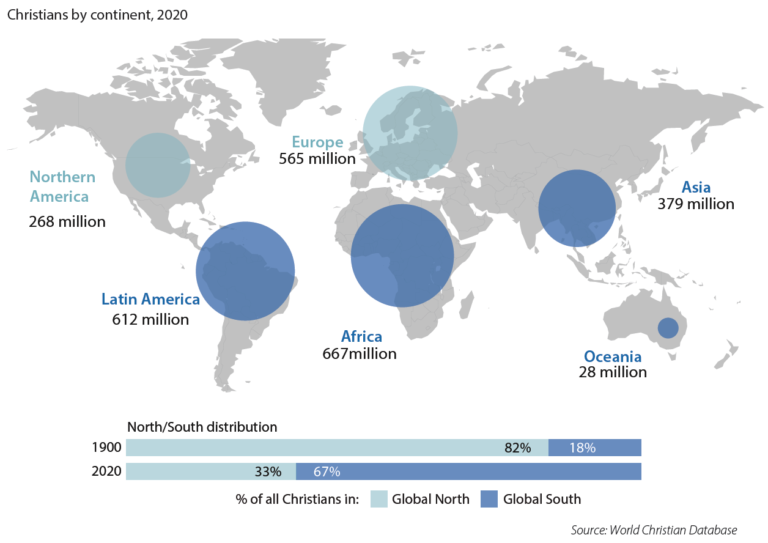
It's not a surprise to most of us that there has been a shift in the population of the church from the Global North to the Global South. Only 18% of Christians lived in the Global South in the year 1900, but today it is 67%. There are 838 million Christians in the Global North but 1.1 billion Christians in the Global South.
But the highest number of Christians can be found on the continent of Africa, with the number at 667 million, compared to 268 million in North America. Europe is the least reached continent - there are more Christians in Saudi Arabia than in Greece!
There are also more females who are Christian than males, so one speaker said that the face of Christianity today is an African woman! We need to begin changing our perception of global Christian leaders to this picture!
Another interesting fact is that while the percentage of Christians worldwide has remained the same (for the past 100 years (around 32%), new data is showing that the global population growth is outpacing the growth of Christianity, which will result in a decline over time.
But here are some other interesting facts:
More than half of all Christians live in countries where mor than 70% of the population are Christian.
More than half of all non-Christians live in a country where less than 8% are Christian.
As one speaker said, "we are good at winning the winnable and ignoring the rest."
However, the place where Christianity is growing the fastest is in the areas where the Human Development Index is the lowest. This is where I see the capacity of Discipling Marketplace Leaders having a positive impact on the Global Church. We need to teach a healthy theology of work, as well as wealth creation God's way, and wealth management as God's stewards. There is no wealth to be shared until there is wealth created. Business has the ability to create wealth, alleviate poverty, create meaningful work, and reach people who would typically never step foot in a church.
This week I'm doing recordings of DML materials for YouTube with a partner organization, Nation to Nation, who allows us to use their studio, and then also sends DML courses to their schools around the world. Have a blessed week!
Greetings, dear friends! I made it back safely from India last Sunday, was home for a week, and am now in Texas for the next two weeks. During these two weeks, DML will be presenting at the Global Alliance for Church Multiplication conference, meeting with some local church leaders in the Dallas area for DML partnership, and then spending a full week at a studio in Harlingen, TX, recording more DML materials with an organization called Nation to Nation (N2N).
Things are moving swiftly for DML, and it's an exciting time!
Our recent visit to India with the BAM South Asia group has garnered interest from individuals and organizations in Singapore, the Philippines, Indonesia, Nepal, Sri Lanka, and many parts of India. We are grateful to God for connecting us with those who share our mission to do work as worship. It's truly inspiring to meet like-minded individuals who are also passionate about this message!
While I was in India, some of our partners in Africa were busy spreading the message in new places, such as Sierra Leone and Zambia. The impact of God's work is spreading across borders, and we are thankful for the opportunities to connect with God's people worldwide.
Here are some quotes from those who attended the workshops in Zambia:
From a businessman: "The church does not care what we go through in business. The church believes we always have money, but at times we go through hard times of loss, and we don't find a place to share our challenges at church, which makes it very hard to identify ourselves in the Kingdom mission."
From a pastor: "We have a dilemma of how best to accommodate businesspeople. We were taught to believe that having a lot of money is a sin, thus we don't have a proper way to accommodate businesspeople in church. It's like we need them because we need their money, which is very bad."
Stay tuned as we continue to join God in what He is doing to build His church and reclaim the redeemed marketplace!
An honor to speak with a number of other great speakers at the Beyond Business conference.
Vaibhav and Sujata with Udhhar on the left, and Praveen and Chrys from GCI on the right.
Greetings again from Uganda! I leave today for Hyderabad, India for a conference with BAM (Business as Mission) South Asia. This past week was a very busy week with conferences in three different parts of Uganda: Kampala, Soroti, and Bukwo. Uganda is a beautiful country and it was a very enjoyable week. I look forward to this coming week in India and learning how BAM is being implemented in different parts of Asia, while sharing about the potential for BAM to integrate more with the local church.
This past week I spoke a lot about Ephesians 4 and the call for all Christians to recognize that they are in fulltime ministry - either in foreign missions (the minority) or home missions (the majority). Their fulltime job description is to glorify God and their specific locations of where they do this are very different. We pleaded with pastors to recognize their positions as coaches to equip the saints for the work of the ministry, so that they grow in ministry to be apostles, prophets, evangelists, pastors, and teachers in every place and space. We encouraged pastors (coaches) to understand their "players," what their strengths and weaknesses are, what their individual parishes are and the opportunities and challenges in those places. We saw our message resonate as pastors recognized that there has been too much focus on the building, and not enough on equipping the members for when they are scattered.
And so this week, we see the last of the five-fold ministry listed in Ephesians 4: teachers. We are to be teachers of the gospel of Christ, discerning true from false doctrine. The church and culture are changing quickly in many places. There are many false teachings that abound. This week I heard that poverty is equated to holiness, therefore wealth is considered sin; that only pastors are called to full-time ministry; that pastors are to be given free things at every business where their members work as a sign of respect; that pastors should never do business, even if the church is hardly able to support them. Every culture has their false teachings and so we need to continue to teach, learn, and be shaped by the Biblical worldview. All Christians need to be prepared and ready to teach when given the opportunity.
We do this more naturally with our children, but there is great potential in the workplace where we will have the opportunity to exercise the gift of teaching. The best teaching comes in the context of a good and trusted relationship. Think of a favorite teacher you had growing up and the qualities that he/she showed. Some of the best teaching comes by asking questions rather than providing answers. Especially in the workplace with other adults, remember that the majority of teaching that is done is non-verbal! That is why it is said, "Preach constantly. When necessary, use words." (Quote credited to St. Francis of Assisi but many do not think it came from him.)
Thank you for your continued prayers for the seeds being sown!
The beauty, the flourishing of farms, the jubilant fields. Such beauty to behold!
My dear sister in Uganda, Grace Koelewijn. Love this lady!
The leader of the Lema Institute, Rev. Joshua Amaezechi, a Nigerian-American who lives in Michigan, and coordinates this work in Uganda and Nigeria.
The training team in Soroti, with speakers from Dordt and Calvin University, as well as the CRC in Nigeria, and others!