Monday, June 17, 2024

"Business people are not Christians."

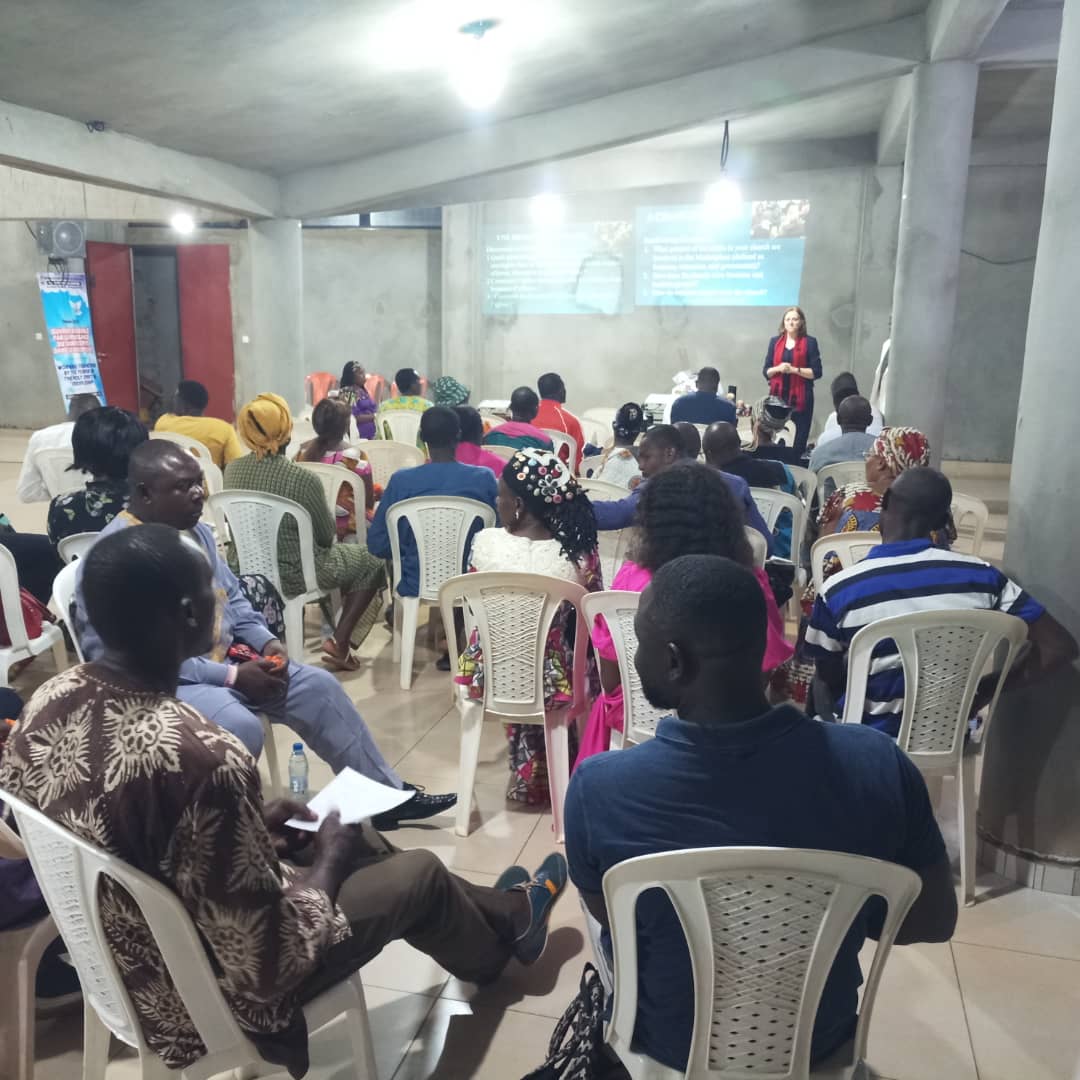
Greetings from Ghana, where I am ready to travel to the fourth city to present the message of "Work as Worship."  I started presentations last week in Kumasi (west), then to Tamale (north), then to Navrongo (far north, almost to Burkina Faso border), and now to Ho (east).  Lots of driving this past week!  Thankful to God for safety! On Thursday, I will leave for Benin.

The quote in the title, "Business people are not Christians," was spoken to me by a young pastor in Kumasi.  He continued by saying, "They are not Christians because Christians have given their whole selves to Jesus and business people clearly have not done that."

Thankfully, by the end of the workshop, he had changed his perspective.  

But how sad that it was even spoken.  And I know that if it was spoken by one pastor, it was likely in the minds of others. 

There is such a tension between business people and pastors in many churches.  Recently I attended a service that included three offerings and six announcements of fees that were due.  If my pocket was empty, I would be inclined to stay home from church.  The same service announced about eight different programs that were going on during the week, encouraging all members to come.  While these programs are designed to be helpful with discipleship, they put a lot of pressure on those who are doing business six days a week, often for 10 hours a day (especially in cities where traffic is terrible), not to mention other obligations.

We had important discussions about the challenge of church attendance becoming the "end" or the goal, rather than transformed lives through whole-life discipleship.  Members who do not attend Sundays and Wednesdays and many of the other meetings can be viewed as "back-sliders" by the pastors.  Those who attend regularly are assumed to be "right with God."

In the north, we had debates about whether pastors could be co-vocational - doing both business and pastoring a church.  Knowing the challenges of poverty faced by members in predominantly rural/agricultural settings, my tongue-in-cheek initial response was, "If your church isn't paying you enough to take care of yourself and your family, then you should do business.  Otherwise, you may be tempted to become creative with trying to get more from members, charging fees-for-service for prayers and blessings."  That got a good laugh (mostly because everyone knows that to be true) and then ensued a good discussion.

I spent an afternoon with the youth (ages 20-40!) to talk about entrepreneurship and had excellent discussions about the need for each person to release their potential in order that others may also release their potential.  For example, a farmer produces crops, which when are consumed releases potential in the person eating the food.  Those people then do their work, maybe as a mechanic, which releases the potential of someone to drive from point A to point B to do their work.  And on and on.  We emphasized that you can't do just one thing - everything is connected!

Sadly, starting a business is often viewed as a sign of failure for those who get a college education. So we talked about the value of being job makers and not just job seekers.  What a privilege to be able to provide a job for someone, where they can flourish and their family can flourish!

Lots of good and important discussion.  Discipling Marketplace Leaders stands on such a solid Biblical foundation that the debates that ensue can almost always be resolved by going to Scripture.  

But soooooo much work to do to help churches get a healthy theology of work and begin to understand the importance of teaching wealth creation and wealth management from God's perspective.  

It looks like another denomination might formally join with DML and set up a workplace department, which will bring our partners in Ghana to four.  We thank God for what He is continuing to do and that we get to join Him! Please continue to pray for the seeds planted!

Leaders for Assemblies of God in Northern Ghana

Monday, June 10, 2024

Faithfulness in the Workplace

Greetings from Ghana!  So thankful for traveling mercies!  

I was recently asked to give a speech for a large international company on “Faithfulness in the Workplace.”  The company executives were looking to encourage their employees to be more faithful in achieving the company goals, but of course, the responsibility for employee faithfulness is not a one-way street.

As I considered the topic, I realized that we don’t hear the word “faithfulness” in the workplace very often anymore – we hear more about loyalty.  Loyalty is defined as a "strong feeling of support or allegiance," but the word "faithfulness" is richer - it goes deeper than loyalty. 

There are two main components to faithfulness:  1. It is the willingness and 2. the ability to complete a job. 

And in this definition, the two-way street in terms of the relationship between employee and employer becomes very obvious. 

Let’s look at the employee first. 

A faithful worker is one who is WILLING to complete a job regardless of their personal feelings.  They don’t only do the jobs they like but they consider all the tasks that need to be done for the flourishing of the customer, the work environment, and the company.  Being willing is about our attitude and it is about the only thing in life that we can control.

It reminds me of the Circles of Control, Influence, and Concern by Stephen Covey (author of Seven Habits of Highly Effective People), which describes the largest circle in the picture as the circle of concern.  Unfortunately, this is where we spend most of our time but where we have the least amount of influence or impact.  The middle circle is the circle of influence.  That is where we spend some of our time, seeking to influence those in our inner circles.  The smallest circle at the center is the circle of control. This is where we often spend the least amount of time and when explored, we find that the only thing we really can control is our attitude and how we respond to things that concern us or deal with the areas of potential influence.  This is where willingness and understanding can be developed. 

But a faithful worker is also ABLE to complete the job.  They have the skills and resources to be successful in terms of their goals and the company’s goals.  Ability includes physical, mental, legal, moral, financial, and spiritual capacity.  It comes from education, training, mentoring, resources, networks, and access.  In our Christian life, it is called discipleship.  And in our workplace, we also need the tools and resources to help us have the ability to do the job.  For Christians, understanding that work is to be done as an act of worship increases our spiritual ability to integrate faith into all aspects of life.  It then motivates us to be successful in all other abilities, as we recognize ourselves as co-laborers, co-creators, with the most high God.  

Companies need to help create an environment that allows their employees to flourish.  Employees need to challenge their personal circle of control, to strive for the customer to flourish.  The reality is that when the primary goal in a business is the flourishing of all, the company will do better.  Goals will be achieved.  Turnover will reduce.  

And so, on this Monday morning, we can ask ourselves, 

  1. How willing am I to do all the tasks on my list for this day and this week?  How willing am I, even if I don't like my boss, colleagues, or the work itself?  Who am I working for today?  God or man?
  2. How able am I to do the work that has been given to me to do?  Am I seeking to improve, to do it with even greater excellence?  If so, where can I get the help to grow in my ability?
Usually, if we are struggling in our work, there is a challenge in one of these two areas.  Remember that we can't control our boss or our workplace, but we can control our attitude.  And when we turn our work over to God and do it for Him and the flourishing of this world, it can get easier!  If you need a Biblical example of this, read about Joseph and Daniel - two men who worked as slaves and captives, yet worked with excellence and not only flourished for themselves but brought about flourishing for many others.

May God bless you in this work week, whether you work in the home or outside the home!

Sunday, June 2, 2024

Five Countries, Eight Cities, and Eight Partners in Five Weeks

This Friday, June 7, I leave for Africa again, and I will be spending most of my time in West and Central Africa.  I will start in Ghana, where I will spend time with each of our three partners there (Assemblies of God Ghana, SIM, and Hopeline Institute), doing training in four different cities:  Kumasi, Tamale, Navrongo, and Ho (see yellow stars on map).  I am blessed to join with three amazing DML leaders there:  Rev. Derek Amoo-Sakyi, Yvonne Mildred, and Apostle Emmanuel pictured below (L to R). 

Ghana Team
From Ghana, I will travel to Benin, where I will be joined by Pastor Theo from Burkina Faso, who is leading the workplace discipleship ministry for the Christian Missionary Alliance denomination in Francophone West Africa. The CMA in Benin has called for this opportunity, and Pastor Theo has responded!  This will be my first time in Benin.

Pastor Theo
Pastor Theo has also started work in Togo, but that work has gone beyond the CMA to the Pentecostal and Baptist churches, with the help of our Life Ministries (CRU) partner.  We will be doing the "Work As Worship" workshop and the Basic Business Training while in Togo.  DML started in Togo in 2023 and we are seeing a good reception and application! 

From Togo, I will travel to Burundi, where I will join the amazing DML team that is doing youth entrepreneurship with 400 youth in twelve churches.  The trainers for these 400 youth are pictured in blue shirts below.  DML Burundi is doing a five-year study to see the impact of church-based workplace discipleship on youth (aged 18-35) and the greater community at large.  We will be gathering all 400 youth for one week to do some intensive business training and inspirational teaching on work as worship.

DML Burundi Trainers
Lastly, I will travel to Cameroon for the launch of a "BAM Cameroon" initiative.  BAM Cameroon is a consortium of churches, businesses, government, and education, looking to see how these institutions work together for the flourishing of the nation.  I have been asked to speak on the roles of these institutions and how they can complement and not compete with each other.  

Please pray for this trip and all the different opportunities that are involved in it!

As a DML team, we have been spending our time in the book of Ezra where the people are engaged in rebuilding the temple of God.  In this book, we have seen the role of the prophets in not only calling the people to that work but also joining in that work (Ezra 5).  The DML team is also seeing our team members learning to "flex" their prophetic voice as they call the church to a new understanding of a holistic gospel from a Sovereign God.  The evidence of this voice is showing up in multiple new partnerships across Africa.  We are thankful for the old and new voices that are being brought into this message of purpose and meaning for each person!  In just this past week alone, I had conversations with potential partners in Pakistan, Trinidad and Tobago, Chad, and the Congo, with more voices looking to join this movement!

God is at work in rebuilding His temple through His people and we are delighted to join Him!

Tuesday, May 28, 2024

How the World Gives

I've been engaged in connecting Christians to global ministry opportunities for 27 years and have learned a lot along the way.  You'll notice I didn't say, "I've been engaged in fund-raising for 27 years," as that term connotes a singular direction of getting money from people for ministry.  I've learned, with God's help, that my work is to tell the story of what He is doing and invite people to participate.  That type of partnership goes both ways and is a much healthier approach.  DML has been blessed with many loyal donors who not only believe in the vision but also seek to live it out in their own lives - what a blessing!

Over the years, as I've sought to grow in wisdom in this subject matter, I have become curious about how the world gives.  This is in part because DML is currently trying to help our implementing partner ministries find connections with Christians in their local community who can also partner in this work.  And what I'm learning is fascinating (maybe just to me...I know not everyone loves statistics!).

So let me share some facts that I read from the websites cited below:

  • 72% of the world's population supports others. I've helped people with their budgeting in many warm cultures, and found that often upwards of 40% of their budget goes to helping family members, parents, the poor, and more!
  • Religious people have a higher giving index.  However religious giving is less than it was during the Great Depression when giving was at 3.3%.  
  • Jews outgive every other religious group for generosity.  Muslims are required to give 2.5% of their wealth.  Christians currently give 2.5% in the US, which is 7x the amount given by European counterparts and 2x the amount given by Canadians.  (As a Canadian, I'm a little surprised at this!  Canadians are known to be generous people!)
  • The US gave $471 billion to charities in the year 2020.  Only 20% of that comes from companies; 80% from individuals.
  • Of this, 41% goes to congregations, 3% goes to religious charities, and 27% goes to groups with no religious ties.  In total, 73% of all giving is connected to religion.  There are 25 churches for every Starbucks in the US, showing the strength of religious philanthropy in numbers.
  • Immigrants give more than nationals.
  • In the US, those making less than $50,000 a year give more in relation to total income than those in all other income ranges except the highest earners.  Those who make between $100,000-$500,000 are the least charitable in relation to gross income.
  • The least likely reason for people to give is for a tax break.
  • 84% of Millennials give; 59% of Gen X give; and 72% of Baby Boomers give.

[80+ Charitable Giving Statistics & Demographics (2023) (definefinancial.com); Less God, Less Giving? (philanthropyroundtable.org); World Giving Index 2023 | CAF (cafonline.org)]

The report on the Great Commission (written about last week) shows that the additional information that the same small amount of money that is given to global missions is also lost to ecclesiastical crime.  That's a difficult number to accept. 

The often-overlooked statistic (in a world of "should" and "ought") is that generosity is linked to life satisfaction. It's what we were made to do - blessed to be a blessing!

Recently a donor shared with me how things have changed of late in terms of giving.  She relayed that growing up, she saw her grandparents and parents give out of the meager amounts that they had.  Today people seem to give out of their abundance but it is rarely sacrificial.  We talked about how sometimes we need to ask ourselves not "how much are we giving" but "how much are we keeping?"  [This reminds me of a not-so-great parenting moment I had when Hannah and Noah were about 10 and 8 years old.  I walked into the room as they were talking about the lottery winnings of 10 million dollars that the TV had advertised.  Hannah proudly said, "Mommy, if I win 10 million dollars, I'm going to give 9 million to the poor!"  Rather than thanking her for her generous heart and spirit, I instinctively responded, "Why do you need one million dollars for yourself?"  Case in point.  Not my best parenting moment, but it speaks to the question of how much should we keep? (Something that I had struggling with at that time in my work with the poor, and poor Hannah got the brunt of it!)]

Some of the challenges inherent in giving stems from our motivation.  Does it come from a "should?"  Does it come from a tradition or habit?  Or does it come from "blessed to be a blessing," an understanding that Christ's love compels us as we have been loved much (2 Cor. 5).  Does it come out of fellowship in the body of Christ?

The reality is that with finance, there are often strings attached.  This is even seen in New Testament times as Paul sometimes didn't want money from some people/places because of the expectation of recompense.  If we give to control, boast, or make strategic statements, control is not given to the Holy Spirit.

And so the struggle of how to give and how to be generous continues.  Our generosity goes beyond our treasure but also to our time and talent.  The struggle is real, as these statistics suggest.  But generosity does lead to life satisfaction.  True happiness comes from being involved in something greater than ourselves - as Christians we know this...but science is also catching on.  It's how we were created.  

At DML, we are looking for partners not donors.  Champions of the idea that work can and should be an act of worship.  This opportunity is global and has nothing to do with poverty.  But it can alleviate poverty.  And it can bring flourishing at a global level.  If you are interested in learning more, please email me!

Monday, May 20, 2024

State of the Great Commission Report: Exciting and Troubling

The Lausanne Commission released the State of the Great Commission Report about two weeks ago.  This paper has more than 150 authors, written over several years.  The timing of this report is in preparation for Lausanne 4, the meeting that will be held in Seoul in September.  While you can watch the entire presentation here, I thought I would highlight a few key takeaways.  

(I apologize - this are a lot of graphs in this post and I'm told that not everyone loves graphs - something I don't understand as a visual learner!)

The first graph titled the "Regional Christian Population" shows that the highest percentage of Christians was in Europe in 1900; the majority of Christians are now in Africa.  There are not a lot of surprises in this graph, but it's always interesting to look at the changes over 120 years relating to geography and Christianity.  This graph doesn't show gender info, but Christianity is made up of more females than males, therefore the average Christian today is an African female.

The second graph titled "Missionary Activity" shows that the US both receives the highest number of missionaries AND sends out the highest number of missionaries. What an interesting position for the US!

The third graph titled "Global Christianity" is rather sorry-looking, showing that the percentage of Christians in the world has not changed in 120 years.  While the number of Christians has increased with the population, the overall percentage has stayed the same.  This graph generates a lot of questions relating to what is working and what is not working, relating to fulfilling the Great Commission.

This leads to the graph titled the "Great Commission," relating to how Christians view this mandate, in terms of being prepared to share, and viewing it as essential or optional.  More Christians say they are not prepared to share and that sharing is optional. Another graph (not pictured here) shows that most Christians report that they are not discipled in the Great Commission Mandate, which may be the reason for people not feeling prepared to share.

This then leads to my favorite graph (in light of DML) entitled, "Call to Discipleship."  This graph asks the question, "In your context, when a person becomes a new believer in Christ, do you feel they are then adequately discipled in the following areas?"

The first area is "Biblical and Theological Understanding."  Most say they do limited discipleship (yellow circles).  

The next is "Christian Integration with Profession." This relates to the work that DML does, which is why it is interesting to us.  Surprisingly, most say that they do limited discipleship (I would have expected that percentage to be lower), but a significant percentage say they do no discipleship as it relates to the workplace.

This graph is important for two reasons.  The first is that it is SO exciting that this question is even being asked!  That tells me that the many ministries engaged in faith/work integration are raising awareness that this is a growing need and opportunity for the global church.  The second reason this is important is that we believe this graph is going to open more demands for workplace discipleship resources for the church.  And DML has been preparing for such a time as this!

DML continues to experience this growing demand (so far this year we have started in Benin, Malawi, Sierra Leone, South Africa, as well as some South Asian countries which will remain unnamed), but there are a few more things that we need to get done in preparation for the exposure that will come through the Lausanne 4 conference in Seoul!  

We are thankful for many partners who continue to join us through prayer, encouragement, financial support, and giving of time and talent!  We believe these requests will increase, as the global church begins to recognize the significant potential of fulfilling the Great Commission by releasing every person to be the church every day of the week!

We hope that you will join us as we seek to see the Great Commitment, Great Commandment, and Great Commission lived out in every workplace!  Please continue to pray for this message and for the work of the Global Church to be salt, light, and leaven in every place and space.

Monday, May 13, 2024

After Apartheid

There's no other way to say it - for me, it's uncomfortable to be white, Dutch, and reformed when in South
Africa.  Especially in a city like Cape Town, where excessive and obvious wealth is still held by many whites, and so much congestion and poverty is lived out by people of color.  As in many places where racism exists, these two drastically different situations are often divided by just a highway or a train track.  On one side are incredibly beautiful mansions - on the other side are clutters of iron-sheet houses, practically on top of each other, each with a TV dish on the top.  One way to escape the despair of poverty, I would guess.

I taught at a black church in an area where many people of color were forced to live during apartheid.  It is a place marked by drug addiction and alcoholism.  I was the only white person at this church and, while that is the case for most places I go in Africa, I was particularly self-conscious of it in this church.

Yet, I was met with grace and warmth. It was quite surprising. During my few days there, relationships grew and stories were shared.  I was humbled by their acceptance.  I was not taken on tours of the beautiful nature surrounding this city, but rather the tragic history of the ugliness of apartheid. I grew increasingly angry during this time but found that my hosts were not. Given that it has only been thirty years since apartheid ended, I wondered how this could be.  

There is no simple answer for this, but one point of significance seems to be that South Africa is a country where the majority are people of color.  When apartheid ended, people of color took control of the government and quickly worked toward economic empowerment for black-owned businesses, restoration of land claims, and more.  

The young woman in the picture with me has a degree in conservation and had never heard creation care taught within a church building before!  She was super excited and can't wait to help churches create plans to promote stewardship of the environment, to the glory of God!

A rainbow could be seen over a vineyard as I left Cape Town.  Thankful to God for His presence in all places! 

Monday, May 6, 2024

From Sierra Leone to Cape Town: Quite the change!

Greetings from Cape Town, South Africa, which is known as one of the most beautiful cities in Africa.  After three weeks of limited electricity, connectivity, running water, and road challenges, I arrived in Cape Town with two suitcases that were full of water due to the downpour in Kenya.  But amazingly, I arrived at my hotel room to meet a washer/dryer - the first time I've ever had that in a hotel room! - and I was definitely in need of it!  I thank God for this provision! 

But back to Sierra Leone, this was my first official trip to Sierra Leone.  Having lived in Liberia for several years, there were a couple of times that I "dipped my toe" in the land of Sierra Leone when doing some work near the border.  I thought that I knew what Sierra Leone was like - I made some assumptions that it was similar to Liberia, and it is in some ways, but in many ways, it is not.

The biggest difference (from my limited perspective) is that Sierra Leone is about 77% Muslim and only 22% Christian, compared to Liberia which is majority Christian.  Sierra Leone is also more economically depressed than Liberia in terms of average income, which was a surprise to me.  For some reason, I always thought it was stronger than Liberia.  But driving through Sierra Leone last week was eye-opening to a significant level of poverty, coupled with a significant lack of access to stable electricity.  

So I moved from a heavy heart for Cameroon to a heavy heart for Sierra Leone.  In my conversations with Sierra Leoneans, there seemed to be a lack of "hope in the heart" for positive change anytime soon.  And, as is typical in many nations where we work, the answer for change seems always to be perceived as lying only in the hands of the government leaders.  [While it's true that the government wields power, seeing them as the only change agent often leaves us feeling like victims, as government behavior is often outside of our control.  Instead, we need to ask "what is in our hand" (i.e. what can WE do) especially as Christians, made in the image of God with the capacity to work and bring flourishing to a nation.]

As we drove through the country, I saw acre after acre of unused land.  I saw many, many mango trees, ripe with fruit, yet many mangoes were rotting on the ground.  

I saw latent potential, yet undeveloped and released, amongst people who seem to think that there is nothing "in their hand."

But then we spent two days with the leaders of the Wesleyan Church of Sierra Leone.  There is a high degree of transparency and accountability within this church.  There is an openness and eagerness to look again at the structure of the church and examine if some methodologies could be changed.  The bishop is a humble servant, willing to listen, dialogue, and discuss how to bring positive change in discipleship within the denomination.  

We are excited to work with the Wesleyan Church as they implement workplace ministries in their local assemblies and begin to help those without hope to see that they are a miracle, made in the image of God, with the potential to be the answer to someone else's prayer through their work!

PS - You may have seen that we have a matching grant campaign for scholarships going on for the last four weeks and we are close to reaching the end of this campaign.  We can't over-emphasize the potential for change that can come as pastors and church leaders who hear the message of "work as worship," revealing the God of Business and the need for discipleship in the workplace.  These scholarships allow pastors, church leaders, businessmen, and businesswomen to see their individual purpose, and the purpose of the church, with new eyes.  We have an incredible opportunity in a $20,000 matching grant for scholarships and wish to invite you to join this effort and see your gift doubled!  These funds will impact many church leaders and will allow us to continue to promote the message that our work matters to God.  If you have already given, we thank you!  If you would like to give, please click here.  

Thank you for your continued partnership!  This work can't be done without you!

Monday, April 29, 2024

Ghost Town in Cameroon

Greetings from Sierra Leone, where we are presenting the DML Basic Business Training to businessmen and women, as well as church leaders and pastors, from the Wesleyan Church.  I’m joined by Dr. Gaga, DML team leader from Nigeria and Rev. Lisa Travis from Liberia, who started this work in Sierra Leone last year.  We thank God for this open door!

But my heart is heavy from my time in Cameroon and as news channels are not covering what is happening, I thought I would share some of what I’ve learned and invite us to continue to pray for those suffering in this region.  

As I have mentioned in earlier blogs, about 20% (or 6 million) of the Cameroon population are considered Anglophone (English speaking) while the other 80% are French-speaking.  They are mostly in the northwestern part of the country, next to Nigeria. Anglophones have long complained that they do not receive the same benefits as the French-speaking population and are often overlooked by the government. In 2017, a civil crisis began when a portion of the Anglophone community decided they wanted to separate, call themselves by a new name, have a new flag, new currency, etc.  Since that time, there has been conflict in the northwest.  

In my limited understanding, it seems that most of the country has simply ignored what is happening.  The government has tried several interventions but there has not been a serious effort to put an end to this – they simply seem to be waiting for this group to implode.  And those bearing the brunt of the cost are the citizens living in this part of Cameroon.

It is these citizens who are being kidnapped by this group wanting independence, to fund their side of the fighting.  When you are kidnapped, you must pay a “liberty tax” or face other members of your family or employees being kidnapped.  Those kidnapped are beaten and molested.  I’m told that just in this last month, more than $500,000 was received in the form of “liberty tax,” as tracked by mobile money transactions.

Every Monday, for years now, this part of the country has mandatory “ghost town days” in which no one is allowed to open their business or work.  Schools are closed and government buildings are also closed.  If you open for business, your place will be burned down.  At any time, other days can be declared a “ghost town” day for whatever reason is deemed appropriate.  For example, this past Thursday and for the next three Thursdays, “ghost town” is in place due to the death of one of their generals.

Let me relay some stories to you, shared by the DML trainers from that area:
  • One man shared that his father died in that area in February.  But because he is Anglophone and had left the area, he is considered a traitor and would be killed if he returned.  Therefore, he was not able to attend his own father’s funeral.
  • One woman shared that her father’s house was burned down a few months ago.  The reason was that he gave her in marriage to a Francophone.  These soldiers happen to respect this man, and so they allowed him and his loved ones to get out of his house before setting it on fire.
  • A woman who runs a school reported that before this crisis, no one could enter the school grounds in police/guard uniforms with guns, as that created stress for the children.  Now there are guards with guns on every school campus.  This has an impact on the children and their sense of security.
  • A woman who was kidnapped watched as twelve others were beaten in front of her. This was her second time being kidnapped.  The first time she was gone for two weeks.  This time, it was about 15 hours.  She had to pay two million francs (about $3,500) as a "liberty tax" or risk having five of her employees kidnapped.  But they also took her car and used it to transport others who were kidnapped.  That car can now be identified as a “rebel” car, which puts her at risk for driving it.  She is still sorting out what to do.
And I could go on.  If you leave this area, you are a traitor and will not be able to return to your home, family, or land.  If you stay, you are at risk of kidnapping and are paralyzed economically.  What to do?

Please pray for the millions of citizens affected daily by this, for years now.  There must be some resolution, but it is difficult to see.  At this point, we are praying for confusion in that camp, as there seems to be a struggle for who is leading this group.  We also pray for wisdom for the citizens who live there in terms of how they could organize protests.  And lastly, we pray for the government to have compassion for those who are suffering and enter into a serious engagement to put an end to this.

With all this, it was reported to me that there is an improvement between French and English-speaking citizens in the rest of the country, as many Anglophones have fled and resettled among the Francophones.  There is also a growing interest amongst French-speaking citizens to learn English and that has led to greater acceptance.

God is sovereign and He is at work in every place and space.  Please pray that His people may become aware of what He is doing and how to join Him.

(Pictured here - DML Cameroon team leaders)

Monday, April 22, 2024

Divine Dimensions: A 3-D Approach to Discipleship

Greetings from Cameroon!  This past week has been very full with DML foundational workshops, Economic of Hope workshops, meetings with the Full Gospel Church and the Body of Christ Church, as well as planning for the launch of BAM Cameroon.  The week culminated in seven hours of church services yesterday at two different churches, which included the commissioning of new marketplace ministers.

As we dialogue with churches and pastors who are so passionate about the Great Commission, I continue to gain new insights into the message that God has invited us to share.  This past week, one pastor said, “I now realize that I have been keeping my people in captivity.  I have held them back from being part of the priesthood of believers.”  Another said, “I have not been a coach to my members for how they can be ambassadors for Christ outside the building.  I have been too focused on my programs and not on how God can use them.”

As the DML Cameroon team processed these comments, we realized that the call to make disciples is three-dimensional.  When we focus only on developing our personal relationship with God, it is one dimensional (vertical) – me and God, and the impact does not go further.  In this case, we are often waiting for heaven.  When we focus on bringing in the Great Commandment, and integrate our faith into how we relate with those around us, it becomes two-dimensional.  Now we have both vertical and horizontal integration of faith and the people around us.  But it is still flat.  When we bring in the third Great Directive of God, the Great Commitment of Genesis 1 and 2, we seek to bring about the Kingdom of God and the flourishing of ALL things – all of creation, all creatures, all of humanity.  Now it is three-dimensional.  That is when it comes to life.

For many, Christianity has been flat – it has not come off the page.  It has not seen the impact in nation-building, in transformation.  We have repeated the problem that Israel faced – being nations WITH priests rather than being nations OF priests.

When we equip every member to be the church in every place and space, we begin to experience the fullness that God intended from the very beginning. 

We serve a 3-D God who invites not only humanity to worship Him, but all of creation! Let's join Him by helping all of creation to glorify God!

Monday, April 15, 2024

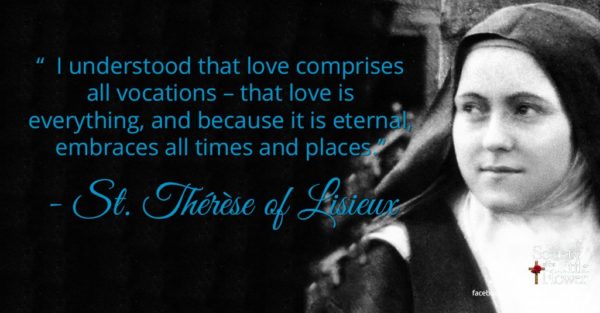
"My Vocation is Love"

These were the words I recently heard from someone quoting Saint Theresa. Being a bit of a cynic, I-ever-so slightly rolled my eyes and groaned inwardly.  

Saying, "My vocation is love" sounded to my cynical ears like the simplified version of "why can't we all just get along" or the song "Kumbaya."

My reaction was a knee-jerk reaction to my thoughts that it's just not that simple.

But then again, maybe it is.  As I thought about it further, I realized that I needed to hear that message today...and will need to hear it again and again going forward.

The reality is that we have been given the gift of life, and with this gift, we are each in full-time ministry of glorifying God.  

And the principal way in which we glorify God is by being His hands and feet.  

And the best way to represent Him as His hands and feet is through love.  Not love in the huggy, kissy, giddy, goo-goo sense of the word.  But love in terms of commitment, in terms of Agape.

Having passed through Easter, we have heard over and again how loving Christ was to give His life for us.  And because I have been loved much, I am compelled to love as well.

And while we often have head knowledge of that vocation, love often is replaced by shoulds, oughts, rules, regulations, calendars, appointments, and general busyness.  All of that busyness is often part of how we seek to express that love - by doing our work with excellence, and providing goods and services that allow customers and employees to flourish - but ironically, love can be lost in that process.  

I begin to care more about deadlines than being present to my colleagues and seeing them.  Before I know it, I am stressed, they are stressed, and we begin to focus on numbers and deadlines only, forgetting about being present to each other; forgetting about love.  So we have to hit the "reset" button and come back to what is important.  As C.S. Lewis states, we have been made for another world, therefore the way we follow our calling and our work is going to be different than those who are not Christian.  

In DML, we teach a quadruple bottom line:  economic, environmental, social, and missional.  We are developing tools for every person in their workplace to learn how to be the church (the hands and feet of Christ in each workplace) fulfilling aspects of each of these four goals.  What does it mean to love as a taxi driver?  As a hairstylist? As a baker? As a cleaner? As an employer?  While we may have different placements for our work, we keep in mind that loving our neighbor needs to be applied with intentionality in each place.

Saint Therese's workplace was different than most of us, but the vocation of love is the same.  She is quoted as saying the following:

Yes, my Beloved, I wish to spend my life thus... I have no other means of proving my love except by strewing flowers, that is to say, letting no little sacrifice pass, no look, no word--profiting by the littlest actions, and doing them out of love. I wish to suffer out of love and to rejoice out of love; thus I shall strew flowers before your throne. I shall not find one without scattering its petals before you... and in strewing my flowers I will sing (can one weep in doing so joyous an action?) I will sing, even if my roses must be gathered from among thorns; and the longer and sharper the thorns, the sweeter shall be my song. (My Vocation is Love! - Therese of Lisieux (pathsoflove.com)

May you move in love today, being willing to stop and "strew flowers" as God gives you the opportunity! I pray to do the same, as I spend time in Cameroon.

Monday, April 8, 2024

The Importance of Travel

This week I leave for Cameroon, Sierra Leone, and South Africa and I wish to ask for your prayers.

In Cameroon, I will join the DML Cameroon team to do some ministry with the Full Gospel Church, teach Economics of Hope, and do a training of trainers.  One of the DML team members recently lost her husband to cancer and another team members was kidnapped (and has since been released) just last week.  The conflict in Cameroon is now going on seven years without much change in sight.  We ask for your prayers as this team deals with these difficult and sorrowful events and seeks to trust God amidst hardship.

In Sierra Leone, we will be working with the Wesleyan Church who started DML last year.  More than 35 churches have completed a business month (four weeks of teaching/preaching/highlighting the God of Business and Work as Worship), and so we will be teaching the Basic Business Principles and finding a way forward to have a training of trainers for this denomination.  Please pray for this denomination as it seeks to make workplace discipleship an integral part of the local church.

Lastly, I will be traveling to South Africa, where DML has an opportunity to engage again with the Full Gospel Church as well as some other strategic meetings in the area.  As we continue to meet the body of Christ around the world who "speak the same language," we continue to pray that God will show us how to link arms with the global church, while discerning how and where to spend our time, treasure, and talent.  I appreciate that for your prayers as well.

One of our DML partners posted the poem below about travel, which resonated with me and reminded me to be very grateful for the chance to travel and learn from people from so many different walks of life.  Travel helps us to see many things, including that what we think is the norm is often not the norm.  It helps us to see that what we think is black and white is often not black and white.  It is invaluable for learning how to love your neighbor.  And remember, traveling is not just getting on a plane or in a car.  Sometimes traveling is going right next door to people we don't know, as the world (cultures and people) has come to each of us in many ways.

Try to travel, otherwise
you may become racist/caste-ist,
and you may end up believing
that your skin is the only one
to be right,
that your language
is the most romantic
and that you were the first
to be the first.

Travel,
because if you don't travel then
your thoughts won’t be strengthened,
won’t get filled with ideas.
Your dreams will be born with fragile legs and then you end up believing in tv-shows, and in those who invent enemies
that fit perfectly with your nightmares
to make you live in terror.

Travel,
because travel teaches
to say good morning to everyone
regardless of which sun we come from.

Travel,
because travel teaches
to say goodnight to everyone
regardless of the darkness
that we carry inside.

Travel,
because traveling teaches to resist,
not to depend,
to accept others, not just for who they are
but also for what they can never be.
To know what we are capable of,
to feel part of a family
beyond borders,
beyond traditions and culture.
Traveling teaches us to be beyond.

Travel,
otherwise you end up believing
that you are made only for a panorama
and instead inside you
there are wonderful landscapes
still to visit.

- Gio Evan, poet and songwriter.
Translated from Italian.

Sunday, March 31, 2024

Lessons about holistic worship from a Hindu

Last week the DML Global team had our monthly book club meeting. We are currently reading a book called Whole Life Discipleship.  (How cool is it to be in a book club with Christians from many different countries, cultures, and perspectives!  What a privilege!)

One participant from Nigeria shared the following excerpt from a related book, having to do with a Christian who had a run-in with a Hindu and discovered a surprising perspective of that person's perception of a Christian's relationship to faith and work.  This perception of Christians should be a wake-up call for the church at large.  

The excerpt is below, with emphasis added.  The book is called, Contagious Disciple Making by David Watson and Paul Watson:

My first learning experience came when I had the unique opportunity to witness to a member of my host community. He was an old shopkeeper who was well-liked and had no problems with me as a foreigner. We conversed almost daily. I liked him, and I think he liked me. I did not hide the fact that I was a Christian. Everyone assumed I was anyway since I was white. He did not hide the fact that he was a Hindu.

One day our conversation strayed to religion. As a trained witness I was thrilled with the opportunity. But as it turned out, the opportunity was one for me to learn, not to lead another person into the Kingdom of God. The old man told me that he just did not understand Christianity. There was no way he could give up his religion, which was so much a part of his daily life, to accept a new religion that from his perspective was so much NOT a part of the daily lives of the Christians he knew. He began every day with meditations, offerings, and prayers to his god. As the day went on, he would stop for more prayer and meditation. Each business transaction was blessed in prayer, and each dollar made thankfully offered to his god.

Everyone knew his devotion, and that devotion was as obvious at home and in private as it was in public. The questions he presented to me shoved me into some long and deep thought and prayer.

“Why would I want to give up the god I can see for one I cannot see?”

“Why would I want to worship only one day a week when now I worship several times every day?”

“Why would I want to do business without the presence of my god to oversee it and bless it?”

“Why would I want to try to convince others of my holiness with words, when they can see my devotion to my god?”

“Why would I want to let only words teach my children, rather than my life?”

This old man had a limited and distorted view of a committed Christian’s life, but the form of secret or private worship that was the norm for most Christians he knew or observed was certainly contributing to his misunderstanding. I realized this had to change. 

Something to think about, for sure.

As I have traveled through India, I have seen many businesses with their gods very proudly on display. As I have traveled in areas dominated by Muslims, I see them breaking their workday up to pray publicly, bowing down on mats on the sidewalks.  I don't see the same thing for Christians.  

I can understand where this man's perceptions came from.

For Christians in the West, Christianity is largely kept to a restricted role.  Many Christians give off a perception and practice that there is a separation of faith and work. Western Christians seem to have accepted that religion must be not only be separate but hidden.  Yet Muslims and Hindus both worship and display their faith freely and openly.  

Have we lost something that needs to be brought back again?  

Longstanding Christian traditions that had a stronger correlation between faith and work seem to be lost. There have been times when we were much more closely aligned in nation-building and the wedding of our faith and work.  That wedding of faith and work doesn't just mean witnessing to others.  

It may mean simply acknowledging who we are and whose we are.

Sunday, March 24, 2024

Frequent mistake: Seeking meaning FROM work.

This week I heard the quote, "I made the mistake of trying to derive meaning FROM my work, instead of bringing meaning TO my work.  I thought that if I would just get the right job, somehow it would fulfill me.  Instead, I have learned that God uses our work to do His work in us.  My work has been the crucible for the formation of my soul."

I love the big difference that these little words can make.  Deriving meaning FROM my work is what many of us do.  We want joy, satisfaction, affirmation, compensation, and more.  

But what if we flipped the question and asked what meaning I can bring TO my work?  I have found that the best way to help people think through this is to ask them, "What is God doing in your workplace?" First of all in me, and then through me to the work?

Sometimes people laugh when they hear this question and say they feel that God isn't even present there.  But we serve a sovereign God - there is no place where He is not present and therefore working.  When I begin to ask God what He is doing, He reveals that and also begins to show me how I can join Him in that work.  

Suddenly the focus of my work turns away from myself and what I can get, to God and what I can bring.  

We are to be salt, light, and leaven.  Most of us don't eat salt by itself.  If I offer you a tablespoon of salt to eat by itself, thinking it a thoughtful gift, almost everyone will say, "No, thank you."  Salt comes in the context of food, bringing flavor and preservation.  For most of us, that food - that context - is our workplace.  Likewise, leaven or yeast works from the inside, quietly and usually in darkness.  Again, it must interact with the dough.  No one wants to eat yeast straight.

God created us to work and, in our work, we are to be the hands and feet of Christ.  That means we bring value and meaning TO our work. We do it with excellence, with integrity, with joy.  We have an economic bottom line, being fruitful and multiplying.  We have an environmental bottom line, being stewards of God's creation.  We have a social bottom line, loving our customers, colleagues, vendors, competitors, and suppliers with time, treasure, and/or talent.  And we have a missional bottom line - being a disciple and making disciples.

It's not easy to change our perspective from wanting work to do something for us, to us doing something in our work.  But the beautiful thing is that when we do that, any work and any position can become meaningful.  Because God is also there working, and He invites us to join Him.

May your work this week open your eyes to see what God is doing in that space.

Sunday, March 17, 2024

A hero of our faith: Robert Allen Reed

On Wednesday, March 20, it will be fourteen years since the death of my first husband, Robert Allen Reed.  If you are new to this blog, he died very suddenly when we lived in Ghana; our daughter Hannah was 16 and our son Noah had just turned 15.  By next year, 2025, he will have been gone from my children's lives more than he was present.  While we still talk of him very frequently, his voice and memories fade from our memories unless we are intentional to watch videos, read his writings, or look at pictures.

During this Lenten season, we consider the sacrifice of Jesus on the cross, and we imagine where we would have been on that day.  Would we have been like Peter?  Like the naked young man who ran away from the soldiers?  What type of sacrificial love do we live out today?  How do we carry our cross?

As always, when the anniversary of Bob's death approaches, I find my mind reliving that week, appreciating his life, it's impact on me, my children, and many others.  And this past week I also considered how he was willing to give his life for his faith.  In this blog, I want to share a bit about him in this regard, as I think it's also an important story to tell.  Please forgive me for the length of this post.  I write it in part for myself and for my children, but I understand that it may be too long for all to read.

Bob did not grow up in a Christian home.  He grew up in Lansing MI, in what many would describe as a "blue-collar" household.  He was the third of four children, and his father died in a house fire when he was three.  His mother later married his uncle (Bob's father's brother) and two more children came from that marriage.  That marriage later ended in divorce when Bob was a teen, and his mother married again to the man with whom she would spend the rest of her life.  These circumstances, and the lack of a reliable father figure during his formative years, had a deep impact on Bob.   

But he was a curious guy and he deeply appreciated curiosity.  [In fact, he often said that curiosity was one of the "missing fruits of the spirit."  He believed too many people simply accepted things and didn't ask the deeper, important questions of life.]  He didn't let life's problems get in the way of trying to figure things out.

It was this curiosity that led him to Christ, but that journey took him through drugs, then other religions, eventually leading him to an encounter with God.  Once he gave his life to Christ, everything changed.  He went to Moody Bible Institute to learn more about God and Scripture, began cooking food in a soup kitchen for the homeless, and sought a way to contribute to the flourishing of others.  He found his giftedness in counseling - he was curious about people and what made them tick.  He had a direct, no-nonsense approach to understanding what drives behavior and a deep desire for people to be curious about that as well.  He desired for people to look in the mirror and understand what they saw there - not simply point to others for the reason for our behavior but to take a deep look inside.  What frustrated him the most is when people refused to take time to be curious about themselves and grow in understanding and wisdom for how God had made them.  While he could be impatient in that, he is also the counselor who sat with one young woman three times a week for more than a year before she spoke a word.  He was willing to simply be present with her until she found the ability to speak.  

As a Christian who grew up in a Christian household, I didn't wrestle with my faith.  Christianity was a deep part of my culture, especially as my father was a pastor.  Faith was not to be questioned.  It simply was.  Marrying Bob introduced me to someone of authentic and questioning faith - someone who made a decision as an adult, without having it modeled to him growing up.  He made a decision to believe in something unseen.  And that is the essence of faith - it is making a decision to believe in something that is not grounded in facts.  Bob had to choose, sometimes daily, to have faith.  It was not unusual for him to wake up in a sweat, wondering if he was wrong.  He was also afraid of death because he hadn't been raised with regular reminder of the comfort of heaven.  So his faith was real and raw.  To me, it was incredible to watch and learn from him.  [Please don't misunderstand me - I'm not saying my family's faith was not real.  It was and is.  But the assurance was imbedded in the culture from the time we could talk.  My bedtime prayer growing up was: "Now I lay me down to sleep, I pray the Lord my soul to keep; and if I die before I wake, I pray the Lord my soul to take."  Now, ignoring the fact that we were being reminded of the fact that we could die each night (!), we were also stating each night that we would/could be with Jesus.  That is the comfort that Bob missed, and it is an anxiety that I don't know.]

Bob helped me to break the "faith of my fathers" and discover Christ for myself at the age of 27.  Then in 1997, we felt called to move, with a four- and two-year-old, into the inner city, on a street with three drug houses and a house of prostitution.  My goal was community development - social work.  His goal?  For one African American child to grow up around a white person who didn't view him/her with prejudice.  

He then lost his job at Calvin University in 2001 because we felt led to send our children to the local failing, closing public school, where they would be the only white children.  After sixteen years of serving at this Christian college, he lost his job for following a call to love our neighbors as we love ourselves.  He not only lost a good salary, retirement benefits, health benefits, and his work community; he also had to deal with Christians and family members telling him he was not a good parent, and that he was sacrificing his children for ministry.  He set up a counseling ministry in the neighborhood, earning one-third of what he had been making, and serving many who could not pay.  And after doing that for a few years, he began to bring up Africa.  

He had brought it up before leaving Calvin, but when he went to visit Africa in 2000, he came back and told me that he was afraid he wasn't strong enough to live there.  But that didn't stop him.  He brought it up again in 2004 and at that time, I was ready to listen.  We went for a visit, and then in 2005, sold all we had and moved to post-war Liberia.  He was 51 when we moved there and again our income was cut to one third of the previous one-third.  We moved to a home with no running water or electricity, where ex-combatants were breaking into our home or other homes in the village where we lived every night.  We were up from 2-5 am nightly while we listened to rogues breaking in, and Bob felt so burdened for the safety of our family.  The days were not much easier as Bob was frequently arrested by the police who were looking for their "blessing," (as they had not been paid for some time and were hoping for a payoff).  But Bob learned to sit all day at the police station and chit-chat with the police until they gave up hope of a bribe and let him go.  

I can't fully describe everything he went through in Liberia - it would take a book to tell the story (and actually he chronicled most of it in our blog Reeds in Liberia) - in brief, from having to change shirts four times a day because of sweating so much, to spending each evening digging out chiggers or mango worms from children and dogs, to loving the kids in the neighborhood, to counseling and setting up the countries first social work program, it was a wild ride.  

And then it was time for us to turn over the ministries we had set up to nationals.  And we asked God to direct us for where to go.  Unfortunately, Bob was not offered the positions that he was hoping for.  I was receiving offers but he was not.  While he loved and supported me, and was proud of me, that hurt him deeply.  Just as like every person, he so wanted to be used and liked and loved.  (He always said that he wanted to be invited to the party and then not go - he was a strong introvert with a tough exterior, but he wanted to be wanted.)  He had struggled with his own self-esteem for most of his life, especially regarding his weight.  Many times he was judged because of being overweight - he was often written off or disregarded because of it.  And how he struggled to lose weight!  Having been overweight since childhood, his weight was not one of complacency or lack of care.  He tried and tried and tried and tried and tried.  Man, did he try.  

And so at the age of 54, having left Liberia and unsure of what would come next, he was lost.  And that brought about depression.  Due to (lengthy) circumstances, he ended up being offered a part-time position to do conflict resolution and justice work in West Africa.  The move to Ghana was difficult for him and he struggled for the first six months that we were there.  The depression continued and it was difficult for him to be motivated.  But two weeks before he died, I saw the old Bob emerge.  And the day before he died, was the first time that I had seen him with his energy renewed, having just returned from a valuable trip to Nigeria.  

He, like all of us, needed to be needed, to be used, to contribute.  He got that gift during the ten days he spent in Nigeria and he had came back invigorated.  What a gift that I saw that right before he died!  The day before he died, he and I had a conversation about our future, something that didn't happen when he was depressed.  I'm so thankful for that!

And then he work up on Saturday morning, didn't feel well, and died that afternoon.  We were told it was a pulmonary embolism.  That was proved wrong in the autopsy, where it was found that every organ was full of infection.  Yet he was fine on Friday and had no fever on Saturday.  

I've puzzled over this for fourteen years, talking to doctors, pathologists, nurses, and many others.  I believe I finally have a plausible idea of what happened.  Unfortunately, it involves me. 

Bob had struggled on and off with staph infections while living in Ghana.  He kept self-diagnosing, self-prescribing antibiotics, and then often not completing the cycle of antibiotics.  He and I made an agreement (in February) that he would not do that again.  The night before he died, he made pizza for the family and then I cut his hair.  In cutting his hair, I noticed that there were three or four sores on his head that looked like staph.  I pointed it out to him, and he said, "This is my year for illness!"  

I believe, in hindsight, that I might have nicked one of those sores when cutting his hair, causing the staph infection to go into his bloodstream.  When staph enters the bloodstream, it can cause sepsis, and has a high mortality rate.  I'm told that if someone's immunity is low, there is the possibility that staph will not manifest with a fever, as the body isn't strong enough to have that fight.  I don't know why his body was not strong enough to develop a fever.  I don't know what was going on with his immune system. But I now believe that he died due to a staph infection that went septic.  Unfortunately, the hospital had no working machines nor doctors who were able to pick upon anything that was going on.  Even the labs that came back after his death showed no problems...which means they weren't real results.  We will never know for sure, of course, but that is my best guess.  There has been no other explanation offered that makes as much sense as this theory.

In the end, Bob gave his life to serve God and His church.  He knew the risk.  WE knew the risk.  He didn't let his fear stop him.  And given that he had to actually choose to believe over and again, and given his fear of death, I marvel all the more.  

This year, I am the same age as Bob was when he died - 55 years old.  As a widow at 41 years old, I didn't know what it was like for him as a 55-year-old man.  Today, I better understand his tiredness.  I better understand his desire to do work that has meaning - to be affirmed in that work. 

I'm proud of him.  His children are proud of him.  He is a hero of the faith.  And while he died too soon, and his life was nowhere near perfect, I know that I know that I know that His Father in heaven was proud of him.

Bob picked up his cross to follow Jesus.  He was a disciple and he discipled others.  Jesus called him and was faithful to be with him until the end.  

On Bob's mug were the words, "Pay Attention."  I often think of that and how indicative it was of his character.  May we continue to pay attention to the one who brought us, to the one who invites us, to the one who equips us, and to the one who is working in us, faithful to complete the good work.

I leave you with the words of his first blog post to Reeds in the Wind, which capture the essence of what I have shared about him:

If you are at all like me, you wonder about the nature of things. You are not so smug as to think you have it all figured out, nor have you uncovered all the rocks under which truth dwells. Even if you are, like I am, deeply devoted to to a particular faith or philosophical orientation, you may acknowledge, as I do, that your devotion is regularly tested by your perceptions of reality.

This blog is an experiment in devotion-testing. My particular faith explicitly, implicitly and logically guides me to a certain way of doing and being, that I spend my time and my life consistently with the implications of my faith.

This blog is a testimony, for better or worse, of the kinds of things that happen when a family continues to say, "Let's take what we say we believe to the next level of action." To testify is to bear witness; affirm as fact or truth; to declare, profess, or acknowledge openly. Our goal is to share our lives as openly and honestly as we can.

And so, this blog hopefully will be evidence. Evidence not only that humans can be increasingly successful at living true to the logical implications of their beliefs, but evidence of something more. Hopefully, if we pay attention--all of us who wonder-- will see evidence that something greater than our faithfulness or even "logical consistency" is here. Hopefully, if we pay attention, we will see evidence that something greater than our work, or ourselves, or even what we smugly call truth is here.

As I say, it's an experiment.

In the book of the Hebrew prophet Malachi, we are told that God is angry. God's people are not taking Him seriously. They are not being logically consistent with the implications of their stated beliefs. They give meagerly to His works. They do not push themselves beyond their levels of comfort. Their spiritual leaders are corrupted by greed. They do not understand the spiritual discipline of sacrifice. So God, understanding that unbelief is at the heart of their hypocrisy, tells them something remarkable. He makes a deal. He says, "Put me to the test. Live it like you say you believe it," He says, "and see if I don't show up." God apparently loves a good experiment.

I believe in God, and I believe He works like this. When we show up, He shows up. Hence this blog. Let's see if the Reeds are just whistling in the wind, or if they are whistling in the Wind.

Let's see if He shows up.

He showed up.  

Bob was also a very good writer.  

I miss him.