Sunday, September 3, 2023

Ephesians 4:11 - Equipping Evangelists

Greetings from Nigeria, where we are so privileged to present to the Nigeria Baptist Convention over the next couple of days.  One thousand pastors and church leaders are gathering together to learn about workplace discipleship and reclaiming the Marketplace for Christ.  We have been talking to leaders from this denomination for some time and have been praying for this opportunity, and we are now here!  We ask for your prayers that the Holy Spirit will use us to present a compelling message for the affirmation of the priesthood of all believers in every workplace!

Our visit in Ghana with the Assemblies of God, as well as the Methodist and Presbyterian pastors, went well and we are excited for the seeds sown.  Below are a couple of pictures from our time together.

But this week, we want to continue to looking at Ephesians 4 where we find the purpose of the church is to equip the saints for the work of the ministry.  There are some who are given special gifts of being apostles, prophets, evangelists, pastors and teachers.  These giftings are not meant to only be offices but to be used to equip all members for growing in maturity in these areas, that the members may not be easily shifted by the winds.

Last week we looked at prophets, and the week before at apostles.  Today, we look at evangelists.  One of the things we often say in our teaching is that "evangelism programs can be one of the greatest barriers to evangelism."  This is often surprising for people to hear, but we explain that when something is a program, it gets compartmentalized.  Our brain likes to put things in different boxes:  this is home, this is work, this is community, this is church.  Within the church box, we often put more boxes:  this is worship, this is Sunday School, this is evangelism, this is giving, etc.  When we do evangelism as a program, it means that when the event is completed, our brain will often say, "Check!  Evangelism is done until the next planned program."  

Rather than a program, evangelism is to be a lifestyle.  We are told to bring the fragrance of Christ to all places, which is an attraction to those around us (2 Cor. 2:14).  Most communication is non-verbal and even the way you live your life and do your work brings the fragrance of Christ.  The Great Commission is for all of us - we are all to be making disciples.  We are either in home missions or we are in foreign missions, but all of us, as mature Christians, are to be in missions.  For some, this comes easily.  For others, it takes great effort.  But all of us are expected to participate in this important call because Christ's love compels us.  We have been loved so much that we now want to share it with others.  

Who might God be urging you to speak to?  Are you asking God for specific opportunities or ways in which to engage?  If you aren't sure where to start, there are lots of places where you can get some great ideas and basic training in finding those opportunities.  

Church, let's equip all members to be evangelists!

A cross-section of the Assemblies of God conference.  Next to me is the General Superintendent of the Assemblies of God Ghana.
Some of the great DML team leaders as well as the Assemblies of God Ghana General Superintendent and the Missions Director.  
With Hopeline Institute, a workshop with Presbyterian, Methodist, and other denominations in Kumasi, Ghana.

Monday, August 28, 2023

Ephesians 4:11 - Prompting Prophets

Greetings from Ghana!  I have the privilege this week to bring the message of "Work as Worship" and workplace discipleship for the local church to the Assemblies of God Ghana denominational leadership, who have 6000 churches across the country.  We anticipate approximately 500 pastors from all over the country to gather in Kumasi from August 29-31.  Please pray with us that this message may be received, and that information will move to application which then then turn into transformation!

I want to continue to look at Ephesians 4, as we seek to learn to become mature Christians, able to safeguard against false teachings.  Last week, we looked at activating apostles, and this week, we turn our attention to prompting prophets.  

I often hear this phrase from different speakers in Africa (taken loosely from Amos 7:14):  "I am not a prophet, nor the son of a prophet, but I will prophesy."  The actual verse says this: Amos answered Amaziah, "I was neither a prophet nor the son of a prophet, but I was a shepherd, and I also took care of sycamore-fig trees."

I love this verse because it reinforces the ability for those in business to also prophesy.  Throughout Scripture, we find most people were engaged in business in some way - from patriarchs, to prophets, to disciples, apostles, and our Savior.  Even the Levite priests had farms that they took care of when it was not their turn in the temple (Nehemiah 13:10).  

But what does it mean to be prophetic?  Being prophetic is to offer a new truth.  In contrast, teachers expand and reveal more about a revealed truth.  The book, The Church of Christ, by Everett Furguson, reminds us that individual prophets often only receive a part of a new truth and their message needs to be tested by the community because there are many false prophets.  Lynn Cohick, in her commentary on the Letter to the Ephesians, says that prophets encourage, comfort, edify, and strengthen the church, and the gift of prophecy should be one that Paul encouraged the Corinthians to long for.  Both men and women were prophets in the Bible.  But delivering the message is just one part - the testing and judgment of the message by the people who hear it is critical.  

Some people believe that God is speaking less to people today than in times past.  But I believe that God has not changed.  We, however, have become poorer at listening.  At the same time, seeking power and prestige is a sin that is common to many, and for those who claim to hear the voice of the Lord, we also need to listen so that we can judge whether the word is from God or from the flesh.

I've never considered myself a prophet (not sure that Amos did either!) but there have been times when I have felt prompted to say something, which in hindsight seemed prophetic.  I need to be open to hearing God's word and will (which means listening prayer!) and then have the courage to speak it when He needs me to open my mouth!  I believe that is true for all of us.

It's true that some have a special anointing for prophecy.  But that gift is not for them alone but for the equipping of the church.  Those with that gift not only share what they hear from the Lord, but also teach us to know how to listen as well and develop that gift.  All of us, like Amos, while we take care of the sheep or the tree farm, can listen and can speak truth into situations that are unique to us based on our spheres of influence. 

This world needs truth as well as faithful, obedient, God-fearing truth tellers.

Are you open and willing to be prophetic in your spheres of influence?  Are you listening to what God is already doing in your home, community, workplace?  And when you hear prophetic voices, are you able to discern what lines up with who God is and what does not?

May we all continue to strive to grow in maturity and wisdom, so that we may "speak the truth in love, growing in every way more and more like Christ, who is the head of the body, the Church." (Ephesians 4:15)

Monday, August 21, 2023

Ephesians 4:11 - Activating Apostles

As a continuation from last week's blog, this week I want to dig a bit deeper into what it means to be an apostle. 

In case you didn't read last week's blog, we looked at Ephesians 4:11-13 in light of every Christian growing in capacity of the gifts that God has given (apostles, prophets, evangelists, pastors, and teachers).  In light of some of your comments (which I love getting - keep sending me your thoughts!), God has indeed given these as gifts and for some, those gifts are very apparent and strong!  Some of us are very gifted in one of the five, but I believe all of us have the capacity to grow in all of the five. 

This is the goal!  As a theologian reminded me this week, the purpose of these gifts is found in the very next verses, 14-16: 14 Then we will no longer be immature like children.  We won't be tossed and blown about by every wind of new teaching. We will not be influenced when people try to trick us with lies so clever they sound like the truth. 15 Instead, we will speak the truth in love, growing in every way more and more like Christ, who is the head of his body, the church.  16 He makes the whole body fit together perfectly.  As each part does its own special work, it helps the other parts grow, so that the whole body is healthy and glowing and full of love.

An equipped Christian understands that there are times when we need to be pastoral, when we need to be an evangelist, when we need to teach, and so on.  There are actually five different lists in the New Testament of different giftings, each of which is different.  As Christians, we are to be building capacity in ourselves in this UNTIL we reach unity in our faith (v.13).  It's a long process and we are all at different points in the journey, but that is the first destination.  The second destination is maturity (v.14), as we seek to become a complete person, becoming more like Christ.

Paul is not concerned with church order in this text, as nothing is said about overseers or deacons. He is interested in the dissemination of wisdom and correct knowledge of the gospel to each believer, in addition to the gift of grace and the gift of Christ. In a commentary by Dr. Lynn Cohick, The Letter to the Ephesians, the gifts described are not an individual's spiritual gifts but rather gifts to the church.  She says, "The focus is not on how the Spirit gifts individuals for ministry but on the duty of such roles in helping the church mature" (pg. 267).

So what does it mean to be an apostle?  Often we think of the twelve disciples whose term changed to apostles after Jesus' death.  But Paul refers to himself as an apostle throughout the New Testament in a different way than the Twelve, more generally as someone who was called after Christ's earthly ministry, especially as a leader for doctrinal and moral guidance.  Other men and women who were called apostles are James, Barnabas, Apollos, Andronicus and Junia.  From this same commentary by Cohick, a third use of the term is for a person who is commissioned by a congregation for a specific duty. 

In DML, we recommend that marketplace ministers are commissioned by the church to be ambassadors for Christ in the marketplace.  Does this in fact make them all apostles?  

I'm not advocating for titles here but challenging us to live into the idea that we have an apostolic calling as followers of Christ.  

What does this mean to you?  

What does it mean to me?  

If I understand that I am an apostle, does it change the way I do my work at my workplace?  In my home? In my community?  What does maturity look like in this particular gift?

My goal in this series of writings is not to provide answers but rather to ask questions; questions that hopefully lead us to thinking thorough our own answers in our own context.  

Next week, prophets!

Monday, August 14, 2023

Ephesians 4:11-13 - Equipping the Saints

What is the church? And what is the purpose of the church?

These are questions that we ask time and again, when speaking to pastors and church leaders.  While we often receive a variety of answers, there is general consensus that the church is the people of God, the "called out ones" (ecclesia), and that the purpose of the church is to "equip the saints for the work of the ministry."

This "purpose" comes from Ephesians 4:11-13 (NLT):  11 Now these are the gifts Christ gave to the church: the apostles, the prophets, the evangelists, and the pastors and teachers.  12 Their responsibility is to equip God's people to do his work and build up the church, the body of Christ.  13 This will continue until we all come to such unity in our faith and knowledge of God's Son that we will be mature in the Lord, measuring up to the full and complete standard of Christ.

Understanding of purpose of the church is critical for how we do church.  If we get the purpose wrong, we are not able to fulfill the purpose.

If we believe the purpose of the church is to worship together (a commonly given answer), then we run the risk of reducing worship to only one morning per week and no transformational power of the people of God outside the building.  

If we believe the purpose of the church is to fellowship together and learn about God, we run the risk of being a social club that knows the Bible very well, but without transformational power.  There is this saying: "Satan doesn't care if you read your Bible and go to church, as long as you don't apply it to your life."

Ephesians 4:12 and 13 tells us that the people of God are to be equipped to do his work and build up the church (the people).  Where do we do His work?  Not in the building (although a few are called to do it there) but outside the building.  As we are built up, we come to unity of faith and knowledge of God's Son SO THAT WE WILL BE MATURE, measuring up to the full and complete standard of Christ. 

Each Christ-follower is to be mature, measuring up to the standard of Christ, able to stand confident in all places of darkness to be salt, light and leaven. Each Christ-follower is to be a saint, ambassador, and priest in the parish God has granted them.

That's the goal.  That's the purpose of why we gather on Sundays.  The purpose of Sunday is Monday.  That transformation must be seen, especially in nations that are majority Christian. Sunday is the only day that the church is closed as we gather for our team meeting - a team huddle - where we lament what happened during the week - where we celebrate the good that we've seen - where we are reminded of our purpose, and we are taught how to fulfill it when we leave the building.

In "team" terms, pastors are coaches and every member is a player.

But I have been thinking about verse 11 for the past number of months, which is often referred to as the "five-fold ministry."  In this text, we read that God gave gifts to the church: apostles, prophets, evangelists, pastors, and teachers.  

For much of my life, I read those words as offices.  In fact, I know many people who are affectionately called "Pastor ___" and that title shows up in their email and other places.  It is who they are.  In Kenya, teachers are called Mwalimu and I was often called "Mwalimu Renita."  I know people who are called Apostle ____ and Prophet ____.

But that has been changing for me, and I'm beginning to read these gifts not as titles or offices, but rather as skill-sets designed for ALL Christians.  

I used to hang my hat on being a teacher, which then allowed me to disqualify myself from the others.  I could say, "I'm not an evangelist.  I'm not a prophet.  I'm not a pastor."  But I realized that that is a bit too easy.

This rethinking of these terms started for me with my dear Aunt Jannie.  She is incredibly hospitable and one day at her house, I made a comment (which I have made many, many times in my life, especially as a strong introvert) and she immediately challenged me on it.  I said, "I don't have the gift of hospitality."  In her wise and gentle way, she said, "Well, it's not really something we can opt out of though, is it?"  Ouch.  Right to the heart.  Since then, whenever I've thought that, I had to tell myself that it isn't an option to not be hospitable.  I must learn to grow in hospitality.  And my aunt has taught me, as have many others.  

And so I'm going to spend a few blogs looking at each of these recommended skill sets and try to unpack what it means for each of us to learn to grow in the capacity of each of these gifts.  

I hope you will journey with me.

And thanks for reading.  It may make you uncomfortable, and for that, I share the following (sent to me by another mentor, Lou Haveman):

St. Francis Prayer… Reversed

Lord, make me a channel of disturbance.  Where there is apathy, let me provoke, where there is compliance, let me bring questioning, where there is silence, may I be a voice.

Where there is too much comfort and too little action, grant disruption.  Where there are doors closed and hearts locked, grant the willingness to listen.

When laws dictate and pain is overlooked, when tradition speaks louder than need; grant that I may seek and do justice rather than to talk about it.

Disturb me, O Lord. To be with, as well as for, the alienated, to love the unlovable as well as the lovely.  Lord, make me a channel of disturbance.  

Author Unknown

Monday, August 7, 2023

A Kingdom Vision or A Church Vision?

Many of us get caught in the trap of having a Church vision rather than a Kingdom vision.  Jesus only spoke three times about the church but many, many times about the Kingdom.  

A church vision is often limited to what happens in the building and has very little to do with what happens outside the church building.  A church vision is often about converts and numbers.  

A Kingdom vision includes the flourishing of all things - people, animals, all of creation.  A Kingdom vision is about holistic discipleship.  As we are part of the Kingdom of God, we are to help to bring the Kingdom of Heaven on earth through restoration and reconciliation.

A Kingdom vision reminds every person that we all have a general call to serve God full time, and that is our purpose.  We are all fulltime ministers with the fulltime job to glorify God in all spheres of life.

But our specific call is very different from person to person.  Our specific call relates to our unique placement and spheres of influence, in our homes, communities, workplaces, and churches.

The prophets Jeremiah and Daniel can help us to understand this better.  Both are prophets during Old Testament times, both have the same general call to serve God full-time, but both have very different specific placements.

Jeremiah 1:5 says, "Before I formed you in the womb, I knew you.  Before you were born, I set you apart.  I appointed you as a prophet to the nations."  This is a very direct placement and calling for Jeremiah.  How affirming it must have been to hear those words!

Daniel's placement is a bit different.  In Daniel 1:1-7, we see that Daniel was taken into captivity and then selected into the King's service based on his looks and health.  He spends his life in captivity, serving four different kings.  Daniel's placement seems to come about as an accident of war.  Daniel does not seem to be placed...but rather, displaced.

I wonder if Daniel ever thought, "Jeremiah heard God's voice call him.  I heard no such voice.  Jeremiah's call made him a prophet.  My circumstances made me a civil servant.  I guess God hasn't called me into ministry."

I wonder how many of us have believed the same for our own placement.  Not placed, but displaced - an accident of birth, culture, happenstance.

But let's see what the truth is from the book of Daniel: 

Daniel 1 - Daniel is challenged to eat and drink the King's food.  He respectfully says no, and God rewards his obedience with the ability to interpret dreams.

Daniel 2 - The King has a dream and wants the wise men to not only interpret the dream but also tell what the dream was!  Thankfully, because of Daniel's earlier obedience, he has this ability.  The response from the King is found in verse 47, "Truly your god is the greatest of gods, the Lord over kings...!"

Daniel 3 - All people are commanded to worship the statue of Nebuchadnezzar, but Daniel's colleagues are caught worshiping God and are thrown into the fiery furnace.  God saves them from death, and the testimony from the King is found in verse 28-29, "Praise to the God of Shadrach, Meshach, and Abednego...I make this decree that [no-one] speak a word against their god...There is no other god who can rescue like this!"

Daniel 4 - Another dream with the awkward foretelling of the King grazing like a cow for seven periods of time.  Daniel interprets this dream...it comes true...yet when his sanity returns, he doesn't punish Daniel, but rather says in verse 37, "Now I, Nebuchadnezzar, praise and glorify and honor the King of heaven.  All his acts are just and true and he is able to humble the proud." 

Daniel 5 - Daniel is now serving under King Belshazzar when a message appears on the wall and only Daniel can interpret it.  It has a message of doom for the King - again, not an easy message to deliver.  Daniel delivers it anyway, and the King promotes him to be the third highest ruler in the land.  And the king dies that night.

Daniel 6 - Daniel is now serving under King Darius, who is tricked into giving a decree that no one should worship any god but the King or be thrown into the den of lions.  Daniel does not obey, worships God, is saved from the lions, and the King says in verses 26 and 27, "I decree that everyone throughout my kingdom should tremble with fear before the God of Daniel.  For he is the living God, and he will endure forever.  His kingdom will never be destroyed, and his rule will never end.  He rescues and saves his people; he performs miraculous signs and wonders in the heavens and on earth." 

Do you hear how God was present in Daniel's placement?  This was no accident!  

But most of Daniel's work was as an administrator, overseeing many other leaders, taking care of many responsibilities that were probably mundane and maybe even boring.  And he did it for the people that had taken his people into captivity.  He spent most of his time carrying out the earthly king's business.  He did it with excellence.  

It seems he did his work as worship.  Daniel was not involved in a church ministry but a Kingdom ministry.

Each of us have a general call to serve God and be fulltime ministers.  And each of us has a specific call - our placement - which varies from person to person.  But in those places, we live out a Kingdom ministry.  

In these places, we have the opportunity to bring order to the world, through our work.  We provide for the things that people need.  We bring joy and beauty to those placements.  And we help to release potential of people and things, depending on where we work.

May we continue to see God at work wherever we are placed, and may His Kingdom come as we avail ourselves to Him.

Monday, July 31, 2023

And the work continues...

Last's week's blog title of a "letter of resignation" caused some alarm to some of you who may not have read the whole email, so I just want to assure everyone that I have not resigned from DML, just from acting in the place of the Holy Spirit!

Last week we learned of a coup by the military in Niger.  This makes a swath of sub-Saharan Africa currently under military rule through coups in the last four years - Mali, Guinea, Niger, and Burkina Faso.  There are similar reasons for why this happened in all four countries, with terrorists being a primary cause.  Security crises and a lack of integrity in the leader are the two key reasons for coups.  Experts say that this is leading to a "dangerous self-perpetuating instability." 

Yet another contributor to instability is economic freedom, which directly relates to the flourishing of the citizens in a nation.  Economic freedom is based on the freedom for individuals and businesses to make economic decisions. You can see a map of Africa, in which each country is ranked out for economic freedom based on four key factors:  

          1. Rule of law: property rights, judicial effectiveness, government integrity
          2. Size of government: tax burdens, fiscal health, government spending
          3. Regulatory efficiency: labor freedom, monetary freedom, business freedom
          4. Open markets: financial freedom, trade freedom, investment freedom
Globally, the top three countries for economic freedom are Singapore, Switzerland, and Ireland, with scores around 83.  In North America, Canada is #16 with a score of 73.7 and the US is #25 with a score of 70.6.  [A score of 80-100 is free; 70-79.9 is mostly free; 60-69.9 is moderately free; 50-59.9 is mostly unfree; and 49.9 and below is repressed.]

Africa is the region with the least economic freedom in the world but the most potential for economic growth.  Because the population continues to grow in Africa (although that growth is slowing) the opportunity for innovation and a labor force are very strong.  Botswana scored the highest for mainline Africa (#52) and Sudan scored the lowest at 172, with a score of 32.8.

China ranks at #154 globally with a score of 48.3, which is categorized as a repressed economy. India is at #131, with a score of 52.9.  

While we continue to work toward the flourishing of all, we also need to step back and look at the big picture, understanding what is going on behind the scenes that are holding people back from being able to fully release their potential.  We continue to both pray for individuals to do work as worship, while at the same time praying for these other situations to see significant change for the better in years to come.  

Mapped: The State of Economic Freedom in 2023 (visualcapitalist.com)

Monday, July 24, 2023

Letter of Resignation

On Tuesday and Wednesday of last week, the DML Board had their annual retreat.  This year it was held at the Hermitage, a silent retreat center, and we were able to intersperse our meeting/discussion time with silence, walks, and prayers.  

But I started the board meeting on Tuesday with sharing a letter of resignation, and I thought it important to share this with you as well.

I officially resign from my role as the third person of the Trinity.  I submit my resignation as the Spiritual head of DML (and my family).  I want Christ, by his Spirit, to be the Spiritual leader of this organization.  I no longer want to be the center.  I want Christ to be the real, functional Spiritual head.  I repent of any desire to control or be prominent in his body.  I realize that he has entrusted me to teach and guard the flock, but I recognize it is his flock.  I am merely an under-shepherd.  I commit myself to being a praying minister who desires to lead a praying organization. (Taken from A Praying Church by Paul Miller)

Thankfully, this letter of resignation was accepted.  

Unfortunately, the next day I had to submit it again as I had attempted to retake the position.  And again the next day.  And again...

But I am committed to continue to try to be a "praying minister who desires to lead a praying organization."  

How difficult it is!  It is so difficult to give up control, to be quiet, to listen, to pay attention.  

I was reminded by a board member that we are to pay attention.  The verb here is important - pay.  Like paying for an item in a store.  There is a cost to our attention.  Am I willing to pay that cost?  Our focus has value.  Do I value it enough to put aside my own desires and will?

When my children were little, there was a store called Naked Plates in Grand Rapids, where you could design your own plates, bowls, etc.  We went in with the four of us and each painted our own mugs.  Bob selected the phrase "Pay Attention" for his mug.  It was his desire to be consciously aware of the need to pay attention.  He knew how easy it was to drift - so much so that he wanted his daily coffee mug to remind him.

Scripture also reminds us to pay attention:

Isaiah 42.20 - You have seen many things, but you pay no attention; your ears are open, but you do not listen.
Proverbs 22:17 - Pay attention and turn your ear to the sayings of the wise; apply your heart to what I teach.

Seeing and hearing are not the same as paying attention.  It takes special focus and intentionality.  It includes quieting oneself.  And it includes having open hands before the Lord, letting go of trying to be the third person of the Trinity.  

May God help me.  

Sunday, July 16, 2023

God and the Second Law of Thermodynamics

I just returned from a camping trip at Letchworth State Park in New York State, with my children, their spouses, and Michael's boys.  Letchworth is known as the "Grand Canyon of the East", and while this name may be a bit generous, it is a very beautiful park. We were eight adults in four tents, camping the way we like - "roughing it."  Unfortunately, the trip started with two days of poor-quality air from the fires in Quebec, followed by a number of days of rain in campsites that turned out to be very, very muddy.  Turns out that roughing-it can be rough!  

This led to a number of thoughts and conversations about the weather...and about order and disorder.  Anyone who has tent-camped knows that it doesn't take long for there to be chaos as it relates to where to find things.  The most common question during our camping trip was, "Who knows where the ____ is?" (The second most common question was, "Who knows what the weather will be for the next couple of hours?")

This led me to think about the second law of thermodynamics.  The second law of thermodynamics talks about how nature moves from order to disorder.  Thermodynamics actually addresses the laws of heat, and how, without energy, things will cool down and get more disordered.  Think about a car that sits without being driven for months, then years.  Tires go flat, things begin to rust, fall off, and so on.  And as we think about the wildfires in Quebec, we know that new energy keeps coming in, which keeps the fires burning.

Renowned scientist Steven Pinker says, “The Second Law defines the ultimate purpose of life, mind, and human striving: to deploy energy and information to fight back the tide of entropy and carve out refuges of beneficial order.”

I love this.  This reminds me of our purpose in fulfilling the Great Commitment of Genesis 1:28 and 2:15. It reminds me of our purpose to work.  Cultivation is all about bringing order (countering entropy) so that we might grow food. When we stop cultivating, vegetation joins the process of entropy, destroying the order that came about because of work (the added energy).

In camping, and in life, we strive to bring order.  When we stop striving, we can't find where anything is!  The purpose of being commanded to "subdue the earth" in Genesis 1:28, is to help curb some of that disorder and bring creation under our will, which is subjected to God's will, in order for people to flourish.

Sadly, the same is true of our faith.  Without the purposeful process of discipleship empowered by the God of order, our faith gradually diminishes as the process of entropy is not purposefully challenged.  Discipleship and the "church gathered" on Sundays help to keep entropy at bay, while we seek to actively and intentionally live out the call to work against entropy from Monday-Saturday as the "church scattered."  We do our work as an act of worship.

Just some musings from this happy camper (who wasn't really happy the whole time, to be honest!).  Oh...and a couple of other lessons from this past trip...avoid poison ivy, don't put your tent on the spot where the water drains, and beware of popcorn that can crack teeth.  Just sayin'!

Disorder is all around us, people, and we need to be on guard! :)

Benjamin and Jonathan at the Upper Falls

(L to R) Hannah and Noah, Hannah and Matt

Saturday, June 24, 2023

When life gives you lemons...learn to shepherd horses?

We all know the saying, "When life gives you lemons, make lemonade."  

In January of this year, I wrote an excited blog about the growth of our US team, with three new team members.  Two short months later, all three of those team members were gone.  While the reasons for their departure are not pertinent here, I was left feeling discouraged and dejected, like I was holding a bucket of lemons.

But around the same time, a new friend from India suggested that I read a book called Shepherding Horses, by Kent Humphreys, and this book gave me insight into how to turn these particular lemons into lemonade.  It talks about different roles that we might find in the body of Christ:

  • Shepherd pastors - Giving care, guidance, protection, and feeding of sheep.
  • Sheep - Loyal members in a church who support the pastor and follow his/her shepherding.
  • Horses - Leaders by personality, background, and experience.  Don't really feel like they fit in with the sheep.  Passion is often aimed at what is done outside the church walls.
  • Combinations of the above - Specifically in this book, the combination of a shepherd and a horse: a shepherding horse.  When trained, they will multiply the ministry of God's work in the marketplace and community.  (No surprise why this book was recommended to me!)
This book then reviewed what is probably familiar to most of us - the five ways in which Jesus did his ministry on earth:

1. He told everyone to respond to the good news.
2. He taught many to understand God's principles.
3. He trained some to do the work.
4. He equipped a few to reproduce.
5. He modeled a relationship with the father.

DML is seeking to respond to everyone (#1) with the reminder that "work is worship" and that we were created to work and care for the earth (Genesis 1:28, 2:15).  We are teaching pastors, denominational leaders, and marketplace ministers to understand God's principles relating to being the church from Monday-Sunday (#2).  We have training teams across fourteen countries in many different cities who are training others (#3).  We have the leaders of our implementing partner organizations/denominations who are showing an incredible ownership of this message as they desire to disseminate this information not only within their own church, denomination, community, and even nation - but to go beyond that to neighboring countries.  They are hungry for this message of freedom from "work as drudgery" to "work as worship," breaking down barriers of purposeless life and work, to joy every day in and through our work.  

This brings us to #4, "equipping a few to reproduce."  Rather than hiring new people in the US and trying to develop loyalty to the DML ministry, we have decided to divide necessary tasks among ourselves (as a team of 18 key leaders) across 15 countries.  We now have one of our leaders leading chaplaincy and media, someone leading metrics and reporting, someone helping with research, and so on.  But what is most exciting to me is the starting of what I'm calling "missionary journeys," as our leaders are getting requests to take this message to new places and countries as the Spirit leads.  Two of our leaders have given up their local churches and are now going fulltime with DML, and God is opening doors to them throughout their own country and in neighboring countries. As conversations naturally happen across borders, we are seeing connections made more naturally and authentically than when someone randomly sees something about DML on the internet and writes to us.  

We have many shepherding horses on our team!

And that brings us to the last one, #5:  Modeling a relationship with the Father.  This is something that all of us must do within our own spheres of influence.  But as I travelled on this last trip, I heard the DML leaders express both joy and fatigue at the many opportunities that they are receiving.  So we are starting what I'm calling a DARE club (Discipleship and Accountability for Rest and Energy).  When you work amongst the poor and vulnerable, there is a "tyranny of the urgent."  To not answer your phone can be perceived as a sign of disrespect.  It is DARING and it takes courage to set boundaries!  We want to model sabbath, rest, and balance, just as Jesus did.  We recognize that we are not God, while still loving and serving with excellence.

There's much more that I can write, but I'll leave it here for now.  I wanted to catch you up on some of these changes and to hear us say as a team that God is good!

Monday, June 19, 2023

The Danger of Free

Many of us know the danger of giving things for free, but I heard this recently and liked the way it was put together:

The first time you give someone something for free, you create appreciation.

The second time you give someone something for free, you create anticipation.

The third time you give someone something for free, you create expectation.

The fourth time you give someone something for free, you create entitlement.

The fifth time you give someone something for free, you create dependency.

Then, if you don't give something for free a sixth time, there may be resentment and even hatred

This challenge is global, as churches and pastors in many places (especially places with poverty) are constantly being asked for funds.  We have been teaching boldly that the church should not see businesspeople as an ATM but neither should the members see the pastor as an ATM.  

Be very careful that your generosity does not lead someone else's dependency.  The highest form of charity, according to Jewish tradition, is help someone find employment in order for the person to support themselves.  Too often we settle for a lower form of charity, as described in the levels of charitable giving.

So we encourage you to support and encourage a local employer today!  Thank them for the important work they are doing in providing salaries that sustain individuals and families!  Pray for them as they care for their employees, that they may see them as part of their household and seek their flourishing.

DML is making sustainability projects a priority for each of our partners, challenging them to see how they can raise funds from within their own country and churches for the support of this ministry, or doing a business to help raise local funds, thereby also practicing what they are preaching.  We are excited by some of the ideas that we are hearing and continue to pray that we may continue to work in ways that promote healthy relationships and the flourishing of all!

Sunday, June 11, 2023

From $0 to $27,600: Social Enterprise in Ethiopia!

DML is ten years old this year, and in Ethiopia last week, we celebrated our five-year anniversary with the first denomination to officially join DML, the Ethiopian Kale Heywet Church (EKHC).  

When we started working with EKHC in 2018, they had 10,000 churches with 10 million members.  Today, they have 11,000 churches with 12 million members.  They are doing amazing work!  We were told that they believe DML is having a positive impact on the denomination financially as well, as the income coming from the local church to the headquarters has doubled in the past couple of years.  While not all of that can be attributed to DML, we know that tithes and offerings have been increasing as business has been increasing.  The picture shows the DML leader, Yoseph Bekele, on the left; then Dr. Simeon Mulato, the head of the EKHC, then Yonatan Simon, DML lead trainer, then Dr. Walker, and myself.

But as is the case with many of our partners, this message is not just for one denomination - it is for the people of God.  Because of this, at our recent Training of Trainers in Addis Ababa, we had people from other denominations in the room, and some shared what they have learned from EKHC DML team.

We heard a testimony from one of the leaders (pictured here) from Meserete Christos, a Mennonite denomination with Pentecostal influence.  They have 1200 churches in Ethiopia.  This leader first heard about DML on TV when he heard the DML leader (Yoseph Bekele) talking about marketplace ministry.  Yoseph is on two weekly TV programs talking about marketplace ministries.  This leader contacted Yoseph who has since done three trainings for this denomination.  

From these trainings, the church decided to open a school to teach the poor about business and how to do work as worship!  One hundred members of this church also got together to open a social enterprise for the community.  To date, they have raised 1.5 million Ethiopian birr (or $27,600 US dollars)!  Wow!  So amazing!  They are now looking to open another shop in another area.

We continue to thank God allowing us to join Him in this message, which is for all people, all nations, all income levels, all education levels, and all denominations!  To Him be the glory, now and forever!

The 85 DML trainers from all over Ethiopia!

Monday, June 5, 2023

Frustration Leads to Change: Meet Abraham from Ethiopia

Greetings from Burundi, the last stop in this current trip.

At our training in Addis Ababa last week, we heard the following testimony from Abraham, who lives in Jinka, Ethiopia and travelled 600 km to attend this training.  

"My father was an evangelist and he was paid almost nothing. We were so poor growing up.  Yet the church structure did not allow evangelists or missionaries to do business to supplement their income.  As I grew up, I was so angry at our poverty and how he was treated.  It felt like no one cared if we lived or died."  

Abraham in the center, with some team members.

So Abraham decided that he would not merely survive, and went into business for himself.  From his business, he put himself through college and worked hard.  

Then in 2019, he heard the message of Discipling Marketplace Leaders through his denomination (the Ethiopian Kale Heywet Church - EKHC) and he saw an opportunity to take his anger and turn it into something productive.  He heard that work is a good and holy calling.  He heard that it is not "secular."  He heard that most people in the Bible were also working in the marketplace.  

So, he started an association called "Christian Professionals Association" which encourages local businesses to meet economic needs.  They now have 30,000 members and are growing rapidly.  They specifically target motivating missionaries and evangelists to be co-vocational - something his father was not allowed to do.  They have given trainings in 314 churches in southern Ethiopia and have trained three trainers in each of these local churches to continue this work.  They have fourteen centers now, and in addition to teaching a healthy theology of work and basic business principles, they also teach about healthy marriages, ethics, and having a healthy relationship with God.  

One of their major projects has been to use the natural resources around them and they have secured 51 hectares of land, with a nursery of 480,000 coffee plants, which they sell to members to help them in their own production.  They also have a banana and apple nursery, and are in the process of adding value addition machinery to begin processing in that area as well.

But he was so happy to report that attitudes toward evangelists is changing and things are becoming much healthier.  This association has also planted sixteen EKHC churches and have sent (and are supporting) missionaries to the Tigray region of Ethiopia, and to Eritrea and South Sudan.  They hope to plant 30 more churches in the next three months!

This is how just one person who heard the message of "work as worship" channeled his frustration into positive change.  And we are hearing this message over and again.  As people are released to see that all things, when done unto the Lord, are sacred, there is an unleashing of potential.  We thank God for this!

The beautiful and fertile land in Jinka - a gift from God!

The coffee plant nursery.

The leaders for the Christian Professionals Association.

The year of planting coffee!

Sunday, May 28, 2023

"The Room was Well-Preached."

I have finished my third week of this trip, having had a delightful and productive time in Tanzania. We often say that it takes about three years for the message to begin to take hold in denominations and gather some momentum.  For Tanzania, other than one smaller denomination, it has been five years.  The leaders were frustrated many times, wondering if it was possible for people in Tanzania to "get it."  And then suddenly, beginning in the fall of 2022, doors started opening.  And the momentum is continuing at great speed!  We thank God for what He is doing in reminding His people and His church to do work as worship!

On Sunday, I was able to bring a message in an Assemblies of God church about all of us being in full-time ministry but our placements being very different by comparing Jeremiah and Daniel.  I was then blessed to meet with some businesspeople who are implementing DML in their business.

On Monday, we had an awareness creation event for about thirty influential leaders in Dar es Salaam from different denominations, NGOs, and businesses.  The message was received very well.

On Tuesday, we spent the day with the DML Tanzania team doing a training of trainers.  As the demand for DML grows across denominations and cities, so does our need for additional trainers!  So we spent time with this team looking at cost analysis, pricing, boundaries, and strategic planning.

On Wednesday and Thursday, we joined the Life Ministries ministry (Campus Crusade for Christ) in their young pastors conference.  We were privileged to host workshops to share about the potential in reaching people through the marketplace, but also reminding about the life affirming call to do good work in the marketplace.  It was a privilege to join them and to listen to some good messages from various bishops and church leaders in Tanzania!  My favorite quote from one bishop was this, "The Holy Spirit does not substitute thinking."  The Holy Spirit prompts and guides, but we still need to think and plan based on that!

My hosts for this week were Pastor Anthony and Leticia (amazing leaders whom I have written about before), pictured here, who celebrated their 11th wedding anniversary this week!  They have been living and breathing DML for a number of years now and you can see how it has settled into their heart, mind, and language.  On Wednesday morning, I sent Pastor Anthony a message on WhatsApp, asking him how their night was.  His response was that it was very good, and that the room was "well-preached."  I was confused.  I thought maybe there was a church with a loudspeaker nearby that kept them up during the night (as is often the case!).  So when I saw them in later, I asked them what they meant by "well-preached."  They laughed and said, "In DML we teach that we are to preach to creation in all of our work!  This hotel has preached well to that room in giving us a place for good sleep!"  They said that they often comment on things that are "well-preached" now, as a reminder of how our work fulfills the call to "preach to all creation."

I had to laugh as they have owned this message even deeper than myself!  Well-preached indeed.

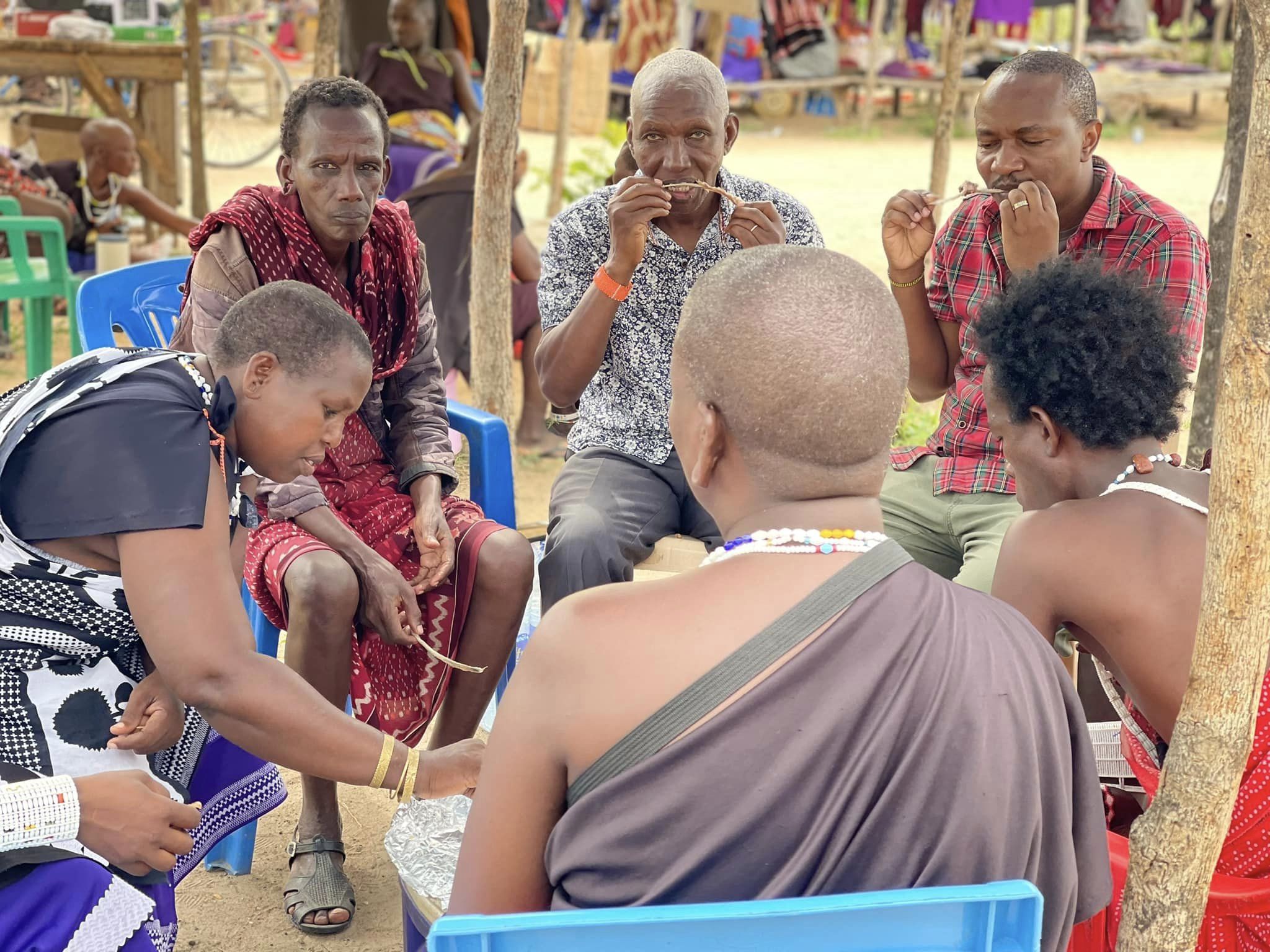
Their work among the Masai has also continued to grow and expand, and they now have three groups of believers, mostly men!  (They say, if a man converts, you have the family.  If a woman converts, you have the woman and the children.  If a child converts, you just have the child.  So they are very excited to have so many men!)  I've included a picture below of DML leader, James Kamau, and Pastor Anthony doing what is called "swallowship" with the Masai men.  

Please continue to pray for this team as it grows and adapts to the many demands.  I believe every day of June is filled with speaking engagements for them, in multiple cities!  Pray for their strength and joy, and for the message to be received as from the Lord.

On Saturday, I left Tanzania for Ethiopia where we will be doing a Training of Trainers all week for the Ethiopian Kale Heywet Church!

Monday, May 22, 2023

The Reed of God

Greetings from Dar es Salaam, Tanzania, where I just arrived after being in Kenya for two weeks.  God is good!

In 2005, my late husband, Robert Allen Reed, started a family blog for friends and family when we moved to Liberia.  He called it "Reeds in Liberia."

When we moved to Ghana in 2009, he recognized that we may be moving more often, as God would lead, and so he started a new blog, which he called "Reeds in the Wind."  This is what he wrote about the reason for this name (and this write-up is still on the blog today):

WHAT DOES IT MEAN TO BE A "REED IN THE WIND?"

From Henri Nouwen, Bread for the Journey:  The Virtue of Flexibility

Trees look strong compared with the wild reeds in the field. But when the storm comes the trees are uprooted, whereas the wild reeds, while moved back and forth by the wind, remain rooted and are standing up again when the storm has calmed down.

Flexibility is a great virtue. When we cling to our own positions and are not willing to let our hearts be moved back and forth a little by the ideas or actions of others, we may easily be broken. Being like wild reeds does not mean being wishy-washy. It means moving a little with the winds of the time while remaining solidly anchored in the ground. A humorless, intense, opinionated rigidity about current issues might cause these issues to break our spirits and make us bitter people. Let's be flexible while being deeply rooted.

PAYING ATTENTION TO THE WIND

"The wind blows where it wills." That was Jesus, who compared the spirit of God to the wind. The Reeds have followed the Wind from Grand Rapids, Michigan to Monrovia, Liberia, to Accra, Ghana...

This phrase "Reeds in the Wind" has had a great deal of meaning to us, especially after losing Bob, and continuing the adventure of following Jesus through wind and storms, seeking to be flexible while being deeply rooted.

But on my recent silent retreat, I ran into a book called The Reed of God by Caryll Houselander, written in 1944.  Caryll Houselander was a single Catholic "laywoman" who struggled with poverty.  The title caught my attention, not to mention the fact I was staying in a little hut in the woods that was named for the author.  I thought I should give it a read.  And I was delightfully surprised by what I found.  And, of course, I was surprised by what I hadn't yet considered (a life truth that will continue until I die, I suspect!).

While the common reed does good for ecosystems in wet areas, it also has the capacity to be used in other ways as well.  We know of the use of reeds in musical instruments, but they are also used for thatching, construction, arrows, baskets, beds, boats, and more.  The book asks if we are "reed pipes that God is waiting to live lyrically through, not in doing "spiritual work" (which many of us define as doing pious exercises) but through my work, my cleaning, my caring for children, my cooking, and all the duties and responsibilities I have."  It is through our ordinary life, every hour of every day, that union with God comes about.

Now you know why I like this book.  I'm beginning to look at the world differently.  Every object I see reminds me of the countless people who had a hand in bringing that object to fruition, and every object then declares the glory of God.  Human beings, made in His image, going about their business, solving problems and working, but many are yet unaware that they do this because they are made in the image of a working, creative God.  It makes me shake my head in wonder while rejoicing at the same time.  

A reed is the simplest of things, but it must be cut by a sharp knife to be shaped into something that can be used for the Shepherd's song.  A little reed can utter infinite music.  

And so it is with us.  Every person has that capacity.  And I believe every person needs to understand their capacity and their purpose.  The flexibility that is needed is not just for standing firm in the water, although that may be our call.  It also needs to be in the cutting down and shaping, for a different use, a different call that also brings glory to the Father.

I wonder about starting a new blog called A Reed for God but it is difficult to move away from something started by my late husband and co-laborer in the field many years ago.  For now, I believe that there is a new chapter of sorts that is starting in me, at this time in my life, as I learn what it means to be a reed for God in every sense of the word.

There are many exciting things happening in the work in Tanzania and we covet your prayers!  God is at work in the hearts of many to recognize the importance of work as worship!

George, with G Natural Honey in Dar es Salaam, has seen great growth in his business since taking DML classes!  Not only is he selling honey for consumption but also soap made of honey, cucumber and carrot!  

This is the message he sent after we visited his store:  "Thanks DML team for visitation to our office...your teachings brought us to this level."  Gnaturalhoney

Sunday, May 14, 2023

Pregnant with Jesus: A Mother's Day reflection

My desire to better understand the life of Jesus prior to the start of his public ministry at age thirty has been growing over time.  If you have been following this blog, you will remember the post about Jesus and the death of his father, Joseph, and the subsequent responsibility of Jesus as eldest son to provide for the members of his family.  His relationship with his mother, it appears, also seemed to be strong.

On my recent silent retreat, I read a book entitled The Reed of God, written in the 1940s by a Catholic woman named Caryll Houselander.  Caryll's description of Mary, the mother of Jesus, caught my attention and I have been thinking about it since.  She writes, 

Mary was at the most 14 when the angel came to her. Perhaps she was younger. The whole world trembled on the word of a child, on a child's consent. To what was she asked to consent? First of all, to the descent of the Holy Spirit, to surrender her littleness to the infinite love, and as a result to become the mother of Christ.

It was so tremendous, yet so passive. 

She was not asked to do anything herself but to let something be done to her. She was not asked to renounce anything, but to receive an incredible gift. She was not asked to lead a special kind of life, to retire to the temple and live as a nun, to cultivate suitable virtues or claim special privileges. 

She was simply to remain in the world, to go forward with her marriage to Joseph. To live the life of an artisan's wife, just what she had planned to do when she had no idea that anything out of the ordinary would ever happen to her. 

It was, it seemed, almost as if God's becoming man and being born of a woman were ordinary. The whole thing was to happen secretly. There was to be no announcement... 

...The one thing God did ask of her was the gift of her humanity.

While on the one hand, Mary was asked to do something extraordinary, at the same time, her life continued to be very ordinary.  She was a wife, a mother, a homemaker.  She was not exempt from any human experience.  She even dealt with poverty, giving the offering of two doves for her sacrifice (Luke 2).  

She was "simply" asked to give herself to God, body and soul.  She was asked to bring Christ into the world.

And in many ways, we are asked to do the same.  We are not asked to do something extraordinary or to be set apart...but to give of ourselves, body and soul, to the one true God.

We too are asked to bring Christ into the world.  We are asked to be the hands and feet of Jesus.  We are asked to have the same attitude as Christ.  When we help a sick friend, or do an excellent job at work, or cook a good meal, we do it in such a way that Christ may serve through us.

By His own will, Jesus was dependent on Mary during her pregnancy.  He went where she went, her breath was his breath, he could not speak.  In a similar way, Jesus dependent on us today.  We must carry him to the workplace, to the hospitals and prisons, to the dying.  There are many places that He may never go unless we take Him to them.

In fact, we may be working at a place that feels purposeless and empty, full of waste and weariness.  But it may be that God has sent us there because if not for us, Christ would not be there.

And so, Christ is growing in us.  He is forming Himself in us. It is not time for us to see His face.  That day will come.  It is a beautiful mystery.  

We can carry a deep gratitude, a deep joy, a deep wonder at Christ in us - just as a pregnant mother experiences that same wonder.

Caryll goes on to say this:

The gift of Christ's body makes everyone a priest, because everyone can offer the body of Christ on the altar of his/her own life.  But the offering must be the offering of a human being who is intensely alive, a potent humanness, great sorrow and great joy, a life lit up with the flame of love, fierce fasts and thirsts and feasts of sheer joy. 

1 Peter 2:9 says that we are a chosen people, a royal priesthood.  We are part of the priesthood of believers, and our parishes are those places of influence where we spend our time.

While I am thankful for my own amazing mother this day, I am also thankful for Mary, the mother of Jesus.  And I'm mostly thankful that Mary's story can be my story - it can be all of our stories (men and women alike!).  May God find us to be "intensely alive, with fierce fasts and thirsts, and feasts of sheer joy" as we carry Christ into the world.