Monday, November 11, 2013

Weddings and Babies

The Bride and Groom prayed for by Rev. Dr. Chemengich, of ATS
On Saturday, I had the opportunity to be in the "line" for the wedding of the chaplain of the Africa Theological Seminary (ATS), Livingstone Matunda and his beautiful bride, Drusila Kemunto.  While I have witnessed a number of African weddings, this was my first opportunity to be a participant.  I was honored that they asked.  Matunda had lost his wife about two years ago and over the past year, he and I became friends as we shared about grief and loss.  I was so happy for him and his new-found love and happiness, as are his four daughters who encouraged him to find someone.

This is only PART of the wedding party - there were 40 of us in total!
The pre-wedding experience was interesting though as I was also able to experience that "from the inside."  Weddings are definitely a community experience rather than an individual experience.  The entire ATS team formed the committee for the wedding and worked on logistics and budgets every week after our team meeting.  It was very interesting to watch that procedure.  It was a big challenge to raise the budget for the wedding as people are not necessarily invited but rather "show up."

The children's line for the wedding party.
So there was an estimated attendance at the reception for 500-600 people - a lot of people to feed.  We came up with 17 cars to be in a convoy as most people do not have transportation and we had to ferry them from ATS to the church and then back to ATS again for the reception.  During one meeting as the budget was being addressed, I heard the sound of a chain saw, and then heard a tree fall, and then the chain saw again.  I didn't think too much of it as there are businesses around and a forest.  But then the ATS deputy principal announced that the firewood for cooking the dinner was being donated by ATS in the form of a trees.  My eyes widened...I thought for a moment of the poor tree that was just cut down for this...but then celebrated with the rest of them for this provision and practical problem-solving. 

Dancing at the reception
A little fun during the photo shoot with the groom!
The day of the wedding was fun, long, and also interesting.  Aside from the fact that I got my dress that morning (and that the tailor had NOT done what we had asked and did a rather poor job), the wedding was to start at 9 am.  I had been told to hold this loosely and to expect that it might not start until 11 am.  By 11:15 am, all cars were decorated and we loaded up.  Next stop though was not the church but to pick up the bride and best lady.  We all pulled up there and parked.  And then waited.  And waited.  And waited.  By 12:30 we were informed that the aunts were refusing to release the bride until the groom pay a "release price" of 37,000 KSH (about $435 US).  The groom countered with 10,000 KSH.  I don't know how it actually was resolved - all I know is that at 12:45 the bride came out and we all piled back in our cars and drove to the church.

The ceremony started at just after 1 pm (four hours late), amidst a downpour (in my mind, as it rains EVERY afternoon, a good argument to start earlier!).  After standing in the rain waiting, the wedding party danced down the aisle two by two; the maids (us) then get back up to dance out again to line the path for the bride; the maids then get back out to dance again during the songs throughout the church.  The service last a couple of hours with a very long passionate message (including some traditional views of gender roles, such as "men are helpless in the home" and the role of the wife is to "organize the husband's life").  Then dancing on the way out of the service and again upon entering the reception.  Lots of dancing - sore thighs!  But I had fun with it.  It was a good time.  They were surprised to see a "mzungu" (white person) in the line up and especially to see a white woman dancing!

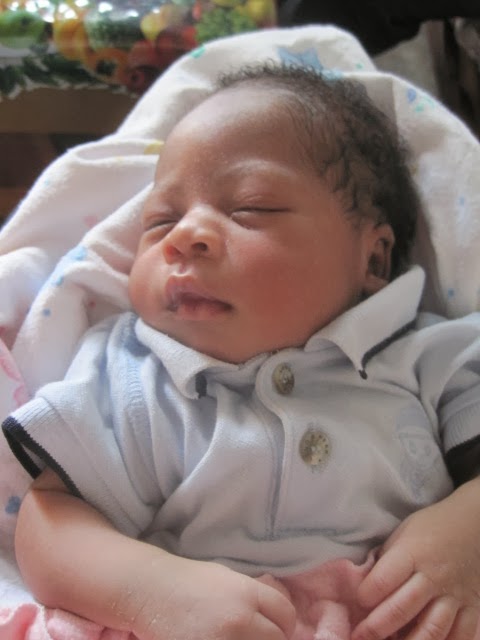
The other fun thing that happened was that there is a new baby in Kenya named Renita!  There is a couple in Kakamega who are both in my business training.  The father is a teacher and also runs a motorcycle part supply shop; the mother runs a hair salon.  They apparently liked me and my name and named their baby after me!  I got a chance to meet her last Sunday and hold her.  She is delightful. 
Baby Renita, looking at Big Renita, looking oh-so-thoughtful.
As far as I know, she is the fifth baby to be given my name, across three countries!  I kind of feel bad for them, as it is not an easy name for people to get.  Many people in Kenya are calling me "Renny" which is an interesting nick-name that I had not been given before!
The happy family with their two year old daughter, Marvel.

Monday, November 4, 2013

Shoes and Laces, by Jeff Bloem

Sammy and his wife in their shop
Jeff Bloem (Research Assistant intern with me in Kitale) wrote this story on one of our business clients in Kitale.  The story is well-written and I'm sure you will enjoy it.

Samuel Ondieki’s day starts early and ends late. At 6:00am, while it is still dark he opens his business, Ambassador General Shop, which provides household essentials and cooking products. The shop stays open until 10:00pm, serving customers in Kitale; a bustling agricultural town in Western Kenya well after the sun has set.

Sammy considers his business successful: the sales are profitable and he is usually able to sell whatever he stocks. Most importantly, he is able to provide for his wife and three children from the profits of the store.

The business is not perfect however. Admittedly, Sammy struggles with bookkeeping, specifically recording daily sales figures and purchasing records. It is this lack of recordkeeping that primarily hinders Sammy’s ability to strategically plan and invest for the future of his store.

The boundaries between Sammy’s business and Sammy’s personal life are blurred and also create a hurdle for the growth of his business. It is difficult to decipher the difference between Sammy’s home life and business life. Physically, he and his family live in a house adjoined to the back of the shop. Even when at home, Sammy is never far from his business. Economically, Sammy struggles to differentiate between which goods, profits, and materials are for the use of the business and which are for the use of his family.

In the eleven years Sammy has owned and operated Ambassador General Shop he has taken five loans, each for about $3,000. All were used to expand and grow the assets of his business, which is now staffed by three employees.

The history and reality of Sammy’s business point to the importance of viable access to capital and business training when it comes to business development as a means for poverty reduction.


The evidence is generally pessimistic when it comes to job or business training as a means of developing countries and communities, however. In terms of education and training the return is simply much higher when focusing on primary and secondary school aged children than training full-grown adults. Nonetheless the training of business men and women is almost ubiquitous in the operations of microfinance and other loan institutions throughout many developing countries.  


Ambassador General Shop
More and more experts are thinking the main constraint to growth is plain old capital. Many now believe that once most people have proper access to capital other necessities such as health, education, infrastructure, and government institutions become not so necessary. This idea is reinforced by recent reports in The EconomistThe New York Times MagazineNPR, and the radio shows Planet Money and This American Life that one-time cash grants are providing surprisingly positive results in the lives and businesses of the poor the world over. Surely Sammy would not be where he is today without access and support of capital infusions into his business.

But what then, is the significance of his struggles to keep complete records of his business and properly separate his family’s needs and his business’s stock? How does business training help Sammy, if at all?


Those who Run Together… 
Columbia University professor and blogger on aid and development, Chris Blattman explains the relationship between acquired skills and capital this way: “I used to think skills and capital were like right and left shoes: one’s not so useful without the other. Now I think of capital like the shoes and skills like the laces: if I have capital, I can jog a good pace, but I can’t really run unless I have the skills.” 

Sammy has been jogging with his business for the last eleven years. He provides for his family and is even able to slowly expand his business, but he doesn’t do it as fast or as well as he could. He needs business training to be able to really run.

Last spring Sammy received the training he needed. This, however, wasn’t the typical training seen by most business owners in developing countries. The training took place within his church. He didn’t just learn how to keep better records and separate his business initiatives from his family life; he learned that his work with his business was deeply spiritual and could be a way to worship and to serve God.

Furthermore, after the twelve-week training ended, his pastor was there to continually equip and encourage Sammy. Discipleship is the key to expanding and growing Sammy’s business so that he can better care for the poor and vulnerable, support the church, and influence the businesses and businesspeople around him.

The problem with having good shoes with good laces is that sometimes Sammy doesn’t feel like running. Surely anyone who has began a new year by purchasing new shoes or a gym membership understands that exercising more requires something additional outside of just having access to the equipment. To wake up everyday and operate a business efficiently and successfully takes inner-drive, self-sacrifice, and passion. The pain and agony that inevitably comes with hard work must be overcome by a sense of purpose, a calling, and encouragement from others.

In his book, The Social Animal, David Brooks writes about the importance of meaningful human interaction in the lives of humans. Without meaningful interaction between each other our accomplishments, no matter how extraordinary, will fail to bring fulfillment and purpose to our lives. Researchers call networks of meaningful interaction social capital. The lesson here is social capital is important and must not be overlooked when evaluating projects of development and business growth.

A runner doesn’t achieve his highest goals without constant coaching and teammates to run with. Likewise, Sammy’s business will not achieve it’s goals of serving God, caring for the poor, preserving the environment, and making a steady and healthy profit without consistent discipleship from his pastor and his fellow church members.

Sammy certificated and commissioned as a Marketplace Minister.

Discipleship for business growth and the Gospel message is now deeply routed in Sammy who has joined a “Training of Trainers” class and is becoming certified to teach other businesspeople the principles he has learned. He forms a key part of the Marketplace Ministry team at his church, the Friends Quaker Church in Kitale. In addition, Sammy is mentoring a business owner of a smaller business from his church while simultaneously being mentored by a businessperson of a larger business from his church.  

… Will Be Transformed
 Nicholas Wolterstorff observes the heartbeat of the Christian existence, which has been in place since the creation of the world. We gather on Sunday to engage in liturgy as a community of believers and then disperse from Monday through Saturday to go about our duties and responsibilities which we call work. This constant one-plus-six heartbeat has defined the Christian way of being in the world from age to age.

Wolterstorff goes on to define the meaning of this constant expanding and contracting as follows: “The church is to gather for the celebration of the liturgy, and when it is dispersed it is to practice and struggle for justice and to spread the word about its Lord”. The most central point Wolterstorff is making is that liturgy in the church is not authentic unless those same members of the church go and “act justly, love mercy, and walk humbly with God” (Micah 6:8).

Put in terms of the analogy already in use; liturgy and justice are not right and left shoes, rather liturgy is like the shoes and justice is like the laces. To engage only in liturgy, one could jog slowly and go to church every week. But to really run in the way God intended; those shoes need the laces of justice to become truly effective.

Sammy now has both shoes strapped on tight and he is ready to run. On his left foot he wears a shoe, this is the capital he is able to access in order to invest and grow his business. His left shoe is laced up tight with the laces of business training, which taught him to keep better records and construct secure boundaries between his business and his family. On his right foot he wears another shoe, this is liturgy—the actions of worship, confession, thanksgiving, praise, scripture reading, and preaching he receives every Sunday. This shoe is laced tight with his acts of justice from Monday through Saturday—caring for the widow, the orphan, the alien, and the poor while operating his business efficiently.

Put together Sammy is now able to run in the way God intended. Furthermore, he has a community of brothers and sisters running with him—there were forty other business people just like Sammy who also attended the business training class. They are able to support and ride the ups and downs of business and life together. They are able to discuss and debate the inevitable ethical dilemmas each will experience in the marketplace.


This transformation is what Bryant Myers writes about in his book, Walking with the Poor. The poor have a marred identity. Their understanding of who they are, their relationship with those around them, with the ground below them, and with God above them must be restored. (For matters of discussion, Myers also writes about the marred identity of the non-poor.) A rigorous and statistical evaluation of this program is currently in progress and will not have results until late next year, it seems however, at least anecdotally, that real transformation is happening in Western Kenya.  

With capital and training, liturgy and justice, Sammy and his fellow church members are able to grow their businesses and escape poverty all the while confident that they are fulfilling God’s call through their work and actions not just on Sunday but also Monday through Saturday.

Sources:
-          Chris Blattman’s blog; www.chrisblattman.com; Dear Governments: Want to Help the Poor and Transform your Economy? Give People Cash; May, 2013
-          David Brooks; The Social Animal; Random House, New York; 2011
-          Bryant Myers; Walking with the Poor;
-          Nicholas Wolterstorff; Hearing the Call: Liturgy, Justice, Church World; Eerdmans, Grand Rapids, MI; 2011

[Jeff is the seventh intern that I have had and the first to quote sources in his story!!  I think research is a good role for him!]

Sammy joins me on Monday for the second session of the Training of Trainers, along with 29 other pastors and business persons who will be certificated as trainers by November 12.  It will be an intense class with a good size group that will give some challenges to make sure that everyone is comfortable with the material and able to teach it.  Please pray for us!

Monday, October 28, 2013

Traveling Mercies

"Have a safe trip."  How many times have we uttered those words to loved ones before a trip?  If you are like me, you have said it many times, often without thinking. In North America, most of the time it is said without much conviction that there will be a significant problem:  roads are pretty safe, air travel is pretty safe, walking is pretty safe.  In Africa, those words take on a whole new meaning.  Praying for traveling mercies is not something that is said lightly.  Additionally, after praying for a safe trip, how many times do we forget to thank God for traveling mercies?  Again, if you are like me, you only remember when there was a close call.  Not in Africa.  People regularly pray for traveling mercies and seem to always remember to thank God for safe travel.  My trip to Kakamega yesterday may shed some light on to why this may be.

Driving in the dark has not been a practice of ours in the eight years that we have lived in Africa.  We have done everything we can to avoid it.  The business class that was held at the Deliverance Church in Kakamega ran from 2 pm - 5 pm, resulting in the return two hour drive taking place mostly in the dark (especially as we did not get out of class until about 5:40 pm).  Since I had class again in Kitale on Monday morning, I thought driving back Sunday evening would be necessary.  And the rule for not driving at night was mostly true for West Africa, I rationalized to myself.  I had yet to test the need for such a rule in Kenya.  Suffice it to say, I learned my lesson - the same rule does apply - and I will find alternatives to driving at night even if I have to stay in Kakamega late and need to be back in Kitale early the next morning!

Here are a few reasons:
  • The roads are often narrow, with no shoulders at all.  In fact, when there are shoulders, they are often a sharp one to two foot drop as the tarmac meets dirt; often there are chunks of tarmac missing right on the edge of the road due to the lack of support.  So vehicles are forced to drive very close together.  
  • Vehicles are often overloaded, both with goods and people, making them risky to drive behind.  People may jump on or off moving vehicles in front of you (and a couple of times they jumped on the vehicle I was in).   

  • Pedestrians are all over.  Yesterday we drove after a very heavy rain, so the shoulders were muddy.  People chose instead to walk on the road.  In the dark, without street lights, seeing them is problematic.
  • Motorbikes and bicycles are all over the road, transporting people and merchandise.  When a truck decides to pass a motorcycle or bicycle, they are forced to the middle of the road (due to the narrowness), making it difficult for on-coming traffic.  If we both have bikes on each side of the road, someone has to slow way down and take turns. 
  • People move their goods in all sorts of manners, including these carts, which also need to move on the road, as there are not sidewalks or shoulders.
Hard work, yes.  But also blocking traffic due to slow movement.
Lorries with sugar cane.
  • In addition to all this, this area of Kakamega is sugar cane country, and lorries and tractors are moving up and down the roads, with wide loads of harvested sugar cane.   A few times, the produce brushed up and over the car as we had to pass so closely to the tractors.
Tractors with sugar cane.
A typical matatu.
So last night, we left for Kitale at dusk, enveloped in darkness about thirty minutes into the trip.  The roads were wet and muddy with rain.  As we rounded a bend in a road, going down a hill, a matatu (van-bus) was foolishly trying to pass a lorry, going uphill and around a blind corner.  A head-on collision seemed imminent.  The next five seconds passed very slowly as I stepped on my brakes and found my car sliding due to the wet roads and mud filled (slightly bald) tires.  Looking for a path to avoid collision, there was no shoulder on either side as the road was up against the bush.  By the grace of God, the matatu was able, at the very last second, to swing in front of the lorry and we passed without a collision.

And so today, even though I had a different blog prepared, I felt I had to take a moment and thank God publicly for traveling mercies.  And I have promised not to do this ride again at night.  And as we speak, the mechanic is working on my brakes as well as replacing the two front tires.  I have joked that I want a Kenyan shilling for every person that I avoid hitting - while I say that with a smile, I know that EVERY DAY that I do not have an accident is through the grace of God and because of His protection.

Monday, October 21, 2013

Inspiration from the Field

This past week, Jeff Bloem (research assistant intern) and I spent four days in Kakamega. On the map to the right, you can see Kitale (white arrow) on the western side of Kenya, close to Mt. Elgon.  Kakamega is south of Kitale (red arrow).

Jeff, Richard, and myself.
Prior to going to Kakamega, however, we spent a day on the farm of Richard Lukuyu.  Richard was my interpreter for the business class I taught at the Friends Church in Kitale.  He is a micro-biology and business professor in Eldoret during the week, and does farming as a "hobby" (his word).  His farm was featured by the Ministry of Agriculture last week and over 200 farmers came out to his farm to see what he is doing.  He informed me that when we started talking about Business as Mission earlier this year, he decided to set a portion of his farm aside for demonstration.  It was really quite amazing how many different crops and varieties that he is using on his farm.  I am priviledged to be Richard's mentor now(at his request), as we are starting the mentoring component of our work in Kitale, although I have told him that he has more to teach me than the other way around - I'd rather see myself as having the opportunity to be his assistant!

Canola is a new crop in this area.  There is a new factory that is expected to be set up in Kitale, and many farmers are beginning to plant Canola - Richard being one of the first.  This woman is talking about the crop and the advantages of this oil.  The plants behind her are Canola plants.
When I started the class in March, I printed a number of agricultural "how-to" posters for the farmers in the class.  I wondered whether it was worth the cost of printing and if they would be used or tossed aside.  Richard took those posters and immediately set up a number of compost piles at his farm.  Here are three.  The stick in the middle is how they measure the heat.  If they pull it out and it is hot, they know composting is taking place.  Once it is cold, they know the composting is complete.
We then traveled to Kakamega, a city of about 100,000 persons, to meet the business owners from the Deliverance Church.  We really enjoyed the worship and the service, especially because they sing some songs in English and translate the message as well!  One thing that was very unique about this church was the way they give their tithe.  The picture to the left shows Pastor Charles Keya (who attended the second BAM class that I taught) receiving the envelopes of tithe from each person.  Everyone giving a tithe lines up and places it directly in the Pastors hand.  He spends a few seconds with each person, warmly greeting them, sharing a few words, laughter, thanking them for their faithfulness, and the person then finds their seat.  I found it fascinating to watch.  I've seen many different churches handle tithing differently - many processes which have made me squirm.  But there was something about this - about giving your tithe to a person, rather than a plate, to a person who represents the church and the ministry, that was special and unique.  There was something about the affirmation received in that.  And undoubtedly, in the 52 subsequent business visits that we made over the next few days, over and over again, the businesses told us about how important tithing is to them. Maybe this church is on to something.  It's true that our tithe is between us and God, but there is definitely a community aspect to it as well.  The tithe was in envelopes so there was no evaluation of the gift, just a receiving with a smile, a hug, and a kind, encouraging word. 

The businesses that we met with were a wide, wide range of service industry, retail, wholesale, manufacturing, and some farming.  Many were very solid SMEs (small and medium size entrepreneurs) with 20+ employees.  Several were small businesses and a handful were micro-businesses.  We will begin teaching their class on October 27 and will travel to Kakamega every week for 12 weeks to teach each component.  The church had 120 businesses ready to take the class, but we decided to split it into two groups of 60 each.  The first class that I teach will be in English only, and the subsequent class will be in Swahili.  I'm very relieved that it is English only as it allows a lot more content to be covered rather than losing time in translation!  For the pilot project, we needed to conduct a baseline survey to assess where the businesses are prior to starting the training.  Let me introduce you to some of the businesses.
Humphrey is the head of an organization that has worked to help 3200 farmers start poultry farming!  He has over 40 employees, many of whom work as extension officers with these farmers.  They have a slaughter slab where they butcher the birds but do not yet have a cold storage, so they are forced to sell immediately.  These farmers average 100-200 birds per farm, and can turn over these birds every six weeks.  A conservative estimate puts this at over two million birds per year! This is only one component of the work that Humphrey does.  Very impressive!

The woman on the left is Mary, the owner of Ushindi Snacks.  She produces probably twenty different baked goods that are mass produced and then shipped out; she has twenty fulltime employees and quite an amazing story of how she grew this business.  The two subsequent pictures are of her business as well.  (She makes shortbread, bundt cakes, mandazi, donuts, and on and on.)
Ushindi Snacks operates out of a very cramped building.  Here we see some of the mandazi (Kenyan fried bread that are eaten with chai on a daily basis) being produced.
And here the women are bagging the baked goods for delivery.
Mary (right) instructs one of the many orphans (left) she has taken in and cares for.  That was another theme with many of these business owners - caring for orphans.  Mary's English is not very good and she would like to send this young lady to the class on her behalf, but the training works best with the business owner, so unfortunately, Mary will have to wait to attend the second class in Swahili.
Jeff interviews Keziah, owner of Rejoice Boutique, a successful clothing store that has been open for twenty years.
Three Wasps is a security business owned by three brothers, located in both Kakamega and Mombasa.  They have 38 security guards employed, plus three office staff, just in the Kakamega office.  We kept the visit short because of the sign in their office, which I had to take a picture of.  :-)
We met two women who have made their own worship CDs and are writing their own songs!  Decimah (above) had just sold the last twenty CDs she had that day, so I wasn't able to get one.  She promised to save one for me the next time I see her.  CDs like this sell for 100 Kenya shillings (about $1.20 US).  Very affordable but not much profit for the effort.

This delightful woman is Florence, who is one of three landlords with whom we met.  People use their land very well here.  They either use every bit of space for farming or they build additional units to rent.  Florence has built five 3-room units on her property, which helps to supplement her income.  She has been doing this since 2010 and has yet to receive a late rent payment!
This is Simon, who is the founder and owner of Zulmac Insurance.  He employs seven people.  I think we had our longest interview with Simon.  In fact, Jeff said that if Simon had offered him a job, he probably would have taken it on the spot!  He is a very dynamic, charismatic, articulate, and wise business man.  He gave the best answers to some of our interview questions.  His success seems to hinge on not being satisfied with having satisfied customers - he wants delighted customers.  Not an easy task in the insurance business.  But in the time we spent with him, we watched him do it time and again with passersby. 
What an honor and a privilege to work with such impressive business people!  I was so inspired this week after meeting them and I thank God for the privilege to get to know such industrious souls.  I look very forward to starting with this group and seeing what God is going to do as we work to reclaim the Marketplace for Christ in Kakamega!

I am in need of a prayer partner for each business going through this training.  A prayer partner will pray for a business for the twelve weeks of class, praying through each aspect of the training as the business owner works to apply it to his or her business.  If you are interested in being a prayer partners, or are interested in more information, please email me at renitar@icmusa.org.  Thanks!

Lastly, a picture of a truck we drove behind for a bit.  Since these huge logs were not tied down in any way, I decided I'd rather pass than stay behind.  Unfortunately, as I passed, the road narrowed, with a two foot drop off on the side so I had to inch very close to the truck.  Poor Jeff ducked as he thought the log (on the right) was going right into our car.  We thank God for traveling mercies daily here!